Page 156 of 386

2-81
If the amber SERVICE
BRAKES SOON warning
light comes on, it means
that there is something
wrong in the brake system.
When this light comes on, you will also hear a warning
tone. If this light comes on, have the system repaired
immediately.
Both of these lights should come on briefly every time
you start the engine. If they don't come on then, have
them fixed so they will be ready to warn you if there's a
problem. If one or both of these warning lights stay on
after you start the engine, there could be a brake
problem. Have your brake system inspected right away.If one or both of these lights come on and stay on while
you are driving, pull off the road and stop carefully. You
may notice that the pedal is harder to push. Or, the pedal
may go closer to the floor. It may take longer to stop. If
the BRAKE light is still on, have the vehicle towed for
service. See ªTowing Your Vehicleº in the Index. See
ªHydraulic Brake Systemsº in the Index for more
information.
CAUTION:
Your brake system may not be working properly
if a brake system warning light is on. Driving
with a brake system warning light on can lead to
an accident. If the light is still on after you've
pulled off the road and stopped carefully, have
the vehicle towed for service.
Page 226 of 386
5-
5-1
Section 5 Problems on the Road
Here you'll find what to do about some problems that can occur on the road.
5
-2 Hazard Warning Flashers
5
-3 Other Warning Devices
5
-3 Jump Starting
5
-10 Towing Your Vehicle
5
-17 Engine Overheating5
-20 Cooling System
5
-26 Engine Fan Noise
5
-26 If a Tire Goes Flat
5
-27 Changing a Flat Tire
5
-28 If You're Stuck: In Sand, Mud, Ice or Snow
Page 235 of 386
5-10
Towing Your Vehicle
CAUTION:
To help avoid serious personal injury to you
or others:
�Never let passengers ride in a vehicle that is
being towed.
�Never tow faster than safe or posted speeds.
�Never tow with damaged parts not fully
secured.
�Never get under your vehicle after it has
been lifted by the tow truck.
�Always secure the vehicle on each side with
separate safety chains when towing it.
�Working on air brakes without first using
the release studs to compress the springs
can lead to injury. Never work on the air
brakes chambers without first using the
release studs to compress the brake springs.
CAUTION: (Continued)
CAUTION: (Continued)
�When the brake springs are manually
compressed, you will have no brakes.
Release your air
-operated parking brakes
manually only to tow the vehicle. Never
drive the vehicle with the brakes released.
Consult your dealer or a professional towing service if
you need to have your vehicle towed. They can provide
the right equipment and know
-how to tow it without
damage. See ªRoadside Assistanceº in the Index.
Before you do anything, turn on the hazard warning
flashers (if they have not been damaged).
When you call, tell the towing service:
�That your vehicle has rear
-wheel drive.
�The make, model and year of your vehicle.
�Whether you can still move the shift lever.
�If there was an accident, what was damaged.
When the towing service arrives, let the tow operator
know that this manual contains towing instructions.
The operator may want to see them.
Page 236 of 386

5-11
Here are specific towing instructions:
Towing Your Vehicle From the Front
(Front Wheels Off the Ground)
Before Towing
Block the rear wheels of the disabled vehicle. On
vehicles with air brakes, release the emergency brake
system by compressing the brake chamber springs
as outlined in this section. (This is to prevent the
possibility of the emergency brake being applied
during towing.)
On vehicles with hydraulic brakes, release the parking
brake fully by moving the lever to the fully
-released
position.
Disconnect the propshaft at the rear axle (forward axle
on tandem axle models). Secure the propshaft to the
frame or crossmember.
Towing the Vehicle with the Front Bumper Removed
1. Remove the front bumper.
2. Connect and lock the lift chains to the front axle,
outside of the spring anchor plates as shown.
A. Spring Anchor Plate
B. Lift Chain
C. Front Axle
3. Place a 6º x 6º x 5' hardwood beam underneath and
slightly behind the front spring shackle brackets.
4. Connect the lift chains to the tow bar and raise the
tow bar until lift chain slack has been taken up and
the hardwood beam is fully seated against the spring
shackle brackets as shown.
Page 237 of 386
5-12
A. Shackle Bracket
B. Tow Bar
C. Lift Chain
D. Hardwood Beam
5. Raise the vehicle to the required height.Towing the Vehicle with the Front Bumper Installed
1. Connect and lock the lift chains to the front axle,
outside of the spring anchor plates as previously
shown.
2. Place a 6º x 6º x 5' hardwood beam underneath and
slightly behind the front spring shackle brackets as
previously shown.
3. Connect the lift chains to the tow bar and take up the
slack in the chains until the tow bar is within 4º of
the front bumper facing. Place a 2º x 12º x 40º
hardwood board with rubber pads against the front
bumper and secure as shown.
Page 239 of 386
5-14
Single Drive Rear Axle
Disconnect the propshaft at the rear axle. Secure the
propshaft to the frame or crossmember.
Tandem Drive Rear Axles
(Forward Axle Off the Ground)
Raise the front of the vehicle until the forward tandem
axle wheels are off the ground. Remove the rearward
propshaft.Tandem Drive Rear Axle (Both Axles on the Ground
Due to Type of Suspension or Attached Load)
Disconnect the propshaft at the forward tandem axle.
Secure the propshaft to the frame or crossmember.
If there is damage or suspected damage to the axle(s),
remove all axle shafts. Cover the hub openings to
prevent the loss of lubricant or entry of dirt or
foreign objects.
After Towing
1. Block the rear wheels and install axle and propshafts.
2. Check for proper phasing of universal joints.
3. Apply the emergency brake system before
disconnecting from the towing vehicle.
Page 240 of 386

5-15 Towing Your Vehicle From the Front
(All Wheels On the Ground)
Your vehicle may be towed on all wheels provided the
steering is working. Remember that the power brakes
and power steering will not have power assist. Vehicles
with air brakes will not have brakes. There must be a
tow bar installed between the towing vehicle and the
disabled vehicle.
Before Towing
Block the wheels of the disabled vehicle. On vehicles
with air brakes, release the emergency brake system by
compressing the brake chamber springs as outlined in
this section. (This is to prevent the possibility of the
emergency brake being applied during towing.)
On vehicles with hydraulic brakes, release the parking
brake fully by moving the lever to the fully
-released
position.
Disconnect the propshaft at the rear axle (forward axle
on tandem axle models). Secure the propshaft to the
frame or crossmember.
If there is damage or suspected damage to the axle(s),
remove the axle shafts. Cover the hub openings to
prevent the loss of lubricant or entry of dirt or
foreign objects.After Towing
1. Block the rear wheels and install axle and propshafts.
2. Check for proper phasing of universal joints.
3. Apply the parking brake system before
disconnecting from the towing vehicle.
4. Check and fill with oil as required.
Towing Your Vehicle From the Rear
Before Towing
Secure the steering wheel to maintain a straight
-ahead
position. Make certain that the front axle is not loaded
above the front axle Gross Axle Weight Rating (GAWR)
as indicated on the vehicle's Gross Vehicle Weight
Rating (GVWR) label. See ªGross Vehicle Weight
Rating (GVWR)º in the index for more information.
After Towing
Block the rear wheels and release the steering. Apply the
parking brake system before disconnecting from the
towing vehicle.
Refer to the transmission shift label for additional
information.
Page 241 of 386
5-16 Releasing Air-Operated Parking Brakes
(If Equipped)
If your vehicle has air brakes, you could have a special
towing problem. If your vehicle has to be towed because
of a complete loss of air pressure from both systems, the
parking brakes will have automatically engaged. The
tow operator can release the brakes manually by using
the following steps. Then your vehicle can be towed
with all wheels or only the rear wheels on the ground.
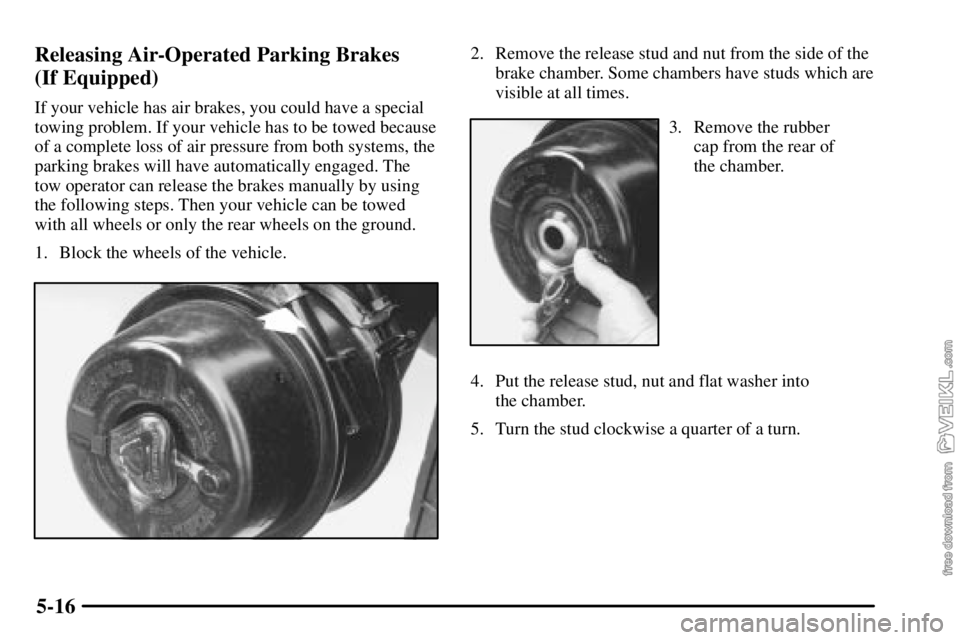
1. Block the wheels of the vehicle.
2. Remove the release stud and nut from the side of the
brake chamber. Some chambers have studs which are
visible at all times.
3. Remove the rubber
cap from the rear of
the chamber.
4. Put the release stud, nut and flat washer into
the chamber.
5. Turn the stud clockwise a quarter of a turn.