Page 239 of 386
5-14
Single Drive Rear Axle
Disconnect the propshaft at the rear axle. Secure the
propshaft to the frame or crossmember.
Tandem Drive Rear Axles
(Forward Axle Off the Ground)
Raise the front of the vehicle until the forward tandem
axle wheels are off the ground. Remove the rearward
propshaft.Tandem Drive Rear Axle (Both Axles on the Ground
Due to Type of Suspension or Attached Load)
Disconnect the propshaft at the forward tandem axle.
Secure the propshaft to the frame or crossmember.
If there is damage or suspected damage to the axle(s),
remove all axle shafts. Cover the hub openings to
prevent the loss of lubricant or entry of dirt or
foreign objects.
After Towing
1. Block the rear wheels and install axle and propshafts.
2. Check for proper phasing of universal joints.
3. Apply the emergency brake system before
disconnecting from the towing vehicle.
Page 240 of 386

5-15 Towing Your Vehicle From the Front
(All Wheels On the Ground)
Your vehicle may be towed on all wheels provided the
steering is working. Remember that the power brakes
and power steering will not have power assist. Vehicles
with air brakes will not have brakes. There must be a
tow bar installed between the towing vehicle and the
disabled vehicle.
Before Towing
Block the wheels of the disabled vehicle. On vehicles
with air brakes, release the emergency brake system by
compressing the brake chamber springs as outlined in
this section. (This is to prevent the possibility of the
emergency brake being applied during towing.)
On vehicles with hydraulic brakes, release the parking
brake fully by moving the lever to the fully
-released
position.
Disconnect the propshaft at the rear axle (forward axle
on tandem axle models). Secure the propshaft to the
frame or crossmember.
If there is damage or suspected damage to the axle(s),
remove the axle shafts. Cover the hub openings to
prevent the loss of lubricant or entry of dirt or
foreign objects.After Towing
1. Block the rear wheels and install axle and propshafts.
2. Check for proper phasing of universal joints.
3. Apply the parking brake system before
disconnecting from the towing vehicle.
4. Check and fill with oil as required.
Towing Your Vehicle From the Rear
Before Towing
Secure the steering wheel to maintain a straight
-ahead
position. Make certain that the front axle is not loaded
above the front axle Gross Axle Weight Rating (GAWR)
as indicated on the vehicle's Gross Vehicle Weight
Rating (GVWR) label. See ªGross Vehicle Weight
Rating (GVWR)º in the index for more information.
After Towing
Block the rear wheels and release the steering. Apply the
parking brake system before disconnecting from the
towing vehicle.
Refer to the transmission shift label for additional
information.
Page 319 of 386
6-65
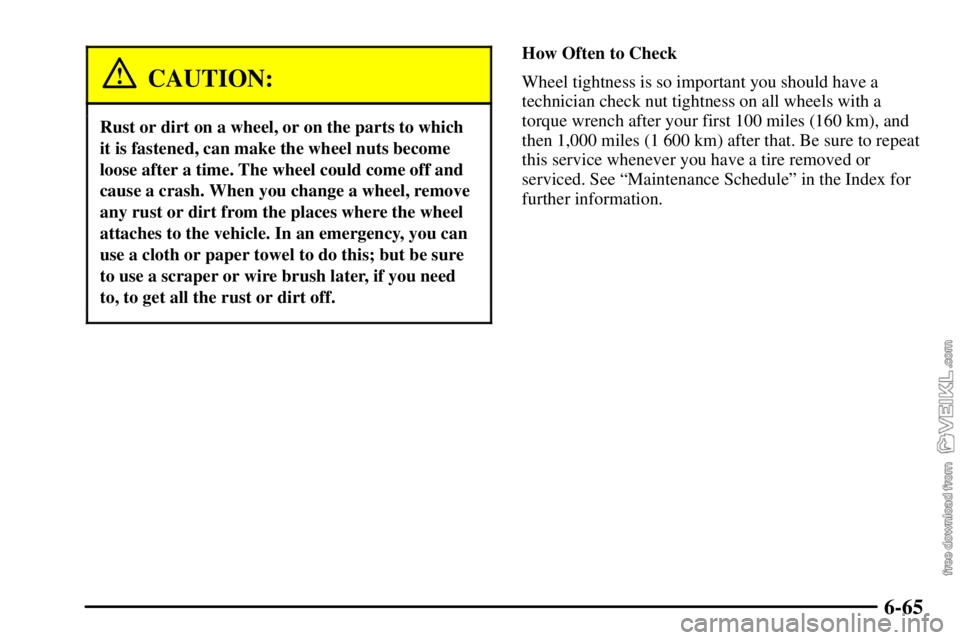
CAUTION:
Rust or dirt on a wheel, or on the parts to which
it is fastened, can make the wheel nuts become
loose after a time. The wheel could come off and
cause a crash. When you change a wheel, remove
any rust or dirt from the places where the wheel
attaches to the vehicle. In an emergency, you can
use a cloth or paper towel to do this; but be sure
to use a scraper or wire brush later, if you need
to, to get all the rust or dirt off.
How Often to Check
Wheel tightness is so important you should have a
technician check nut tightness on all wheels with a
torque wrench after your first 100 miles (160 km), and
then 1,000 miles (1 600 km) after that. Be sure to repeat
this service whenever you have a tire removed or
serviced. See ªMaintenance Scheduleº in the Index for
further information.