2003 CHEVROLET BLAZER transmission
[x] Cancel search: transmissionPage 220 of 420

·As you are backing down the hill, put your left hand
on the steering wheel at the 12 o'clock position.
This way, you'll be able to tell if your wheels
are straight and maneuver as you back down. It's
best that you back down the hill with your
wheels straight rather than in the left or right
direction. Turning the wheel too far to the left or
right will increase the possibility of a rollover.
Here are some things you
must notdo if you stall, or
are about to stall, when going up a hill.
·Never attempt to prevent a stall by shifting into
NEUTRAL (N) (or pressing the clutch, if you have a
manual transmission) to ªrev-upº the engine and
regain forward momentum. This won't work.
Your vehicle will roll backwards very quickly and
you could go out of control.
Instead, apply the regular brake to stop the vehicle.
Then apply the parking brake. Shift to
REVERSE (R), release the parking brake, and
slowly back straight down.
·Never attempt to turn around if you are about to
stall when going up a hill. If the hill is steep
enough to stall your vehicle, it's steep enough to
cause you to roll over if you turn around. If you can't
make it up the hill, you must back straight down
the hill.
Q:Suppose, after stalling, I try to back down
the hill and decide I just can't do it. What
should I do?
A:Set the parking brake, put your transmission in
PARK (P) (or the manual transmission in
FIRST (1)) and turn off the engine. Leave the
vehicle and go get some help. Exit on the uphill
side and stay clear of the path the vehicle
would take if it rolled downhill. Do not shift the
transfer case to NEUTRAL when you leave
the vehicle. Leave it in some gear.
4-22
Page 221 of 420

{CAUTION:
Shifting the transfer case to NEUTRAL can
cause your vehicle to roll even if the
transmission is in PARK (P) (or, if you have
the manual transmission, even if you're in
gear). This is because the NEUTRAL position
on the transfer case overrides the
transmission. You or someone else could be
injured. If you are going to leave your vehicle,
set the parking brake and shift the
transmission to PARK (P) (or, put your manual
transmission in FIRST (1)). But do not shift the
transfer case to NEUTRAL. Leave the transfer
case in a drive gear.
Driving Downhill
When off-roading takes you downhill, you'll want to
consider a number of things:
·How steep is the downhill? Will I be able to maintain
vehicle control?
·What's the surface like? Smooth? Rough? Slippery?
Hard-packed dirt? Gravel?
·Are there hidden surface obstacles? Ruts? Logs?
Boulders?
·What's at the bottom of the hill? Is there a hidden
creek bank or even a river bottom with large
rocks?
If you decide you can go down a hill safely, then try to
keep your vehicle headed straight down, and use a
low gear. This way, engine drag can help your brakes
and they won't have to do all the work. Descend slowly,
keeping your vehicle under control at all times.
{CAUTION:
Heavy braking when going down a hill can
cause your brakes to overheat and fade. This
could cause loss of control and a serious
accident. Apply the brakes lightly when
descending a hill and use a low gear to keep
vehicle speed under control.
4-23
Page 222 of 420

Q:Are there some things I should not do when
driving down a hill?
A:Yes! These are important because if you ignore
them you could lose control and have a serious
accident.
·When driving downhill, avoid turns that take you
across the incline of the hill. A hill that's not too steep
to drive down may be too steep to drive across. You
could roll over if you don't drive straight down.
·Never go downhill with the transmission in
NEUTRAL (N), or with the clutch pedal pressed
down in a manual shift. This is called ªfree-wheeling.º
Your brakes will have to do all the work and could
overheat and fade.
Q:Am I likely to stall when going downhill?
A:It's much more likely to happen going uphill. But if
it happens going downhill, here's what to do.
·Stop your vehicle by applying the regular brakes.
Apply the parking brake.
·Shift to PARK (P) (or to neutral with the manual
transmission) and, while still braking, restart the
engine.
·Shift back to a low gear, release the parking brake,
and drive straight down.
·If the engine won't start, get out and get help.
Driving Across an Incline
Sooner or later, an off-road trail will probably go across
the incline of a hill. If this happens, you have to
decide whether to try to drive across the incline. Here
are some things to consider:
·A hill that can be driven straight up or down may be
too steep to drive across. When you go straight up
or down a hill, the length of the wheel base (the
distance from the front wheels to the rear wheels)
reduces the likelihood the vehicle will tumble
end over end. But when you drive across an incline,
the much more narrow track width (the distance
between the left and right wheels) may not prevent
the vehicle from tilting and rolling over. Also,
driving across an incline puts more weight on the
downhill wheels. This could cause a downhill
slide or a rollover.
·Surface conditions can be a problem when you
drive across a hill. Loose gravel, muddy spots,
or even wet grass can cause your tires to slip
sideways, downhill. If the vehicle slips sideways, it
can hit something that will trip it (a rock, a rut,
etc.) and roll over.
·Hidden obstacles can make the steepness of the
incline even worse. If you drive across a rock
with the uphill wheels, or if the downhill wheels drop
into a rut or depression, your vehicle can tilt
even more.
4-24
Page 235 of 420
If you drive regularly in steep country, or if you're
planning to visit there, here are some tips that can make
your trips safer and more enjoyable. See
Off-Road
Driving with Your Four-Wheel-Drive Vehicle on
page 4-15
for information about driving off-road.
·Keep your vehicle in good shape. Check all ¯uid
levels and also the brakes, tires, cooling system
and transmission. These parts can work hard
on mountain roads.
·Know how to go down hills. The most important
thing to know is this: let your engine do some of
the slowing down. Shift to a lower gear when you go
down a steep or long hill.
{CAUTION:
If you don't shift down, your brakes could get
so hot that they wouldn't work well. You would
then have poor braking or even none going
down a hill. You could crash. Shift down to let
your engine assist your brakes on a steep
downhill slope.
{CAUTION:
Coasting downhill in NEUTRAL (N) or with the
ignition off is dangerous. Your brakes will have
to do all the work of slowing down. They could
get so hot that they wouldn't work well. You
would then have poor braking or even none
going down a hill. You could crash. Always
have your engine running and your vehicle in
gear when you go downhill.
·Know how to go uphill. You may want to shift down
to a lower gear. The lower gears help cool your
engine and transmission, and you can climb the
hill better.
·Stay in your own lane when driving on two-lane
roads in hills or mountains. Don't swing wide or
cut across the center of the road. Drive at speeds
that let you stay in your own lane.
·As you go over the top of a hill, be alert. There
could be something in your lane, like a stalled car or
an accident.
4-37
Page 240 of 420

If You Are Stuck: In Sand, Mud, Ice
or Snow
In order to free your vehicle when it is stuck, you will
need to spin the wheels, but you don't want to spin your
wheels too fast. The method known as ªrockingº can
help you get out when you're stuck, but you must
use caution.
{CAUTION:
If you let your tires spin at high speed, they
can explode, and you or others could be
injured. And, the transmission or other parts of
the vehicle can overheat. That could cause an
engine compartment ®re or other damage.
When you're stuck, spin the wheels as little as
possible. Don't spin the wheels above 35 mph
(55 km/h) as shown on the speedometer.
Notice:Spinning your wheels can destroy parts of
your vehicle as well as the tires. If you spin the
wheels too fast while shifting your transmission
back and forth, you can destroy your transmission.
For information about using tire chains on your
vehicle, see
Tire Chains on page 5-62.
4-42
Page 241 of 420
Rocking Your Vehicle To Get It Out
First, turn your steering wheel left and right. That will
clear the area around your front wheels. If you have a
four-wheel-drive vehicle, shift into 4HI. Then shift
back and forth between REVERSE (R) and a forward
gear (or with a manual transmission, between FIRST (1)
or SECOND (2) and REVERSE (R)), spinning the
wheels as little as possible. Release the accelerator
pedal while you shift, and press lightly on the accelerator
pedal when the transmission is in gear. By slowly
spinning your wheels in the forward and reverse
directions, you will cause a rocking motion that may free
your vehicle. If that doesn't get you out after a few
tries, you may need to be towed out. Or, you can use
your recovery hooks if your vehicle has them. If you do
need to be towed out, see
Towing Your Vehicle on
page 4-45.
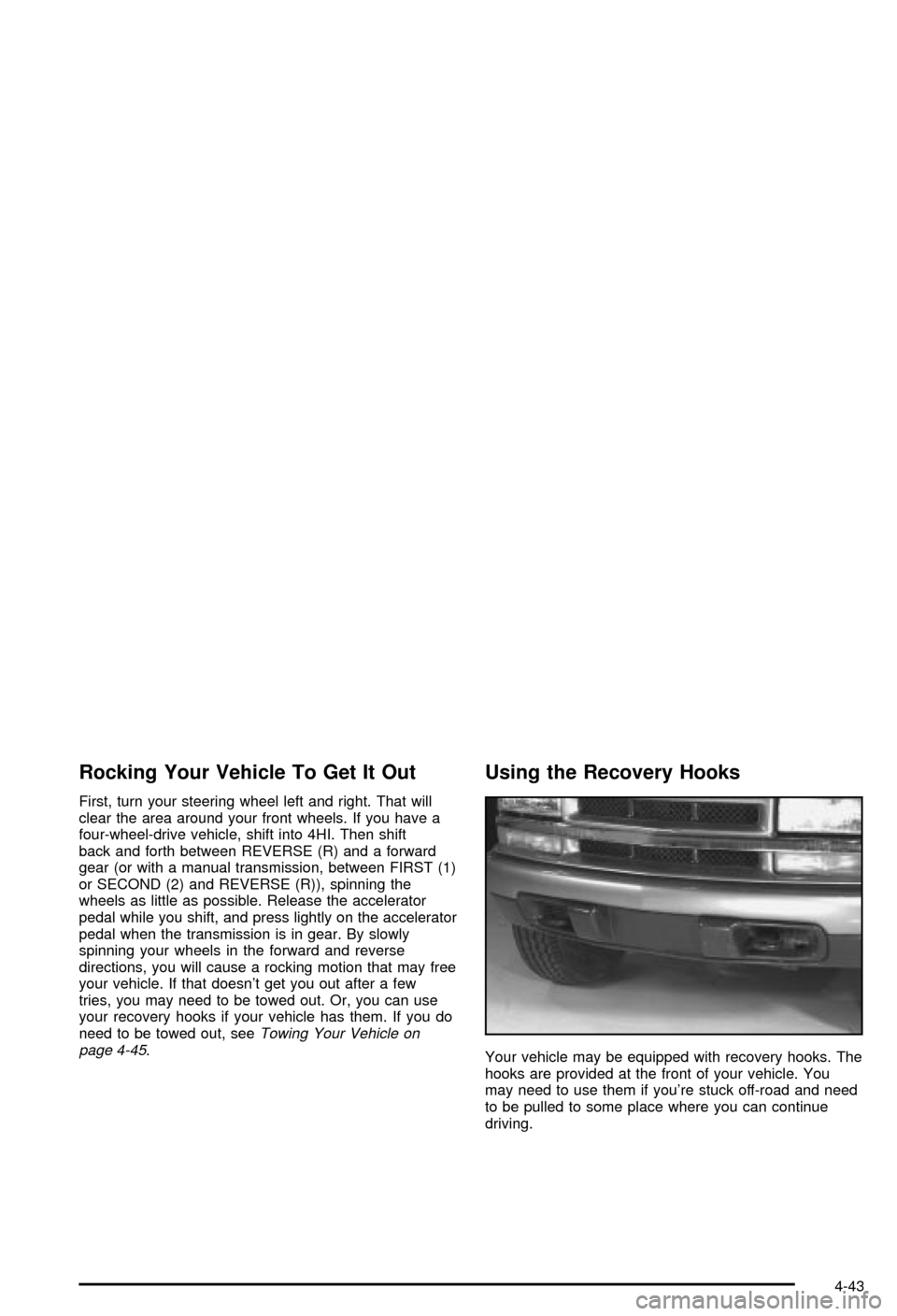
Using the Recovery Hooks
Your vehicle may be equipped with recovery hooks. The
hooks are provided at the front of your vehicle. You
may need to use them if you're stuck off-road and need
to be pulled to some place where you can continue
driving.
4-43
Page 244 of 420

Dinghy Towing
Vehicles with the Automatic Transfer Case
If your vehicle is equipped with an automatic transfer
case with a NEUTRAL position, you can dinghy tow your
vehicle. To dinghy tow your vehicle, use the following
steps:
1. Firmly set the parking brake.
2. Place the transmission in PARK (P).3. Securely attach the vehicle being towed to the tow
vehicle.
{CAUTION:
Shifting a four-wheel-drive vehicle's transfer
case into NEUTRAL can cause your vehicle to
roll even if the transmission is in Park (P) for
an automatic transmission, or if your vehicle is
in gear, for a manual transmission. You or
others could be injured. Make sure the parking
brake is ®rmly set before you shift the transfer
case to NEUTRAL.
4. With the engine running, shift the transfer case to
NEUTRAL (N). See ªAutomatic Transfer Caseº
under
Four-Wheel Drive on page 5-45for more
information on how to shift the transfer case
to NEUTRAL.
4-46
Page 245 of 420

5. Release the parking brake only after the vehicle
being towed is ®rmly attached to the towing
vehicle.
Notice:Make sure that the towing speed does not
exceed 55 mph (90 km/h), or your vehicle could
be badly damaged.
Notice:Do not exceed the posted speed limit when
towing your vehicle. If you do, your vehicle could
be badly damaged.
6. Turn the ignition to OFF. To prevent your battery
from draining while towing, remove the RDO BATT
and CLSTR fuses from the instrument panel
fuse block. Be sure to replace the fuse when you
reach your destination. See
Fuses and Circuit
Breakers on page 5-85.
Dinghy Towing (Two-Wheel Drive
Vehicles and Vehicles with the Electronic
Transfer Case)
Notice:Towing your vehicle with all four wheels on
the ground will damage drivetrain components.
Two-wheel drive and four-wheel drive vehicles with the
electronic transfer case should not be towed with all
four wheels on the ground. Your transmission has
no provision for internal lubrication while being towed.
To properly tow your vehicle, it should be placed
on a platform trailer with all four wheels off the ground.
4-47