2003 CHEVROLET AVALANCHE battery
[x] Cancel search: batteryPage 379 of 492
{CAUTION:
Using a match near a battery can cause battery
gas to explode. People have been hurt doing
this, and some have been blinded. Use a
¯ashlight if you need more light.
Be sure the battery has enough water. You
don't need to add water to the ACDelco
ž
battery installed in your new vehicle. But if a
battery has ®ller caps, be sure the right
amount of ¯uid is there. If it is low, add water
to take care of that ®rst. If you don't, explosive
gas could be present.
Battery ¯uid contains acid that can burn you.
Don't get it on you. If you accidentally get it in
your eyes or on your skin, ¯ush the place with
water and get medical help immediately.5. Check that the jumper cables don't have loose or
missing insulation. If they do, you could get a
shock. The vehicles could be damaged too.
Before you connect the cables, here are some
basic things you should know. Positive (+) will go to
positive (+) or to a remote positive terminal (+) if
the vehicle has one. Negative (-) will go to a heavy,
unpainted metal engine part or to a remote
negative (-) terminal, if the vehicle has one.
Don't connect positive (+) to negative (-) or you'll
get a short that would damage the battery and
maybe other parts too.
{CAUTION:
Fans or other moving engine parts can injure
you badly. Keep your hands away from moving
parts once the engine is running.
5-46
Page 380 of 492
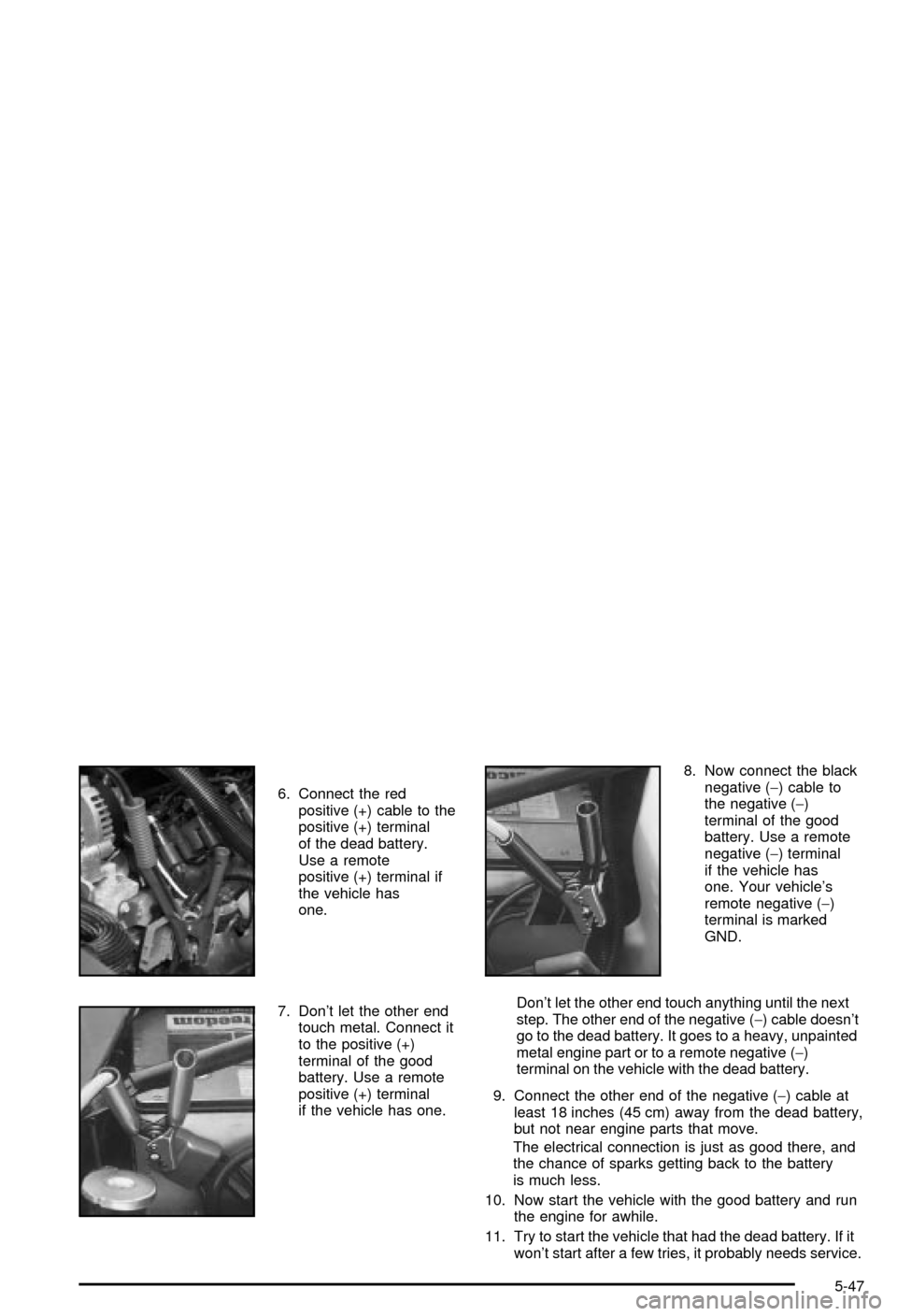
6. Connect the red
positive (+) cable to the
positive (+) terminal
of the dead battery.
Use a remote
positive (+) terminal if
the vehicle has
one.
7. Don't let the other end
touch metal. Connect it
to the positive (+)
terminal of the good
battery. Use a remote
positive (+) terminal
if the vehicle has one.8. Now connect the black
negative (-) cable to
the negative (-)
terminal of the good
battery. Use a remote
negative (-) terminal
if the vehicle has
one. Your vehicle's
remote negative (-)
terminal is marked
GND.
Don't let the other end touch anything until the next
step. The other end of the negative (-) cable doesn't
go to the dead battery. It goes to a heavy, unpainted
metal engine part or to a remote negative (-)
terminal on the vehicle with the dead battery.
9. Connect the other end of the negative (-) cable at
least 18 inches (45 cm) away from the dead battery,
but not near engine parts that move.
The electrical connection is just as good there, and
the chance of sparks getting back to the battery
is much less.
10. Now start the vehicle with the good battery and run
the engine for awhile.
11. Try to start the vehicle that had the dead battery. If it
won't start after a few tries, it probably needs service.
5-47
Page 381 of 492
Notice:Damage to your vehicle may result from
electrical shorting if jumper cables are removed
incorrectly. To prevent electrical shorting, take care
that the cables don't touch each other or any
other metal. The repairs wouldn't be covered by
your warranty.
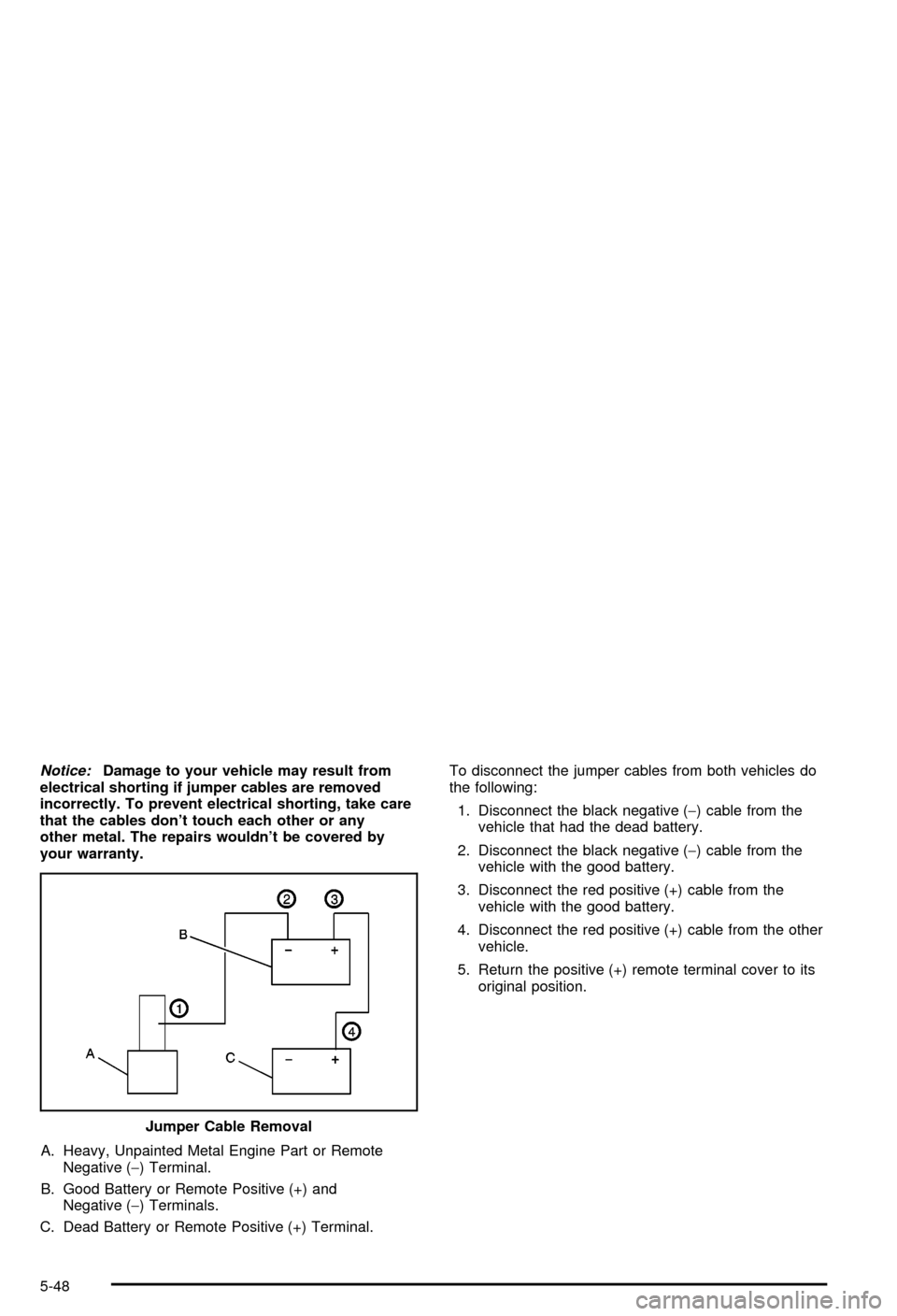
A. Heavy, Unpainted Metal Engine Part or Remote
Negative (-) Terminal.
B. Good Battery or Remote Positive (+) and
Negative (-) Terminals.
C. Dead Battery or Remote Positive (+) Terminal.To disconnect the jumper cables from both vehicles do
the following:
1. Disconnect the black negative (-) cable from the
vehicle that had the dead battery.
2. Disconnect the black negative (-) cable from the
vehicle with the good battery.
3. Disconnect the red positive (+) cable from the
vehicle with the good battery.
4. Disconnect the red positive (+) cable from the other
vehicle.
5. Return the positive (+) remote terminal cover to its
original position.
Jumper Cable Removal
5-48
Page 431 of 492
You may have spare fuses located behind the fuse
block access door. These can be used to replace a bad
fuse. However, make sure it is of the correct amperage.
Your vehicle may not have all of the features or
fuses listed in this section.
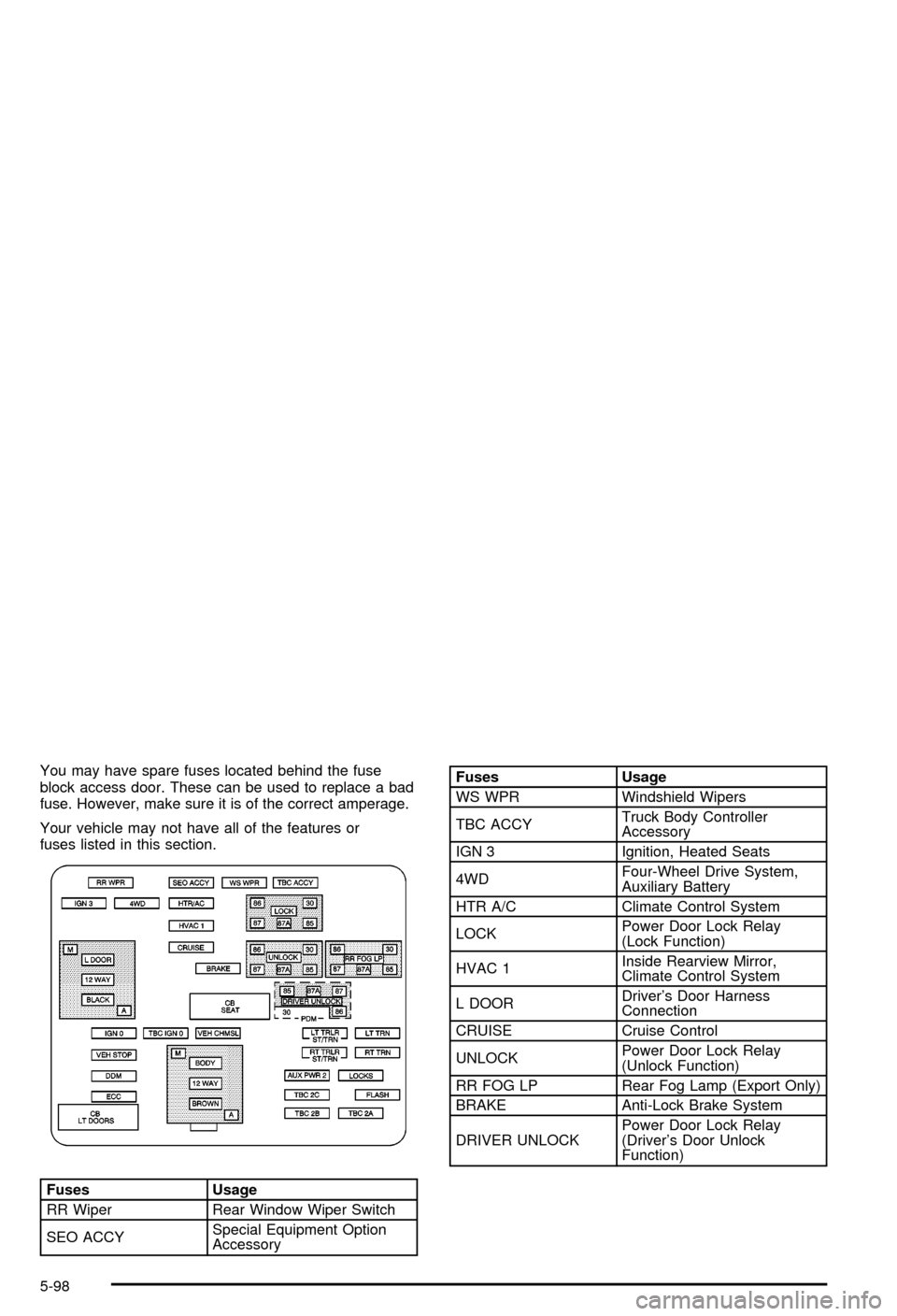
Fuses Usage
RR Wiper Rear Window Wiper Switch
SEO ACCYSpecial Equipment Option
Accessory
Fuses Usage
WS WPR Windshield Wipers
TBC ACCYTruck Body Controller
Accessory
IGN 3 Ignition, Heated Seats
4WDFour-Wheel Drive System,
Auxiliary Battery
HTR A/C Climate Control System
LOCKPower Door Lock Relay
(Lock Function)
HVAC 1Inside Rearview Mirror,
Climate Control System
L DOORDriver's Door Harness
Connection
CRUISE Cruise Control
UNLOCKPower Door Lock Relay
(Unlock Function)
RR FOG LP Rear Fog Lamp (Export Only)
BRAKE Anti-Lock Brake System
DRIVER UNLOCKPower Door Lock Relay
(Driver's Door Unlock
Function)
5-98
Page 434 of 492
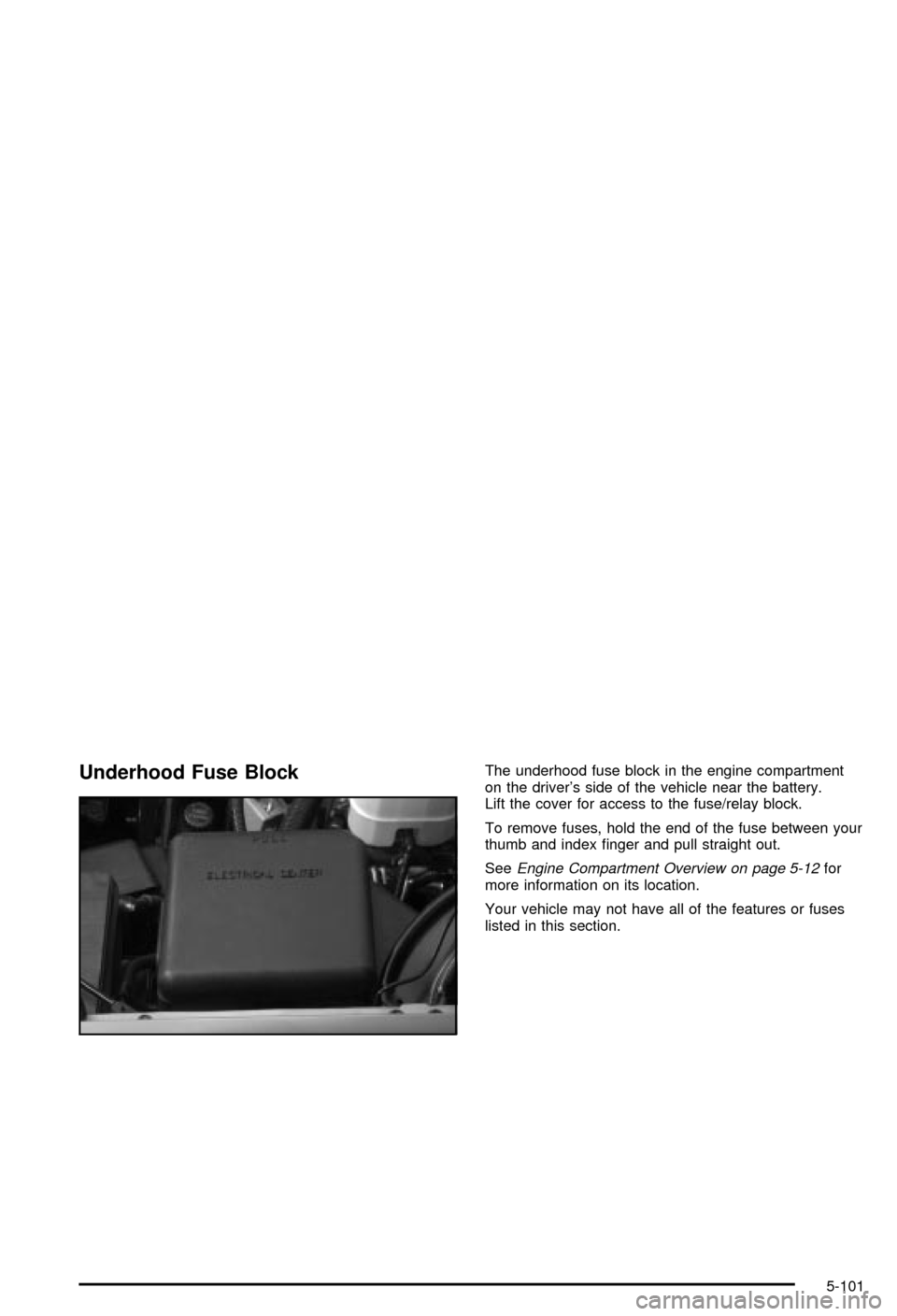
Underhood Fuse BlockThe underhood fuse block in the engine compartment
on the driver's side of the vehicle near the battery.
Lift the cover for access to the fuse/relay block.
To remove fuses, hold the end of the fuse between your
thumb and index ®nger and pull straight out.
See
Engine Compartment Overview on page 5-12for
more information on its location.
Your vehicle may not have all of the features or fuses
listed in this section.
5-101
Page 436 of 492

*1Ð Gasoline Engine and Fuel Injection Rail #2.
*2Ð Gasoline Engine and Fuel Injection Rail #1.
*3Ð Gasoline Engine; Oxygen Sensors.
*4Ð Gasoline Engine; Oxygen Sensors.
*5Ð PCM Ignition
Fuses Usage
GLOW PLUG Not Used
CUST FEED Gasoline Accessory Power
STUD #1Auxiliary Power (Single
Battery and Diesels
Only)/Dual Battery (TP2) Do
not install fuse.
MBECMid Bussed Electrical Center
Power Feed, Front Seats,
Right Doors
BLOWER Front Climate Control Fan
LBECLeft Bussed Electrical Center,
Door Modules, Door Locks,
Auxiliary Power Outlet
STUD 2Accessory Power/Trailer
Wiring Brake Feed
ABS Anti-Lock Brakes
VSES/ECAS Vehicle Stability
Fuses Usage
IGN A Ignition Power
IGN B Ignition Power
LBEC 1Left Bussed Electrical Center,
Left Doors, Truck Body
Controller, Flasher Module
TRL PARK Parking Lamps Trailer Wiring
RR PARKRight Rear Parking and
Sidemarker Lamps
LR PARKLeft Rear Parking and
Sidemarker Lamps
PARK LP Parking Lamps Relay
STARTER Starter Relay
INTPARK Interior Lamps
STOP LP Stoplamps
TBC BATTTruck Body Controller Battery
Feed
SUNROOF Sunroof
SEO B2 Off-Road Lamps
4WSVent Solenoid
Canister/Quadrasteer Module
Power
RR HVAC Rear Climate Control
5-103
Page 477 of 492

Automatic Transmission Check..........................6-12
Automatic Transmission Shift Lock Control
System Check.............................................6-13
Automatic Transmission...................................5-22
Fluid..........................................................5-22
Operation...................................................2-31
Auxiliary Battery..............................................4-69
Auxiliary Roof Mounted Lamp Switch.................3-16
B
Backing Up....................................................4-65
BATTERY NOT CHARGING.............................3-58
Battery Replacement......................................... 2-6
Battery Run-Down Protection............................3-18
Battery..........................................................5-42
Before Leaving on a Long Trip.........................4-38
Before You Drive............................................3-90
Before You Go Off-Roading..............................4-19
Body Lubrication Service..................................6-12
Brake Adjustment............................................5-42
Brake Fluid....................................................5-39
Brake Pedal, Throttle.......................................2-29
Brake Pedal Travel.........................................5-42
Brake Wear...................................................5-41
Brake............................................................2-39
Parking......................................................2-39
System Inspection.......................................6-16
System Warning Light..................................3-37Brake (cont.)
Brakes..........................................................5-39
Braking in Emergencies..................................... 4-9
Braking........................................................... 4-6
Break-In, New Vehicle.....................................2-27
Bulb Replacement...........................................5-52
Center High-Mounted Stoplamp (CHMSL)........5-58
Daytime Running Lamps...............................5-58
Front Turn Signal, Sidemarker and Daytime
Running Lamps........................................5-56
Front Turn Signal, Sidemarker and Parking
Lamps....................................................5-55
Halogen Bulbs............................................5-52
Headlamps.................................................5-52
Replacement Bulbs......................................5-59
Taillamps....................................................5-58
Buying New Tires...........................................5-64
C
California Fuel.................................................. 5-6
Canada ± Customer Assistance.......................... 7-5
Canadian Owners................................................ ii
Canadian Roadside Assistance........................... 7-7
Capacities and Speci®cations..........................5-106
Carbon Monoxide...........4-41, 4-58, 2-12, 2-21, 2-44
Care of.........................................................5-91
Safety Belts................................................5-91
Your CD and DVD Player...........................3-103
2
Page 480 of 492

Driving Downhill..............................................4-26
Driving in Mud, Sand, Snow or Ice....................4-29
Driving in Water..............................................4-30
Driving On Grades..........................................4-66
Driving on Off-Road Hills.................................4-23
Driving on Snow or Ice....................................4-42
Driving Through Deep Standing Water...............4-35
Driving Through Flowing Water.........................4-35
Driving Uphill..................................................4-24
Driving with a Trailer.......................................4-64
Driving..........................................................4-32
At Night.....................................................4-32
City...........................................................4-36
Defensive..................................................... 4-2
Drunken....................................................... 4-3
Freeway.....................................................4-37
Hill and Mountain Roads..............................4-39
In Rain and on Wet Roads...........................4-33
Winter........................................................4-41
Dual Climate Control System............................3-26
DVD Player....................................................3-90
DVD ............................................................3-103
Cleaning the Video Screen..........................3-103
Distortion..................................................3-102
Rear Seat Entertainment System...................3-90E
Easy Exit Seat...............................................2-86
Electrical System............................................5-96
Fuses and Circuit Breakers...........................5-97
Power Windows and Other Power Options......5-97
Windshield Wiper Fuses...............................5-97
Electrochromic Mirror Operation................2-46, 2-49
Emissions Inspection and Maintenance
Programs...................................................3-43
ENGINE COOLANT HOT.................................3-58
Engine Coolant Level Check.............................6-10
Engine Oil Additives........................................5-18
Engine Oil and Chassis Lubrication Scheduled
Maintenance................................................. 6-5
Engine Oil Level Check...................................6-10
ENGINE OVERHEATED..................................3-58
Engine..........................................................5-20
Air Cleaner/Filter.........................................5-20
Battery.......................................................5-42
Check and Service Engine Soon Light............3-41
Compartment Overview................................5-12
Coolant Heater............................................2-30
Coolant Temperature Gage...........................3-39
Coolant......................................................5-24
Cooling System Inspection............................6-16
Exhaust.....................................................2-44
Fan Noise..................................................5-36
Oil .............................................................5-15
Overheating................................................5-27
5