2003 CHEVROLET ASTRO ECU
[x] Cancel search: ECUPage 174 of 386
Unlocking the Theft-Deterrent Feature
After
a Power Loss
Enter your secret code as follows; pause no more than
15 seconds between steps:
1. Turn the ignition on. LOC will appear on the display.
2, Press MN and 000 will appear on the display.
3. Press MN again to make the last two digits agree
with your code.
4. Press HR to make the first one or two digits agree
with your code.
5. Press AM FM after you have confirmed that the
code matches the secret code you have written
down. The display will show SEC, indicating
the radio is now operable and secure.
If you enter the wrong code eight times, INOP will
appear on the display. You will have to wait an hour
with the ignition on before you can try again. When you
try again, you will only have three chances to enter
the correct code before INOP appears.
If you lose or forget your code, contact your dealership.
Disabling the Theft-Deterrent Feature
Enter your secret code as follows; pause no more than
15 seconds between steps:
1. Turn the ignition on.
2. Turn the radio off.
3. Press the 1 and 4 pushbuttons at the same time.
Hold them down until SEC shows on the display.
4. Press MN and
000 will appear on the display.
5. Press MN again to make the last two digits agree
with your code.
6. Press HR to make the first one or two digits agree
with your code.
7. Press AM FM after you have confirmed that the
code matches the secret code you have written
down. The display will show
- - -, indicating that the
radio is no longer secured.
If the code entered is incorrect, SEC will appear on the
display. The radio will remain secured until the correct
code is entered.
When battery power is removed and later applied to a
secured radio, the radio won’t turn on and LOC will
appear on the display.
To unlock a secured radio, see Unlocking the
Theft-Deterrent Feature After
a Power Loss earlier
in this section.
3-49
Page 199 of 386
Winter Driving
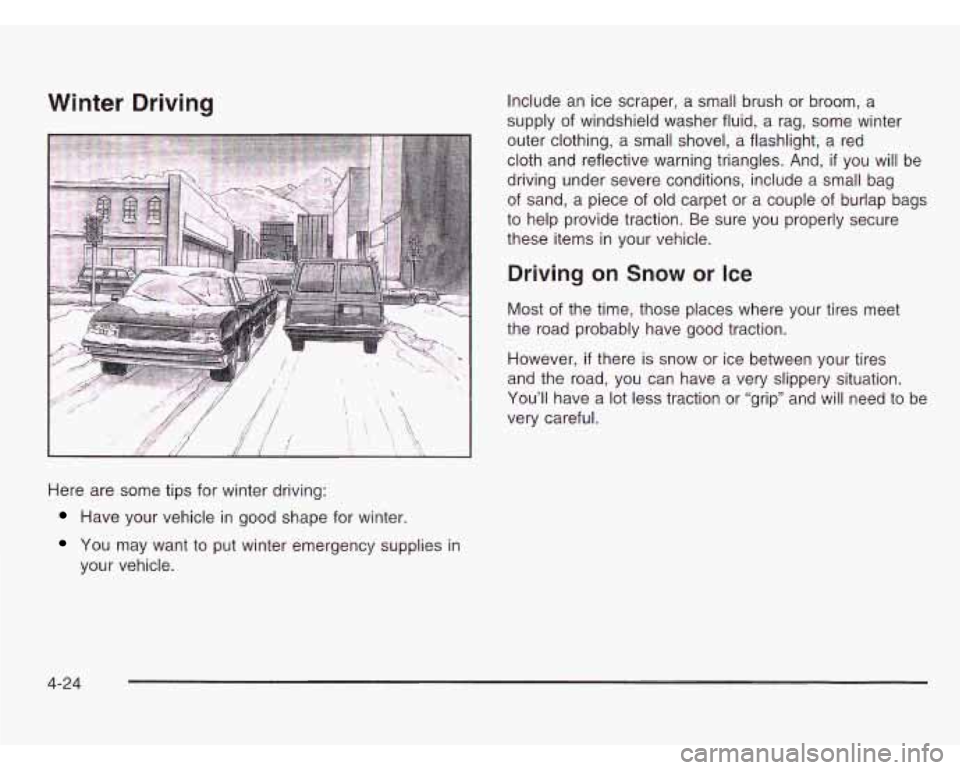
Here are some tips for winter driving:
Have your vehicle in good shape for winter.
You may want to put winter emergency supplies in
your vehicle. Include
an ice scraper, a small brush or broom, a
supply of windshield washer fluid, a rag, some winter
outer clothing, a small shovel, a flashlight, a red
cloth and reflective warning triangles. And,
if you will be
driving under severe conditions, include a small bag
of sand, a piece of old carpet or a couple of burlap bags
to help provide traction. Be sure you properly secure
these items
in your vehicle.
Driving on Snow or Ice
Most of the time, those places where your tires meet
the road probably have good traction.
However,
if there is snow or ice between your tires
and the road, you can have a very slippery situation.
You’ll have a lot less traction or “grip” and will need to be
very careful.
4-24
Page 205 of 386
The Certificationnire label also tells you the maximum Notice: Your warranty does not cover parts or
weights for the front and rear axles, called Gross components that fail because of overloading.
Axle Weight Rating (GAWR).
To find out the actual loads
on your front and rear axles, you need to go to a
If you put things inside of your vehicle - like suitcases,
weigh station and weigh your vehicle. Your dealer can tools, packages, or anything else
- they will go as
help you with this. Be sure to spread out your load fast as the vehicle goes.
If you have to stop or turn
equally on both sides of the centerline. ciiickly qr if there is a crash, they’ll keep going.
Never exceed the GVWR for your vehicle, or the GAWR
for either the front or rear axle.
And, if you do have a heavy load, you should spread
it out.
-3 not load your e any heavier Ian _..e
GVWR, or either the maximum front or rear
GAWR. If you do, parts on your vehicle can
break, and
it can change the way your vehicle
handles. These could cause you to lose
control and crash. Also, overloading can
shorten the life of your vehicle.
Using heavier suspension components to get added
durability might not change your weight ratings. Ask your
dealer to help you load your vehicle the right way. Things you put inside your vehicle can
srlI6e
and injure people in a sudden stop or turn, or
in a crash.
Put things in the cargo area of your
vehicle. Try to spread the weight evenly.
Never stack heavier things, like suitcases,
inside the vehicle
so that some of them
are above the tops of the seats.
Don’t leave an unsecured child restraint
in your vehicle.
When you carry something inside the
vehicle, secure
it whenever you can.
Don’t leave a seat folded down unless
you need
to.
4-30
Page 212 of 386

Driving with a Trailer
If you ~ ve a rear-most window open and
you pull a trailer with your vehicle, carbon monoxide (CO) could come into your vehicle.
You can’t see or smell
CO. It can cause
unconsciousness or death. See “Engine
Exhaust” in the Index.
To maximize your safety
when towing a trailer:
Have your exhaust system inspected for
leaks, and make necessary repairs before
starting on your trip.
Keep the rear-most windows closed.
If exhaust does come into your vehicle
through a window
in the rear or another
opening, drive with your front, main
heating or cooling system on and with the
fan on any speed. This will bring fresh,
outside air into your vehicle.
Do not use
the climate control setting for maximum air because
it only recirculates the air inside
your vehicle. See “Climate Controls” in
the Index. Towing
a trailer requires a certain amount of experience.
Before setting out for the open road, you’ll want to get
to know your rig. Acquaint yourself with the feel of
handling and braking with the added weight of the trailer.
And always keep in mind that the vehicle you are
driving is now a good deal longer and not nearly as
responsive as your vehicle is by itself.
Before you start, check the trailer hitch and platform
(and attachments), safety chains, electrical connector,
lamps, tires and mirror adjustment. If the trailer has
electric brakes, start your vehicle and trailer moving and
then apply the trailer brake controller by hand to be
sure the brakes are working. This lets you check your
electrical connection at the same time.
During your trip, check occasionally
to be sure that
the load
is secure, and that the lamps and any trailer
brakes are still working.
4-37
Page 240 of 386
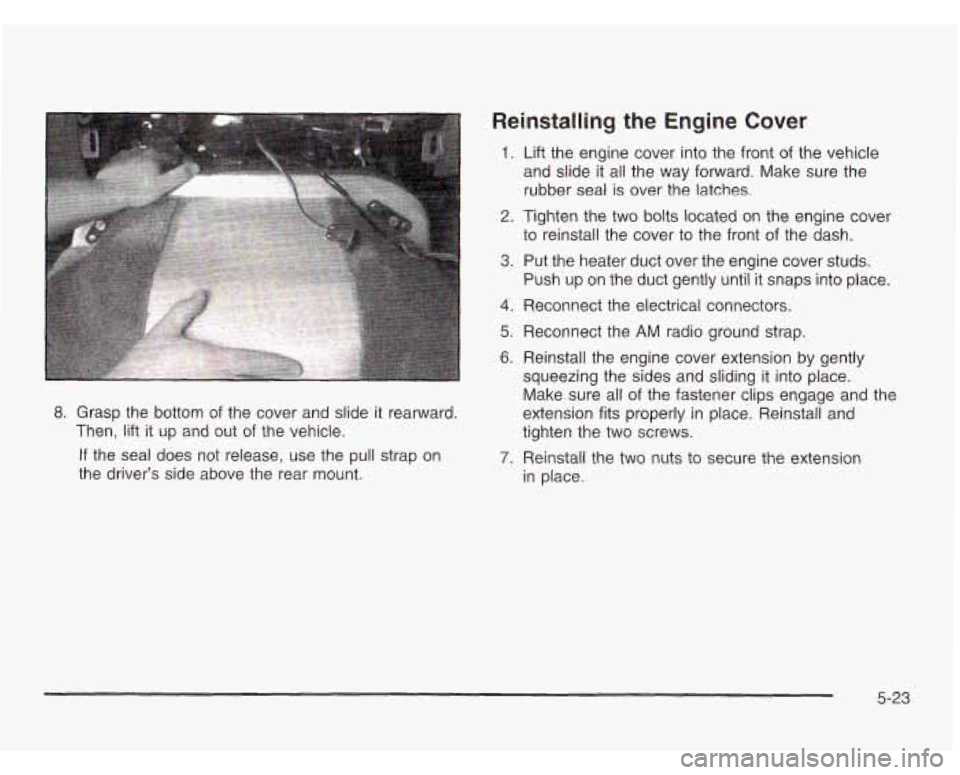
8. Grasp the bottom of the cover and slide it rearward.
Then,
lift it up and out of the vehicle.
If the seal does not release, use the pull strap on
the driver’s side above the rear mount.
Reinstalling the Engine Cover
1. Lift the engine cover into the front of the vehicle
and slide it all the way forward. Make sure the
rubber seal
is over the latches.
2. Tighten the two bolts located on the engine cover
to reinstall the cover to the front of the dash.
3. Put the heater duct over the engine cover studs.
Push up on the duct gently until it snaps into place.
4. Reconnect the electrical connectors.
5. Reconnect the AM radio ground strap.
6. Reinstall the engine cover extension by gently
squeezing the sides and sliding it into place.
Make sure all of the fastener clips engage and the
extension fits properly in place. Reinstall and
tighten the two screws.
7. Reinstall the two nuts to secure the extension
in place.
5-23
Page 241 of 386
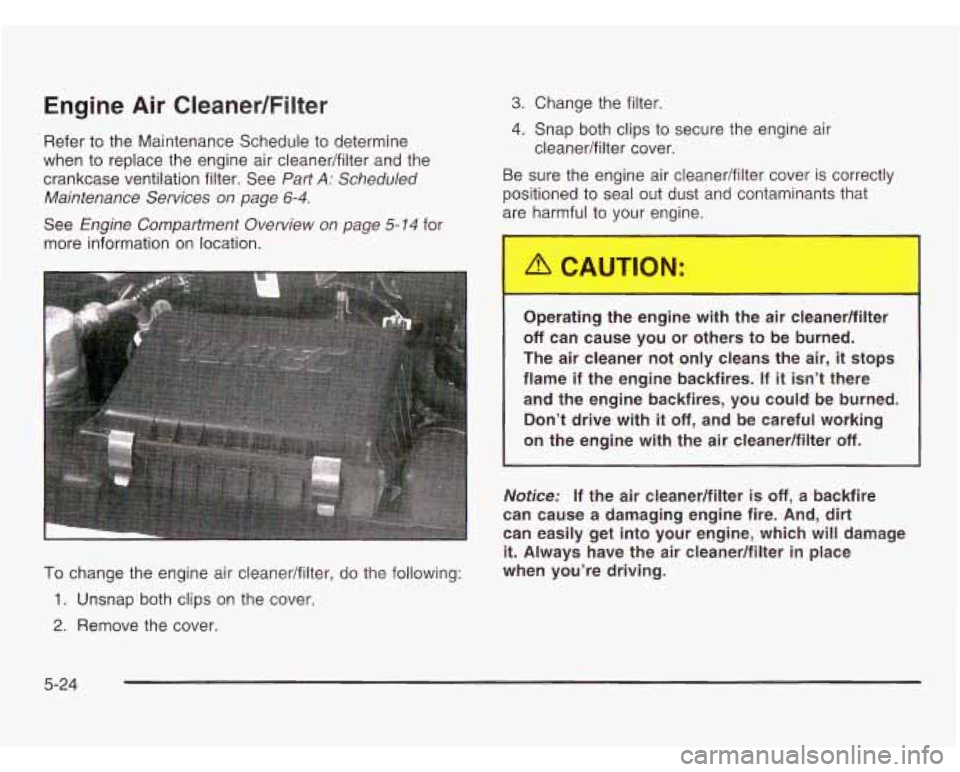
Engine Air Cleaner/Filter
Refer to the Maintenance Schedule to determine
when to replace the engine air cleanedfilter and the
crankcase ventilation filter. See
Part A: Scheduled
Maintenance Services on page
6-4.
See Engine Compartment Overview on page 5-14 for
more information on location.
3. Change the filter.
4. Snap both clips to secure the engine air
cleaner/filter cover.
Be sure the engine air cleaner/filter cover is correctly
positioned
to seal out dust and contaminants that
are harmful to your engine.
To change the engine air cleaner/filter, do the following:
1. Unsnap both clips on the cover.
2. Remove the cover. Operat
...d the engine witt.
_.re air cleaner/ ____ er
off can cause you or others to be burned.
The air cleaner not only cleans the air,
it stops
flame if the engine backfires.
If it isn’t there
and the engine backfires, you could be burned.
Don’t drive with
it off, and be careful working
on the engine with the air cleaner/filter
off.
Notice: If the air cleanedfilter is off, a backfire
can cause a damaging engine fire. And, dirt
can easily get into your engine, which will damage
it. Always have the air cleanedfilter in place
when you’re driving.
5-24
Page 282 of 386
Make sure the spare tire is stored securely. Push,
pull, and then try to rotate or turn the tire.
If it moves,
use the ratchevwheel wrench to tighten the cable.
See
Changing a Flat Tire on page 5-71.
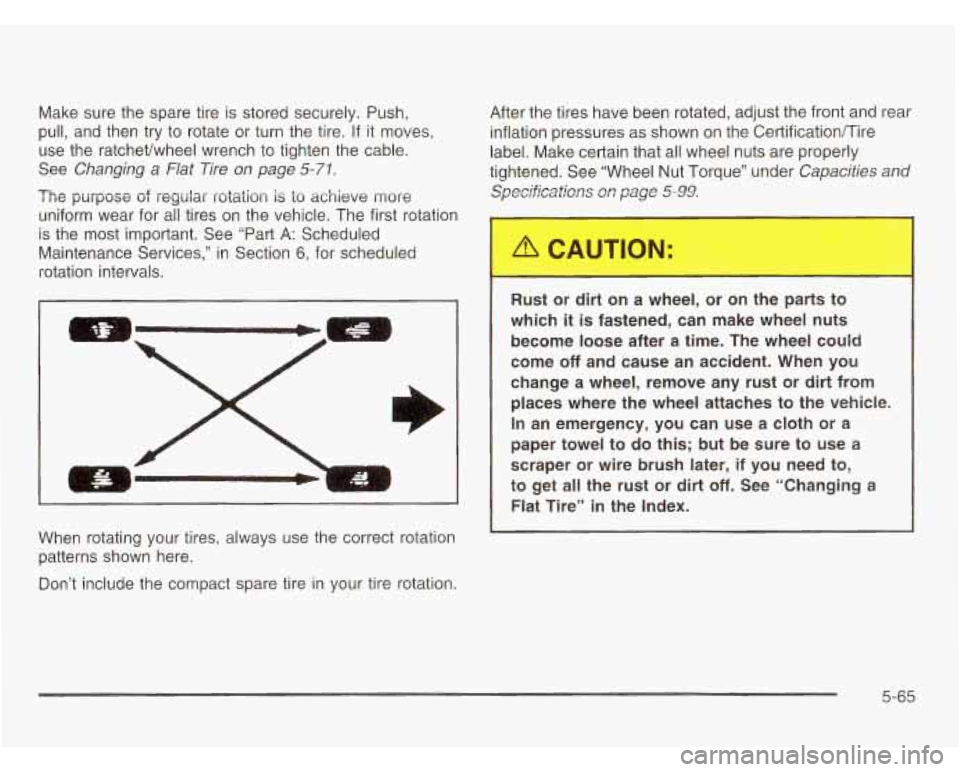
The purpose Gf regular rotation is lo achieve more
uniform wear for all tires on the vehicle. The first rotation
is the most important. See “Part
A: Scheduled
Maintenance Services,” in Section
6, for scheduled
rotation intervals. After
the tires have been rotated, adjust the front and rear
inflation pressures as shown on the CertificationA-ire
label. Make certain that all wheel nuts are properly
tightened. See “Wheel Nut Torque” under
Capacities and
Specifications
on page 5-99.
When rotating your tires, always use the correct rotation
patterns shown here.
ts to
-
Rust or dirt on a wheel, or on the par
which
it is fastened, can make wheel nuts
become loose after a time. The wheel could
come
off and cause an accident. When you
change a wheel, remove any rust or dirt from
places where the wheel attaches to the vehicle.
In an emergency, you can use a cloth or a
paper towel to do
this; but be sure to use a
scraper
or wire brush later, if you need to,
to get all the rust or dirt
off. See “Changing a
Flat Tire” in the Index.
Don’t include the compact spare tire in your tire rotation.
5-65
Page 287 of 386
Used Replacement Wheels
Putting a uscu wheel on your vehicle is
dangerous. You can’t know how it’s been used or how far
it’s been driven. It could fail suddenly
and cause a crash. If you have to replace a
wheel, use a new
GM original equipment wheel.
Tire Chains
Notice: Use tire chains only where legal and only
when you must. Use only
SAE Class ”S” type chains
that are the proper size for your tires. Install them on the rear axle tires and tighten them as tightly
as possible with the ends securely fastened.
Drive slowly and follow the chain manufacturer’s
instructions.
If you can hear the chains contacting
your vehicle, stop and retighten them. If the contact
continues, slow down until
it stops. Driving too
fast or spinning
the wheels with chains on will
damage your vehicle.
If a Tire Goes Flat
It’s unusual for a tire to “blow out” while you’re driving,
especially
if you maintain your tires properly. If air
goes out of a tire, it’s much more likely to leak out
slowly. But
if you should ever have a “blowout”, here are
a few tips about what to expect and what to do:
If a front tire fails, the flat tire will create a drag that
pulls the vehicle toward that side. Take your foot off the
accelerator pedal and grip the steering wheel firmly.
Steer to maintain lane position, and then gently brake to
a stop well out of the traffic lane.
A rear blowout, particularly on a curve, acts much like a
skid and may require the same correction you’d use
in a skid. In any rear blowout, remove your foot from the
accelerator pedal. Get the vehicle under control by
steering the way you want the vehicle to go. It may be
very bumpy and noisy, but you can still steer. Gently
brake to a stop
- well off the road if possible.
If a tire goes flat, the next part shows how to use your
jacking equipment to change a flat tire safely.
5-70