Page 252 of 386
Notice: In cold weather, water can freeze and crack
the engine, radiator, heater core and other parts.
Use the recommended coolant and the proper
coolant mixture.
You can be burned if you spill coolant on hot
engine parts. Coolant contains ethylene glycol and
it will burn if the engine parts are hot
enough. Don't spill coolant on a hot engine.
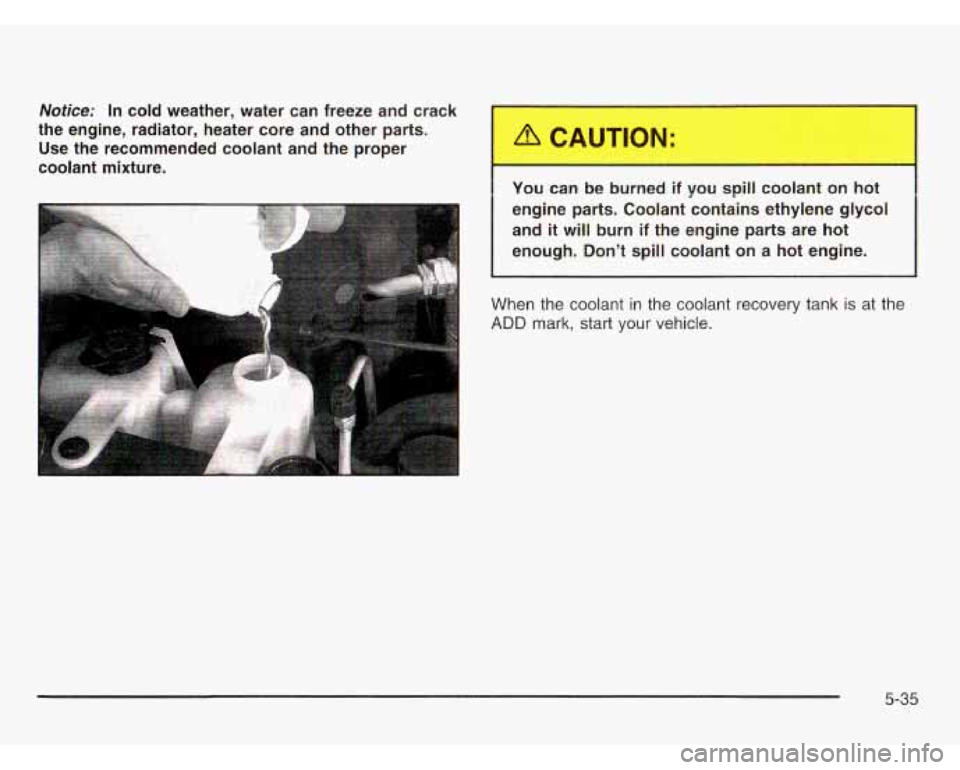
When the coolant in the coolant recovery tank
is at the
ADD mark, start your vehicle.
5-35
Page 253 of 386
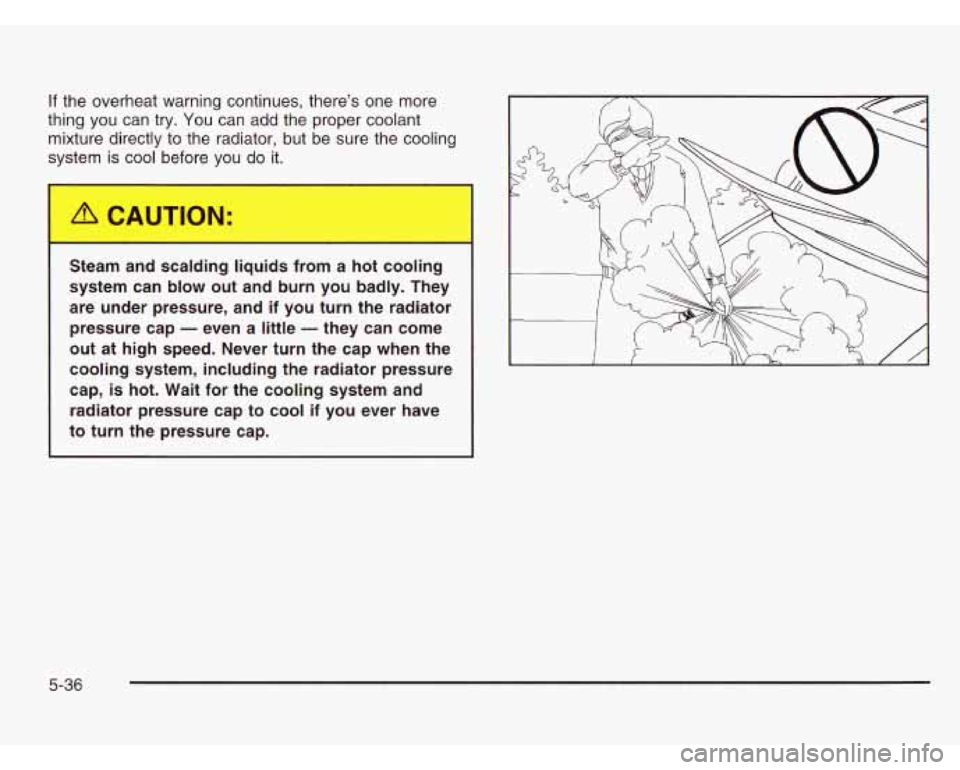
If the overheat warning continues, there’s one more
thing you can try.
You can add the proper coolant
mixture directly to the radiator, but be sure the cooling
system is cool before you do it.
1
Steam and scalding liquids from a hot cooling
system can blow out and burn you badly. They
are under pressure, and
if you turn the radiator
pressure cap
- even a little - they can come
out at high speed. Never turn the cap when
the
cooling system, including the radiator pressure
cap, is hot. Wait for the cooling system and
radiator pressure cap to cool if you ever have
to
turn the pressure cap.
5-36
Page 254 of 386
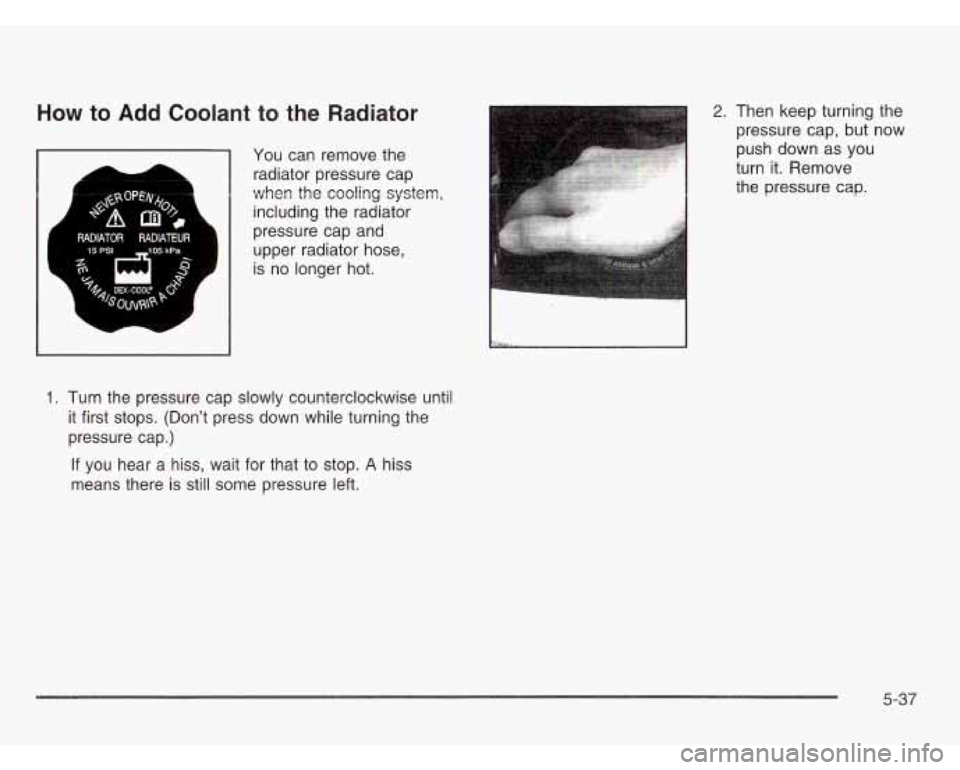
How to Add Coolant to the Radiator
You can remove the
radiator pressure cap
when the cooling system,
including the radiator
pressure cap and
upper radiator hose,
is no longer hot.
1. Turn the pressure cap slowly counterclockwise until
it first stops. (Don't press down while turning the
pressure cap.)
2. Then keep turning the pressure cap, but now
push down as you
turn it. Remove
the pressure cap.
If you hear a hiss, wait for that
to stop. A hiss
means there is still some pressure left.
5-37
Page 255 of 386
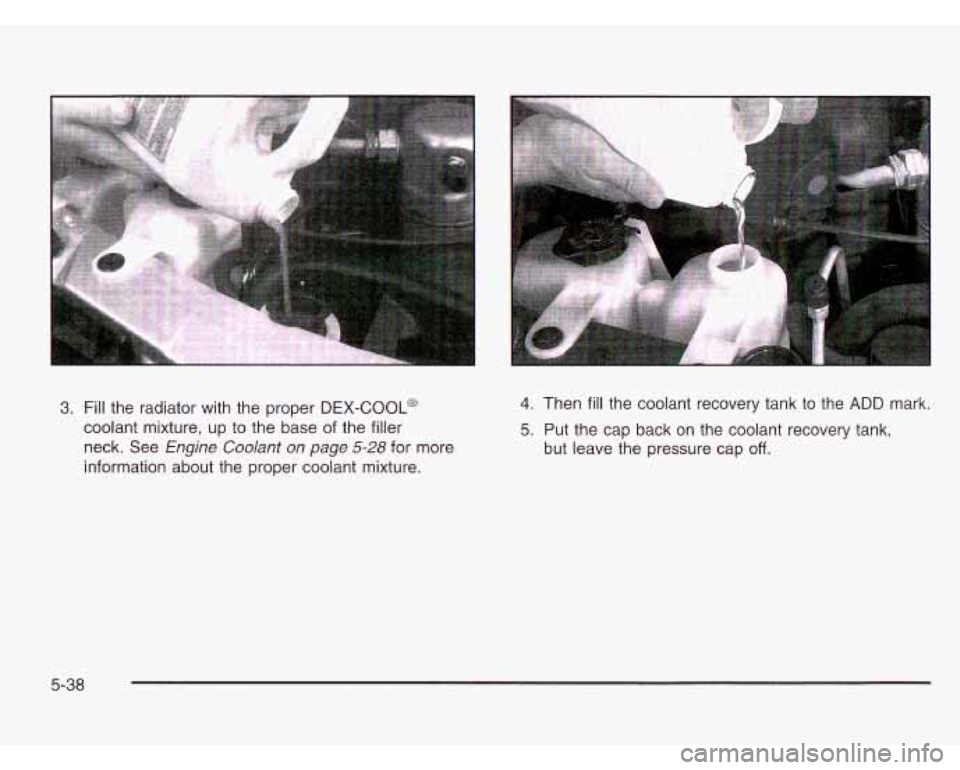
3. Fill the radiator with the proper DEX-COOL@
coolant mixture, up to the base of the filler
neck. See
Engine Coolant on page 5-28 for more
information about the proper coolant mixture.
4. Then fill the coolant recovery tank to the ADD mark.
5. Put the cap back on the coolant recovery tank,
but leave the pressure cap
off.
5-38
Page 256 of 386
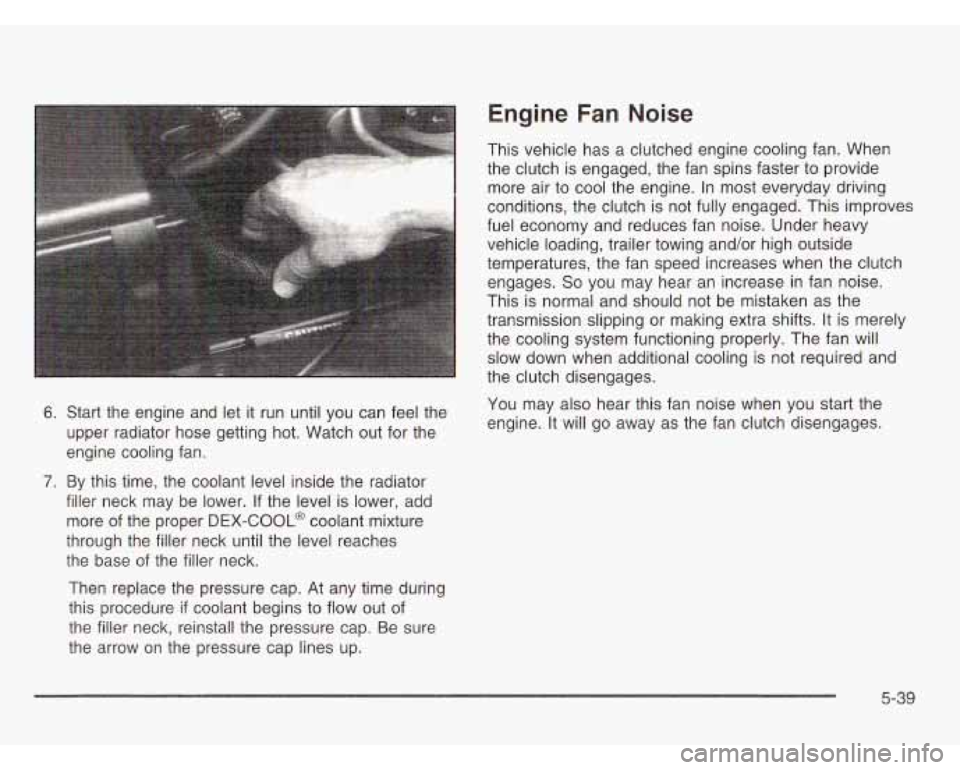
6. Start the engine and let it run until you can feel the
upper radiator hose getting hot. Watch out for the
engine cooling fan.
7. By this time, the coolant level inside the radiator
filler neck may be lower.
If the level is lower, add
more of the proper
DEX-COOL@ coolant mixture
through the filler neck until the level reaches
the base of the filler neck.
Then replace the pressure cap. At any time during
this procedure
if coolant begins to flow out of
the filler neck, reinstall the pressure cap. Be sure
the arrow on the pressure cap lines up.
Engine Fan Noise
This vehicle has a clutched engine cooling fan. When
the clutch is engaged, the fan spins faster to provide
more air to cool the engine. In most everyday driving
conditions, the clutch is not fully engaged. This improves
fuel economy and reduces fan noise. Under heavy
vehicle loading, trailer towing and/or high outside
temperatures, the fan speed increases when the clutch
engages.
So you may hear an increase in fan noise.
This is normal and should not be mistaken as the
transmission slipping or making extra shifts. It is merely
the cooling system functioning properly. The fan will
slow down when additional cooling is not required and
the clutch disengages.
You may also hear this fan noise when you start the
engine. It will go away as the fan clutch disengages.
5-39
Page 258 of 386
Windshield Washer Fluid
What to Use
When you need windshield washer fluid, be sure to read
the manufacturer’s instructions before use. If you will
be operating your vehicle in an area where the
temperature may fall below freezing, use a fluid that
has sufficient protection against freezing.
Adding Washer Fluid
Open the cap with the
washer symbol on it.
Add washer fluid until the
tank is full.
Notice:
When using concentrated washer fluid, follow
the manufacturer’s instructions for adding water.
Don’t mix water with ready-to-use washer fluid.
Water can cause the solution to freeze and
damage your washer fluid tank and other parts
of the washer system.
Also, water doesn’t
clean as well as washer fluid.
0 Fill your washer fluid tank only three-quarters
full when
it’s very cold. This allows for
expansion
if freezing occurs, which could
damage the tank if
it is completely full.
Don’t use engine coolant (antifreeze) in your
windshield washer.
It can damage your
washer system and paint.
5-41
Page 337 of 386

100,000 Miles (166 000 km)
0 Inspect spark plug wires. An Emission Control
Service.
0 Replace spark plugs. An Emission Control Service.
0 If you haven’t used your vehicle under severe service
conditions listed previously and, therefore, haven’t
changed your automatic transmission fluid, change
both the fluid and filter.
0 Change transfer case fluid.
Cl Inspect Positive Crankcase Ventilation (PCV) valve.
An Emission Control Service.
150,000 Miles (240 000 km)
0 Drain, flush and refill cooling system (or every
60 months since last service, whichever occurs first).
See
Engine Coolant on page 5-28 for what to use.
Inspect hoses. Clean radiator, condenser, pressure
cap and neck. Pressure test cooling system and
pressure cap.An
Emission Control Service.
An Emission Control Service.
Cl Inspect engine accessory drive belt.
Long Trip/Highway Scheduled
Maintenance
The services shown in this schedule up to 100,000 miles
(166 000 km) should be repeated after 100,000 miles
(166 000 km) at the same intervals for the life of
this vehicle. The services shown at
150,000 miles
(240 000 km) should be repeated at the same interval
after
150,000 miles (240 000 km) for the life of this
vehicle.
See
Part 5: Owner Checks and Services on page 6-26
and Part C: Periodic Maintenance Inspections on
page 6-30.
Footnotes
t The U.S. Environmental Protection Agency or the
California Air Resources Board has determined that the
failure to perform this maintenance item will not nullify the emission warranty or limit recall liability prior to
the completion of the vehicle’s useful life. We, however,
urge that all recommended maintenance services be
performed at the indicated intervals and the
maintenance be recorded.
# Lubricate the front suspension, ball joints and kingpin
bushings, steering linkage and transfer case shift linkage,
parking brake cable guides and brake pedal springs.
+ A good time to check your brakes is during tire
rotation. See Brake System Inspection
on page 6-31.
6-1 8
Page 344 of 386

97,500 Miles (162 500 km)
U Change engine oil and filter (or every 12 months,
0 Lubricate chassis components (or every 12 months,
0 Check readfront axle fluid level and add fluid as
whichever occurs first).
An Emission Control Service.
whichever
occurs first). (See footnote #).
needed. Check constant velocity joints and axle seals
for leaking.
page 5-64 for proper rotation pattern and additional
information.
(See footnote +).
0 Rotate tires. See Tire Inspection and Rotation on
100,000 Miles (166 000 km)
0 Inspect spark plug wires. An Emission Control
U Replace spark plugs. An Emission Control Service.
Service.
0 If you haven’t used your
vehicle under severe service
conditions listed previously and, therefore, haven’t
changed your automatic transmission fluid, change
both the fluid and filter.
150,000 Miles (240 000 km)
U Drain, flush and refill cooling system (or every
60 months since last service, whichever occurs first).
See
Engine Coolant on page 5-28 for what to use.
inspect hoses. Clean radiator, condenser, pressure
cap and neck. Pressure test the cooling system
and pressure cap.
An Emission Control Service.
U Inspect engine accessory drive belt. An Emission
Control Service.
0 Change transfer case fluid.
0 Inspect Positive Crankcase Ventilation (PCV) valve.
An Emission Control Service.
6-25