2003 CADILLAC SEVILLE ECU
[x] Cancel search: ECUPage 244 of 408
Winter Driving
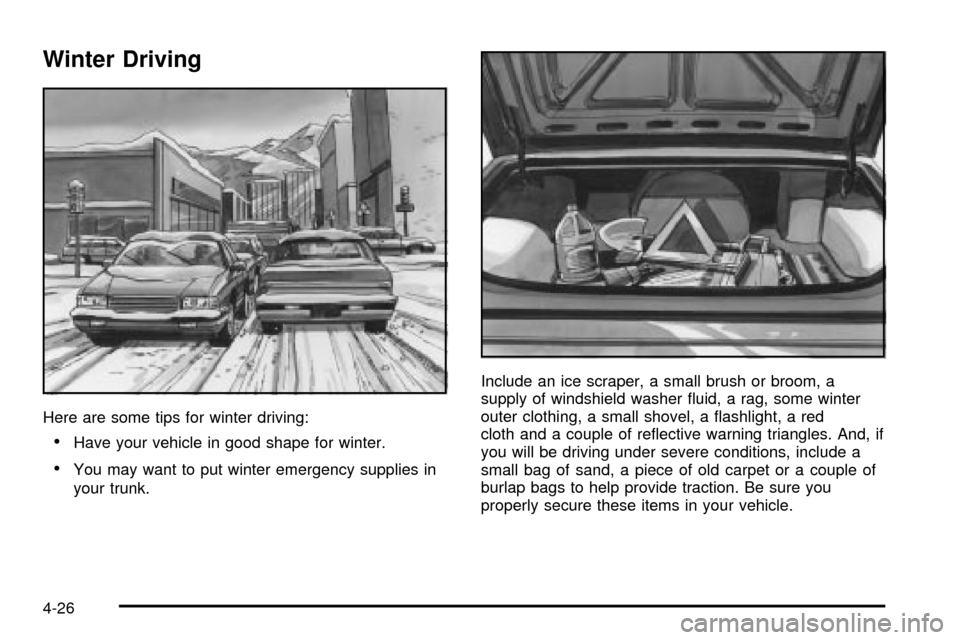
Here are some tips for winter driving:
·Have your vehicle in good shape for winter.
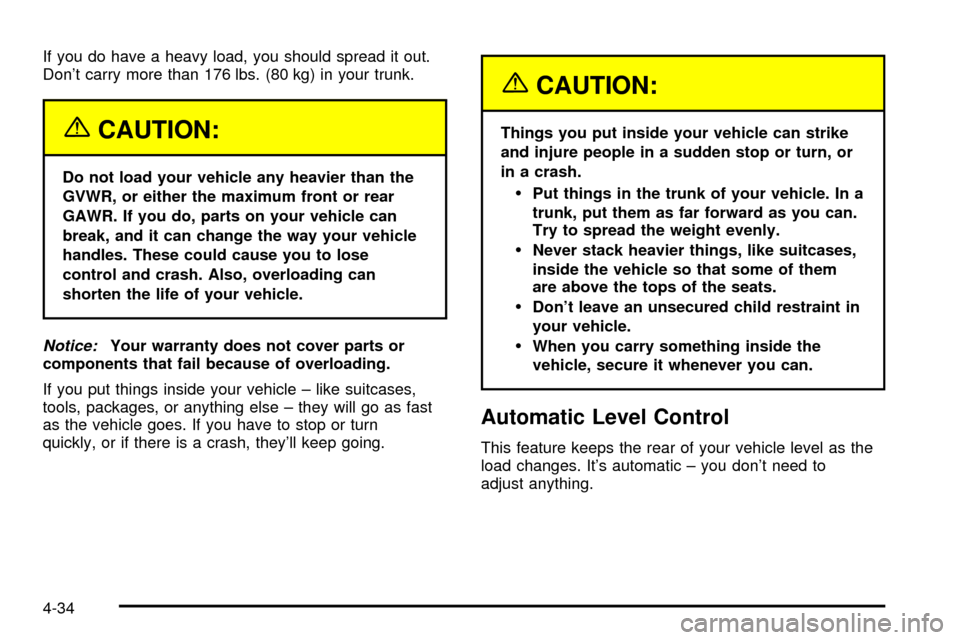
·You may want to put winter emergency supplies in
your trunk.Include an ice scraper, a small brush or broom, a
supply of windshield washer ¯uid, a rag, some winter
outer clothing, a small shovel, a ¯ashlight, a red
cloth and a couple of re¯ective warning triangles. And, if
you will be driving under severe conditions, include a
small bag of sand, a piece of old carpet or a couple of
burlap bags to help provide traction. Be sure you
properly secure these items in your vehicle.
4-26
Page 252 of 408
If you do have a heavy load, you should spread it out.
Don't carry more than 176 lbs. (80 kg) in your trunk.
{CAUTION:
Do not load your vehicle any heavier than the
GVWR, or either the maximum front or rear
GAWR. If you do, parts on your vehicle can
break, and it can change the way your vehicle
handles. These could cause you to lose
control and crash. Also, overloading can
shorten the life of your vehicle.
Notice:Your warranty does not cover parts or
components that fail because of overloading.
If you put things inside your vehicle ± like suitcases,
tools, packages, or anything else ± they will go as fast
as the vehicle goes. If you have to stop or turn
quickly, or if there is a crash, they'll keep going.
{CAUTION:
Things you put inside your vehicle can strike
and injure people in a sudden stop or turn, or
in a crash.
·Put things in the trunk of your vehicle. In a
trunk, put them as far forward as you can.
Try to spread the weight evenly.
·Never stack heavier things, like suitcases,
inside the vehicle so that some of them
are above the tops of the seats.
·Don't leave an unsecured child restraint in
your vehicle.
·When you carry something inside the
vehicle, secure it whenever you can.
Automatic Level Control
This feature keeps the rear of your vehicle level as the
load changes. It's automatic ± you don't need to
adjust anything.
4-34
Page 257 of 408

Trailer Brakes
Because you have anti-lock brakes, don't try to tap into
your vehicle's hydraulic brake system. If you do,
both brake systems won't work well, or at all. If you tow
more than 1,000 lbs (450 kg), use trailer brakes. Be
sure to follow the instructions that come with the trailer
or from the brake manufacturer.
Be sure to read and follow the instructions for the trailer
brakes so you'll be able to install, adjust and maintain
them properly. Be sure to read and follow the
instructions for the trailer brakes so you'll be able to
install, adjust and maintain them properly.
Driving with a Trailer
Towing a trailer requires a certain amount of experience.
Before setting out for the open road, you'll want to get
to know your rig. Acquaint yourself with the feel of
handling and braking with the added weight of the trailer.
And always keep in mind that the vehicle you are
driving is now a good deal longer and not nearly as
responsive as your vehicle is by itself.Before you start, check the trailer hitch and platform
(and attachments), safety chains, electrical connector,
lamps, tires and mirror adjustment. If the trailer has
electric brakes, start your vehicle and trailer moving and
then apply the trailer brake controller by hand to be
sure the brakes are working. This lets you check your
electrical connection at the same time.
During your trip, check occasionally to be sure that the
load is secure, and that the lamps and any trailer
brakes are still working.
Following Distance
Stay at least twice as far behind the vehicle ahead as
you would when driving your vehicle without a trailer.
This can help you avoid situations that require
heavy braking and sudden turns.
Passing
You'll need more passing distance up ahead when
you're towing a trailer. And, because you're a good deal
longer, you'll need to go much farther beyond the
passed vehicle before you can return to your lane.
4-39
Page 281 of 408

Follow these steps to reinstall the engine air
cleaner/®lter assembly:
1. Slide the cover into the slots in the bottom of
the base.
2. Close the cover and make sure that both latches
are secure and fully engaged.
3. Reinstall the clean air duct over the mass air¯ow
sensor. Make sure that the duct is secure around
the entire outer edge of the sensor.
4. Tighten the air duct clamp.
{CAUTION:
Operating the engine with the air cleaner/®lter
off can cause you or others to be burned. The
air cleaner not only cleans the air, it helps to
stop ¯ame if the engine back®res. If it is not
there and the engine back®res, you could be
burned. Do not drive with it off, and be
careful working on the engine with the air
cleaner/®lter off.
Notice:If the air cleaner/®lter is off, a back®re can
cause a damaging engine ®re. And, dirt can easily get
into your engine, which will damage it. Always have
the air cleaner/®lter in place when you're driving.
Automatic Transaxle Fluid
When to Check and Change
A good time to check your automatic transaxle ¯uid
level is when the engine oil is changed.
Change both the ¯uid and ®lter every 50,000 miles
(83 000 km) if the vehicle is mainly driven under one or
more of these conditions:
·In heavy city traffic where the outside temperature
regularly reaches 90É F (32É C) or higher.
·In hilly or mountainous terrain.
·When doing frequent trailer towing.
·Uses such as found in taxi, police or delivery
service.
If you do not use your vehicle under any of these
conditions, the ¯uid and ®lter do not require change until
the message CHANGE TRANS FLUID appears on
the Driver Information Center.
See
Part A: Scheduled Maintenance Services on
page 6-4.
5-21
Page 304 of 408
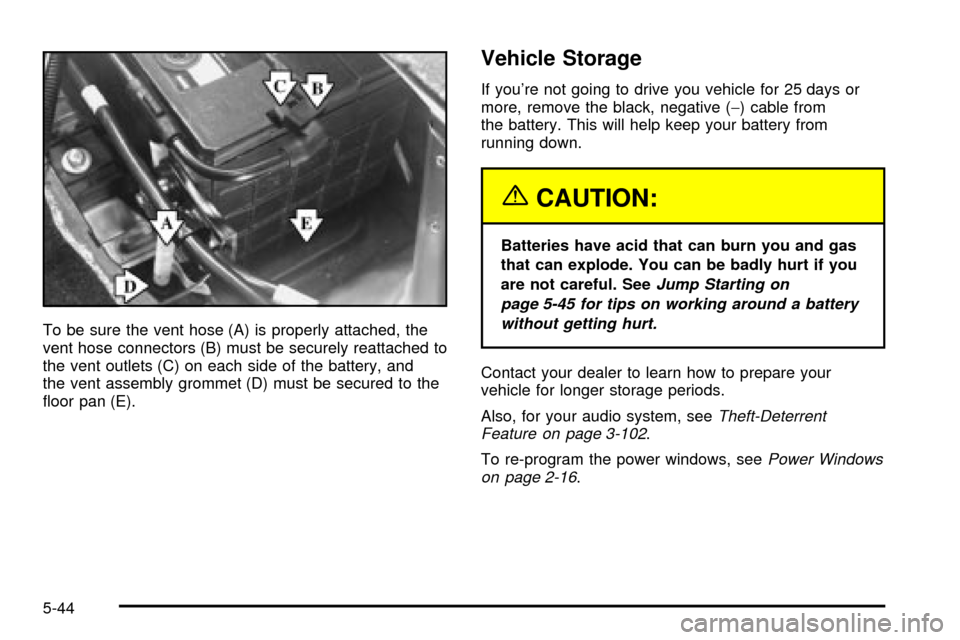
To be sure the vent hose (A) is properly attached, the
vent hose connectors (B) must be securely reattached to
the vent outlets (C) on each side of the battery, and
the vent assembly grommet (D) must be secured to the
¯oor pan (E).
Vehicle Storage
If you're not going to drive you vehicle for 25 days or
more, remove the black, negative (-) cable from
the battery. This will help keep your battery from
running down.
{CAUTION:
Batteries have acid that can burn you and gas
that can explode. You can be badly hurt if you
are not careful. See
Jump Starting on
page 5-45 for tips on working around a battery
without getting hurt.
Contact your dealer to learn how to prepare your
vehicle for longer storage periods.
Also, for your audio system, see
Theft-Deterrent
Feature on page 3-102.
To re-program the power windows, see
Power Windows
on page 2-16.
5-44
Page 333 of 408
Notice:If your vehicle has a tire size other than
P235/55R17 size tires, use tire chains only where
legal and only when you must. Use only SAE Class
ªSº type chains that are the proper size for your
tires. Install them on the front tires and tighten them
as tightly as possible with the ends securely
fastened. Drive slowly and follow the chain
manufacturer's instructions. If you can hear the
chains contacting your vehicle, stop and retighten
them. If the contact continues, slow down until
it stops. Driving too fast or spinning the wheels with
chains on will damage your vehicle.
If a Tire Goes Flat
It's unusual for a tire to ªblowoutº while you're driving,
especially if you maintain your tires properly. If air goes
out of a tire, it's much more likely to leak out slowly.
But if you should ever have a ªblowout,º here are a few
tips about what to expect and what to do:
If a front tire fails, the ¯at tire will create a drag that
pulls the vehicle toward that side. Take your foot off the
accelerator pedal and grip the steering wheel ®rmly.
Steer to maintain lane position, and then gently brake to
a stop well out of the traffic lane.A rear blowout, particularly on a curve, acts much like a
skid and may require the same correction you'd use
in a skid. In any rear blowout, remove your foot from the
accelerator pedal. Get the vehicle under control by
steering the way you want the vehicle to go. It may be
very bumpy and noisy, but you can still steer. Gently
brake to a stop, well off the road if possible.
{CAUTION:
Lifting a vehicle and getting under it to do
maintenance or repairs is dangerous without
the appropriate safety equipment and training.
The jack provided with your vehicle is
designed only for changing a ¯at tire. If it is
used for anything else, you or others could be
badly injured or killed if the vehicle slips off
the jack. Use the jack provided with your
vehicle only for changing a ¯at tire.
If a tire goes ¯at, the next part shows how to use your
jacking equipment to change a ¯at tire safely.
5-73
Page 357 of 408
CAUTION: (Continued)
belt hasn't been routed through the seat
cushion at all, it won't be there to work for the
next passenger. The person sitting in that
position could be badly injured. After
reinstalling the seat cushion, always check to
be sure that the safety belts are properly
routed and are not twisted.
1. Buckle the center passenger position safety belt,
then route the safety belts through the proper slots
in the seat cushion. Don't let the safety belts get
twisted.
2. Slide the rear of the cushion up and under the
seatback so the rear-locating guides hook into
the wire loops on the back frame.
3. With the seat cushion lowered, push rearward and
then press down on the seat cushion until the
spring locks on both ends engage.
4. Check to make sure the safety belts are properly
routed and that no portion of any safety belt is
trapped under the seat. Also make sure the seat
cushion is secured.
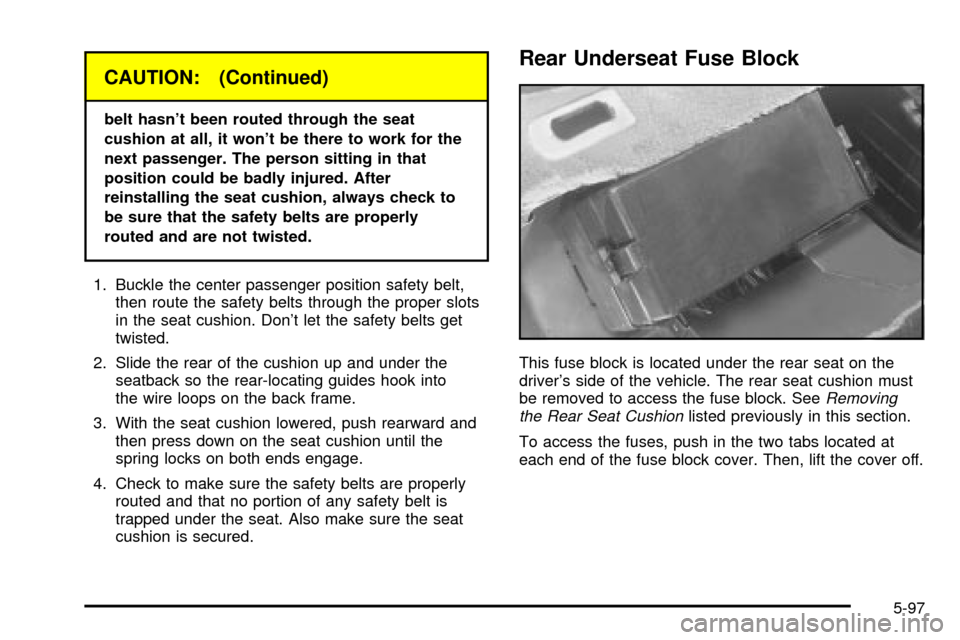
Rear Underseat Fuse Block
This fuse block is located under the rear seat on the
driver's side of the vehicle. The rear seat cushion must
be removed to access the fuse block. See
Removing
the Rear Seat Cushionlisted previously in this section.
To access the fuses, push in the two tabs located at
each end of the fuse block cover. Then, lift the cover off.
5-97
Page 395 of 408

Charging System Light....................................3-43
Checking Coolant............................................5-27
Checking Engine Oil........................................5-14
Checking Things Under the Hood......................5-10
Checking Your Restraint Systems......................1-52
Check...........................................................3-47
Engine Light...............................................3-47
Chemical Paint Spotting...................................5-89
Child Restraints..............................................1-30
Child Restraint Systems...............................1-30
Infants and Young Children...........................1-26
Lower Anchorages and Top Tethers for
Children (LATCH System)..........................1-36
Older Children.............................................1-24
Securing a Child Restraint Designed for
the LATCH System...................................1-38
Securing a Child Restraint in a Rear
Seat Position...........................................1-38
Securing a Child Restraint in the Right
Front Seat Position...................................1-41
Top Strap Anchor Location............................1-35
Top Strap...................................................1-33
Where to Put the Restraint...........................1-33
Cigarette Lighter.............................................3-27
Cleaning Aluminum or Chrome-Plated Wheels.....5-88
Cleaning Exterior Lamps/Lenses.......................5-87
Cleaning Fabric/Carpet....................................5-84
Cleaning Glass Surfaces..................................5-85
Cleaning Interior Plastic Components.................5-85
Cleaning Leather............................................5-85Cleaning the Mirror.................................2-37, 2-40
Cleaning the Speaker Covers...........................5-85
Cleaning the Top of the Instrument Panel...........5-85
Cleaning Tires................................................5-88
Cleaning Vinyl................................................5-84
Cleaning Windshield and Wiper Blades..............5-87
Cleaning Wood Panels....................................5-85
Cleaning........................................................5-84
Inside of Your Vehicle..................................5-84
Outside of Your Vehicle................................5-86
Underbody Maintenance...............................5-89
Weatherstrips..............................................5-86
Climate Control System...................................3-35
Air Filter, Passenger Compartment.................3-35
Climate Controls Personalization....................3-36
Dual..........................................................3-28
Outlet Adjustment........................................3-33
Rear..........................................................3-34
Steering Wheel Controls...............................3-35
Comfort Controls, DIC Personalization................3-63
Compact Disc Changer Errors.........................3-101
Compact Disc Messages..........................3-86, 3-98
Compact Spare Tire........................................5-83
Compass Calibration.......................................2-38
Compass Operation.........................................2-38
Compass Variance..........................................2-39
Control of a Vehicle.......................................... 4-6
Convenience Net............................................2-49
Coolant.........................................................3-46
Engine Temperature Gage............................3-46
3