Page 268 of 408
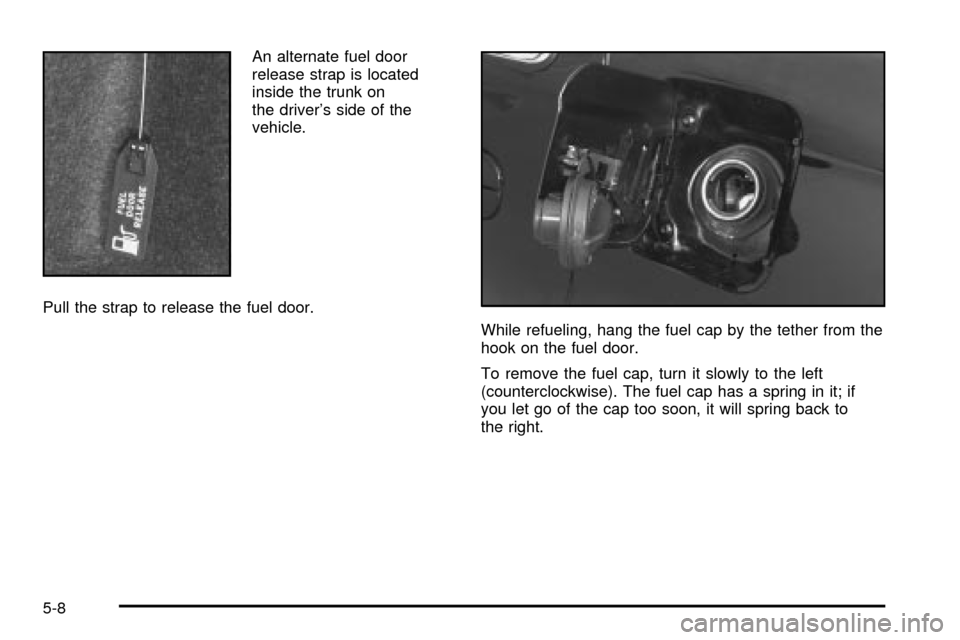
An alternate fuel door
release strap is located
inside the trunk on
the driver's side of the
vehicle.
Pull the strap to release the fuel door.
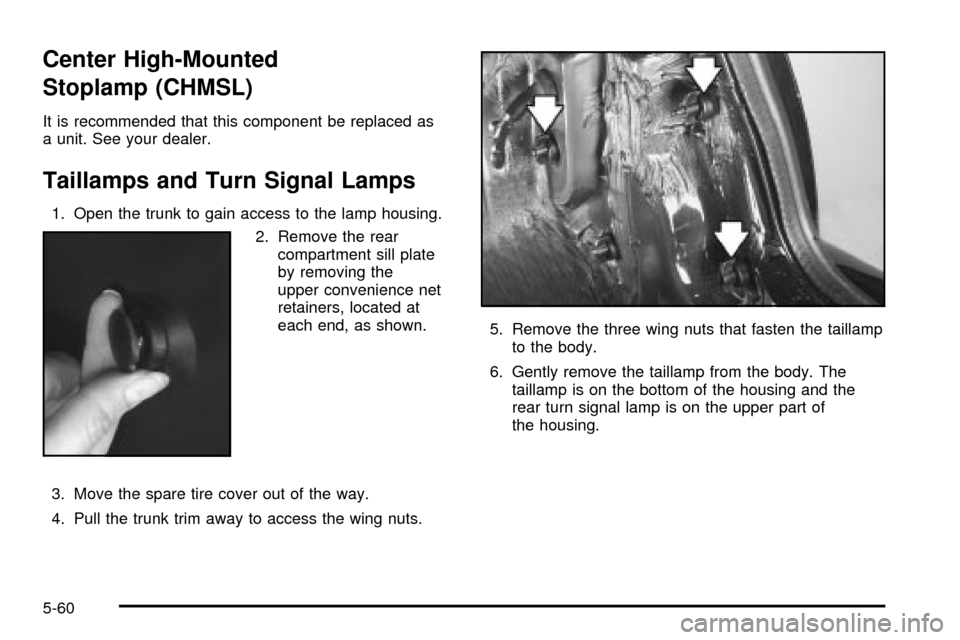
While refueling, hang the fuel cap by the tether from the
hook on the fuel door.
To remove the fuel cap, turn it slowly to the left
(counterclockwise). The fuel cap has a spring in it; if
you let go of the cap too soon, it will spring back to
the right.
5-8
Page 270 of 408
Filling a Portable Fuel Container
{CAUTION:
Never ®ll a portable fuel container while it is in
your vehicle. Static electricity discharge from
the container can ignite the gasoline vapor.
You can be badly burned and your vehicle
damaged if this occurs. To help avoid injury to
you and others:
·Dispense gasoline only into approved
containers.
·Do not ®ll a container while it is inside a
vehicle, in a vehicle's trunk, pickup bed or
on any surface other than the ground.
·Bring the ®ll nozzle in contact with the
inside of the ®ll opening before operating
the nozzle. Contact should be maintained
until the ®lling is complete.
·Do not smoke while pumping gasoline.
Checking Things Under
the Hood
{CAUTION:
An electric fan under the hood can start up
and injure you even when the engine is not
running. Keep hands, clothing and tools away
from any underhood electric fan.
{CAUTION:
Things that burn can get on hot engine parts
and start a ®re. These include liquids like fuel,
oil, coolant, brake ¯uid, windshield washer and
other ¯uids, and plastic or rubber. You or
others could be burned. Be careful not to drop
or spill things that will burn onto a hot engine.
5-10
Page 320 of 408
Center High-Mounted
Stoplamp (CHMSL)
It is recommended that this component be replaced as
a unit. See your dealer.
Taillamps and Turn Signal Lamps
1. Open the trunk to gain access to the lamp housing.
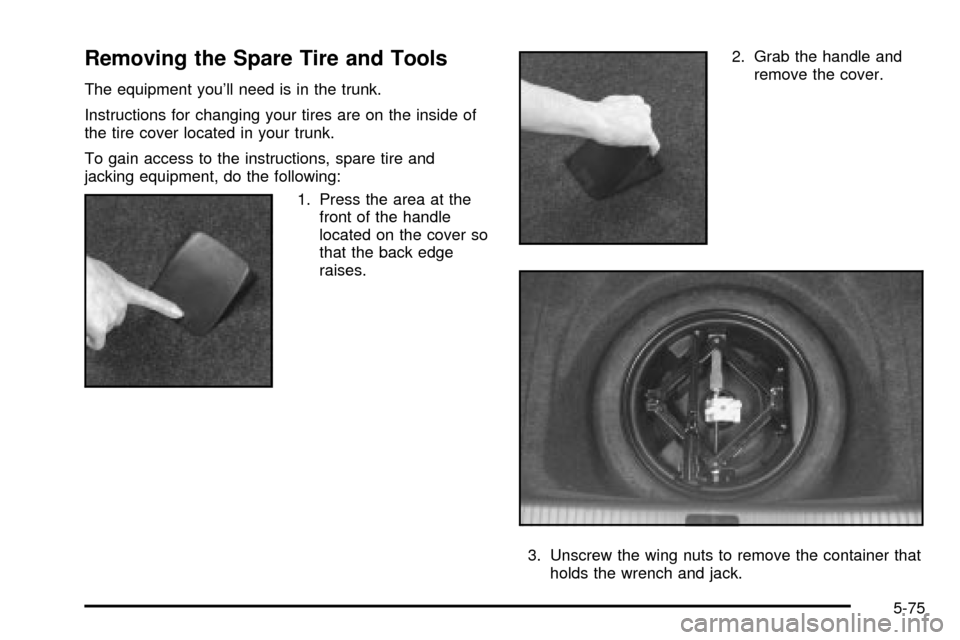
2. Remove the rear
compartment sill plate
by removing the
upper convenience net
retainers, located at
each end, as shown.
3. Move the spare tire cover out of the way.
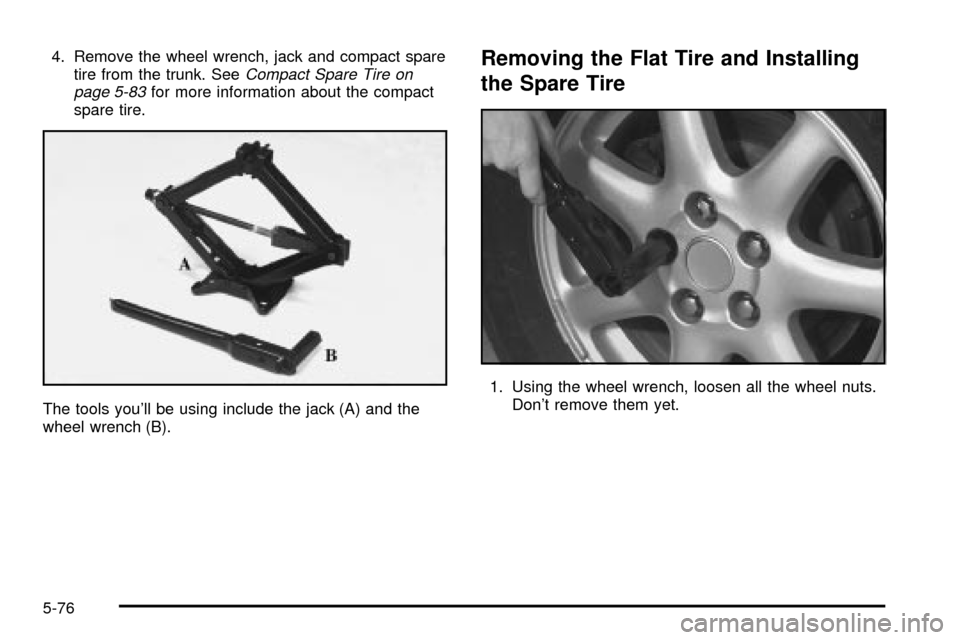
4. Pull the trunk trim away to access the wing nuts.5. Remove the three wing nuts that fasten the taillamp
to the body.
6. Gently remove the taillamp from the body. The
taillamp is on the bottom of the housing and the
rear turn signal lamp is on the upper part of
the housing.
5-60
Page 325 of 408

When to Check
Check your tires once a month or more.
Don't forget your compact spare tire. It should be at
60 psi (420 kPa).
How to Check
Use a good quality pocket-type gage to check tire
pressure. You can't tell if your tires are properly in¯ated
simply by looking at them. Radial tires may look
properly in¯ated even when they're underin¯ated.
Be sure to put the valve caps back on the valve stems.
They help prevent leaks by keeping out dirt and
moisture.
Tire Pressure Monitor System
Your vehicle may have a Tire Pressure Monitor System
(TPM). The TPM system uses radio and sensor
technology to check tire pressure levels. Sensors,
mounted on each road wheel, transmit tire pressure
readings to a receiver located in the trunk. Tire pressure
status and tire pressure warnings are shown on the
Driver Information Center (DIC) display. See
Driver
Information Center (DIC) on page 3-53, for details
regarding DIC controls and displays.The system operates on a radio frequency subject to
Federal Communications Commission (FCC) Rules and
with Industry and Science Canada.
This device complies with Part 15 of the FCC Rules.
Operation is subject to the following two conditions:
(1) this device may not cause harmful interference, and
(2) this device must accept any interference received,
including interference that may cause undesired
operation.
This device complies with RSS-210 of Industry and
Science Canada. Operation is subject to the following
two conditions: (1) this device may not cause
interference, and (2) this device must accept any
interference received, including interference that may
cause undesired operation of the device.
Changes or modi®cations to this system by anyone
other than an authorized service facility could void
authorization to use this equipment.
5-65
Page 335 of 408
Removing the Spare Tire and Tools
The equipment you'll need is in the trunk.
Instructions for changing your tires are on the inside of
the tire cover located in your trunk.
To gain access to the instructions, spare tire and
jacking equipment, do the following:
1. Press the area at the
front of the handle
located on the cover so
that the back edge
raises.2. Grab the handle and
remove the cover.
3. Unscrew the wing nuts to remove the container that
holds the wrench and jack.
5-75
Page 336 of 408
4. Remove the wheel wrench, jack and compact spare
tire from the trunk. SeeCompact Spare Tire on
page 5-83for more information about the compact
spare tire.
The tools you'll be using include the jack (A) and the
wheel wrench (B).
Removing the Flat Tire and Installing
the Spare Tire
1. Using the wheel wrench, loosen all the wheel nuts.
Don't remove them yet.
5-76
Page 341 of 408
CAUTION: (Continued)
Stop somewhere as soon as you can and have
the nuts tightened with a torque wrench to the
proper torque speci®cation. See ªCapacities
and Speci®cationsº in the Index for wheel nut
torque speci®cation.
Notice:Improperly tightened wheel nuts can lead
to brake pulsation and rotor damage. To avoid
expensive brake repairs, evenly tighten the wheel
nuts in the proper sequence and to the proper
torque speci®cation. See ªCapacities and
Speci®cationsº in the index for the wheel nut torque
speci®cation.
Don't try to put a wheel cover on your compact spare
tire. It won't ®t. Store the wheel cover and lug nut caps in
the trunk until you have the ¯at tire repaired or
replaced.
Notice:Wheel covers won't ®t on your compact
spare. If you try to put a wheel cover on your
compact spare, you could damage the cover or
the spare.
Storing the Flat Tire and Tools
{CAUTION:
Storing a jack, a tire, or other equipment in the
passenger compartment of the vehicle could
cause injury. In a sudden stop or collision,
loose equipment could strike someone. Store
all these in the proper place.
After you've put the compact spare tire on your vehicle,
you'll need to store the ¯at tire in your trunk.
Store the ¯at tire as far forward in the trunk as possible.
Store the jack and wheel wrench in their compartment
in the trunk. For storage, the jack must be raised
until the screw end is ¯ush with the edge of the jack.
5-81
Page 342 of 408
Storing the Spare Tire and Tools
{CAUTION:
Storing a jack, a tire, or other equipment in the
passenger compartment of the vehicle could
cause injury. In a sudden stop or collision,
loose equipment could strike someone. Store
all these in the proper place.
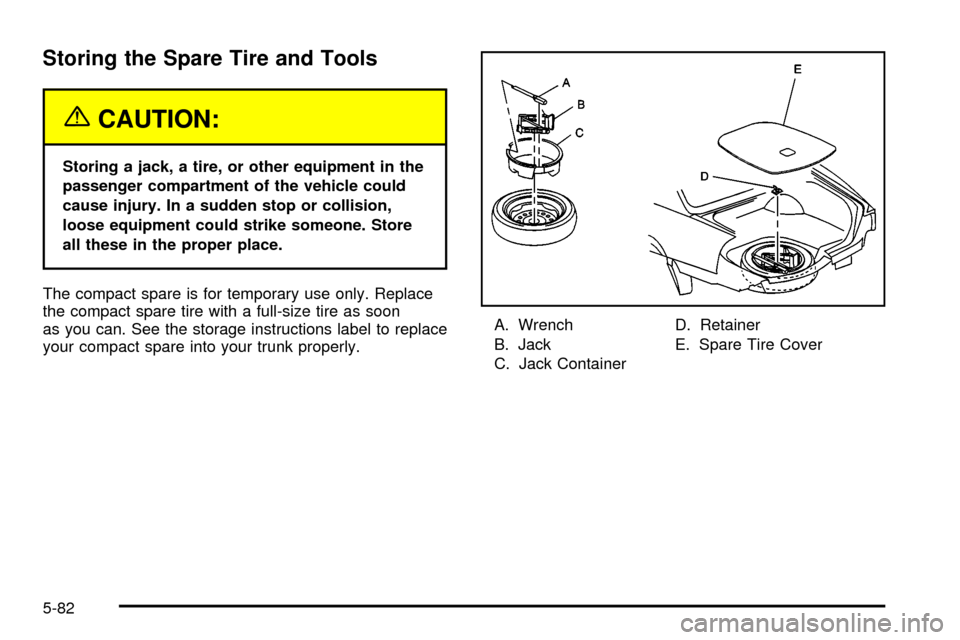
The compact spare is for temporary use only. Replace
the compact spare tire with a full-size tire as soon
as you can. See the storage instructions label to replace
your compact spare into your trunk properly.A. Wrench
B. Jack
C. Jack ContainerD. Retainer
E. Spare Tire Cover
5-82