Page 222 of 435
3-
3-1
Section 3 Comfort Controls and Audio Systems
In this section, you'll find out how to operate the comfort control and audio systems offered with your vehicle.
Be sure to read about the particular systems supplied with your vehicle.
3
-2 Comfort Controls
3
-2 Climate Control System
3
-6 Air Conditioning
3
-6 Defogging and Defrosting
3
-6 Rear Window Defogger
3
-7 Ventilation System
3
-9 Climate Control Steering Wheel Controls
3
-9 Audio Systems
3
-10 Setting the Clock
3
-10 AM-FM Radio with Cassette Tape and
Compact Disc Player with Radio Data
Systems (RDS) and Digital Signal
Processing (DSP)3
-27 Navigation/Radio System (Option)
3
-27 Theft-Deterrent Feature
3
-28 Audio Steering Wheel Controls
3
-29 Understanding Radio Reception
3
-30 Tips About Your Audio System
3
-31 Care of Your Cassette Tape Player
3
-32 Care of Your Compact Discs
3
-32 Care of Your Compact Disc Player
3
-33 Diversity Antenna System
Page 226 of 435

3-5
Interior Temperature Sensor
This sensor
monitors the interior
temperature of the
vehicle. It is located to
the right of the
steering wheel on the
instrument panel.
While the climate control system is in AUTO, the
system uses both the interior temperature sensor and the
electronic solar sensor to automatically adjust the
temperature and airflow in the vehicle. See ªElectronic
Solar Sensorº following for more information. Be sure
not to cover the sensor with anything. If you do, the
automatic climate control system will not work properly.Electronic Solar Sensor
This sensor monitors the sun's solar radiation. It is located
on top of the instrument panel near the windshield.
While the climate control system is in AUTO, the system
uses the information collected by the electronic solar
sensor to automatically adjust the temperature and airflow
to maintain your comfort. The climate control system may
supply cooler air to one side of your vehicle, if that side is
facing the sun. Be sure not to cover the sensor on top of
the instrument panel. If you do, the automatic climate
control system will not work properly.
Page 230 of 435
3-9 Climate Control Steering Wheel Controls
There are four controls that can be programmed for use
with the climate control system.
The controls are located
on the left spoke of the
steering wheel.
See ªReconfigurable Steering Wheel Controlsº in
the Index for more information on programming
these controls.
Audio Systems
Your audio system has been designed to operate easily
and to give years of listening pleasure. You will get the
most enjoyment out of it if you acquaint yourself with it
first. Find out what your audio system can do and how
to operate all of its controls to be sure you're getting the
most out of the advanced engineering that went into it.
Your vehicle has a feature called Retained Accessory
Power (RAP). With RAP, you can play your audio
system even after the ignition is turned off. See
ªRetained Accessory Powerº in the Index.
Page 249 of 435
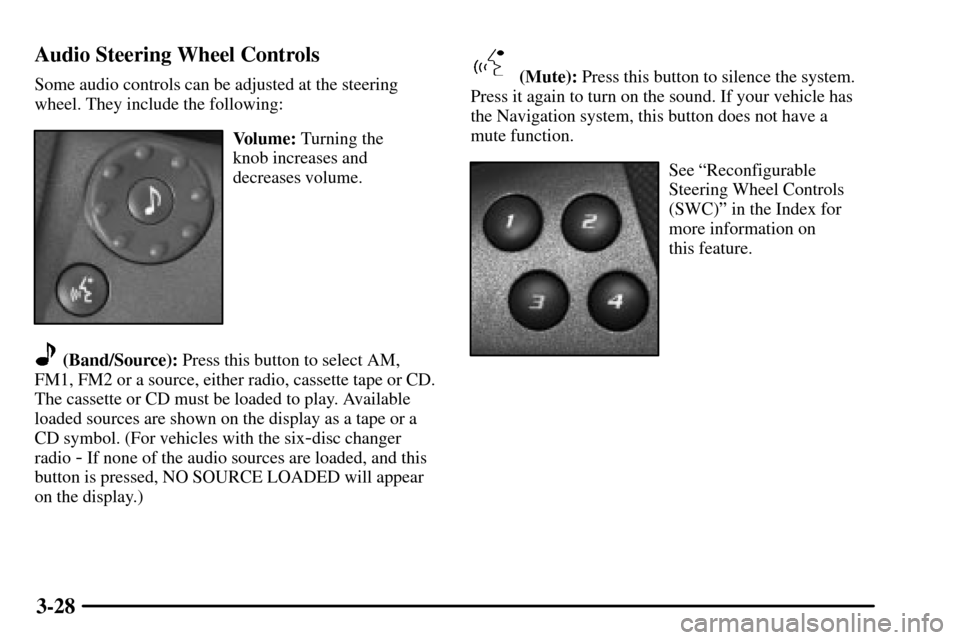
3-28 Audio Steering Wheel Controls
Some audio controls can be adjusted at the steering
wheel. They include the following:
Volume: Turning the
knob increases and
decreases volume.
(Band/Source): Press this button to select AM,
FM1, FM2 or a source, either radio, cassette tape or CD.
The cassette or CD must be loaded to play. Available
loaded sources are shown on the display as a tape or a
CD symbol. (For vehicles with the six
-disc changer
radio
- If none of the audio sources are loaded, and this
button is pressed, NO SOURCE LOADED will appear
on the display.)
(Mute): Press this button to silence the system.
Press it again to turn on the sound. If your vehicle has
the Navigation system, this button does not have a
mute function.
See ªReconfigurable
Steering Wheel Controls
(SWC)º in the Index for
more information on
this feature.
Page 255 of 435
4-
4-1
Section 4 Your Driving and the Road
Here you'll find information about driving on different kinds of roads and in varying weather conditions. We've also
included many other useful tips on driving.
4
-2 Defensive Driving
4
-3 Drunken Driving
4
-6 Control of a Vehicle
4
-6 Braking
4
-9 Traction Control System
4
-10 Stabilitrak� - Vehicle Stability Enhancement
System (If Equipped)
4
-11 Steering
4
-13 Off-Road Recovery
4
-14 Passing
4
-15 Loss of Control4
-16 Driving at Night
4
-18 Driving in Rain and on Wet Roads
4
-21 City Driving
4
-22 Freeway Driving
4
-23 Before Leaving on a Long Trip
4
-24 Highway Hypnosis
4
-24 Hill and Mountain Roads
4
-26 Winter Driving
4
-30 Recreational Vehicle Towing
4
-32 Loading Your Vehicle
4
-34 Towing a Trailer
Page 260 of 435

4-6
Control of a Vehicle
You have three systems that make your vehicle go where
you want it to go. They are the brakes, the steering and
the accelerator. All three systems have to do their work
at the places where the tires meet the road.
Sometimes, as when you're driving on snow or ice, it's
easy to ask more of those control systems than the tires
and road can provide. That means you can lose control
of your vehicle. Also see ªTraction Control Systemº in
the Index.
Braking
Braking action involves perception time and
reaction time.
First, you have to decide to push on the brake pedal.
That's perception time. Then you have to bring up your
foot and do it. That's reaction time.
Average reaction time is about 3/4 of a second. But
that's only an average. It might be less with one driver
and as long as two or three seconds or more with
another. Age, physical condition, alertness, coordination
and eyesight all play a part. So do alcohol, drugs and
frustration. But even in 3/4 of a second, a vehicle
moving at 60 mph (100 km/h) travels 66 feet (20 m).
That could be a lot of distance in an emergency, so
keeping enough space between your vehicle and others
is important.
And, of course, actual stopping distances vary greatly
with the surface of the road (whether it's pavement or
gravel); the condition of the road (wet, dry, icy); tire
tread; the condition of your brakes; the weight of the
vehicle and the amount of brake force applied.
Page 263 of 435

4-9
Remember: Anti-lock doesn't change the time you need
to get your foot up to the brake pedal or always decrease
stopping distance. If you get too close to the vehicle in
front of you, you won't have time to apply your brakes
if that vehicle suddenly slows or stops. Always leave
enough room up ahead to stop, even though you have
anti
-lock brakes.
Using Anti
-Lock
Don't pump the brakes. Just hold the brake pedal down
firmly and let anti
-lock work for you. You may hear the
anti
-lock pump or motor operate, and feel the brake
pedal pulsate, but this is normal.
Braking in Emergencies
With anti-lock, you can steer and brake at the same
time. In many emergencies, steering can help you more
than even the very best braking.
Traction Control System
Your vehicle has a traction control system that limits
wheel spin. This is especially useful in slippery road
conditions. The system operates only if it senses that one
or both of the rear wheels are spinning or beginning to
lose traction. When this happens, the system brakes the
spinning wheel(s) and/or reduces engine power to limit
wheel spin.You may feel or hear the system working, but this
is normal.
This warning light will
come on to let you know if
there's a problem with your
traction control system.
See ªTraction Control System Warning Lightº in the
Index. When this warning light is on, the system will not
limit wheel spin. Adjust your driving accordingly.
When the system is limiting wheel spin, the Traction
Control System warning light will be blinking.
The traction control system automatically comes on
whenever you start your vehicle. To limit wheel spin,
especially in slippery road conditions, you should
always leave the system on. But you can turn the
traction control system off if you ever need to. You
should turn the system off if your vehicle ever gets stuck
in sand, mud or snow and rocking the vehicle is
required. See ªRocking Your Vehicleº in the Index.
Page 264 of 435

4-10
To turn the system off, press
the TC (traction control)
button located in the
glove box.
If you press the TC button once, the traction control
system will turn off and the traction control system
warning light will come on. Press the TC button again
to turn the system back on. If you press and hold the
TC button for five seconds, the Stabilitrak system will
turn off. Press the TC button again to turn Stabilitrak
back on.
Stabilitrak� - Vehicle Stability
Enhancement System (If Equipped)
Your vehicle may be equipped with a vehicle stability
enhancement system called Stabilitrak. Stabilitrak is an
advanced computer controlled system that assists you
with directional control of the vehicle in difficult driving
conditions.Stabilitrak has sensors that detect the direction your
vehicle is going and compares it to the direction that you
are steering the vehicle. Stabilitrak activates when the
computer senses a discrepancy between your intended
path and the direction the vehicle is actually traveling.
To assist you in returning your vehicle to the intended
path, Stabilitrak selectively applies braking pressure at
any one of the vehicle's brakes to help steer the vehicle
in the direction which you are steering.
When the system activates, a STABILITY SYS
ENGAGED message will be displayed on the Driver
Information Center. See ªDriver Information Center
Messagesº in the Index. You may also hear a noise or feel
vibration in the brake pedal. This is normal. Continue to
steer the vehicle in the direction you want it to go.
If there is a problem detected with Stabilitrak, a
SERVICE STABILITY SYS message will be displayed
on the Driver Information Center. See ªDriver
Information Center Messagesº in the Index. When this
message is displayed, the system is not operational.
Driving should be adjusted accordingly.
Stability comes on automatically whenever you start
your vehicle. To help assist you with directional control
of the vehicle, you should always leave the system on.
You can turn Stabilitrak OFF if you ever need to trough
the Traction On/Off button. See ªTraction Control
Systemº in the Index.