Page 138 of 344
Security Light
The SECURITY light will
come on when you turn
the key to START and stay
on until the vehicle
starts.
It will alsoflash if your ignition key is too dirty or wet for
the PASS-Key
®II system to read the resistor pellet.
SeePASS-Key®II on page 2-16.
If the resistor pellet is damaged or missing, the light will
come on.
Cruise Control Light
The CRUISE light comes
on whenever you set the
cruise control, if equipped.
See“Cruise Control”
underTurn
Signal/Multifunction Lever
on page 3-5.
Low Washer Fluid Warning Light
The LOW WASH light will
come on when your
windshield washers are
working and thefluid
container is low.
The light will also come on briefly when your ignition is
turned on to show that it is working properly.
Door/Trunk Ajar Warning Light
The DOOR/TRUNK light
will come on if your trunk
or any door is not
completely closed.
3-40
2003 - Regal OM
Page 184 of 344
Winter Driving
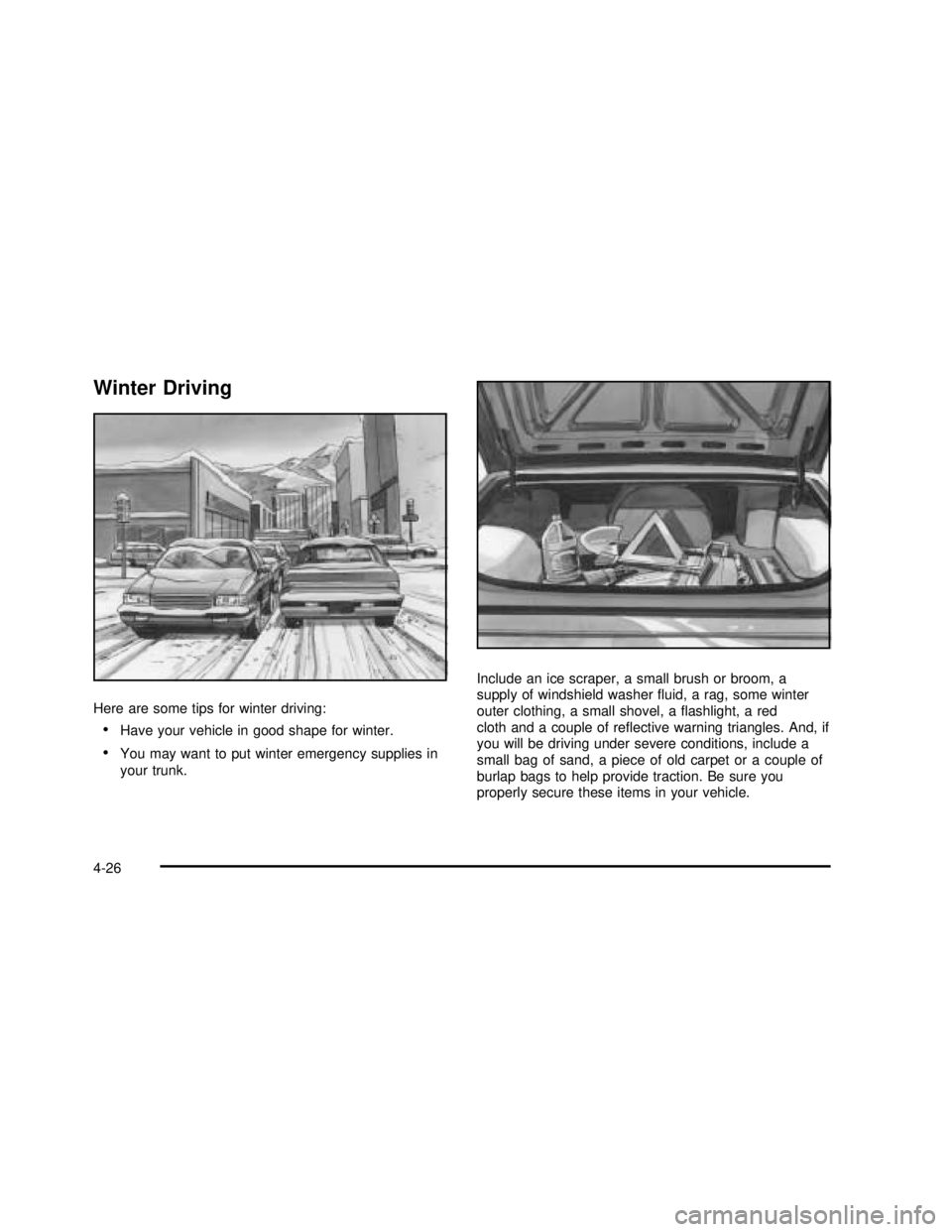
Here are some tips for winter driving:
Have your vehicle in good shape for winter.
You may want to put winter emergency supplies in
your trunk.Include an ice scraper, a small brush or broom, a
supply of windshield washeruid, a rag, some winter
outer clothing, a small shovel, aashlight, a red
cloth and a couple of reective warning triangles. And, if
you will be driving under severe conditions, include a
small bag of sand, a piece of old carpet or a couple of
burlap bags to help provide traction. Be sure you
properly secure these items in your vehicle.
4-26
2003 - Regal OM
Page 191 of 344
Loading Your Vehicle
Two labels on your vehicle show how much weight it
may properly carry. The Tire-Loading Information label is
inside the trunk lid. The label tells you the proper
size, speed rating and recommended ination pressures
for the tires on your vehicle. It also gives you important
information about the number of people that can be
in your vehicle and the total weight you can carry. This
weight is called the vehicle capacity weight and
includes the weight of all occupants, cargo and all
nonfactory-installed options.The other label is the Certication label, found on the
rear edge of the driver’s door. It tells you the gross
weight capacity of your vehicle, called the Gross Vehicle
Weight Rating (GVWR). The GVWR includes the
weight of the vehicle, all occupants, fuel and cargo.
Never exceed the GVWR for your vehicle or the Gross
Axle Weight Rating (GAWR) for either the front or
rear axle.
4-33
2003 - Regal OM
Page 192 of 344
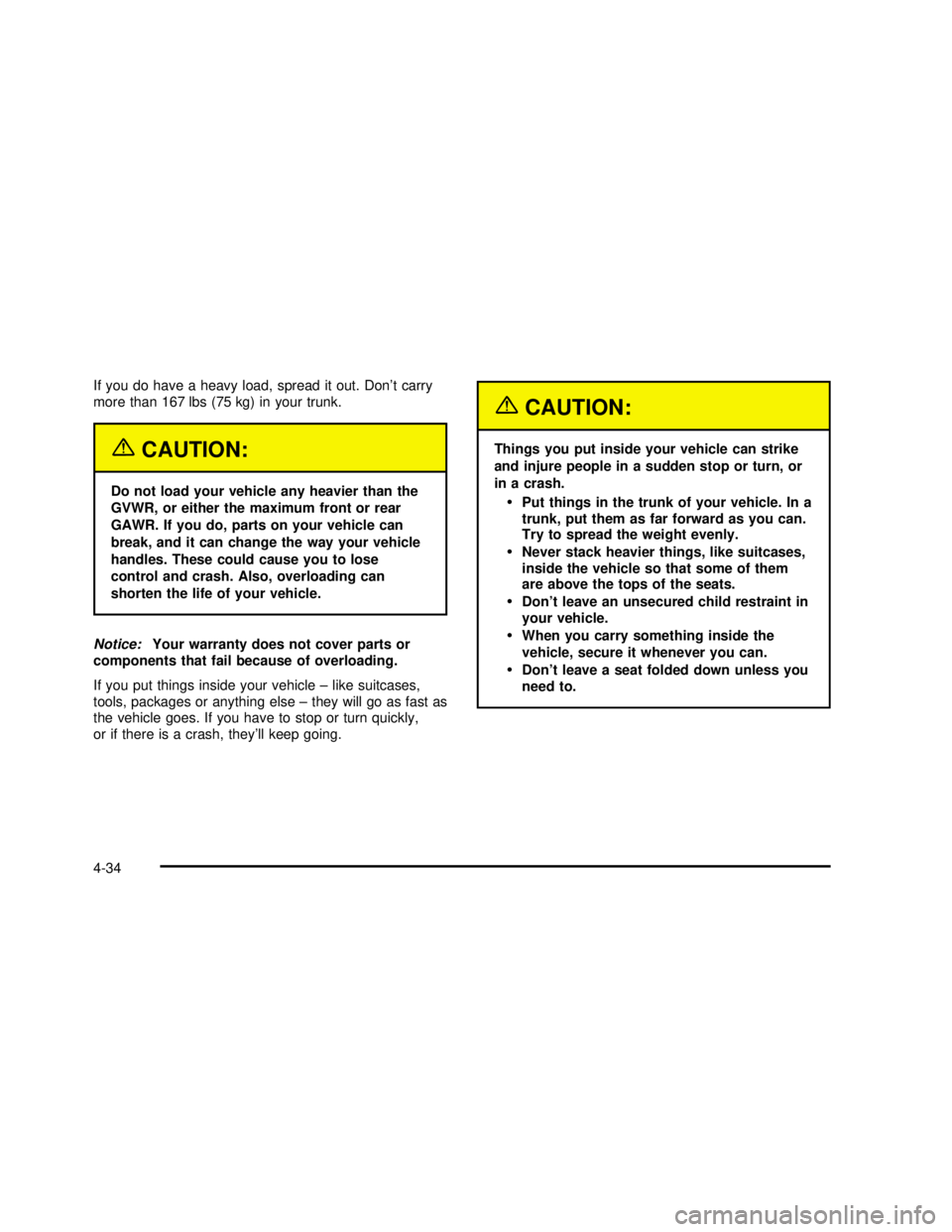
If you do have a heavy load, spread it out. Don’t carry
more than 167 lbs (75 kg) in your trunk.
{CAUTION:
Do not load your vehicle any heavier than the
GVWR, or either the maximum front or rear
GAWR. If you do, parts on your vehicle can
break, and it can change the way your vehicle
handles. These could cause you to lose
control and crash. Also, overloading can
shorten the life of your vehicle.
Notice:Your warranty does not cover parts or
components that fail because of overloading.
If you put things inside your vehicle–like suitcases,
tools, packages or anything else–they will go as fast as
the vehicle goes. If you have to stop or turn quickly,
or if there is a crash, they’ll keep going.
{CAUTION:
Things you put inside your vehicle can strike
and injure people in a sudden stop or turn, or
in a crash.
•Put things in the trunk of your vehicle. In a
trunk, put them as far forward as you can.
Try to spread the weight evenly.
•Never stack heavier things, like suitcases,
inside the vehicle so that some of them
are above the tops of the seats.
•Don’t leave an unsecured child restraint in
your vehicle.
•When you carry something inside the
vehicle, secure it whenever you can.
•Don’t leave a seat folded down unless you
need to.
4-34
2003 - Regal OM
Page 195 of 344

Weight of the Trailer Tongue
The tongue load (A) of any trailer is an important weight
to measure because it affects the total or gross weight
of your vehicle. The Gross Vehicle Weight (GVW)
includes the curb weight of the vehicle, any cargo you
may carry in it, and the people who will be riding in
the vehicle. And if you tow a trailer, you must add the
tongue load to the GVW because your vehicle will
be carrying that weight, too. SeeLoading Your Vehicle
on page 4-33for more information about your
vehicle’s maximum load capacity.If you’re using a weight-carrying hitch or a
weight-distributing hitch, the trailer tongue (A) should
weigh 10–15 percent of the total loaded trailer
weight (B).
After you’ve loaded your trailer, weigh the trailer and
then the tongue, separately, to see if the weights
are proper. If they aren’t, you may be able to get them
right simply by moving some items around in the
trailer.
Total Weight on Your Vehicle’s Tires
Be sure your vehicle’s tires are inated to the upper limit
for cold tires. You’llnd these numbers on the
Tire-Loading Information label (found inside the trunk
lid) or seeLoading Your Vehicle on page 4-33. Then be
sure you don’t go over the GVW limit for your vehicle,
including the weight of the trailer tongue.
4-37
2003 - Regal OM
Page 208 of 344

This would allow fuel to evaporate into the atmosphere.
SeeMalfunction Indicator Lamp on page 3-35.
Notice:If you need a new fuel cap, be sure to get
the right type. Your dealer can get one for you. If you
get the wrong type, it may nott properly. This may
cause your malfunction indicator lamp to light and
may damage your fuel tank and emissions system.
See“Malfunction Indicator Lamp”in the Index.
Filling a Portable Fuel Container
{CAUTION:
Neverll a portable fuel container while it is in
your vehicle. Static electricity discharge from
the container can ignite the gasoline vapor.
You can be badly burned and your vehicle
damaged if this occurs. To help avoid injury to
you and others:
Dispense gasoline only into approved
containers.
CAUTION: (Continued)
CAUTION: (Continued)
Do notll a container while it is inside a
vehicle, in a vehicle’s trunk, pickup bed or
on any surface other than the ground.
Bring thell nozzle in contact with the
inside of thell opening before operating
the nozzle. Contact should be maintained
until thelling is complete.
Don’t smoke while pumping gasoline.
Checking Things Under the
Hood
{CAUTION:
An electric fan under the hood can start up
and injure you even when the engine is not
running. Keep hands, clothing and tools away
from any underhood electric fan.
5-8
2003 - Regal OM
Page 252 of 344
Front Turn Signal and Parking
Lamps
1. Remove the headlamp assembly. Refer to the
removal procedure earlier in this section.
2. Remove the rubber bulb access cover.
3. Twist the sidemarker lamp socket, located on the
outboard side of the headlamp assembly,
counterclockwise and pull it from the headlamp
assembly.
4. Holding the base of the socket, pull the old bulb
from the socket.
5. Push the new bulb into the socket.
6. Reverse Steps 1 through 3 to reinstall the lamp
assembly.
Center High-Mounted
Stoplamp (CHMSL)
1. Open the trunk.
2. Reach through the access opening in the trunk lid.
5-52
2003 - Regal OM
Page 253 of 344
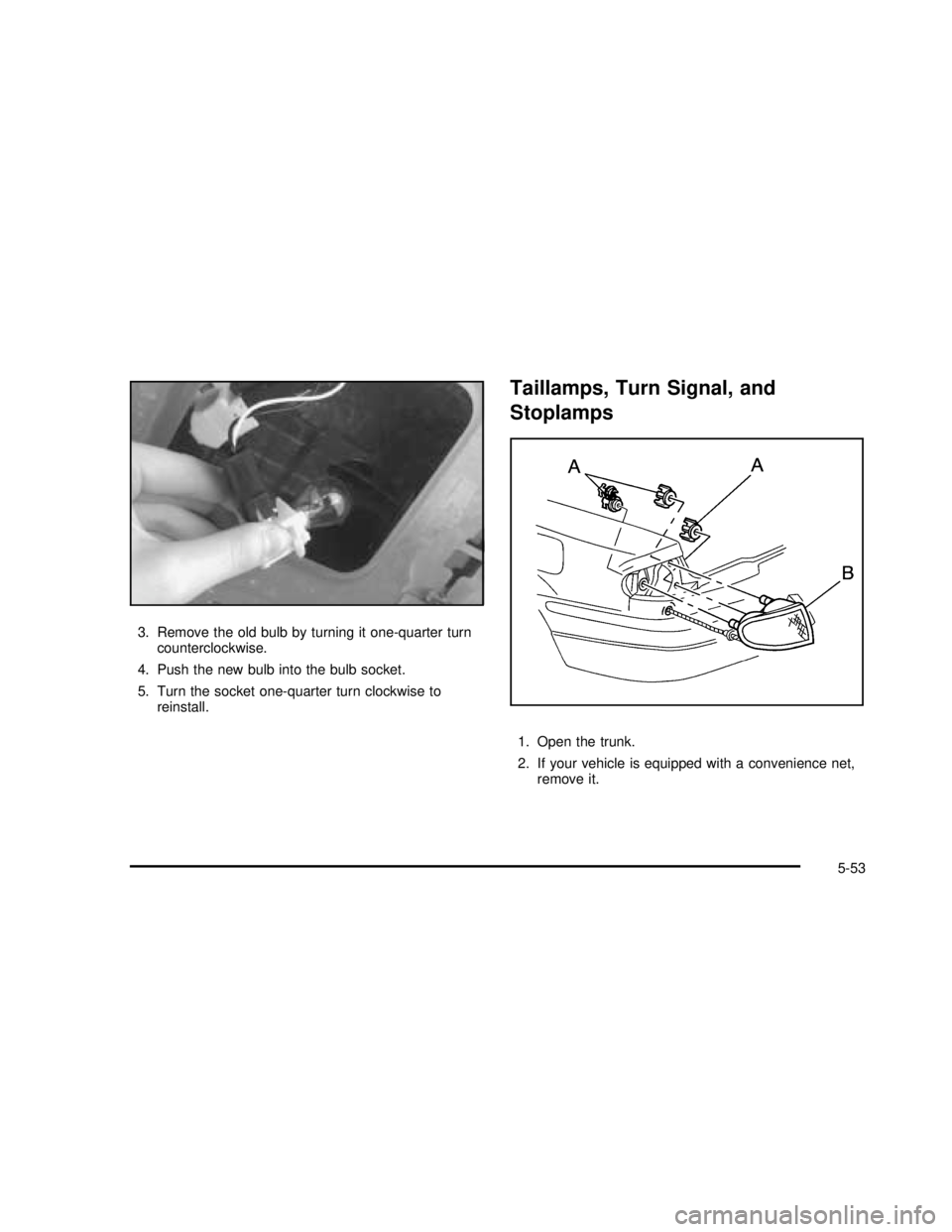
3. Remove the old bulb by turning it one-quarter turn
counterclockwise.
4. Push the new bulb into the bulb socket.
5. Turn the socket one-quarter turn clockwise to
reinstall.
Taillamps, Turn Signal, and
Stoplamps
1. Open the trunk.
2. If your vehicle is equipped with a convenience net,
remove it.
5-53
2003 - Regal OM