Page 305 of 432

Automatic Transaxle Fluid
When to Check and Change
A good time to check your automatic transaxlefluid
level is when the engine oil is changed.
Change both thefluid andfilter every 50,000 miles
(83 000 km) if the vehicle is mainly driven under one or
more of these conditions:
•In heavy city traffic where the outside temperature
regularly reaches 90°F (32°C) or higher.
•In hilly or mountainous terrain.
•When doing frequent trailer towing.
•Uses such as found in taxi, police or delivery
service.
If you do not use your vehicle under any of these
conditions, change thefluid andfilter at 100,000 miles
(166 000 km).
SeePart A: Scheduled Maintenance Services on
page 6-4.
How to Check
Because this operation can be a little difficult, you may
choose to have this done at the dealership service
department.
If you do it yourself, be sure to follow all the instructions
here, or you could get a false reading on the dipstick.Notice:Too much or too littlefluid can damage
your transaxle. Too much can mean that some of the
fluid could come out and fall on hot engine or
exhaust system parts, starting afire. Too littlefluid
could cause the transaxle to overheat. Be sure
to get an accurate reading if you check your
transaxlefluid.
Wait at least 30 minutes before checking the transaxle
fluid level if you have been driving:
•When outside temperatures are above 90°F (32°C).
•At high speed for quite a while.
•In heavy traffic - especially in hot weather.
To get the right reading, thefluid should be at normal
operating temperature, which is 180°Fto200°F
(82°Cto93°C).
Get the vehicle warmed up by driving about 15 miles
(24 km) when outside temperatures are above 50°F
(10°C).Ifit’s colder than 50°F (10°C), you may have to
drive longer.
Checking the Fluid Level
Prepare your vehicle as follows:
•Park your vehicle on a level place. Keep the engine
running.
•With the parking brake applied, place the shift lever
in PARK (P).
5-17
2003 - Rendezvous OM
Page 307 of 432

Notice:We recommend you use onlyfluid labeled
DEXRON®-III, becausefluid with that label is
made especially for your automatic transmission.
Damage caused byfluid other than DEXRON
®-III is
not covered by your new vehicle warranty.
3. After addingfluid, recheck thefluid level as
described under“How to Check.”
4. When the correctfluid level is obtained, push the
dipstick back in all the way.
Engine Coolant
The cooling system in your vehicle isfilled with
DEX-COOL®engine coolant. This coolant is designed
to remain in your vehicle for 5 years or 150,000 miles
(240 000 km), whichever occursfirst, if you add
only DEX-COOL
®extended life coolant.
The following explains your cooling system and how to
add coolant when it is low. If you have a problem
with engine overheating, seeEngine Overheating on
page 5-22.A 50/50 mixture of clean, drinkable water and
DEX-COOL
®coolant will:
•Give freezing protection down to−34°F(−37°C).
•Give boiling protection up to 265°F (129°C).
•Protect against rust and corrosion.
•Help keep the proper engine temperature.
•Let the warning messages and gages work as they
should.
Notice:When adding coolant, it is important that
you use only DEX-COOL
®(silicate-free) coolant.
If coolant other than DEX-COOL®is added to
the system, premature engine, heater core or
radiator corrosion may result. In addition, the engine
coolant will require change sooner -- at 30,000 miles
(50,000 km) or 24 months, whichever occursfirst.
Damage caused by the use of coolant other
than DEX-COOL
®is not covered by your new vehicle
warranty.
5-19
2003 - Rendezvous OM
Page 308 of 432

What to Use
Use a mixture of one-halfclean, drinkable waterand
one-half DEX-COOL®coolant which won’t damage
aluminum parts. If you use this coolant mixture,
you don’t need to add anything else.
{CAUTION:
Adding only plain water to your cooling
system can be dangerous. Plain water, or
some other liquid such as alcohol, can boil
before the proper coolant mixture will. Your
vehicle’s coolant warning system is set for the
proper coolant mixture. With plain water or the
wrong mixture, your engine could get too hot
but you wouldn’t get the overheat warning.
Your engine could catchfire and you or others
could be burned. Use a 50/50 mixture of clean,
drinkable water and DEX-COOL
®coolant.
Notice:If you use an improper coolant mixture,
your engine could overheat and be badly damaged.
The repair cost wouldn’t be covered by your
warranty. Too much water in the mixture can freeze
and crack the engine, radiator, heater core and
other parts.If you have to add coolant more than four times a year,
have your dealer check your cooling system.
Notice:If you use the proper coolant, you don’t
have to add extra inhibitors or additives which claim
to improve the system. These can be harmful.
Checking Coolant
The engine coolant reservoir is located on the driver’s
side of the vehicle, above the engine air cleaner/filter.
SeeEngine Compartment Overview on page 5-10
for more information on location.
5-20
2003 - Rendezvous OM
Page 310 of 432

Engine Overheating
You willfind an engine coolant temperature gage on
your vehicle’s instrument panel. SeeEngine Coolant
Temperature Gage on page 3-40. You also have
an engine coolant temperature warning message on
your instrument panel. SeeEngine Coolant Temperature
Warning Message on page 3-45.
Overheated Engine Protection
Operating Mode
This emergency operating mode allows your vehicle to
be driven to a safe place in an emergency situation.
If an overheated engine condition exists, an overheat
protection mode which alternatesfiring groups of
cylinders helps prevent engine damage. In this mode,
you will notice a significant loss in power and engine
performance. The temperature gage will indicate
an overheat condition exists. Driving extended miles
(km) and/or towing a trailer in the overheat protection
mode should be avoided.
Notice:After driving in the overheated engine
protection operating mode, to avoid engine damage,
allow the engine to cool before attempting any repair.
The engine oil will be severely degraded. Repair the
cause of coolant loss, change the oil and reset the oil
life system. See“Engine Oil”in the Index.
If Steam Is Coming From Your Engine
{CAUTION:
Steam from an overheated engine can burn you
badly, even if you just open the hood. Stay away
from the engine if you see or hear steam coming
from it. Just turn it off and get everyone away
CAUTION: (Continued)
5-22
2003 - Rendezvous OM
Page 312 of 432
If there’s still no sign of steam, idle the engine for three
minutes while you’re parked. If you still have the
warning,turn off the engine and get everyone out of the
vehicleuntil it cools down. Also, see“Overheated
Engine Protection Operating Mode”listed previously in
this section.
You may decide not to lift the hood but to get service
help right away.
Cooling System
When you decide it’s safe to lift the hood, here’s what
you’ll see:
A. Radiator Pressure Cap
B. Electric Engine Cooling Fans
C. Coolant Recovery Tank
{CAUTION:
An electric engine cooling fan under the hood
can start up even when the engine is not
running and can injure you. Keep hands,
clothing and tools away from any underhood
electric fan.
If the coolant inside the coolant recovery tank is boiling,
don’t do anything else until it cools down. The vehicle
should be parked on a level surface.
5-24
2003 - Rendezvous OM
Page 314 of 432
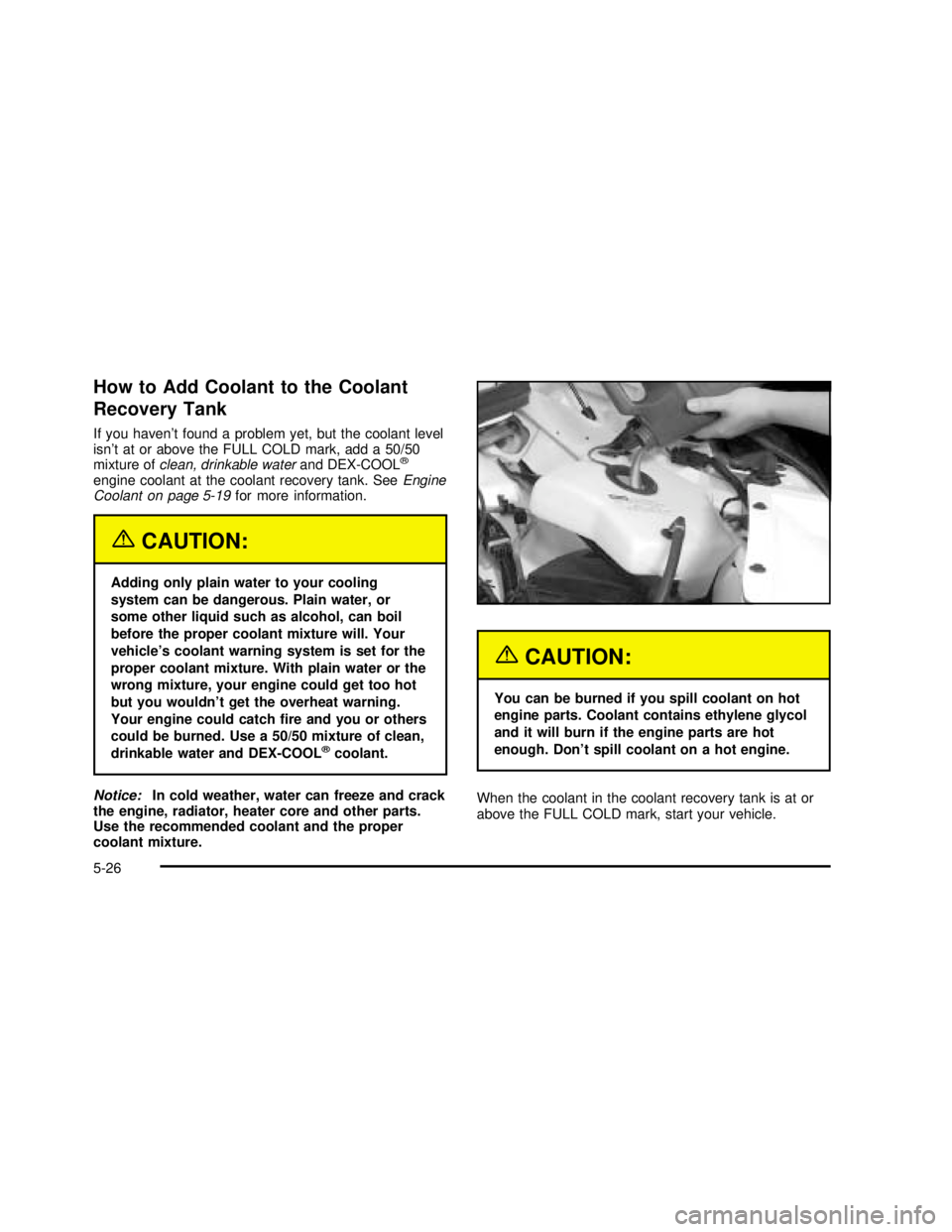
How to Add Coolant to the Coolant
Recovery Tank
If you haven’t found a problem yet, but the coolant level
isn’t at or above the FULL COLD mark, add a 50/50
mixture ofclean, drinkable waterand DEX-COOL
®
engine coolant at the coolant recovery tank. SeeEngine
Coolant on page 5-19for more information.
{CAUTION:
Adding only plain water to your cooling
system can be dangerous. Plain water, or
some other liquid such as alcohol, can boil
before the proper coolant mixture will. Your
vehicle’s coolant warning system is set for the
proper coolant mixture. With plain water or the
wrong mixture, your engine could get too hot
but you wouldn’t get the overheat warning.
Your engine could catchfire and you or others
could be burned. Use a 50/50 mixture of clean,
drinkable water and DEX-COOL
®coolant.
Notice:In cold weather, water can freeze and crack
the engine, radiator, heater core and other parts.
Use the recommended coolant and the proper
coolant mixture.
{CAUTION:
You can be burned if you spill coolant on hot
engine parts. Coolant contains ethylene glycol
and it will burn if the engine parts are hot
enough. Don’t spill coolant on a hot engine.
When the coolant in the coolant recovery tank is at or
above the FULL COLD mark, start your vehicle.
5-26
2003 - Rendezvous OM
Page 322 of 432

When your brakefluid falls to a low level, your brake
warning light will come on. SeeBrake System Warning
Light on page 3-38.
What to Add
When you do need brakefluid, use only DOT-3 brake
fluid. Use new brakefluid from a sealed container
only. SeePart D: Recommended Fluids and Lubricants
on page 6-15.
Always clean the brakefluid reservoir cap and the area
around the cap before removing it. This will help
keep dirt from entering the reservoir.
{CAUTION:
With the wrong kind offluid in your brake
system, your brakes may not work well, or
they may not even work at all. This could
cause a crash. Always use the proper brake
fluid.
Notice:
•Using the wrongfluid can badly damage brake
system parts. For example, just a few drops of
mineral-based oil, such as engine oil, in your
brake system can damage brake system
parts so badly that they’ll have to be replaced.
Don’t let someone put in the wrong kind offluid.
•If you spill brakefluid on your vehicle’s painted
surfaces, the paintfinish can be damaged. Be
careful not to spill brakefluid on your vehicle.
If you do, wash it off immediately. See
“Appearance Care”in the Index. United States
Canada
5-34
2003 - Rendezvous OM
Page 380 of 432
Capacities and Specifications
The following approximate capacities are given in English and metric conversions.
Please refer toPart D: Recommended Fluids and Lubricants on page 6-15for more information.
ApplicationCapacities
English Metric
Air Conditioning Refrigerant (R134a) 1.7 lbs. 0.8 kg
Automatic Transaxle
Pan Removal and Replacement
Complete Overhaul7.4 quarts
10.0 quarts7.0 L
9.5 L
AWD Automatic Transaxle
Pan Removal and Replacement
Complete Overhaul8.7 quarts
10.8 quarts8.3 L
10.3 L
Cooling System with A/C 9.6 quarts 9.1 L
Engine Oil with Filter 4.5 quarts 4.3 L
Fuel Capacity 18.0 gallons 68.1 L
Rear Differential Fluid Capacity 2.1 quarts 1.9 L
Transfer Case Fluid Capacity 0.6 pints 290 ml
Wheel Nut Torque 100 lb ft 140Y
5-92
2003 - Rendezvous OM

