Page 229 of 380

Safety Chains
You should always attach chains between your vehicle
and your trailer. Cross the safety chains under the
tongue of the trailer so that the tongue will not drop to
the road if it becomes separated from the hitch.
Instructions about safety chains may be provided by the
hitch manufacturer or by the trailer manufacturer.
Follow the manufacturer's recommendation for attaching
safety chains and do not attach them to the bumper.
Always leave just enough slack so you can turn
with your rig. And, never allow safety chains to drag on
the ground.
Trailer Brakes
Does your trailer have its own brakes? Be sure to read
and follow the instructions for the trailer brakes so
you'll be able to install, adjust and maintain them
properly.
Because you have anti-lock brakes, do not try to tap
into your vehicle's brake system. If you do, both brake
systems won't work well, or at all.
Trailer Wiring Harness
All of the electrical circuits required for your trailer
lighting system can be accessed at the driver's side rear
lamp connector. This connector is located under the
carpet on the rear corner of the trunk compartment.
Driving with a Trailer
Towing a trailer requires a certain amount of experience.
Before setting out for the open road, you'll want to get
to know your rig. Acquaint yourself with the feel of
handling and braking with the added weight of the trailer.
And always keep in mind that the vehicle you are
driving is now a good deal longer and not nearly as
responsive as your vehicle is by itself.
Before you start, check the trailer hitch and platform
(and attachments), safety chains, electrical connector,
lamps, tires and mirror adjustment. If the trailer has
electric brakes, start your vehicle and trailer moving and
then apply the trailer brake controller by hand to be
sure the brakes are working. This lets you check your
electrical connection at the same time.
During your trip, check occasionally to be sure that the
load is secure, and that the lamps and any trailer
brakes are still working.
4-39
Page 241 of 380
When you put the fuel cap back on, turn it to the right
(clockwise) until you hear a clicking sound. Make
sure you fully install the cap. The diagnostic system can
determine if the fuel cap has been left off or improperly
installed. This would allow fuel to evaporate into the
atmosphere. See
Malfunction Indicator Lamp on
page 3-40.
The GAS CAP LOOSE-CHECK CAP message will be
displayed on the Driver Information Center (DIC) (if
equipped) if the fuel cap is not properly installed.
Notice:If you need a new fuel cap, be sure to get
the right type. Your dealer can get one for you.
If you get the wrong type, it may not ®t properly.
This may cause your malfunction indicator lamp to
light and may damage your fuel tank and emissions
system. See ªMalfunction Indicator Lampº in the
Index.
Filling a Portable Fuel Container
{CAUTION:
Never ®ll a portable fuel container while it is in
your vehicle. Static electricity discharge from
the container can ignite the gasoline vapor.
You can be badly burned and your vehicle
damaged if this occurs. To help avoid injury to
you and others:
·Dispense gasoline only into approved
containers.
·Do not ®ll a container while it is inside a
vehicle, in a vehicle's trunk, pickup bed or
on any surface other than the ground.
·Bring the ®ll nozzle in contact with the
inside of the ®ll opening before operating
the nozzle. Contact should be maintained
until the ®lling is complete.
·Don't smoke while pumping gasoline.
5-9
Page 285 of 380

4. Turn the bulb retainer counterclockwise to remove it
from the bulb assembly.
5. Pull the old bulb straight out from the retainer. Push
the new bulb straight into the retainer.
6. Reverse Steps 1 through 4 to reinstall the headlamp
assembly.
Front Turn Signal Lamps
Once the headlamp assembly has been removed from
the vehicle, the front turn signal bulbs can be
accessed.
1. Reach down into the space provided by the
removal of the headlamp assembly and, while
pushing in the tab on the bulb assembly, turn the
assembly counterclockwise and remove it.
2. Remove the old bulb by pulling it straight out of the
retainer.
3. Install the new bulb and turn the bulb assembly
back into place.
Taillamps, Turn Signal, and
Stoplamps
1. Open the trunk. Turn the screws located just inside
of the trunk counterclockwise and remove them.
2. Remove the plastic trim piece from the trunk.
3. Pull the carpet away from the rear area to access
the turn signal bulb assembly.
4. Loosen and remove the bolts that hold the assembly
in place.
5-53
Page 287 of 380
Taillamps and Back-Up Lamps
1. Open the trunk. Loosen and remove the seven
fasteners that hold the taillamp assembly in
place. The assembly for both sides is one piece.
The entire piece must be removed to replace
any bulbs.2. Pull out the assembly.
5-55
Page 288 of 380
3. Push in the tab and turn the bulb socket
counterclockwise to remove it.
4. Remove the bulb by pulling it straight out.
5. Replace the bulb and reverse the steps to install
the assembly.
Replacement Bulbs
Exterior Lamp Bulb Number
Front
Low Beam Headlamps 9006
High Beam Headlamps 9005
Front Turn Signals 3157
Rear
Trunk Mounted Back-Up Lamps 3057
Trunk Mounted Taillamps 194
Tail/Stop/Turn Signal Lamps 3357
For any bulb not listed here contact your dealer.
5-56
Page 300 of 380
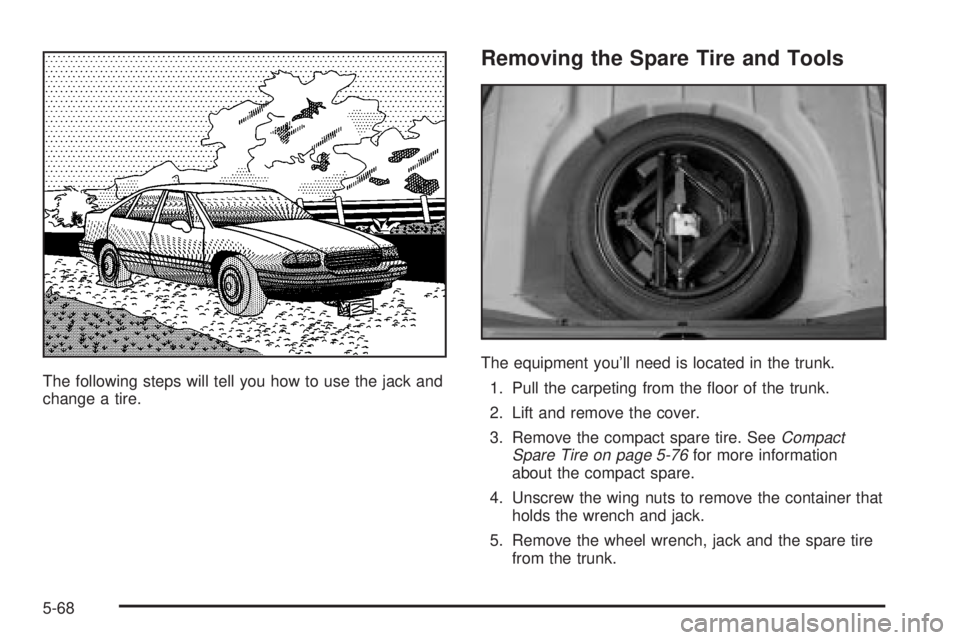
The following steps will tell you how to use the jack and
change a tire.
Removing the Spare Tire and Tools
The equipment you'll need is located in the trunk.
1. Pull the carpeting from the ¯oor of the trunk.
2. Lift and remove the cover.
3. Remove the compact spare tire. See
Compact
Spare Tire on page 5-76for more information
about the compact spare.
4. Unscrew the wing nuts to remove the container that
holds the wrench and jack.
5. Remove the wheel wrench, jack and the spare tire
from the trunk.
5-68
Page 306 of 380

Notice:Improperly tightened wheel nuts can lead
to brake pulsation and rotor damage. To avoid
expensive brake repairs, evenly tighten the wheel
nuts in the proper sequence and to the proper
torque speci®cation. See ªCapacities and
Speci®cationsº in the index for the wheel nut torque
speci®cation.
Notice:Wheel covers won't ®t on your compact
spare. If you try to put a wheel cover on your
compact spare, you could damage the cover or the
spare.
Storing the Flat Tire and Tools
{CAUTION:
Storing a jack, a tire, or other equipment in the
passenger compartment of the vehicle could
cause injury. In a sudden stop or collision,
loose equipment could strike someone. Store
all these in the proper place.After you've put the compact spare tire on your vehicle,
you'll need to store the ¯at tire in your trunk. Use the
following procedure to secure the ¯at tire in the trunk.
Store the ¯at tire as far forward in the trunk as possible.
Store the jack and wheel wrench in their compartment
in the trunk.
5-74
Page 324 of 380
Relays Usage
39 Fuel Pump
40 Parking Lamp
41 Ignition 1
42 Rear Fog Lamp
43 Not Used
44 Park
45 Reverse
46 Retained Accessory Power (RAP)
47 Fuel Tank Door Lock
48 Not Used
49 Ignition 3
50 Fuel Tank Door Release
51 Interior Lamps
52 Trunk Release
53 Front Courtesy Lamps
54 Not Used
55 Electronic Level Control (ELC)
Circuit
BreakersUsage
56 Power Seats
57 Power WindowsRelays Usage
58 Cigar
59 Rear Defogger
Fuses Usage
60 Not Used
61 Rear Defog
62 Not Used
63 Audio Ampli®er
64 Electronic Level Control (ELC)
65 Cigar
66 Not Used
67 Not Used
68 Not Used
69 Spare
70 Spare
71 Spare
72 Spare
73 Spare
74 Spare
75 Fuse Puller
5-92