Page 136 of 344

Engine Coolant Temperature Gage
You have a gage that
shows the engine coolant
temperature. If the
gage pointer moves into
the red area, your
engine is too hot!
This reading means the same thing as the warning light.
It means that your engine coolant has overheated. If
you have been operating your vehicle under normal
driving conditions, you should pull off the road, stop your
vehicle and turn off the engine as soon as possible.
See
Engine Overheating on page 5-26.
Tire Pressure Light
Your vehicle may have a
tire pressure monitor that
can alert you to a large
change in the pressure in
one tire.
After the system has ªlearnedº tire pressures with
properly in¯ated tires, the LOW TIRE light will come on
if the pressure in one tire becomes 12 psi (83 kPa)
lower than the other three tires. The tire in¯ation monitor
system won't alert you if the pressure in more than
one tire is low, if the system is not yet calibrated, or if
the vehicle is moving faster than 70 mph (110 km/h).
When the LOW TIRE light comes on, you should stop as
soon as you can and check all your tires for damage.
If a tire is ¯at, see
If a Tire Goes Flat on page 5-66. Also
check the tire pressure in all four tires as soon as you
can. See
In¯ation Ð Tire Pressure on page 5-57.
The light will stay on, while the ignition is on, until you
reset (calibrate) the system. See
Tire Pressure
Monitor System on page 5-58.
3-30
Page 142 of 344
Security Light
The SECURITY light will
come on when you turn the
key to START and stay on
until the vehicle starts.
It will also ¯ash if your ignition key is too dirty or wet for
the PASS-Key
žII system to read the resistor pellet.
SeePASS-KeyžII on page 2-17.
If the resistor pellet is damaged or missing, the light will
come on.
Cruise Control Light
The CRUISE light comes
on whenever you set the
cruise control, if equipped.
See ªCruise Controlº under
Turn Signal/Multifunction
Lever on page 3-5.
Low Washer Fluid Warning Light
The LOW WASH light will
come on when your
windshield washers are
working and the ¯uid
container is low.
The light will also come on brie¯y when your ignition is
turned on to show that it is working properly.
Door/Trunk Ajar Warning Light
The DOOR/TRUNK light
will come on if your trunk
or any door is not
completely closed.
3-36
Page 144 of 344
Here are four things that some owners ask about. All
these things are normal and do not indicate that
anything is wrong with the fuel gage:
·At the gas station, the pump shuts off before the
gage reads full.
·It takes more (or less) fuel to ®ll up than the gage
reads. For example, the gage reads half full, but it
took more (or less) than half of the tank's
capacity to ®ll it.
·The gage pointer may move while cornering,
braking or speeding up.
·The gage may not indicate empty when the ignition
is turned off.
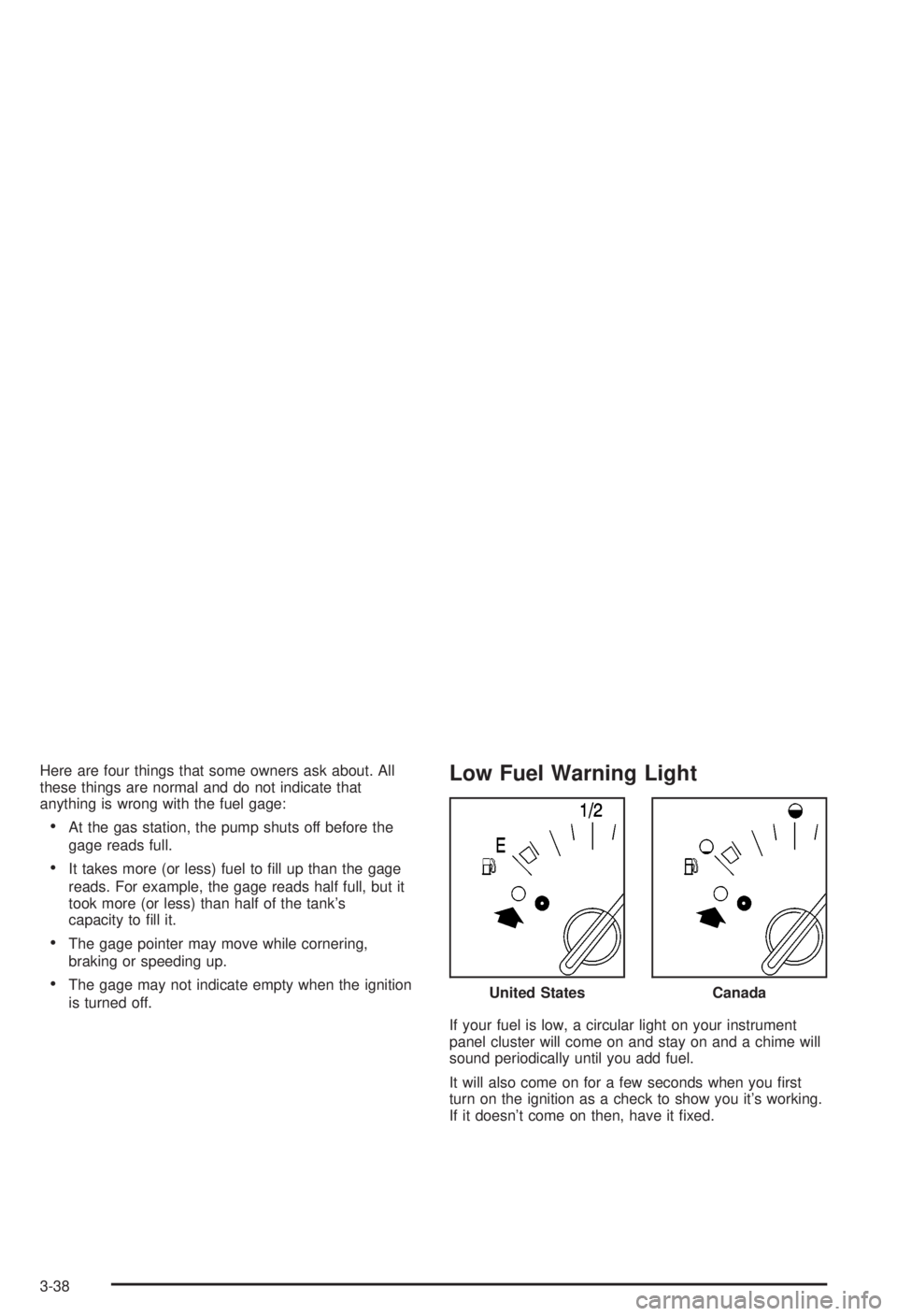
Low Fuel Warning Light
If your fuel is low, a circular light on your instrument
panel cluster will come on and stay on and a chime will
sound periodically until you add fuel.
It will also come on for a few seconds when you ®rst
turn on the ignition as a check to show you it's working.
If it doesn't come on then, have it ®xed.United States
Canada
3-38
Page 165 of 344

Avoid needless heavy braking. Some people drive in
spurts Ð heavy acceleration followed by heavy
braking Ð rather than keeping pace with traffic. This is
a mistake. Your brakes may not have time to cool
between hard stops. Your brakes will wear out much
faster if you do a lot of heavy braking. If you keep pace
with the traffic and allow realistic following distances,
you will eliminate a lot of unnecessary braking.
That means better braking and longer brake life.
If your engine ever stops while you're driving, brake
normally but don't pump your brakes. If you do,
the pedal may get harder to push down. If your engine
stops, you will still have some power brake assist.
But you will use it when you brake. Once the power
assist is used up, it may take longer to stop and
the brake pedal will be harder to push.Anti-lock Brake System (ABS)
Your vehicle may have anti-lock brakes. ABS is an
advanced electronic braking system that will help
prevent a braking skid.
If your vehicle has anti-lock brakes, this warning light on
the instrument panel will come on brie¯y when you
start your vehicle.
When you start your engine, or when you begin to drive
away, your anti-lock brake system will check itself.
You may hear a momentary motor or clicking noise while
this test is going on, and you may even notice that
your brake pedal moves or pulses a little. This is normal.United States
Canada
4-7
Page 168 of 344
Enhanced Traction System (ETS)
Your vehicle may have an Enhanced Traction System
(ETS) that limits wheel spin. This is especially useful in
slippery road conditions. The system operates only if
it senses that one or both of the front wheels are
spinning or beginning to lose traction. When this
happens, the system reduces engine power and may
also upshift the transaxle to limit wheel spin.
This light will come on the
instrument panel cluster
while the Enhanced
Traction System is limiting
wheel spin. See
Enhanced
Traction System Warning
Light on page 3-28
.
You may feel or hear the system working, but this is
normal.
If your vehicle is in cruise control when the enhanced
traction system begins to limit wheel spin, the cruise
control will automatically disengage. When road
conditions allow you to safely use it again, you may
re-engage the cruise control. See ªCruise Controlº under
Turn Signal/Multifunction Lever on page 3-5.The Enhanced Traction System operates in THIRD (3)
and OVERDRIVE (
X). If you are in THIRD (3), the
system can upshift the transaxle to OVERDRIVE (
X).
The Enhanced Traction System is turned off in
SECOND (2) or FIRST (1) gear. See
Automatic
Transaxle Operation on page 2-23.
While the system is on,
this warning light will come
on the instrument panel
cluster to let you know
if there is a problem.
See
Enhanced Traction System Warning Light on
page 3-28. While this warning light is on, the system will
not limit wheel spin. Adjust your driving accordingly.
To limit wheel spin, especially in slippery road
conditions, you should always leave the Enhanced
Traction System on. But you can turn the system off if
you ever need to. You should turn the system off if
the vehicle ever gets stuck in sand, mud or snow and
rocking the vehicle is required. See ªRocking Your
Vehicle To Get It Outº under
If You Are Stuck: In Sand,
Mud, Ice or Snow on page 4-31.
4-10
Page 169 of 344
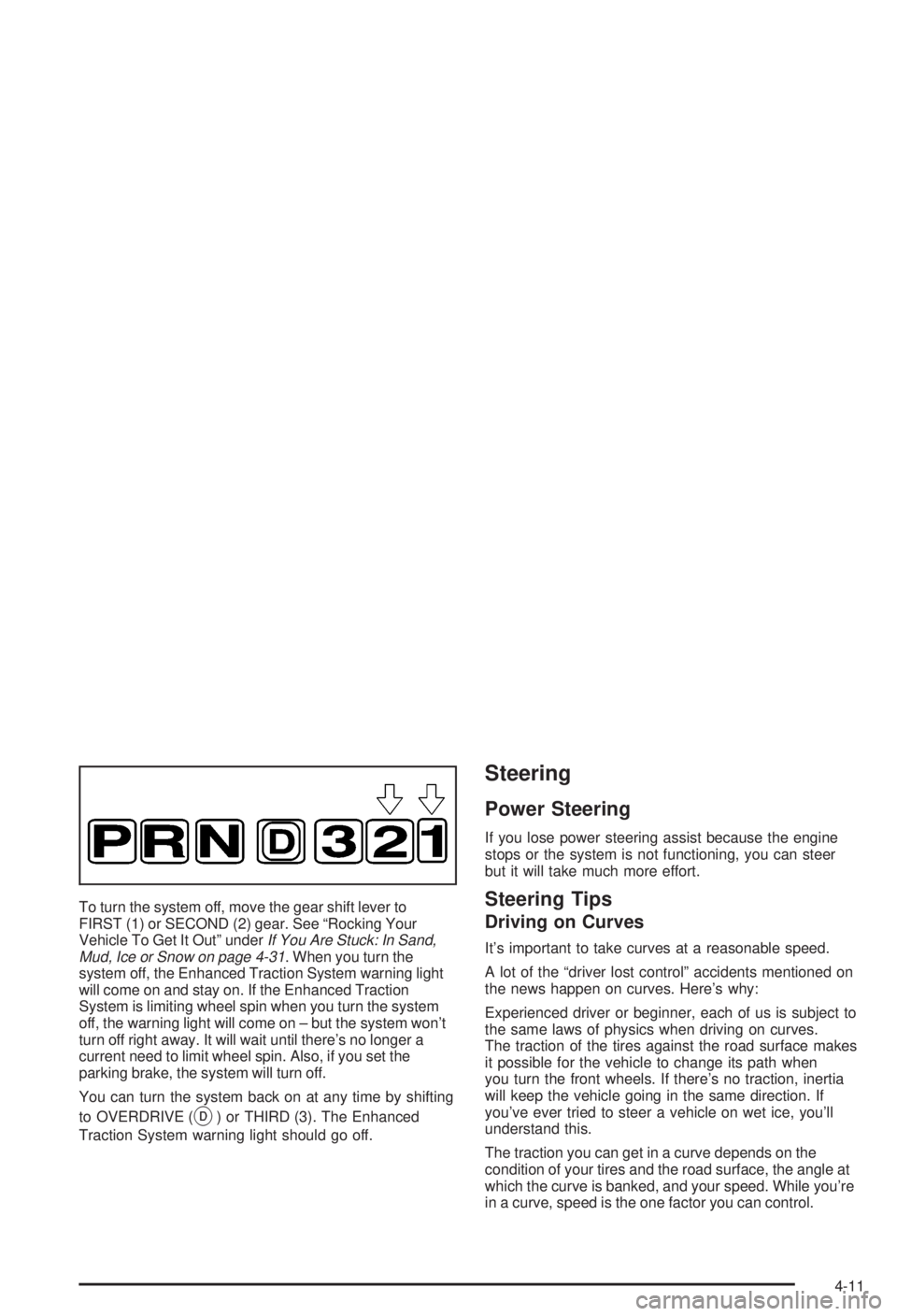
To turn the system off, move the gear shift lever to
FIRST (1) or SECOND (2) gear. See ªRocking Your
Vehicle To Get It Outº under
If You Are Stuck: In Sand,
Mud, Ice or Snow on page 4-31. When you turn the
system off, the Enhanced Traction System warning light
will come on and stay on. If the Enhanced Traction
System is limiting wheel spin when you turn the system
off, the warning light will come on ± but the system won't
turn off right away. It will wait until there's no longer a
current need to limit wheel spin. Also, if you set the
parking brake, the system will turn off.
You can turn the system back on at any time by shifting
to OVERDRIVE (
X) or THIRD (3). The Enhanced
Traction System warning light should go off.
Steering
Power Steering
If you lose power steering assist because the engine
stops or the system is not functioning, you can steer
but it will take much more effort.
Steering Tips
Driving on Curves
It's important to take curves at a reasonable speed.
A lot of the ªdriver lost controlº accidents mentioned on
the news happen on curves. Here's why:
Experienced driver or beginner, each of us is subject to
the same laws of physics when driving on curves.
The traction of the tires against the road surface makes
it possible for the vehicle to change its path when
you turn the front wheels. If there's no traction, inertia
will keep the vehicle going in the same direction. If
you've ever tried to steer a vehicle on wet ice, you'll
understand this.
The traction you can get in a curve depends on the
condition of your tires and the road surface, the angle at
which the curve is banked, and your speed. While you're
in a curve, speed is the one factor you can control.
4-11
Page 174 of 344
Of course, traction is reduced when water, snow, ice,
gravel or other material is on the road. For safety, you'll
want to slow down and adjust your driving to these
conditions. It is important to slow down on slippery
surfaces because stopping distance will be longer and
vehicle control more limited.
While driving on a surface with reduced traction, try
your best to avoid sudden steering, acceleration
or braking (including engine braking by shifting to a
lower gear). Any sudden changes could cause the tires
to slide. You may not realize the surface is slippery
until your vehicle is skidding. Learn to recognize warning
clues Ð such as enough water, ice or packed snow
on the road to make a ªmirrored surfaceº Ð and slow
down when you have any doubt.
If you have the anti-lock braking system, remember:
It helps avoid only the braking skid. If you do not have
anti-lock, then in a braking skid (where the wheels
are no longer rolling), release enough pressure on the
brakes to get the wheels rolling again. This restores
steering control. Push the brake pedal down steadily
when you have to stop suddenly. As long as the wheels
are rolling, you will have steering control.Driving at Night
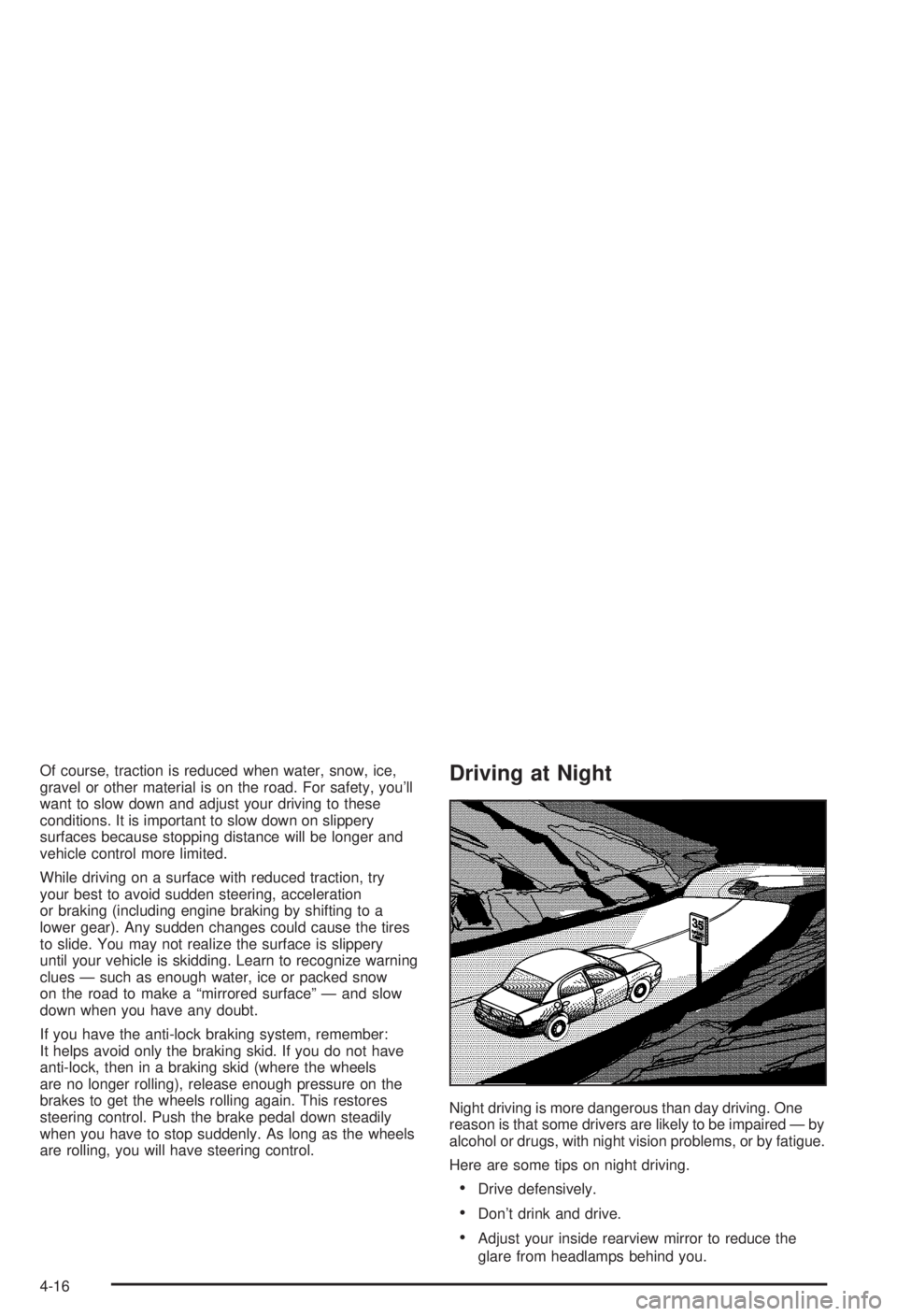
Night driving is more dangerous than day driving. One
reason is that some drivers are likely to be impaired Ð by
alcohol or drugs, with night vision problems, or by fatigue.
Here are some tips on night driving.
·Drive defensively.
·Don't drink and drive.
·Adjust your inside rearview mirror to reduce the
glare from headlamps behind you.
4-16
Page 178 of 344
Driving Through Deep Standing Water
Notice:If you drive too quickly through deep
puddles or standing water, water can come in
through your engine's air intake and badly damage
your engine. Never drive through water that is
slightly lower than the underbody of your vehicle.
If you can't avoid deep puddles or standing
water, drive through them very slowly.
Driving Through Flowing Water
{CAUTION:
Flowing or rushing water creates strong forces.
If you try to drive through ¯owing water, as you
might at a low water crossing, your vehicle can
be carried away.
CAUTION: (Continued)
CAUTION: (Continued)
As little as six inches of ¯owing water can carry
away asmaller vehicle. If this happens, you and
other vehicle occupants could drown. Don't
ignore police warning signs, and otherwise be
very cautious about trying to drive through
¯owing water.
Some Other Rainy Weather Tips
·Besides slowing down, allow some extra following
distance. And be especially careful when you
pass another vehicle. Allow yourself more clear
room ahead, and be prepared to have your
view restricted by road spray.
·Have good tires with proper tread depth. SeeTires
on page 5-57
.
4-20