Page 31 of 344
When the shoulder belt is pulled out all the way, it
will lock. If it does, let it go back all the way
and start again. If the belt is not long enough, see
Safety Belt Extender on page 1-29.
Make sure the release button on the buckle is
positioned so you would be able to unbuckle the
safety belt quickly if you ever had to.
3. To make the lap part tight, pull down on the buckle
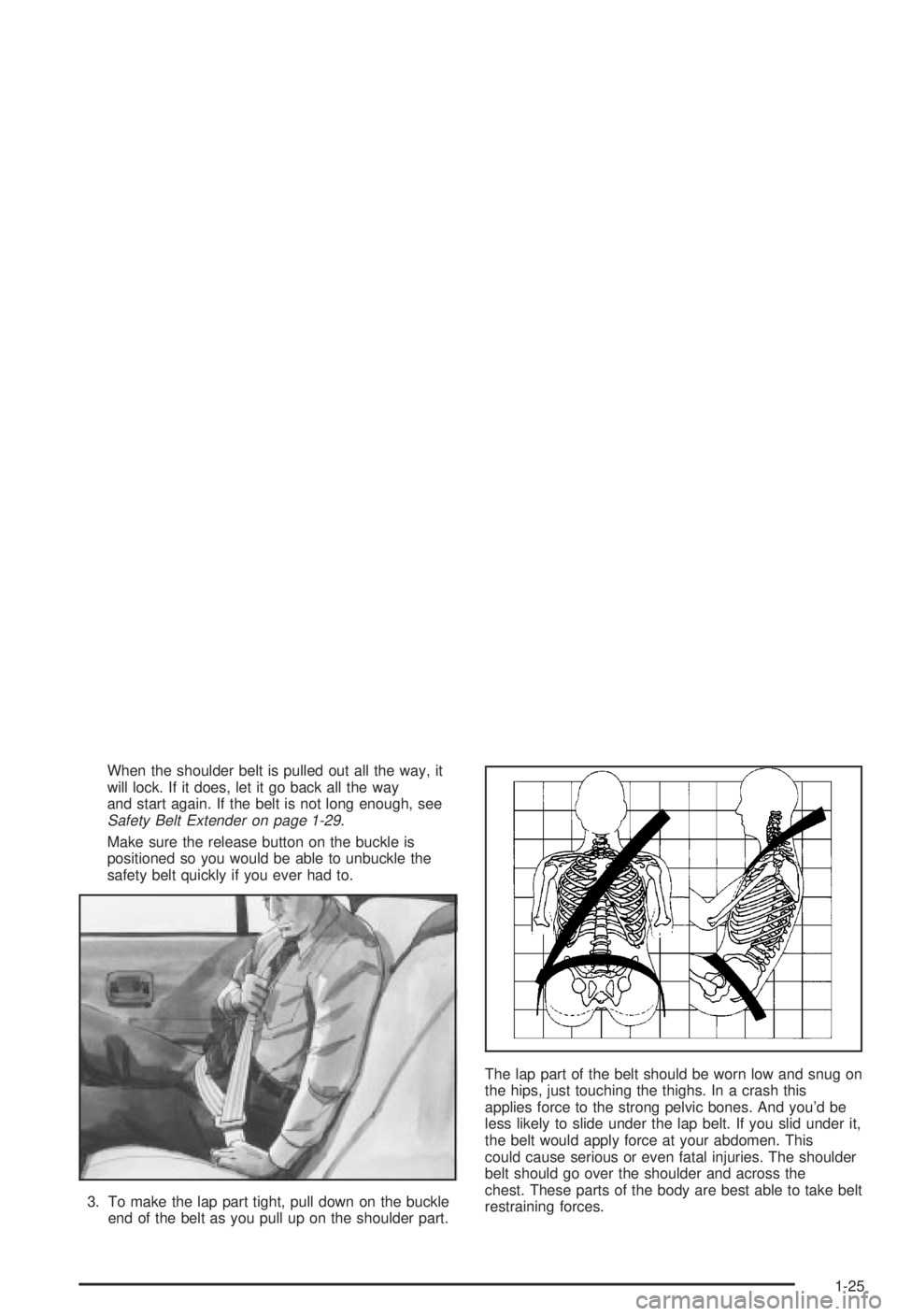
end of the belt as you pull up on the shoulder part.The lap part of the belt should be worn low and snug on
the hips, just touching the thighs. In a crash this
applies force to the strong pelvic bones. And you'd be
less likely to slide under the lap belt. If you slid under it,
the belt would apply force at your abdomen. This
could cause serious or even fatal injuries. The shoulder
belt should go over the shoulder and across the
chest. These parts of the body are best able to take belt
restraining forces.
1-25
Page 33 of 344
Rear Safety Belt Comfort Guides for
Children and Small Adults
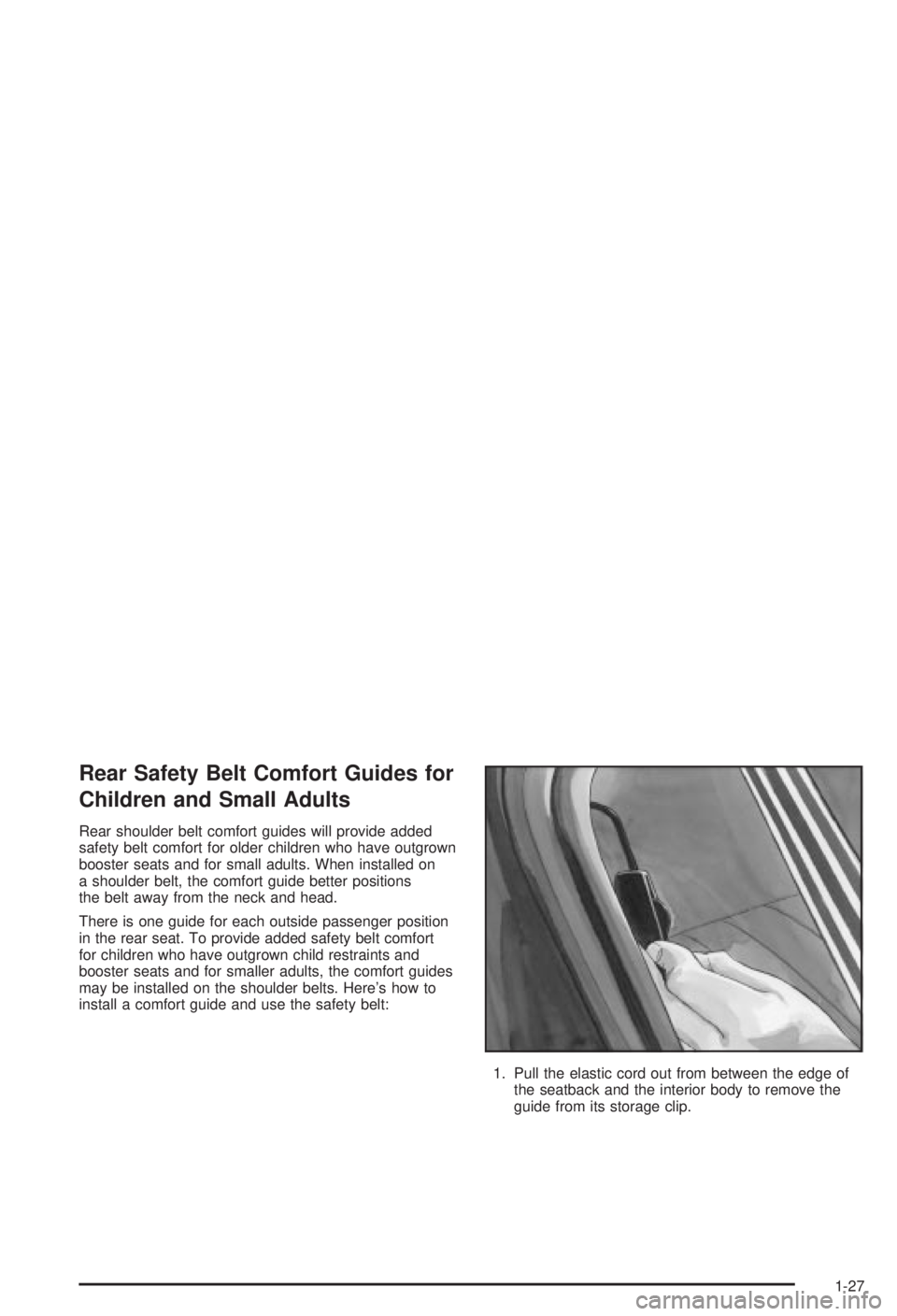
Rear shoulder belt comfort guides will provide added
safety belt comfort for older children who have outgrown
booster seats and for small adults. When installed on
a shoulder belt, the comfort guide better positions
the belt away from the neck and head.
There is one guide for each outside passenger position
in the rear seat. To provide added safety belt comfort
for children who have outgrown child restraints and
booster seats and for smaller adults, the comfort guides
may be installed on the shoulder belts. Here's how to
install a comfort guide and use the safety belt:
1. Pull the elastic cord out from between the edge of
the seatback and the interior body to remove the
guide from its storage clip.
1-27
Page 37 of 344
{CAUTION:
Never do this.
Here two children are wearing the same belt.
The belt can't properly spread the impact
forces. In a crash, the two children can be
crushed together and seriously injured. A belt
must be used by only one person at a time.
Q:What if a child is wearing a lap-shoulder belt,
but the child is so small that the shoulder belt
is very close to the child's face or neck?
A:Move the child toward the center of the vehicle,
but be sure that the shoulder belt still is on the
child's shoulder, so that in a crash the child's upper
body would have the restraint that belts provide.
If the child is sitting in a rear seat outside position,
see
Rear Safety Belt Comfort Guides for Children
and Small Adults on page 1-27
. If the child is
so small that the shoulder belt is still very close to
the child's face or neck, you might want to place
the child in the center seat position, the one
that has only a lap belt.
1-31
Page 38 of 344
{CAUTION:
Never do this.
Here a child is sitting in a seat that has a
lap-shoulder belt, but the shoulder part is
behind the child. If the child wears the belt in
this way, in a crash the child might slide under
the belt. The belt's force would then be applied
right on the child's abdomen. That could cause
serious or fatal injuries.
Wherever the child sits, the lap portion of the belt
should be worn low and snug on the hips, just touching
the child's thighs. This applies belt force to the child's
pelvic bones in a crash.
Infants and Young Children
Everyone in a vehicle needs protection! This includes
infants and all other children. Neither the distance
traveled nor the age and size of the traveler changes
the need, for everyone, to use safety restraints. In fact,
the law in every state in the United States and in
every Canadian province says children up to some age
must be restrained while in a vehicle.
1-32
Page 42 of 344
{CAUTION:
The body structure of a young child is quite
unlike that of an adult or older child, for whom
the safety belts are designed. A young child's
hip bones are still so small that the vehicle's
regular safety belt may not remain low on the
hip bones, as it should. Instead, it may settle
up around the child's abdomen. In a crash, the
belt would apply force on a body area that's
unprotected by any bony structure. This alone
could cause serious or fatal injuries. Young
children always should be secured in
appropriate child restraints.
Child Restraint Systems
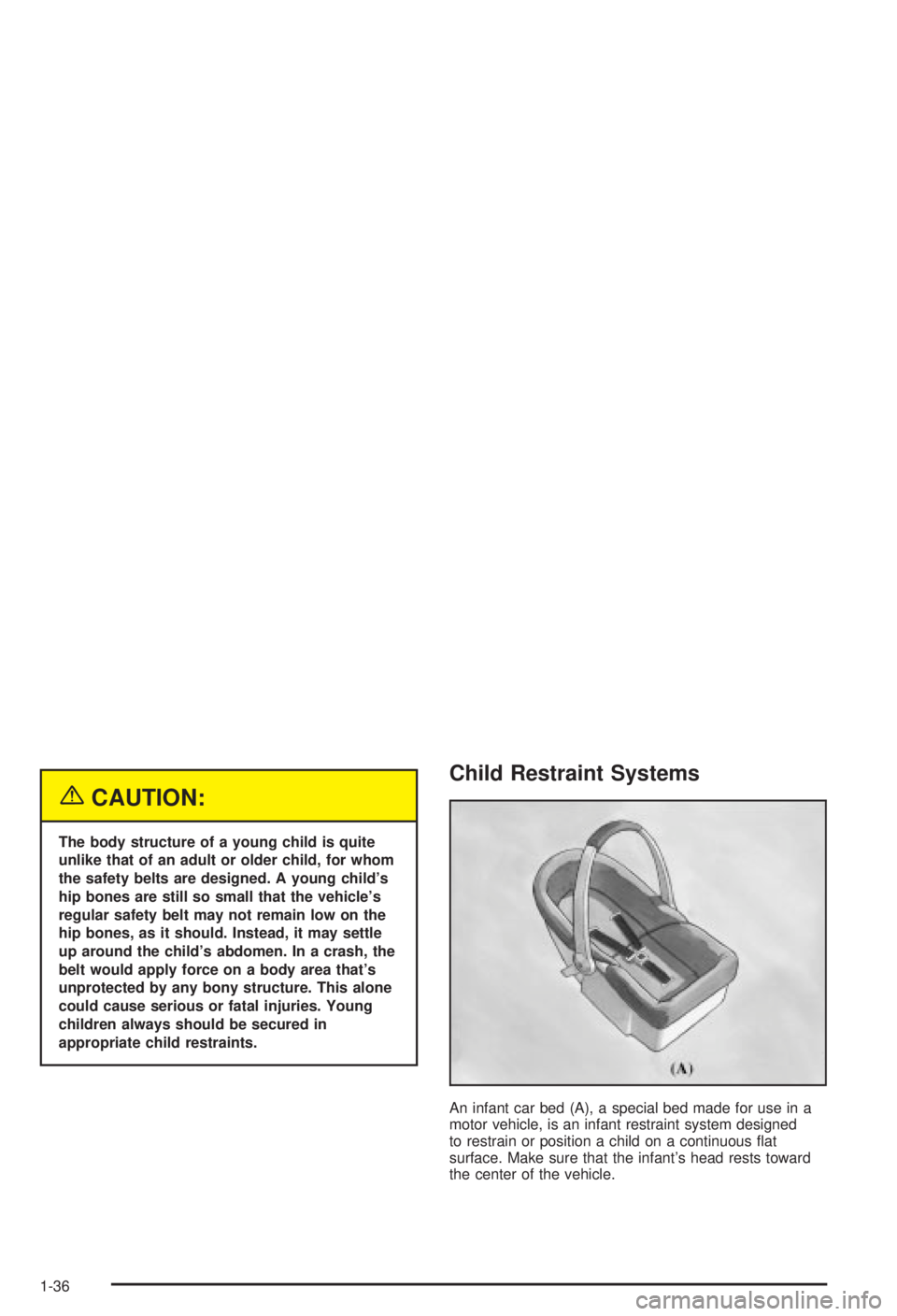
An infant car bed (A), a special bed made for use in a
motor vehicle, is an infant restraint system designed
to restrain or position a child on a continuous ¯at
surface. Make sure that the infant's head rests toward
the center of the vehicle.
1-36
Page 46 of 344
{CAUTION:
A child in a child restraint in the center front
seat can be badly injured or killed by the right
front passenger's air bag if it in¯ates. Never
secure a child restraint in the center front seat.
It's always better to secure a child restraint in
the rear seat. You may secure a forward-facing
child restraint in the right front passenger seat,
but before you do, always move the front
passenger seat as far back as it will go. It's
better to secure the child restraint in a rear seat.
Wherever you install it, be sure to secure the child
restraint properly.
Keep in mind that an unsecured child restraint can
move around in a collision or sudden stop and injure
people in the vehicle. Be sure to properly secure
any child restraint in your vehicle ± even when no child
is in it.
Top Strap
Some child restraints have a top strap, or ªtop tether.º
It can help restrain the child restraint during a collision.
For it to work, a top strap must be properly anchored
to the vehicle. Some top strap-equipped child restraints
are designed for use with or without the top strap
being anchored. Others require the top strap always to
be anchored. Be sure to read and follow the
instructions for your child restraint. If yours requires that
the top strap be anchored, don't use the restraint
unless it is anchored properly.
If the child restraint does not have a top strap, one can
be obtained, in kit form, for many child restraints.
Ask the child restraint manufacturer whether or not a kit
is available.
1-40
Page 48 of 344
Top Strap Anchor Location
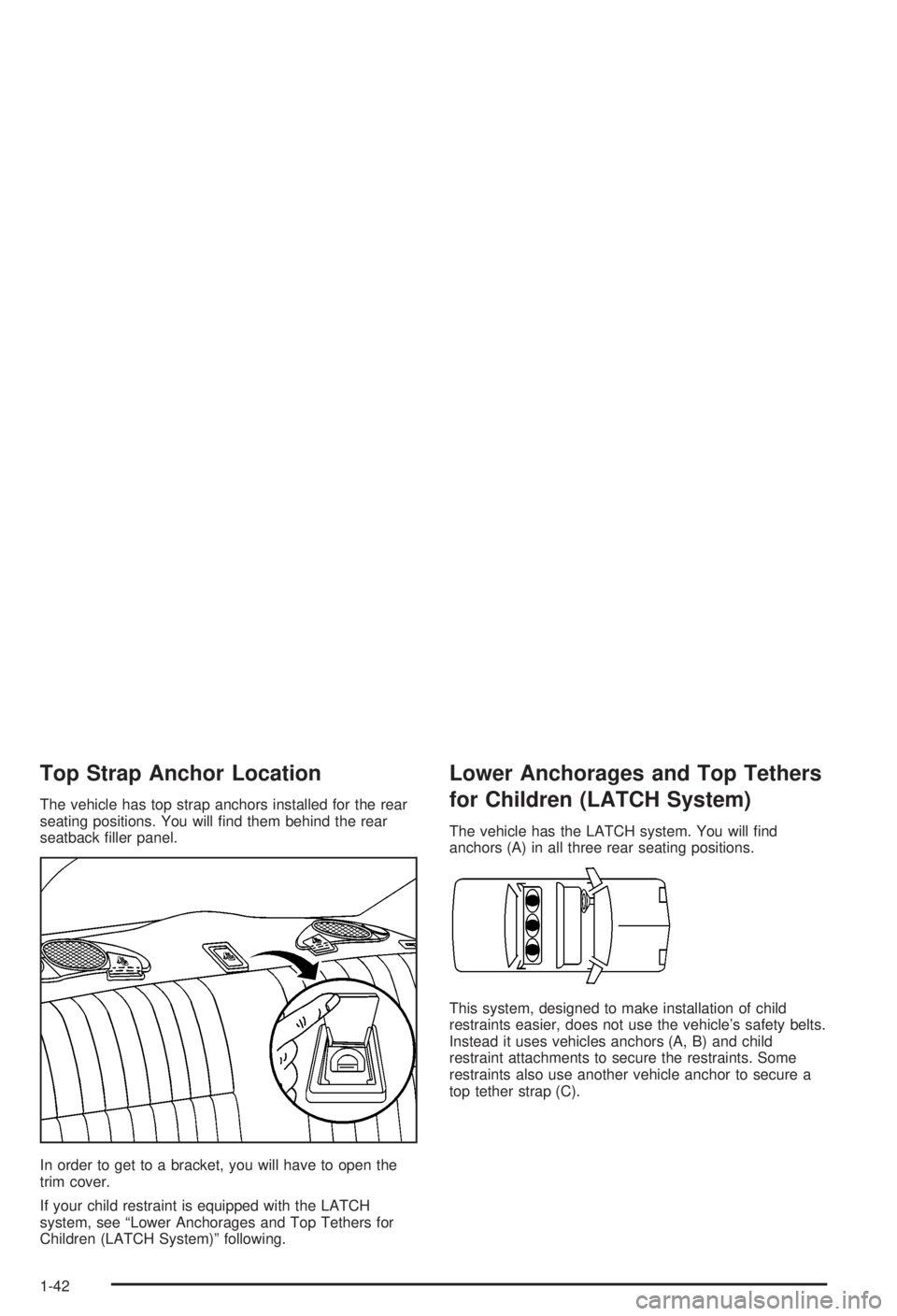
The vehicle has top strap anchors installed for the rear
seating positions. You will ®nd them behind the rear
seatback ®ller panel.
In order to get to a bracket, you will have to open the
trim cover.
If your child restraint is equipped with the LATCH
system, see ªLower Anchorages and Top Tethers for
Children (LATCH System)º following.
Lower Anchorages and Top Tethers
for Children (LATCH System)
The vehicle has the LATCH system. You will ®nd
anchors (A) in all three rear seating positions.
This system, designed to make installation of child
restraints easier, does not use the vehicle's safety belts.
Instead it uses vehicles anchors (A, B) and child
restraint attachments to secure the restraints. Some
restraints also use another vehicle anchor to secure a
top tether strap (C).
1-42
Page 50 of 344
To assist you in locating the
lower anchors for this child
restraint system, each
seating position with the
LATCH system has a label
on the seatback at each
lower anchor position.
The labels are located near the base of all three rear
seating positions.
{CAUTION:
If a LATCH-type child restraint isn't attached to
its anchorage points, the restraint won't be
able to protect the child correctly. In a crash,
the child could be seriously injured or killed.
Make sure that a LATCH-type child restraint is
properly installed using the anchorage points,
or use the vehicle's safety belts to secure the
restraint. See ªSecuring a Child Restraint
Designed for the LATCH Systemº or ªSecuring
a Child Restraint in a Rear Seat Positionº in
the Index for information on how to secure a
child restraint in your vehicle.
1-44