2003 BMW M5 SEDAN fuel
[x] Cancel search: fuelPage 111 of 155

111n
OverviewControlsMaintenanceRepairsDataIndex
Tire replacement Wheel and tire combinations
Do not use retreaded tires, since
driving safety may be impaired.
This is due to the possible variations in
casing structures and, in some cases,
to their extreme age, which can lead to
a decrease in their durability.<
Tire ageThe date on which the tire was manu-
factured is indicated by the code on the
sidewall:
DOT ... 3401 indicates that the tire was
manufactured in week 34 of the year
2001.
Although tires may have a theoretical
service life of up to 10 years, BMW
strongly recommends that you replace
all tires after an absolute maximum of
6 years.
The right choice
Never mount wheels and tires that
have not been specifically
approved by BMW for use on your par-
ticular model. Although other wheels
and tires may theoretically have the
same dimensions, variations in factors
such as manufacturing tolerances can
result in contact between tire and body-
work, ultimately leading to serious acci-
dents. If non-approved wheels and tires
are used, BMW cannot evaluate their
suitability, and therefore cannot be held
liable for driving safety.<
BMW has tested certain tires for each
tire size, rated them according to road
safety and approved them. Your BMW
center can inform you which tires have
been tested in this way. Observe pos-
sible national guidelines, e.g. regarding
entry into vehicle documents.
Because various systems on your
vehicle, such as ABS, DSC and
the Flat Tire Monitor, rely on the correct
combination of tires and wheels for
optimal operation, their operation may
be adversely affected if other tires and/
or wheels are mounted .
You should therefore ensure that tires
from a single manufacturer with the
same tread pattern are mounted at all
four wheels. After installing a spare tire
in response to a flat tire you should
always ensure that a tire of the original
specifications is remounted as soon as
possible.<
The use of rims and wheel bolts
that do not meet the specifica-
tions of the original factory-installed
equipment will affect the safe operation
of your vehicle and may cause an acci-
dent and personal injury.
Never mix tires of different design, such
as steel-belted radials with radial bias-
belted or bias-ply tires, etc. Mixing tire
types will adversely affect roadholding and can lead to loss of vehicle control.
possible. Protect the tires against con-
tact with oil, grease and fuel.
Page 115 of 155
115n
OverviewControlsMaintenanceRepairsDataIndex
Washer fluids Engine oilHeadlamp and windshield
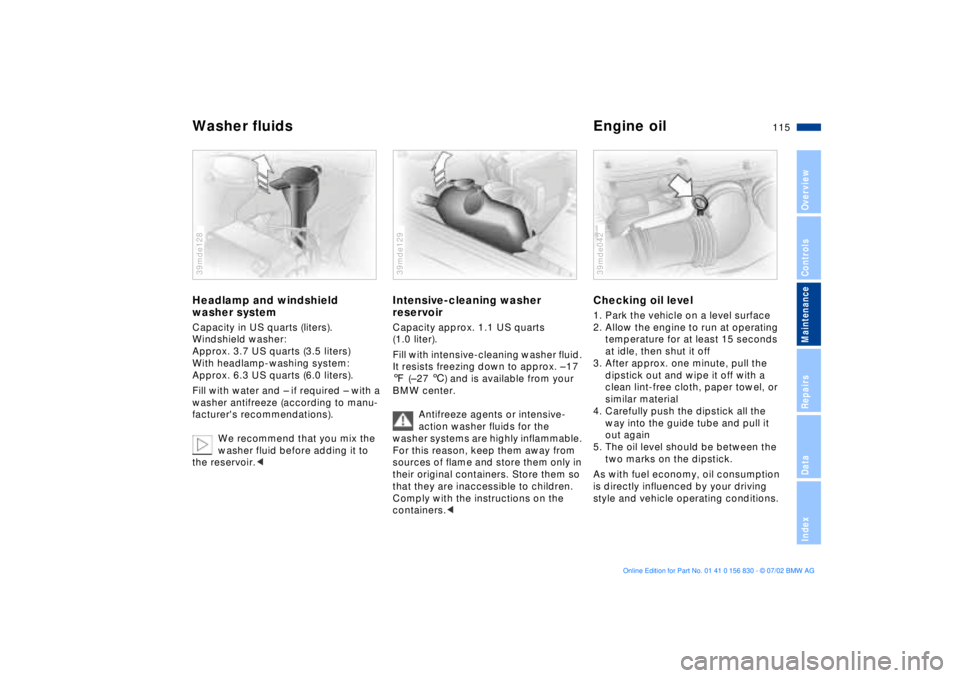
washer systemCapacity in US quarts (liters).
Windshield washer:
Approx. 3.7 US quarts (3.5 liters)
With headlamp-washing system:
Approx. 6.3 US quarts (6.0 liters).
Fill with water and Ð if required Ð with a
washer antifreeze (according to manu-
facturer's recommendations).
We recommend that you mix the
washer fluid before adding it to
the reservoir.< 39mde128
Intensive-cleaning washer
reservoirCapacity approx. 1.1 US quarts
(1.0 liter).
Fill with intensive-cleaning washer fluid.
It resists freezing down to approx. Ð 17
7 (Ð 27 6) and is available from your
BMW center.
Antifreeze agents or intensive-
action washer fluids for the
washer systems are highly inflammable.
For this reason, keep them away from
sources of flame and store them only in
their original containers. Store them so
that they are inaccessible to children.
Comply with the instructions on the
containers.<39mde129
Checking oil level 1. Park the vehicle on a level surface
2. Allow the engine to run at operating
temperature for at least 15 seconds
at idle, then shut it off
3. After approx. one minute, pull the
dipstick out and wipe it off with a
clean lint-free cloth, paper towel, or
similar material
4. Carefully push the dipstick all the
way into the guide tube and pull it
out again
5. The oil level should be between the
two marks on the dipstick.
As with fuel economy, oil consumption
is directly influenced by your driving
style and vehicle operating conditions. 39mde042
Page 121 of 155
121n
OverviewControlsMaintenanceRepairsDataIndex
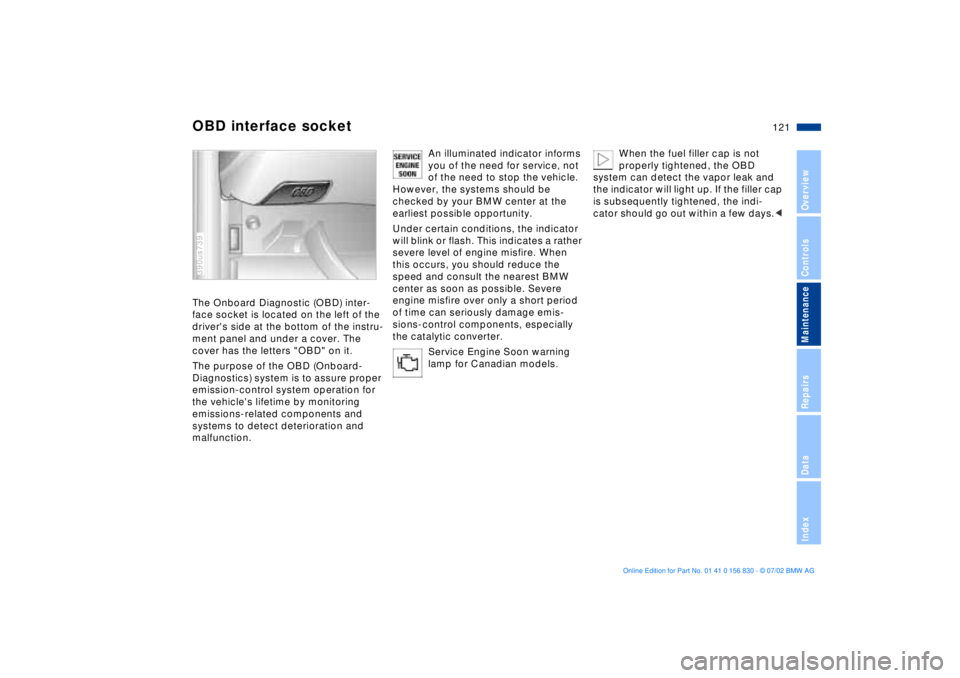
OBD interface socketThe Onboard Diagnostic (OBD) inter-
face socket is located on the left of the
driver's side at the bottom of the instru-
ment panel and under a cover. The
cover has the letters "OBD" on it.
The purpose of the OBD (Onboard-
Diagnostics) system is to assure proper
emission-control system operation for
the vehicle's lifetime by monitoring
emissions-related components and
systems to detect deterioration and
malfunction.390us739
An illuminated indicator informs
you of the need for service, not
of the need to stop the vehicle.
However, the systems should be
checked by your BMW center at the
earliest possible opportunity.
Under certain conditions, the indicator
will blink or flash. This indicates a rather
severe level of engine misfire. When
this occurs, you should reduce the
speed and consult the nearest BMW
center as soon as possible. Severe
engine misfire over only a short period
of time can seriously damage emis-
sions-control components, especially
the catalytic converter.
Service Engine Soon warning
lamp for Canadian models.
When the fuel filler cap is not
properly tightened, the OBD
system can detect the vapor leak and
the indicator will light up. If the filler cap
is subsequently tightened, the indi-
cator should go out within a few days.<
Page 140 of 155

140n
BMW M5
Displacement
Number of cylinders cu in (cm
3) 301.5 (4,941)
8
Maximum output
at engine speed hp
rpm 394
6,600
Maximum torque
at engine speedlb ft (Nm)
rpm 368 (500)
3,800
Compression ratioe
11.0
Stroke
Borein (mm)
in (mm)3.50 (89.0)
3.70 (94.0)
Fuel-injection system Digital electronic engine-management system
Engine data
Page 142 of 155

142n
Weights
BMW M5
Curb weight (with one person, ready for operation, full tank of fuel, options not included)
lbs. (kg) 4,024 (1,825)
Approved gross vehicle weight lbs. (kg) 5,049 (2,290)
Approved front axle load lbs. (kg)
2,426 (1,100)
Approved rear axle load lbs. (kg) 2,701 (1,225)
Approved roof load capacity
Approved axle loads and approved gross vehicle
weight may not be exceeded.lbs. (kg) 220 (100)
Luggage compartment capacity cu ft (liters) 16.2 (460)
Page 143 of 155
143n
OverviewControlsMaintenanceRepairsDataIndex
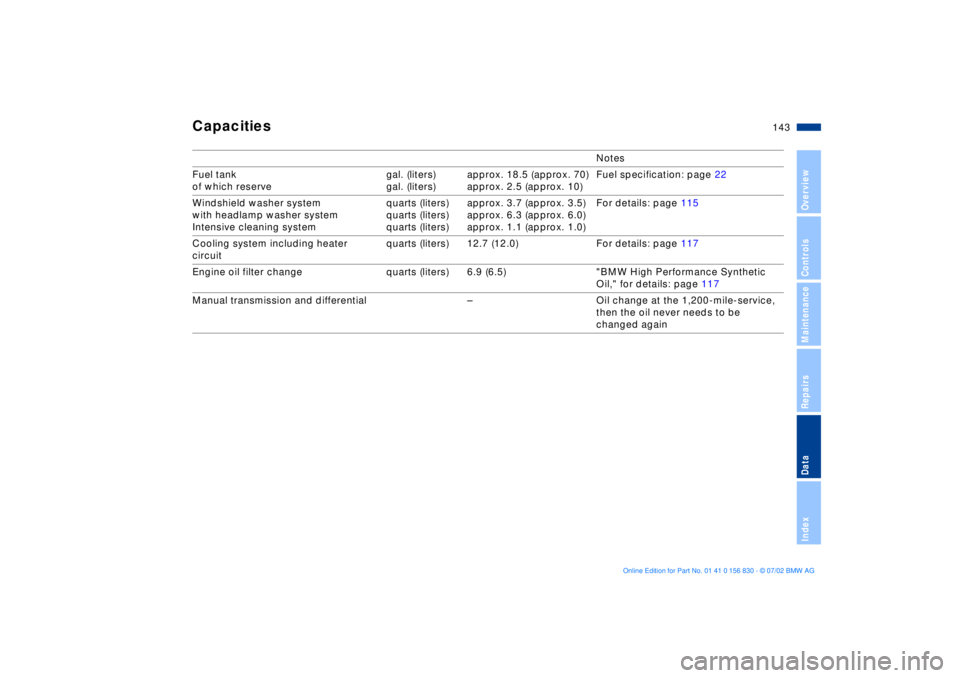
Capacities
Notes
Fuel tank
of which reserve gal. (liters)
gal. (liters)approx. 18.5 (approx. 70)
approx. 2.5 (approx. 10) Fuel specification: page 22
Windshield washer system
with headlamp washer system
Intensive cleaning systemquarts (liters)
quarts (liters)
quarts (liters)approx. 3.7 (approx. 3.5)
approx. 6.3 (approx. 6.0)
approx. 1.1 (approx. 1.0) For details: page 115
Cooling system including heater
circuitquarts (liters) 12.7 (12.0) For details: page 117
Engine oil filter change quarts (liters) 6.9 (6.5) "BMW High Performance Synthetic
Oil," for details: page 117
Manual transmission and differential Ð Oil change at the 1,200-mile-service,
then the oil never needs to be
changed again
Page 146 of 155

Everything from A to ZA
ABS (Antilock Brake
System)17, 107
Activated-charcoal filter91
Active seat43
Adding
brake fluid118t
engine coolant118t
engine oil116t
washer fluid115t
Adjusting
backrest41
head restraints43
mirrors48
seats40
steering wheel47
temperature89
Air conditioning90
Air distribution89
Air pressure, tires22, 109
Air supply89
Airbags17, 49
Alarm system35
Anchorage points
child-restraint system with
tether strap52
Antifreeze118
Antilock Brake System
(ABS)17, 107
Aquaplaning107, 109 Ashtray
front97
rear98
Attach vacuum cleaner98
AUC (Automatic recircu-
lated-air control)90
Automatic climate
control87
removing condensation
from the windows89
Automatic cruise control61
Automatic curb monitor46
Automatic dimming
exterior mirror48
interior rearview mirror48
Automatic recirculated-air
control (AUC)90
Automatic steering wheel
adjustment47
Automatic windshield
washer60
Average fuel
consumption75
Average speed76
Avoiding unintentional
alarms36
Axle loads142
B
Backrest, adjusting41
Backup lamps59
bulb replacement126t
Battery131
care131
charging131
discharged133t
Belts44
Beverage holder97
Blower89
BMW active seat43
BMW comfort seat42
BMW High Performance
Synthetic Oil117
BMW M sport seat41
BMW Maintenance
System119
BMW Universal
Transmitter93
Bottle holder, refer to
Beverage holder97
Brake fluid118
disposal118
Brake hydraulic system,
brake pads16
Brake system108
brake fluid level108
brake linings108
malfunctions108t
Break-in procedures106 Bulbs and lamps124
C
California Proposition
65 Warning120
Capacities143
Car telephone97
Cargo loading102
Cellular phone97
refer also to the separate
Owner's Manual97
Center (high mount) brake
lamp127
Central locking system26
key31
Charging the battery132t
CHECK button66
Check Control66
Check engine oil
level115t
Check tire inflation
pressure22t, 109
Child seats51
Child-restraint
installation53
Child-restraint system with
tether strap52
Cigarette lighter98
Clock70
refer also to the "Owner's
Manual for Onboard
Computer"
Page 147 of 155

Everything from A to Z
147n
OverviewControlsMaintenanceRepairsDataIndex
Cockpit14
Code76
activating76
deactivating76
refer also to the "Owner's
Manual for Onboard
Computer"
selecting76
Comfort seat42
Compartments96
Computer73
refer also to the "Owner's
Manual for Onboard
Computer"
remote control77
Configuring individual
settings55
Consumption75
Convenience operation of
windows and sliding/tilt
sunroof27
Coolant117
disposal118
Coolant temperature
gauge65
Cooling, maximum90
Copyright4
Cover, roller sun blinds92
Cruise control61
Cruising range75 Cup holder, refer to
Beverage holder97
Curb weight142
D
Date
calling up70
changing70
refer also to the "Owner's
Manual for Onboard
Computer"
Daytime driving lamps84
DBC (Dynamic Brake
Control)17, 80
Deactivating
interior motion sensor36
tilt alarm sensor36
Deep water107
Defrosting position89
Defrosting the
windows89t
Digital clock70
refer also to the "Owner's
Manual for Onboard
Computer"
Dimensions141
Disconnecting the
battery133t
Displacement140
Display lighting85 Displays, instrument
cluster15
Disposal
brake fluid118
coolant118
engine oil116
Distance from
destination74
Divided rear backrest99
Door key26
Doors
manual operation27
remote control28
unlocking and locking27
DOT Quality Grades110
Driving notes107
DSC (Dynamic Stability
Control)17, 80
Dynamic Brake Control
(DBC)17, 80
Dynamic Driving Control81
Dynamic Stability Control
(DSC)17, 80
E
Electric power windows36
Electrical heating, exterior
mirror48 Electrical malfunction
doors27t
fuel filler door20t
luggage compartment
lid32t
sliding/tilt sunroof39t
Elements of operation14
Emergency release of
luggage compartment
lid from luggage
compartment's interior34
Engine compartment114
Engine coolant118
temperature gauge65
Engine data140
Engine oil
checking level115
consumption115
dipstick115
disposal116
grades117
level16
pressure16
temperature gauge64
Engine performance140
Estimated time of arrival75
Exterior mirrors48
automatic dimming48
electrical heating48