2003 BMW M3 COUPE belt
[x] Cancel search: beltPage 55 of 158
55
If there is a system malfunction, there is
a risk that the airbags will not be trig-
gered within their normal response
range, even if the level of impact would
normally have triggered them.
Have your BMW center inspect the sys-
tem immediately.
Transporting children safelyCommercially available child-restraint
systems are designed to be secured
with a lap belt or with the lap belt por-
tion of a combination lap/shoulder belt.
Improperly or inadequately installed
restraint systems can increase the risk
of injury to children. Always read and
follow the instructions that come with
the system.
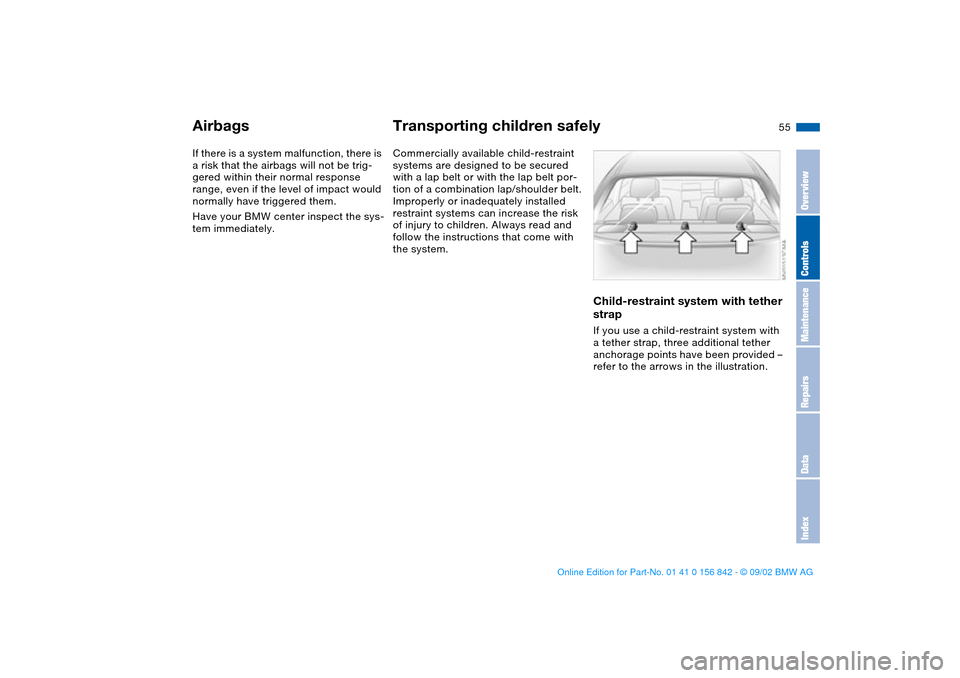
Child-restraint system with tether
strapIf you use a child-restraint system with
a tether strap, three additional tether
anchorage points have been provided –
refer to the arrows in the illustration.
Airbags
OverviewControlsMaintenanceRepairsDataIndex
handbook.book Page 55 Saturday, July 27, 2002 1:12 PM
Page 56 of 158

56
Depending on the location selected for
seating in the rear passenger area,
attach the tether strap to the corre-
sponding anchorage point to secure the
child-restraint system, as shown in the
illustration.
If the respective seating position is fit-
ted with a headrest lift the headrest and
pass the tether strap between the
headrest and the seat back.
It is recommended to readjust the head
restraint in the lowest possible position.
Adjust the tether strap according to the
child-restraint manufacturer's instruc-
tions.
Before installing any child-
restraint device or child seat,
please read the following:
Never install a rearward-facing child-
restraint system in the front passenger
seat of this vehicle.
Your vehicle is equipped with an airbag
supplemental restraint system for the
front passenger. Because the backrest
on any rear-facing child-restraint sys-
tem – of the kind designed for infants
under 1 year and 20 lbs/9 kg – would be
within the airbag's deployment range,
you should never mount such a device
in the front passenger seat, since the
impact of the airbag against the child
restraint's backrest could lead to seri-
ous or fatal injuries.
If it is necessary for a child – not an
infant – to ride in the front seat, certain
precautions should be taken. First,
move the passenger seat as far away
from the instrument panel as possible.
This important precaution is intended to
maximize the distance between the air-
bag and the child. Older children
should be tightly secured with the
safety belt after they have outgrown a
booster seat that is appropriate for their
age, height, and weight.
Younger children should be secured in
an appropriate forward-facing child-
restraint system that has first been
properly secured with a safety belt.
Never install a rearward-facing child-
restraint system in the front passenger
seat.
We strongly urge you to carefully read
and comply with the instructions for
installation and use provided by the
child-restraint's manufacturer whenever
you use such a device.
Do not attempt to modify child-restraint
systems. If you do this, the protection
provided by these systems could be
impaired.
Be sure that all occupants – of all ages –
remain properly and securely restrained
at all times.<
All rear seating positions in your vehicle
meet the recommendations of
SAE J1819, an industry recommended
practice for securing child-restraint sys-
tems in motor vehicles.
Transporting children safely
handbook.book Page 56 Saturday, July 27, 2002 1:12 PM
Page 57 of 158

57
Child seat securityAll of the rear belt retractors and the
front passenger's safety belt can be
locked for mounting and securing child-
restraint systems.
A label with the appropriate instructions
for this is located in the immediate
vicinity of the buckle latch of each
safety belt.To lock the safety beltExtract the entire length of the belt from
the inertia reel mechanism. Allow the
reel to retract the belt somewhat and
engage the buckle, then tighten the belt
against the child-restraint system. The
retraction mechanism is now locked.
The belt cannot be extracted further.
Always observe the installation instruc-
tions provided by the manufacturer of
the child-restraint system.To unlock the safety belt Release the safety belt, remove the
child seat and retract the safety belt to
its end position on the belt retractor.
LATCH child-restraint mounting
systemLATCH: Lower Anchors and Tether for
CHildren
Canadian models only:
The LATCH anchorage points are iden-
tified by buttons.
Transporting children safely
OverviewControlsMaintenanceRepairsDataIndex
handbook.book Page 57 Saturday, July 27, 2002 1:12 PM
Page 58 of 158
58
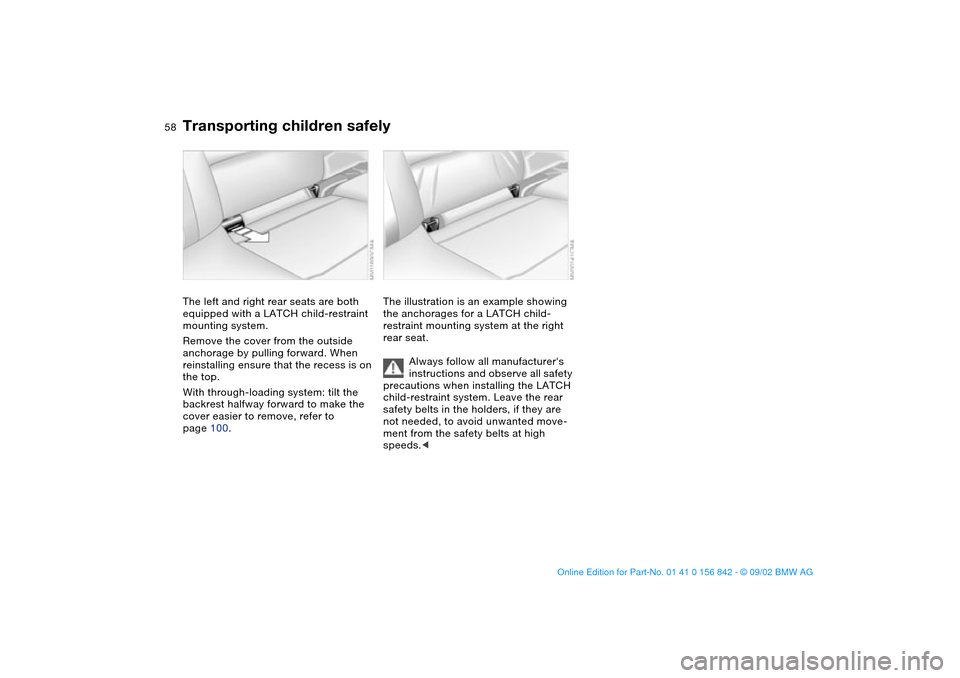
The left and right rear seats are both
equipped with a LATCH child-restraint
mounting system.
Remove the cover from the outside
anchorage by pulling forward. When
reinstalling ensure that the recess is on
the top.
With through-loading system: tilt the
backrest halfway forward to make the
cover easier to remove, refer to
page 100.
The illustration is an example showing
the anchorages for a LATCH child-
restraint mounting system at the right
rear seat.
Always follow all manufacturer's
instructions and observe all safety
precautions when installing the LATCH
child-restraint system. Leave the rear
safety belts in the holders, if they are
not needed, to avoid unwanted move-
ment from the safety belts at high
speeds.<
Transporting children safely
handbook.book Page 58 Saturday, July 27, 2002 1:12 PM
Page 100 of 158
100Loading and transporting
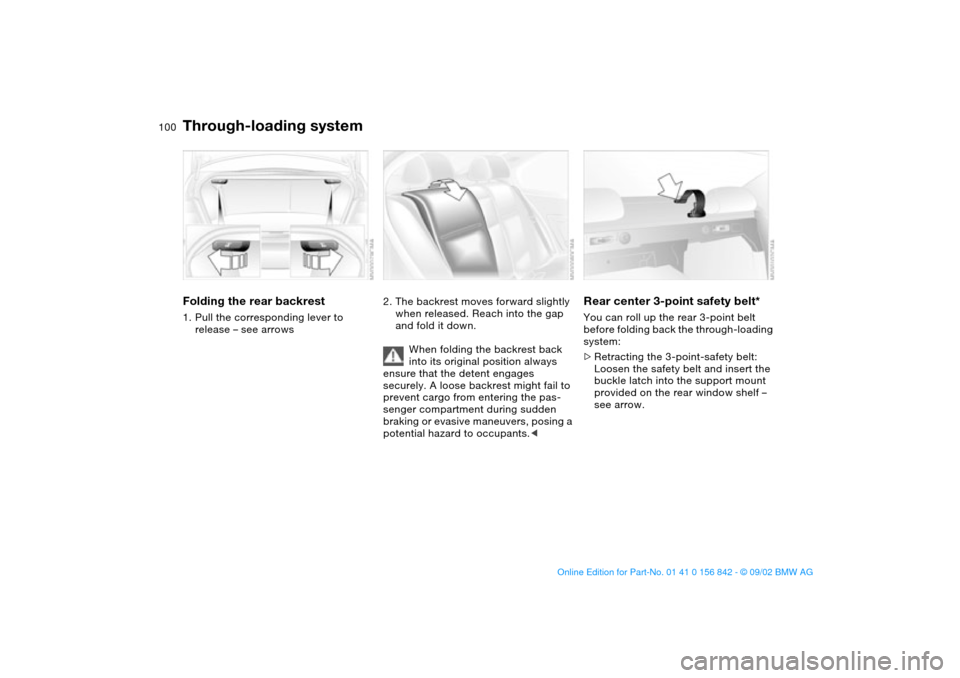
Through-loading systemFolding the rear backrest1. Pull the corresponding lever to
release – see arrows
2. The backrest moves forward slightly
when released. Reach into the gap
and fold it down.
When folding the backrest back
into its original position always
ensure that the detent engages
securely. A loose backrest might fail to
prevent cargo from entering the pas-
senger compartment during sudden
braking or evasive maneuvers, posing a
potential hazard to occupants.<
Rear center 3-point safety belt*You can roll up the rear 3-point belt
before folding back the through-loading
system:
>Retracting the 3-point-safety belt:
Loosen the safety belt and insert the
buckle latch into the support mount
provided on the rear window shelf –
see arrow.
handbook.book Page 100 Saturday, July 27, 2002 1:12 PM
Page 102 of 158
102
Cargo loading
Always position and secure the
load correctly. If you do not, it can
endanger the passengers during brak-
ing or evasive maneuvers.
Do not exceed the approved gross
weight or the approved maximum axle
loads, refer to page 146. Otherwise the
vehicle's operating safety is no longer
assured and you are in violation of the
law
Do not stow heavy or hard objects in
the passenger compartment without
first securing them. Otherwise they
would be thrown around during braking
and evasive maneuvers and endanger
the occupants.<
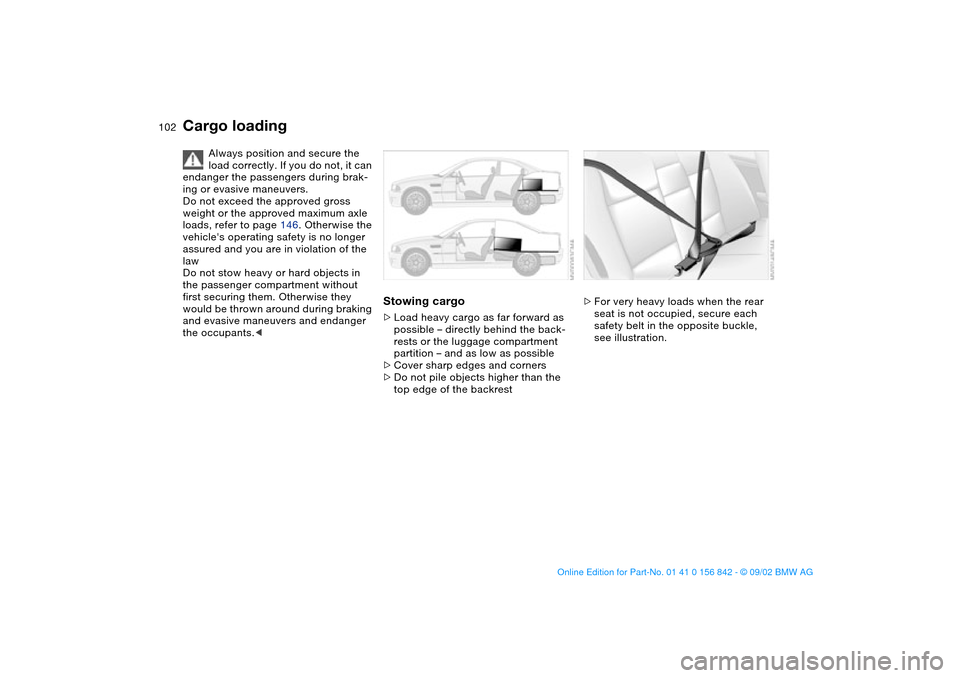
Stowing cargo>Load heavy cargo as far forward as
possible – directly behind the back-
rests or the luggage compartment
partition – and as low as possible
>Cover sharp edges and corners
>Do not pile objects higher than the
top edge of the backrest
>For very heavy loads when the rear
seat is not occupied, secure each
safety belt in the opposite buckle,
see illustration.
handbook.book Page 102 Saturday, July 27, 2002 1:12 PM
Page 112 of 158
112
Wheel and tire combinationsThe right choice
BMW recommends using only
wheels and tires that have been
approved by BMW for your particular
vehicle model, as otherwise body con-
tact and serious accidents can result
despite the use of the same nominal
size, e.g. due to manufacturing toler-
ances. If non-approved wheels and
tires are used, BMW cannot evaluate
their suitability, and therefore cannot be
held liable for driving safety.<
BMW tests certain tire brands for each
tire size, classifies them as road-safe
and approves them. Consult your BMW
center for more information. Observe
any country-specific regulations, e.g.
on making a corresponding entry in the
vehicle documents.
The correct wheel and tire combi-
nation affects different systems
such as ABS, DSC, Flat Tire Monitor.
The function of these systems is
impaired if improper wheel and tire
combinations are used.
Therefore, only use tires of the same
brand and same tread configuration on
the vehicle and, for example following a
tire failure, restore the approved wheel
and tire combination as soon as possi-
ble.<
The use of rims and lug bolts that
do not meet the specifications of
the original factory-installed equipment
will affect the safe operation of your
vehicle and may cause an accident and
personal injury.
Never mix tires of different design, such
as steel-belted radials with radial bias-
belted or bias-ply tires, etc. Mixing tire
types will adversely affect roadholding
and can lead to loss of vehicle con-
trol.<
StorageStore wheels and tires in a cool, dry
place, protecting them against light
whenever possible. Protect the tires
against contact with oil, grease and
fuel.
Winter tiresChoosing the right tireBMW recommends winter tires – M+S
tires – for operation under inclement
winter driving conditions. While all-sea-
son tires – M+S designation – provide
better winter traction than the corre-
sponding summer tires, they generally
do not achieve the performance of win-
ter tires.
In the interest of safe tracking and
steering response, install radial tires
made by the same manufacturer and
with the same tread configuration on all
four wheels if you elect to mount winter
tires.
When mounting winter wheels,
observe the different recesses of
the front and rear wheels, as otherwise
damage may result.<
handbook.book Page 112 Saturday, July 27, 2002 1:12 PM
Page 150 of 158

Everything from A to ZA
ABS Antilock Brake
System 107
indicator lamp 19
Accessories 5
Activated-charcoal filter 94
Adding brake fluid 116, 121
Air conditioning 92
Air distribution
automatic 92
individual 92
Air nozzles 90
Air outlets 90
Air pressure 109
checking 25
Air supply 92
Air supply vents
recirculated-air mode 93
Airbags 53
warning lamp 18
Alarm system 38
avoiding unintentional
alarms 39
indicator lamp 39
interior motion sensor 38
tilt alarm sensor 38
Antifreeze 120
Antilock Brake System
(ABS) 107
indicator lamp 19
Anti-theft system 30, 38
Armrest 96Ashtray
front 98
rear 98
AUC Automatic recircu-
lated-air control 93
Automatic car wash, refer to
the Caring for your vehicle
brochure
Automatic climate control 90
Automatic cruise control 72
Automatic dimming, interior
rearview mirror 52
Automatic headlamp
control 86
Automatic recirculated-air
control (AUC) 93
Auxiliary terminal for jump-
starting 116, 139
Average fuel
consumption 79
Average speed 79
Avoiding unintentional
alarms 39
Axle loads 146
B
Backrests
adjusting 44
unlocking 47
width adjustment 46
Backup lamps 64
replacing bulb 131Battery 137
charge 137
charge current 18
current warning lamp 18
Belts 47
3-point safety belt 100
height adjustment 48
Beverage holder 96
Blind, sun protection 94
Blower 92
BMW Maintenance
System 122
Bore 144
Bottle holder, see Beverage
holder 96
Brake fluid level 108
warning lamp 18, 121
Brake hydraulic system
warning lamps 18
Brake lamps
replacing bulb 131
Brake pads 108
Brake system
brake fluid level, warning
lamp 18
brake pads, indicator
lamp 19
Brakes
malfunctions 108
parking brake 63
Braking
driving notes 107Break-in procedures 106
Bulb replacement 129
C
California Proposition
65 warning 124
Can holder, see Beverage
holder 96
Capacities 147
Car care, refer to the Caring
for your vehicle brochure
Car vacuum cleaner, con-
necting 98
Car wash, refer to the Caring
for your vehicle brochure
Care, refer to the Caring for
your vehicle brochure
Cargo loading 102
Caring for headlamp cov-
ers, refer to the Caring for
your vehicle brochure 129
CBC Cornering Brake Con-
trol 107
indicator lamp 19
Cellular phone 97
Center armrest 96
Center high-mount brake
lamp 132
Central locking system 30
button 34
Check Control 76
handbook.book Page 150 Saturday, July 27, 2002 1:12 PM