2003 BMW 325XI belt
[x] Cancel search: beltPage 53 of 166
53
cult for a driver to ensure that children
in the rear seat will remain properly
positioned at all times and not place
their heads on or near the side airbag.
Therefore, we recommend that the
rear-seat side airbags, if installed in the
vehicle, be deactivated if children will
travel in the rear seat.
The rear side airbags may already have
been deactivated, either at the time of
manufacture or by a BMW center.
Labels in the door opening should indi-
cate the status of your rear side air-
bags. If you are uncertain of their sta-
tus, or wish to have the airbags
activated or deactivated, please con-
tact your BMW center.<
Even when all these guidelines are fol-
lowed, there is still a small residual risk
of injuries to the face, hands and arms
occurring from airbag deployment in
isolated instances.
The ignition and inflation noise may
induce a mild temporary hearing loss in
sensitive individuals.
Corresponding airbag warning labels
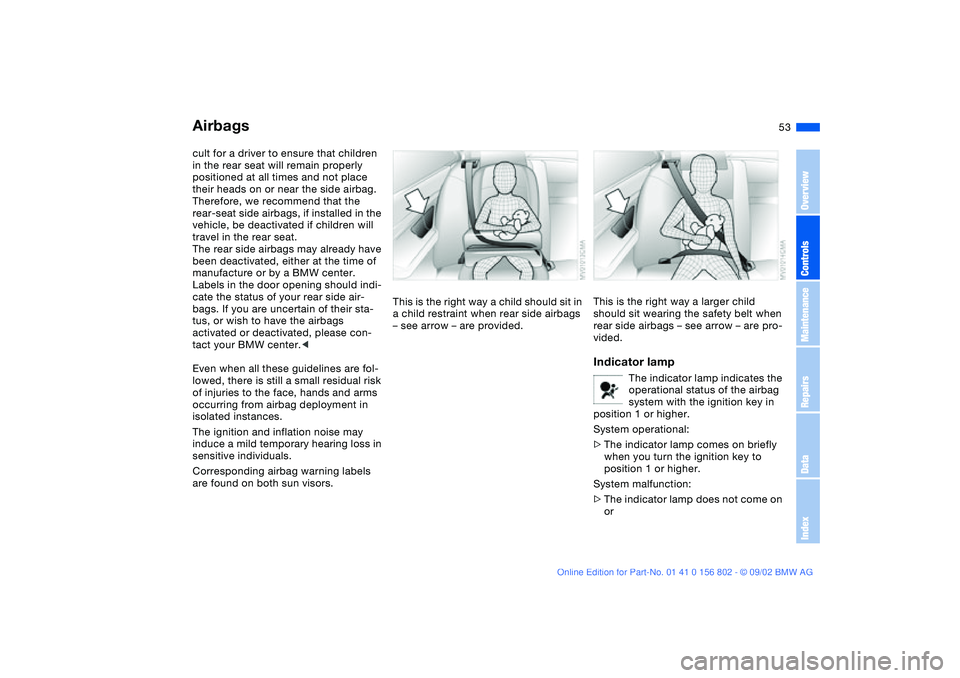
are found on both sun visors.This is the right way a child should sit in
a child restraint when rear side airbags
– see arrow – are provided.
This is the right way a larger child
should sit wearing the safety belt when
rear side airbags – see arrow – are pro-
vided.Indicator lamp
The indicator lamp indicates the
operational status of the airbag
system with the ignition key in
position 1 or higher.
System operational:
>The indicator lamp comes on briefly
when you turn the ignition key to
position 1 or higher.
System malfunction:
>The indicator lamp does not come on
or
Airbags
OverviewControlsMaintenanceRepairsDataIndex
handbook.book Page 53 Saturday, July 27, 2002 1:36 PM
Page 54 of 166
54
>the indicator lamp lights up continu-
ously.
If there is a system malfunction, there is
a risk that the airbags will not be trig-
gered within their normal response
range, even if the level of impact would
normally have triggered them.
Have your BMW center inspect the sys-
tem immediately.
Transporting children safelyCommercially available child-restraint
systems are designed to be secured
with a lap belt or with the lap belt por-
tion of a combination lap/shoulder belt.
Improperly or inadequately installed
restraint systems can increase the risk
of injury to children. Always read and
follow the instructions that come with
the system.
Child-restraint system with
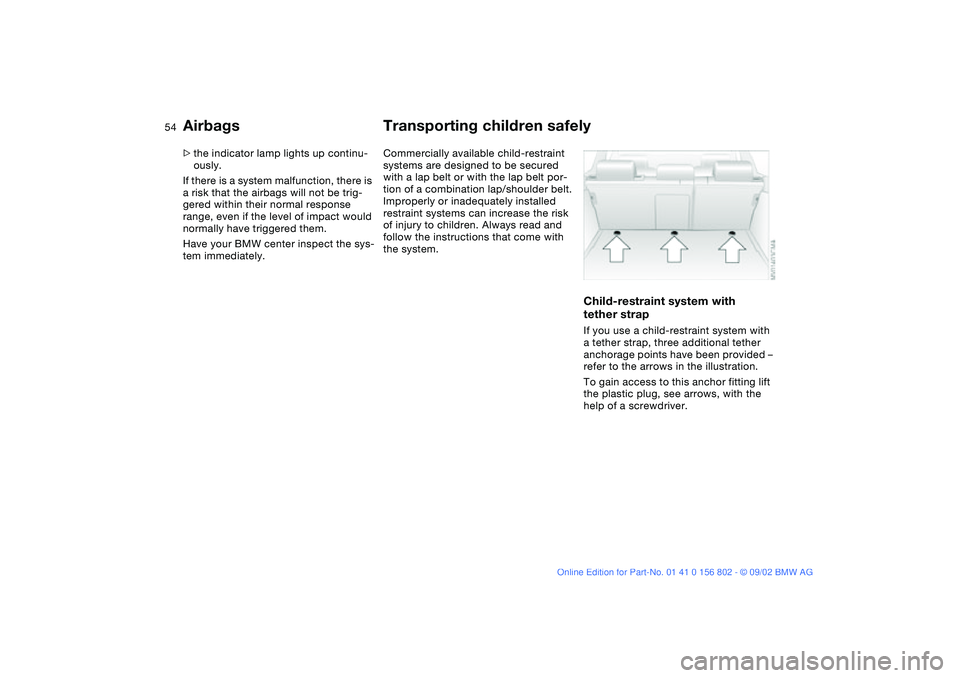
tether strapIf you use a child-restraint system with
a tether strap, three additional tether
anchorage points have been provided –
refer to the arrows in the illustration.
To gain access to this anchor fitting lift
the plastic plug, see arrows, with the
help of a screwdriver.
Airbags
handbook.book Page 54 Saturday, July 27, 2002 1:36 PM
Page 55 of 166
55
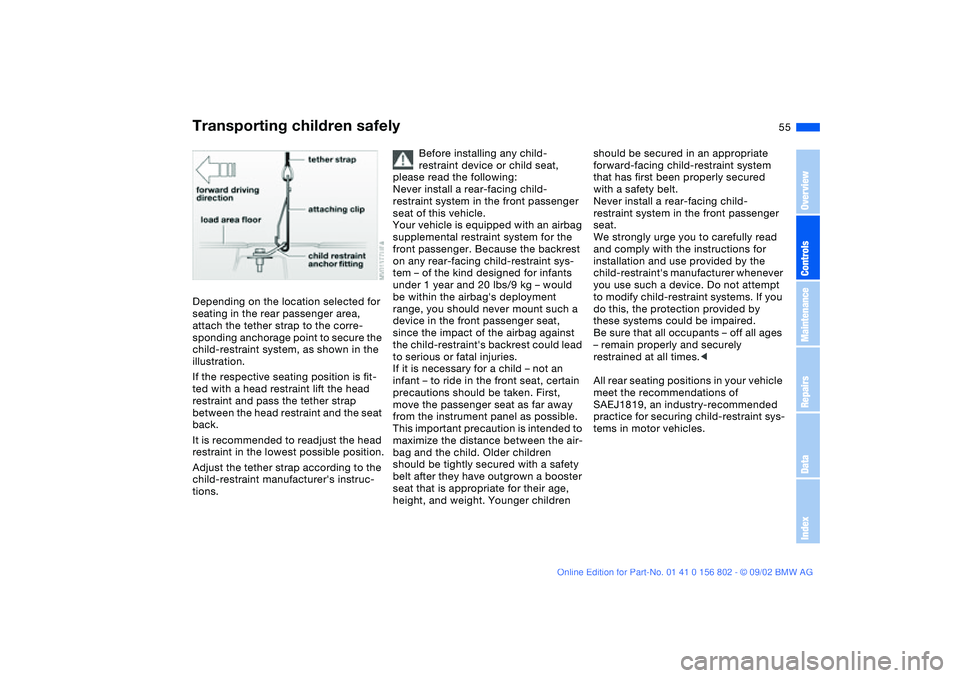
Depending on the location selected for
seating in the rear passenger area,
attach the tether strap to the corre-
sponding anchorage point to secure the
child-restraint system, as shown in the
illustration.
If the respective seating position is fit-
ted with a head restraint lift the head
restraint and pass the tether strap
between the head restraint and the seat
back.
It is recommended to readjust the head
restraint in the lowest possible position.
Adjust the tether strap according to the
child-restraint manufacturer's instruc-
tions.
Before installing any child-
restraint device or child seat,
please read the following:
Never install a rear-facing child-
restraint system in the front passenger
seat of this vehicle.
Your vehicle is equipped with an airbag
supplemental restraint system for the
front passenger. Because the backrest
on any rear-facing child-restraint sys-
tem – of the kind designed for infants
under 1 year and 20 lbs/9 kg – would
be within the airbag's deployment
range, you should never mount such a
device in the front passenger seat,
since the impact of the airbag against
the child-restraint's backrest could lead
to serious or fatal injuries.
If it is necessary for a child – not an
infant – to ride in the front seat, certain
precautions should be taken. First,
move the passenger seat as far away
from the instrument panel as possible.
This important precaution is intended to
maximize the distance between the air-
bag and the child. Older children
should be tightly secured with a safety
belt after they have outgrown a booster
seat that is appropriate for their age,
height, and weight. Younger children
should be secured in an appropriate
forward-facing child-restraint system
that has first been properly secured
with a safety belt.
Never install a rear-facing child-
restraint system in the front passenger
seat.
We strongly urge you to carefully read
and comply with the instructions for
installation and use provided by the
child-restraint's manufacturer whenever
you use such a device. Do not attempt
to modify child-restraint systems. If you
do this, the protection provided by
these systems could be impaired.
Be sure that all occupants – off all ages
– remain properly and securely
restrained at all times.<
All rear seating positions in your vehicle
meet the recommendations of
SAEJ1819, an industry-recommended
practice for securing child-restraint sys-
tems in motor vehicles.
Transporting children safely
OverviewControlsMaintenanceRepairsDataIndex
handbook.book Page 55 Saturday, July 27, 2002 1:36 PM
Page 56 of 166
56
Securing child-restraint systemAll of the rear belt retractors and the
front passenger's safety belt can be
locked for mounting and securing child-
restraint systems.
A label with the appropriate instructions
for this is located in the immediate
vicinity of the buckle latch of each
safety belt.To lock the safety beltExtract the entire length of the belt from
the inertia reel mechanism. Allow the
reel to retract the belt somewhat and
engage the buckle, then tighten the belt
against the child-restraint system. The
retraction mechanism is now locked.
The belt cannot be extracted further.
Always observe the installation instruc-
tions provided by the manufacturer of
the child-restraint system.To unlock the safety beltRelease the safety belt, remove the
child's seat and retract the safety belt
to its end position on the belt retractor.
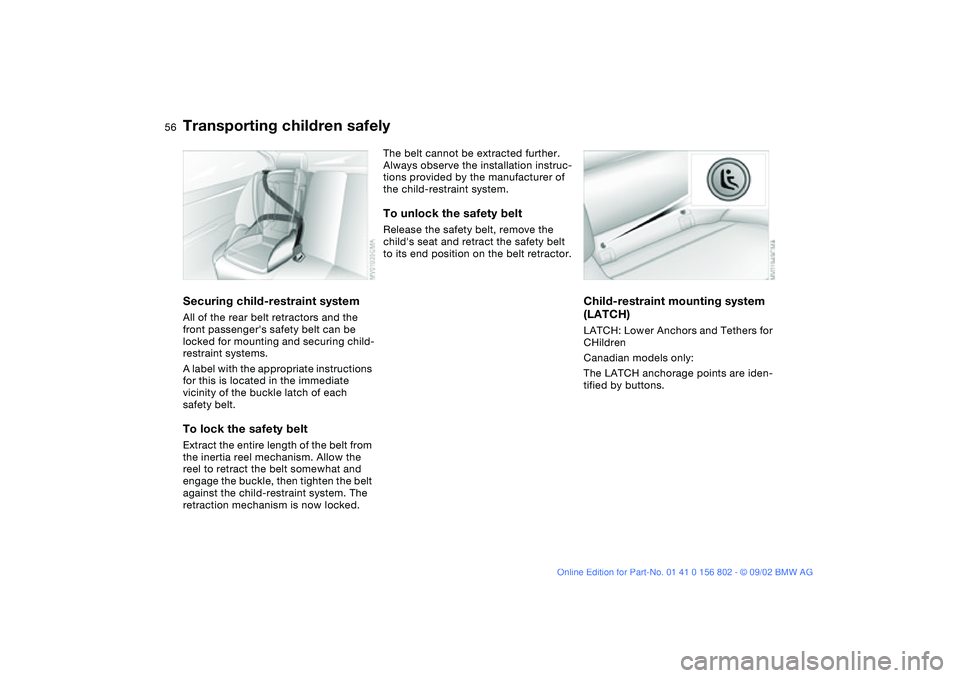
Child-restraint mounting system
(LATCH)LATCH: Lower Anchors and Tethers for
CHildren
Canadian models only:
The LATCH anchorage points are iden-
tified by buttons.
Transporting children safely
handbook.book Page 56 Saturday, July 27, 2002 1:36 PM
Page 110 of 166
110
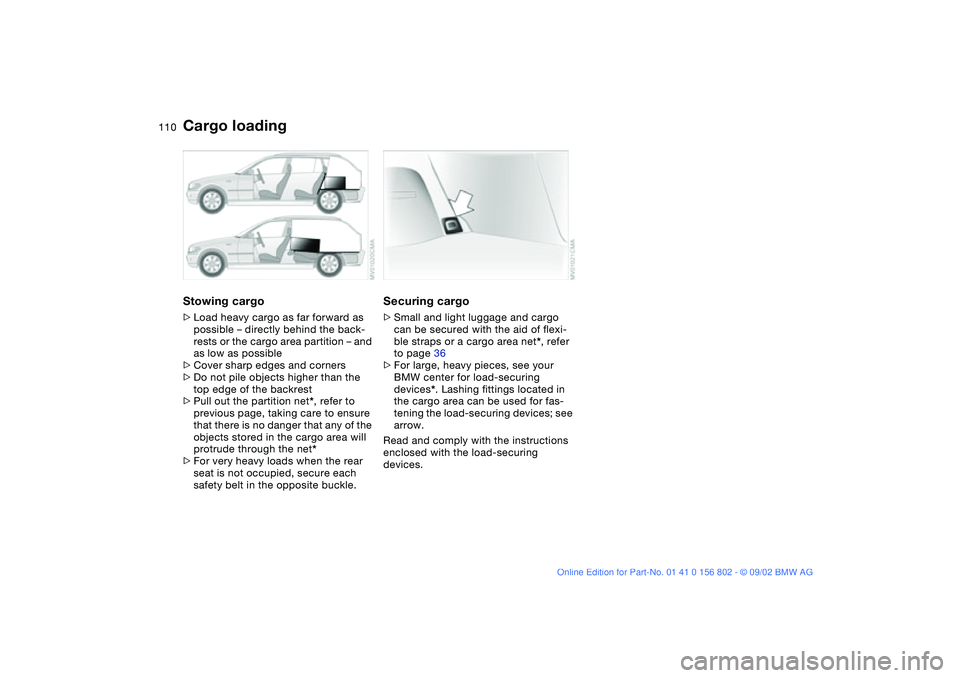
Stowing cargo>Load heavy cargo as far forward as
possible – directly behind the back-
rests or the cargo area partition – and
as low as possible
>Cover sharp edges and corners
>Do not pile objects higher than the
top edge of the backrest
>Pull out the partition net*, refer to
previous page, taking care to ensure
that there is no danger that any of the
objects stored in the cargo area will
protrude through the net*
>For very heavy loads when the rear
seat is not occupied, secure each
safety belt in the opposite buckle.
Securing cargo>Small and light luggage and cargo
can be secured with the aid of flexi-
ble straps or a cargo area net*, refer
to page 36
>For large, heavy pieces, see your
BMW center for load-securing
devices*. Lashing fittings located in
the cargo area can be used for fas-
tening the load-securing devices; see
arrow.
Read and comply with the instructions
enclosed with the load-securing
devices.
Cargo loading
handbook.book Page 110 Saturday, July 27, 2002 1:36 PM
Page 158 of 166
Everything from A to ZA
ABS Antilock Brake System
18, 115
Accessories 4, 5
Activated-charcoal filter 100
ADB Automatic Differential
Brake 78
Adding brake fluid 129
Air conditioning 92
Air distribution 94, 98
Air nozzles 92, 96
Air outlets 92, 96
Air pressure 117
check 25
Air supply 94, 98
Airbags 18, 52
Alarm system 37
Antifreeze agent 128
Antilock Brake System (ABS)
18, 115
Anti-theft system 37
Armrest 102
ASC+T Automatic Stability
Control plus Traction 18,
19, 78
Ashtray
front 104
rear 104
AUC Automatic recircu-
lated-air control 99Automatic car wash, refer to
the Caring for your vehicle
brochure
Automatic climate control 96
Automatic cruise control 69
Automatic Differential Brake
(ADB) 78
Automatic dimming, interior
rearview mirror 51
Automatic headlamp
control 89
Automatic recirculated-air
control (AUC) 99
Automatic Stability Control
plus Traction (ASC+T) 18,
19, 78
Automatic transmission with
Steptronic 19, 63
Average fuel
consumption 76
Average speed 76
Avoiding unintentional
alarms 38
Axle loads 154
B
Backrest, adjusting 44, 45
Backup lamps 62
replacing bulb 139
Battery
charge 146
discharged 146Battery charge current 18
Belts 47
Beverage holder 103
Blower 94, 98
BMW High Performance
Synthetic Oils 127
BMW sports seat 45, 46
Bore 152
Bottle holder, see Beverage
holder 103
Brake hydraulic system 18
Brake lamps
replacing bulb 139
Brake pads 19
Brake, parking 61
Brakes, malfunctions 116
Break-in procedures 114
Bulb, replacing 137
C
California Proposition 65
warning 132
Can holder, see Beverage
holder 103
Capacities 155
Car care, refer to the Caring
for your vehicle brochure
Car radio
refer to the Owner's Man-
ual for RadioCar telephone
refer to the separate
Owner's Manual
Car vacuum cleaner, con-
necting 104
Car wash, refer to the Caring
for your vehicle brochure
Cargo area 36, 107
capacity 154
emergency operation 35
floor 36
floor panel 109
remote control 32
Cargo area cover 107
Cargo area lamps 34
Cargo loading 109
Cargo, securing 110
Cassette player operation,
refer to the Owner's Man-
ual for Radio
CBC Cornering Brake
Control 18, 115
CD player operation, refer to
the Owner's Manual for
Radio
Cellular phone 103
Center armrest 102
Center high-mount brake
lamp 140
Central locking system 30
button 34
Charge indicator lamp 18
handbook.book Page 158 Saturday, July 27, 2002 1:36 PM
Page 161 of 166

Everything from A to Z
161
N
Navigation System, refer to
the separate Owner's
Manual
Neckrest 47
O
OBD interface socket 132
Obstruction protection 39
Odometer 71
Oil
capacity 155
quality 127
viscosity 127
Oil additives 127
Oil change intervals, refer to
the Service and Warranty
Information Booklet for US
models/Warranty and Ser-
vice Guide Booklet for
Canadian models
Oil consumption 126
Oil dipstick 126
Oil filter change 155
Oil level
checking 126
indicator lamp 18
Oil pressure
indicator lamp 18
OIL SERVICE 73
Oil types 127Onboard computer, refer to
the Owner's Manual for
Onboard Computer
Onboard tool kit 136
Operating elements 14
Outlets, ventilation 92, 96
Outside temperature dis-
play 75
P
Panic mode 32
Park Distance Control
(PDC) 77
Parking aid 77
Parking brake 61
Parking lamps 89
replacing bulb 138
Partition net 107
PDC Park Distance
Control 77
Pocket flashlight 102
Pollen 95, 100
Power output 152
Power seat 46
Power windows
safety switch 40
Pressure, tires 25, 85, 117
monitoring 85
R
Radiator 155Radio, refer to the Owner's
Manual for Radio
Rain sensor 67
Range 76
Reading lamps
front 91
rear 91
Rear lamps 139
Rear window defroster
94, 99
Rearview mirror 50
Recirculated-air mode
94, 99
Reclining seat 44
Refueling 24
Remote control 31
Remote control keys 30
Replacement key 30
Reporting safety defects 6
Reserve indicator lamp 72
Reverse 62
Roof load capacity 154
Roof-mounted luggage
rack 111
Run Flat tires 119, 145
S
Safety belt height adjust-
ment 48
Safety feature 39
Safety instructions 5Seat adjustment 44
mechanical 44
power 46
Seat heating 49
Seat memory 48
Securing cargo 110
Securing devices 110
Selector lever, automatic
transmission 63
Service and Warranty Infor-
mation Booklet 130
Service interval display
73, 130
Shiftlock 63
Side airbags 52
Size 153
Ski bag 106
Sliding/tilt sunroof 40
closing following an elec-
trical malfunction 42
convenience operation 31
remote control 32
Snow chains 121
Socket 104
Spare key 30
Spare tire 141
Speedometer 16
Sports seat 45
Standing lamps 90
Starting problems 59
Starting the engine 59
Steering wheel lock 59
OverviewControlsMaintenanceRepairsDataIndex
handbook.book Page 161 Saturday, July 27, 2002 1:36 PM
Page 162 of 166

Everything from A to ZSteering wheel with multi-
function buttons 22
Steering wheel, adjusting 50
Steptronic 63
Storage
refer to the Caring for your
vehicle brochure 137
Storage compartments 102
Stroke 152
Switching off the engine 61
Synthetic oils 127
T
Tachometer 16, 71
Tail lamp assembly
replacing bulb 139
Tail lamps
replacing bulb 139
Tailgate 34
emergency operation 35
Tailgate lamp
replacing bulb 141
Tank capacity 155
Technical data 152
Technical modifications 4, 5
Telephone hookup 103
Telephone, refer to the sep-
arate Owner's Manual
Temperature adjustment
94, 98Temperature display
engine coolant 72
outside temperature 75
Temperature layering 95, 99
Thigh support area, adjust-
ing 45
Third brake lamp 140
Tilt alarm sensor 32, 38
remote control 32
switching off 38
Time 74
Tire change 141
Tire inflation pressure
25, 117
Tire Pressure Monitor
(TPM) 85
Tire replacement 118
Tools 136
Torque 152
Towing eyelet 148
Towing the vehicle 148
TPM Tire Pressure
Monitor 85
Track 153
Transmission 62
Transporting children
safely 54
Tread depth, tires 117
Tread wear indicator 117
Trip odometer 71
Turn signal indicator 20, 66
replacing bulb 138Turning circle 153
U
Uniform Tire Quality
Grading 119
V
Vacuum cleaner, connect-
ing 104
Vehicle
break-in procedures 114
starting 59
switching off 61
Vehicle Memory 58
Vehicle storage
refer to the Caring for your
vehicle brochure
Vehicle weight 154
Ventilation 92, 96
draft-free 95, 99
Voice Control System, refer
to the separate Owner's
Manual
Voice recognition 22
W
Warning lamp Please fasten
safety belts 18
Warning lamps 18
Warning messages 73
Warranty and Service
Guide 130Warranty, refer to separate
booklet 6
Washer fluid
refilling 126, 155
Washer reservoir
filling 126, 155
Washer/wiper system 67
Water on roadways
deep water 115
Wear indicator for tires 117
Weights 154
Wheel, changing 141
Wheelbase 153
Wheels and tires 120
Width 153
Window condensation
removing 95, 98
Windows
convenience operation 31
defrosting 95
power 39
remote control 32
Windows, defrosting 98
Windshield washer reser-
voir, filling 126, 155
Windshield wipers 67
Winter tires 120
Wiper blades
replacing 136
Work in the engine compart-
ment 122
handbook.book Page 162 Saturday, July 27, 2002 1:36 PM