Page 230 of 355

Be sure
there is adequate ventilation
whenever you operate the engine.
Let the
engine and exhaust system cool
bef ore touching any parts.
Do
not run the engine unless in-
structed to do so. Read the instructions before you
begin, and make sure you have the
tools and skills required.
To reduce the possibility of f ire or
explosion, be caref ul when working
around gasoline or batteries. Use a
commercially available degreaser or
parts cleaner, not gasoline, to clean
parts. Keep cigarettes, sparks, and
flames away from the battery and all
f uel-related parts.
Bef ore you begin any maintenance,
make sure your car is parked on
level ground and that the parking
brake is set. Also, be sure the engine
is of f . This will help to eliminate
several potential hazards:
You should wear eye protection and
protective clothing when working
near the battery or when using
compressed air.
Maintenance Saf ety
Maint enance
Important Saf ety Precautions
Carbon monoxide poisoning
f rom engine exhaust.
Burns f rom hot parts.
Injury f rom moving parts.
227
Page 258 of 355
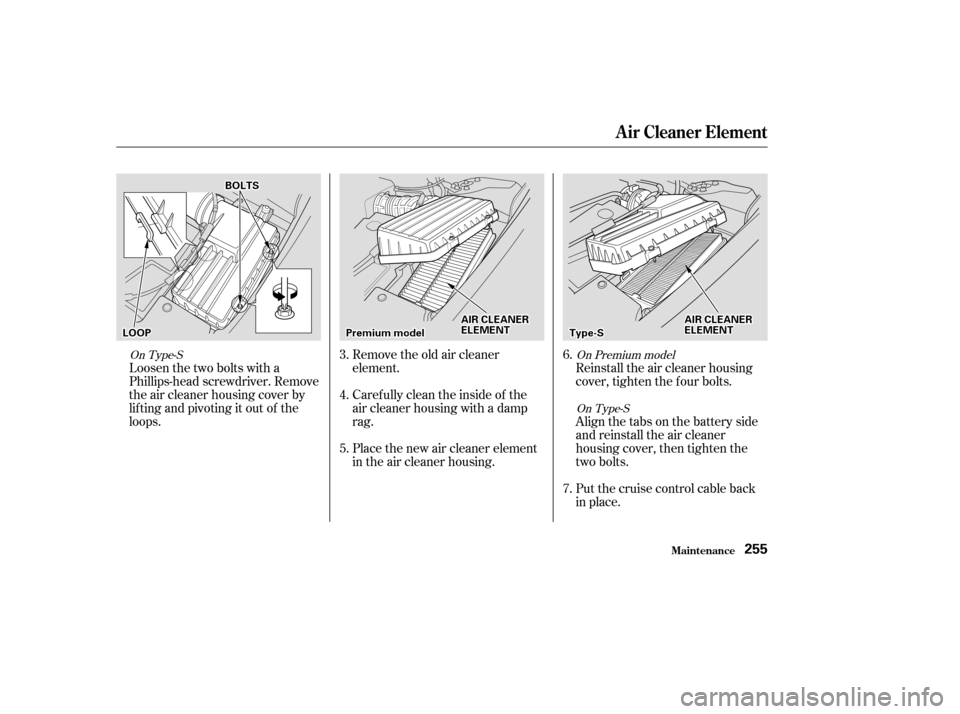
Loosen the two bolts with a
Phillips-head screwdriver. Remove
the air cleaner housing cover by
lif ting and pivoting it out of the
loops.Remove the old air cleaner
element.
Caref ully clean the inside of the
air cleaner housing with a damp
rag.
Place the new air cleaner element
in the air cleaner housing.Reinstall the air cleaner housing
cover, tighten the f our bolts.
Align the tabs on the battery side
and reinstall the air cleaner
housing cover, then tighten the
two bolts.
Put the cruise control cable back
in place.
3.
4.
5.
6.
7.
On Premium model
On Type-S
On Type-S
A ir Cleaner Element
Maint enance255
A AI
IRR C
CLLE
E A
A N
NE ER
R
E
E L
LEE M
M E
EN
NT T
L
LO OO OPP P
Pr
ree m
m i
iuu m
m m
mo
od
de
ell A
A
I
IRR C
CLLE
E A
A N
NE ER
R
E
E L
LEE M
M E
EN
NT T
B
BO
OL LTT S
S
T
Ty
ypp e
e-
-S
S
Page 262 of 355
Check the battery condition by
looking at the test indicator window
on the battery.
The label on the battery explains the
test indicator’s colors.
Check the condition of your car’s
battery monthly. You should check
the color of the test indicator window,
and f or corrosion on the terminals.
To remove the battery cover, pull up
on the right side of the cover to
remove it from the bolt, then pull the
cover out.
To reinstall the cover, insert the pins
ontheleftsideof thecoverintothe
holes and put the cover over the
battery, then push the right side of
the cover over the bolt.
CONT INUED
Battery
Maint enance259
T TE
ES
ST T I
INND DI
ICCA A T
TO
OR R W
WI INND DO
OW W
T
T
E
ES
ST T I
INND DI
ICCA A T
TO
OR R W
WI INND DO
OW W B
BA
A T
TT
TE
ER
RY Y
C
CO OV VE
ER
R
Page 263 of 355

�µ
Check the battery terminals for
corrosion (a white or yellowish
powder). To remove it, cover the
terminals with a solution of baking
soda and water. It will bubble up and
turn brown. When this stops, wash it
of f with plain water. Dry of f the
battery with a cloth or paper towel.
Coat the terminals with grease to
help prevent f uture corrosion.
If the terminals are severely cor-
roded, clean them with baking soda
and water. Then use a wrench to
loosen and remove the cables f rom
the terminals. Always disconnect the
negative ( ) cable f irst and recon-
nect it last. Clean the battery termi-
nals with a terminal cleaning tool or
wire brush. Reconnect and tighten
the cables, then coat the terminals
with grease.If you need to connect the battery to
a charger, disconnect both cables to
prevent damage to the car’s
electrical system.
Battery posts,
terminals and related accessories
contain lead and lead compounds. WARNING:
Wash hands af ter handling.
Battery
Maint enance260
The battery gives off explosive
hydrogen gas during normal
operation.
A spark or flame can cause the
battery to explode with enough
force to kill or seriously hurt you.
Wear protective clothing and a
face shield, or have a skilled
mechanic do the battery
maintenance.
Page 264 of 355
If your car’s battery is disconnected
or goes dead, all stored driving
positions will be lost. To store the
driving positions again, see the
storingprocedureonpage .
The Navigation System will also
disableitself.Thenexttimeyouturn
on the ignition switch, the system
will require you to enter a PIN
bef ore it can be used. Ref er to the
Navigation System Owner’s Manual.
If your car’s battery is disconnected
or goes dead, your driver’s power
window (see page ) and your
audio system will disable itself . The
nexttimeyouturnontheradioyou
will see ‘‘ ’’ in the f requency
display. Use the Preset buttons to
enter the f ive-digit code (see page
). 100
106
157
3.2 CL with Navigation System
Battery
Maint enance261
Charging the battery with the cables
connected can seriously damage your
car’s electronic controls. Detach the
battery cables bef ore connecting the
battery to a charger.
Page 286 of 355

Block the rear wheels.
Fill the f uel tank.
Change the engine oil and f ilter
(see page ).
Wash and dry the exterior
completely.
Cleantheinterior.Makesurethe
carpeting, floor mats, etc. are
completely dry.
If you need to park your car f or an
extended period (more than one
month), there are several things you
should do to prepare it f or storage.
Proper preparation helps prevent
deterioration and makes it easier to
get your car back on the road. If
possible, store your car indoors.
If the car is to be stored for a
longer period, it should be
supported on jackstands so the
tires are of f the ground.
Leave one window open slightly (if
the car is being stored indoors).Coverthecarwitha‘‘breathable’’
cover, one made f rom a porous
material such as cotton.
Nonporous materials, such as
plastic sheeting, trap moisture,
which can damage the paint.
Disconnect the battery.
Support the f ront wiper blade
arms with a f olded towel or rag so
they do not touch the windshield.
To minimize sticking, apply a
silicone spray lubricant to all door
and trunk seals. Also, apply a
vehiclebodywaxtothepainted
surfaces that mate with the door
and trunk seals. If possible, run the engine f or a
while periodically (pref erably once
amonth).
If you store your car f or 12 months
or longer, have your Acura dealer
perf orm the inspections called f or in
the 24 months/30,000 miles (48,000
km) maintenance schedule (Normal
Conditions) as soon as you take it
out of storage (see page ). The
replacements called f or in the
maintenance schedule are not
needed unless the car has actually
reached that time or mileage.
Leave the parking brake off. Put
the transmission in Reverse
(6-speed manual) or Park
(automatic). 230
241
Maint enance
St oring Your Car
283
Page 304 of 355

When you turn the ignition switch to
START (III), you do not hear the
normal noise of the engine trying to
start. You may hear a clicking sound
or series of clicks, or nothing at all.
Check these things:Check the transmission interlock.
The transmission must be in Park
orNeutralorthestarterwillnot
operate.
Turn the ignition switch to ON (II).
Turn on the headlights and check
their brightness. If the headlights
are very dim or don’t light at all,
the battery is discharged. See on page . Turn the ignition switch to START
(III). If the headlights do not dim,
check the condition of the f uses. If
thefusesareOK,thereisproba-
bly something wrong with the
electrical circuit for the ignition
switch or starter motor. You will
need a qualif ied technician to
determine the problem. (See
on page .)If the headlights dim noticeably or
go out when you try to start the
engine, either the battery is dis-
charged or the connections are
corroded. Check the condition of
the battery and terminal connec-
tions (see page ). You can
then try jump starting the car from
a booster battery (see page ).
303 320
259
303
If Your Engine Won’t Start
T aking Care of t he Unexpect ed
Nothing Happens or the Starter
Motor Operates Very Slowly
Jump Starting Emergency T owing
301
Page 306 of 355

If your car’s battery has run down,
you may be able to start the engine
by using a booster battery. Although
this seems like a simple procedure,
you should take several precautions.Turn of f all the electrical acces-
sories: climate control, stereo
system, lights, etc.
Put the transmission in Neutral or
Park, and set the parking brake.
Remove the battery cover (see
page ).
You cannot start an Acura with an
automatic transmission by pushing
or pulling it.
Open the hood and check the
physical condition of the battery
(see page ). In very cold
weather, check the condition of
the electrolyte. If it seems slushy
or like ice, do not try jump starting
until it thaws.
To jump start your car, f ollow these
directions closely:
1. 2.
3.
259
259
CONT INUED
Jump Starting
T aking Care of t he Unexpect ed303
A battery can explode if you do
not follow the correct procedure,
seriously injuring anyone
nearby.
Keep all sparks, open flames,
and smoking materials away
from the battery. If a battery sits in extreme cold, the
electrolyte inside can f reeze.
Attempting to jump start with a f rozen
battery can cause it to rupture.