2002 VOLVO S60 trunk
[x] Cancel search: trunkPage 56 of 106

Fuel filler door
Press the button on the light switch panel (see illustration on page 40) when the car is at a standstill to unlock the fuel
filler door. Please note that the fuel filler door will remain unlocked until the car is driven again at a speed of over
approximately 5 mph (8km/h). An audible click will be heard when the fuel filler door relocks.
If you intend to leave your car while it is being refueled, this feature enables you to lock the doors/trunk while leaving
the fuel filler door unlocked.
You can also keep the car locked if you remain inside during refueling. The central locking button does not lock the
fuel filler door.
Be sure the fuel filler door is not obstructed and is completely closed after refueling.
Open the fuel filler cap slowly during hot weather.
NOTE: During a transitional period, a small number of service stations may still have fuel nozzles that are not
compatible with the fuel filler neck on cars equipped with the evaporative control system.
Refueling
The fuel tank is designed to hold approximately 18.5 US gals (70 liters) or 21.1 US gals (80 liters) on turbo models,
with sufficient volume left over to accommodate possible expansion of the fuel in hot weather. Be aware that the
"usable" tank capacity will be somewhat less than the specified maximum. When the fuel level is low, such factors as
ambient temperature, the fuel's "Reid vapor pressure" characteristics, and terrain can affect the fuel pump's ability to
supply the engine with an adequate supply of fuel. Therefore, it is advisable to refuel as soon as possible when the
needle nears the red zone, or when the fuel warning light comes on.
CAUTION:
Do not refuel with the engine running *. Turn the ignition off or to position I. If the ignition is on, an incorrect reading
could occur in the fuel gauge After refueling, close the fuel filler cap by turning it clockwise until it clicks into place*.
Allow for fuel expansion by not overfilling the tank. Overfilling could also cause damage to the emission control
systems. Avoid spilling gasoline during refueling. In addition to causing damage to the environment, gasolines
containing alcohol can cause damage to painted surfaces, which may not be covered under the New Vehicle Limited
Warranty.
Do not use gasolines containing methanol (methyl alcohol, wood alcohol). This practice can result in vehicle
performance deterioration and can damage critical parts in the fuel system. Such damage may not be covered under the
New Vehicle Limited Warranty.
* If the fuel filler cap is not closed tightly or if the engine is running when the car is refueled, the Check Engine Light
(malfunction indicator lamp) may indicate a fault. However, your vehicle's performance will not be affected. Use only
ProCarManuals.com
Page 59 of 106

Do not exceed posted speed limits.
Avoid carrying unnecessary items (extra load) in the car.
Maintain correct tire pressure. Check tire pressure regularly (when tires are cold).
Remove snow tires when threat of snow or ice has ended.
Note that roof racks, ski racks, etc, increase air resistance and also fuel consumption.
Avoid using automatic transmission kickdown feature unless necessary.
However, at higher driving speeds, fuel consumption will be lower with the air conditioning on and the windows
closed than with the air conditioning off and the windows open.
Using the onboard trip computer's fuel consumption modes can help you learn how to drive more economically.
Other factors that decrease gas mileage are:
Worn or dirty spark plugs
Incorrect spark plug gap
Dirty air cleaner
Dirty engine oil and clogged oil filter
Dragging brakes
Incorrect front end alignment Some of the above mentioned items and others are checked at the standard
Maintenance Service intervals.
NOTE: Vehicles equipped with automatic transmissions should use (D) rive as often as possible and avoid using
"kickdown" to help improve fuel economy.
WARNING!
Driving with the trunk open: Driving with the trunk open could lead to poisonous exhaust gases entering the
passenger compartment. If the trunk must be kept open for any reason, proceed as follows
- Close the windows
- Set the ventilation system control to air flow to floor, windshield and side windows and blower control to its
highest setting.
CAUTION: Drive slowly and carefully if going through standing water (i. e. flooded roadways, etc.). Damage to the
engine could result if excess water is drawn in through the air intake system. Never drive the vehicle in water deeper
than 1 foot (300 mm).
Weight distribution affects handling
At the specified curb weight your car has a tendency to understeer, which means that the steering wheel has to be
turned more than might seem appropriate for the curvature of a bend. This ensures good stability and reduces the risk
of rear wheel skid. Remember that these properties can alter with the vehicle load.
pg. 134 General information
The heavier the load in the trunk (max. 220 lbs, 100 kg), the less the tendency to understeer.
Handling, roadholding
Vehicle load, tire design and inflation pressure all affect vehicle handling. Therefore, check that the tires are inflated to
the recommended pressure according to the vehicle load. See "Tire pressure" section.
Loads should be distributed so that capacity weight or maximum permissible axle loads are not exceeded.
pg. 135 Manual transmission
ProCarManuals.com
Page 72 of 106

Changing wheels
The spare wheel is located under the carpet on the trunk floor. The jack and crank are secured in the wheel recess.
There are two jack attachment points on each side of the car (see illustration on next page). To change a wheel:
Engage the parking brake.
Put the gear selector in (P) ark (automatic transmission) or reverse (manual transmission).
Remove the wheel cap (where applicable) using the lug wrench in the tool kit.
With the car still on the ground, use the lug wrench to loosen the wheel bolts 1/2 - 1 turn. Turn the bolts
counterclockwise to loosen.
CAUTION:
The car must not be driven with wheels of different dimensions or with a spare tire other than the one that came with
the car. The use of different size wheels can seriously damage your car's transmission.
Correct tightening torque on wheel bolts must be observed. The wheel bolts should never be greased or lubricated. The
extended, chromed wheel bolts must not be used with steel rims, as they make it impossible to fit the hub caps.
pg. 161 Changing wheels
ProCarManuals.com
Page 83 of 106

WARNING!
Check that the hood locks properly when closed!
Engine compartment
1. Expansion tank - coolant
2. Power steering fluid reservoir
3. Washer fluid reservoir
4. Dipstick - engine oil
5. Radiator
6. Cooling fan
7. Oil filler cap - engine
8. Clutch/brake fluid reservoir
9. Relay/fuse box
10. Air cleaner
11. Battery (in trunk)
12. Data plate
WARNING!
The cooling fan (6) may start or continue to operate (for up to 6 minutes) after the engine has been switched off.
pg. 173 Oils and fluids
Oil quality
Engine oil must meet the minimum ILSAC specification GF-2, including ACEA A1, API SJ, SJ/CF and SJ/ Energy
Conserving.
Your Volvo has been certified using ILSAC oil specification GF-2 5W -30. Volvo recommends use of oil with a
quality rating equal to or higher that ILSAC GF-2. Equivalent and better oils include ACEA A1, API SJ, SJ/CF and
SJ/Energy conserving. Lower quality oils may not offer the same fuel economy, engine performance, or engine
protection.
Depending on your driving habits, premium or synthetic oils may provide superior fuel economy and engine
protection. Consult your Volvo retailer for recommendations on premium or synthetic oils.
Oil additives must not be used.
NOTE: Synthetic oil is not used when the oil is changed at normal maintenance services. This oil is only used at
customer request, at additional charge. Please consult your Volvo retailer.
ProCarManuals.com
Page 89 of 106

*The Vehicle Identification Number (VIN) should always be quoted in all correspondence concerning your vehicle
with the retailer and when ordering parts.
pg. 195 Dimensions, weights
Dimensions
Length 180 in. (458 cm)
Width 71 in. (180 cm)
Height 56.2 in. (143 cm)
Wheelbase 107 in. (272 cm)
Front track 61.5 in. (156 cm)
Rear track 61.4 (156 cm)
Turning circle, between curbs 35.4- 38.7 ft. (10.8- 11.8 m)
Cargo capacity, trunk SAE V1 - 13.9 (394)
Weights
Gross vehicle weight *
5 cyl. (manual transmission)
USA 4360 lbs
Canada 1980 kg
5 cyl. (automatic transmission)
USA 4400 lbs
Canada 1996 kg
5 cyl. turbo (manual transmission)
USA 4430 lbs
Canada 2110 kg
5 cyl. turbo (automatic transmission)
USA 4470 lbs
Canada 2030 kg
ProCarManuals.com
Page 93 of 106

Trunk lighting5 WSV 8.5
Glove compartment lighting 2 WBA 9 s
Vanity mirror 1.2 WSV 5.5
pg. 201 Suspension
Wheel dimension 15"16"
Rim diameter (mm) 415440
tire side diameter(mm) 515540
Toe- in front (degrees) 0.1°± 0. 1°0.1°± 0. 1°
Toe- in rear (degrees) 0.2°+± 0.2°0.2+± 0. 2°
Toe- in front (mm) rim measurement 2. 2± 0. 72.3± 0.8
tire side measurement 2.7± 0.92. 8± 0. 9
Toe- in rear (mm) rim measurement 1. 4± 1. 41.5± 1.5
tire side measurement 1.8± 1.81. 9± 1. 9
Rear suspension
Individual rear wheel suspension with longitudinal support arms, double link arms and track rods.
Front suspension
Spring strut suspension with integrated shock absorbers and control arms linked to the support frame. Power-assisted
rack and pinion steering. Safety type steering column.
pg. 202 Electrical system
Electrical system
12- volt system with voltage controlled generator. Single wire system in which the chassis and engine block are used
as conductors, grounded on the chassis.
Battery
Voltage 12 V
Cold start capacity (CCA) 600 A
Reserve capacity (RC) 115 min
If you must replace your battery, be sure to replace it with a battery of the same cold start capacity and reserve
capacity as the original (See the decal on the battery).
Generator max. current 140 A
Starter motor, power 1.4 kW
Spark plugs P/ N272313- 8 or equivalent
Gap 0.028- 0.032 in. 0.7- 0.8 mm
Tightening torque 22 ft. lbs. (30 Nm)
Firing order 1- 2- 4- 5- 3
WARNING!
The distributor ignition system operates at very high voltages. Special safety precautions must be followed to
prevent injury. Always turn the ignition off when:
áReplacing distributor ignition components e. g. plugs, coil, etc.
ProCarManuals.com
Page 100 of 106

K
Keylock2 , 131
Keys118
Kickdown137
L
LED illumination41
Lighting panel40
Load carriers152
Locking121
Locking steering wheel132
Locks117
Long distance trips154
Long loads - carrying114
Low beam bulb182
Lubricants198
M
Maintenance Schedule168
Malfunction indicator light33
Manual climate control with air conditioning60
Manual transmission135
Messages in the display36
Multifilter with air quality sensor59
O
Occupant safety28
Octane rating128
Odometer30
Oil pressure33
Oil quality173
Oil viscosity173
Opening the trunk from the inside122
Opening/ locking the trunk122
P
P Park136
, 138
Paint - color code166
Paintwork damage166
Parking brake33 , 46
Parking lights40
Pen holder111
Polishing165
Power seat104
Power steering fluid176
Power sun roof50
Prem- Air3
Programme type PT72
ProCarManuals.com
Page 103 of 106
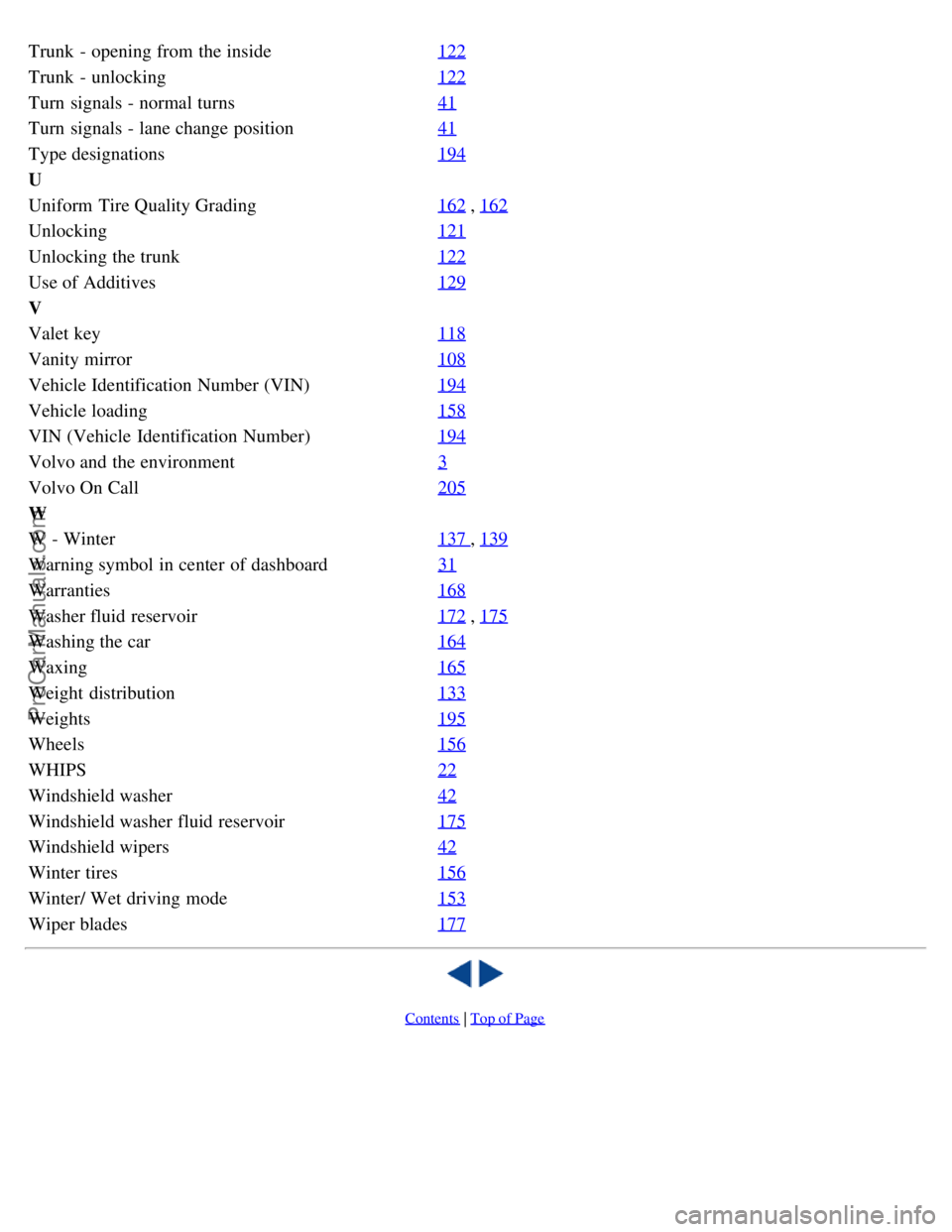
Trunk - opening from the inside122
Trunk - unlocking122
Turn signals - normal turns41
Turn signals - lane change position41
Type designations194
U
Uniform Tire Quality Grading162
, 162
Unlocking121
Unlocking the trunk122
Use of Additives129
V
Valet key118
Vanity mirror108
Vehicle Identification Number (VIN)194
Vehicle loading158
VIN (Vehicle Identification Number)194
Volvo and the environment3
Volvo On Call205
W
W - Winter137
, 139
Warning symbol in center of dashboard31
Warranties168
Washer fluid reservoir172 , 175
Washing the car164
Waxing165
Weight distribution133
Weights195
Wheels156
WHIPS22
Windshield washer42
Windshield washer fluid reservoir175
Windshield wipers42
Winter tires156
Winter/ Wet driving mode153
Wiper blades177
Contents | Top of Page
ProCarManuals.com