Page 238 of 334
02 SIENNA_U (L/O 0107)
2342002 MY SIENNA_U (OM45407U)
�Do not drive with objects left on
top of the instrument panel. They
may interfere with the driver’s field
of view. Or they may move during
sharp vehicle acceleration or turn-
ing, and impair the driver’s control
of the vehicle. In an accident they
may injure the vehicle occupants.
NOTICE
Do not load the vehicle beyond the
vehicle capacity weight specified in
Section 8.
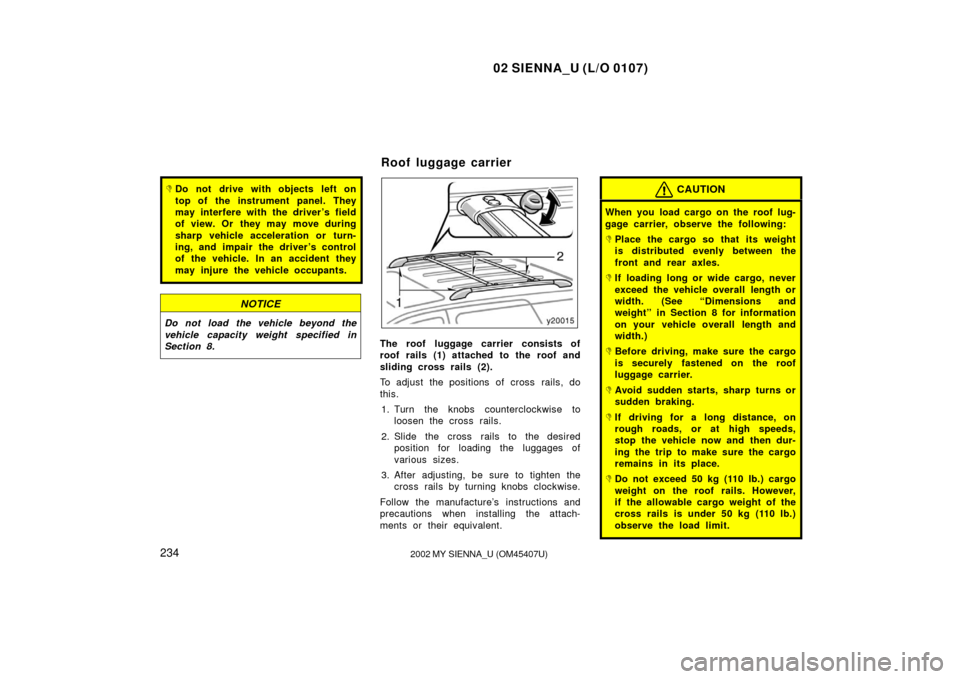
The roof luggage carrier consists of
roof rails (1) attached to the roof and
sliding cross rails (2).
To adjust the positions of cross rails, do
this.
1. Turn the knobs counterclockwise to loosen the cross rails.
2. Slide the cross rails to the desired position for loading the luggages of
various sizes.
3. After adjusting, be sure to tighten the cross rails by turning knobs clockwise.
Follow the manufacture’s instructions and
precautions when installing the attach-
ments or their equivalent.
CAUTION
When you load cargo on the roof lug-
gage carrier, observe the following:
�Place the cargo so that its weight
is distributed evenly between the
front and rear axles.
�If loading long or wide cargo, never
exceed the vehicle overall length or
width. (See “Dimensions and
weight” in Section 8 for information
on your vehicle overall length and
width.)
�Before driving, make sure the cargo
is securely fastened on the roof
luggage carrier.
�Avoid sudden starts, sharp turns or
sudden braking.
�If driving for a long distance, on
rough roads, or at high speeds,
stop the vehicle now and then dur-
ing the trip to make sure the cargo
remains in its place.
�Do not exceed 50 kg (110 lb.) cargo
weight on the roof rails. However,
if the allowable cargo weight of the
cross rails is under 50 kg (110 lb.)
observe the load limit.
Roof luggage carrier
Page 304 of 334
02 SIENNA_U (L/O 0107)
3002002 MY SIENNA_U (OM45407U)
If wheel covers are used, they will be
scratched by the chain band, so remove
the covers before putting on the chains.
CAUTION
�Do not exceed 50 km/h (30 mph) or
the chain manufacturer ’s recom-
mended speed limit, whichever is
lower.
�Drive carefully avoiding bumps,
holes, and sharp turns, which may
cause the vehicle to bounce.
�Avoid sharp turns or lockedwheel
braking, as use of chains may ad-
versely affect vehicle handling.
�When driving with chains installed,
be sure to drive carefully. Slow
down before entering the curves to
avoid losing control of the vehicle.
Otherwise an accident may occur.
NOTICE
Do not attempt to use a tire chain on
the compact spare tire, as it may re-
sult in damage to the vehicle as well
as the tire.
Replacing wheels
WHEN TO REPLACE YOUR WHEELS
If you have wheel damage such as
bending, cracks or heavy corrosion, the
wheel should be replaced.
If you fail to replace damaged wheels, the
tire may slip off the wheel or cause loss
of handling control.
WHEEL SELECTION
When replacing wheels, care should be
taken to ensure that the wheels are re-
placed by ones with the same load ca-
pacity, diameter, rim width, and offset.
This must be observed on compact spare
tires, too.
Correct replacement wheels are available
at your Toyota dealer.
A wheel of a different size or type may
adversely affect handling, wheel and bear-
ing life, brake cooling, speedometer/odom-
eter calibration, stopping ab ility, headlight
aim, bumper height, vehicle ground clear-
ance, and tire or snow chain clearance to
the body and chassis. Replacement with used wheels is not rec-
ommended as they may have been sub-
jected to rough treatment or high mileage
and could fail without warning. Also, bent
wheels which have been straightened may
have structural damage and therefore
should not be used. Never use an inner
tube in a leaking wheel which is designed
for a tubeless tire.
Initial adjustment of the tire pressure
warning system is necessary after you
have replaced your wheels. See “Tire
pressure warning system” in Section
16.
Page 320 of 334
02 SIENNA_U (L/O 0107)
3162002 MY SIENNA_U (OM45407U)
Dimensions and weight Engine
Model:
1MZFE
Type: 6 cylinder V type 4 cycle, gasoline
Bore and stroke, mm (in.): 87.5 �83.0 (3.44 �3.27)
Displacement, cm
3 (cu. in.):
2995 (182.8)
Overall width mm (in.)
2900 (114.2)
Overall height mm (in.)
1610 (63.4)
Wheelbase mm (in.)
Front tread mm (in.) 1565 (61.6)
Rear tread mm (in.)
511 (1127)
∗: Unladen vehicleOverall length mm (in.)
Vehicle capacity weight
kg (lb.)
(occupants + luggage) 4930 (194.1)
1865 (73.4)
1710 (67.3)
∗
Page 328 of 334

02 SIENNA_U (L/O 0107)
3242002 MY SIENNA_U (OM45407U)
If you believe that your vehicle
has a defect which could cause a
crash or could cause injury or
death, you should immediately in-
form the National Highway Traffic
Safety Administration (NHTSA) in
addition to notifying Toyota Motor
Sales, U.S.A., Inc.
(Tollfree: 18003314331).
If NHTSA receives similar com-
plaints, it may open an investiga-
tion, and if it finds that a safety
defect exists in a group of ve-
hicles, it may order a recall and
remedy campaign. However,
NHTSA cannot become involved
in individual problems between
you, your dealer, or Toyota Motor
Sales, U.S.A., Inc. To contact NHTSA, you may ei-
ther call the Auto Safety Hotline
tollfree at 18004249393 (or
3660123 in Washington, D.C.
area) or write to: NHTSA, U.S.De-
partment of Transportation, Wash-
ington, D.C. 20590. You can also
obtain other information about mo-
tor vehicle safety from the Hotline.
Uniform tire quality gradingThis information has been prepared in ac-
cordance with regulations issued by the
National Highway Traffic Safety Adminis-
tration of the U.S. Department of Trans-
portation. It provides the purchasers and/
or prospective purchasers of Toyota
vehicles with information on uniform tire
quality grading.
Your Toyota dealer will help answer any
questions you may have as you read this
information.
DOT quality grades—All passenger car
tires must conform to Federal Safety
Requirements in addition to these
grades. Quality grades can be found
where applicable on the tire sidewall
between tread shoulder and maximum
section width. For example: Treadwear
200 Traction AA Temperature A
Reporting safety defects
for U.S. owners