Page 224 of 286
’02 L/C U (L/O 0108)
220
—After changing wheels
11. Check the air pressure of the re-placed tire.
Adjust the air pressure to the specification
designated in Section 8. If the pressure is
lower, drive slowly to the nearest service
station and fill to the correct pressure.
Do not forget to reinstall the tire inflation
valve cap as dirt and moisture could get
into the valve core and possibly cause air
leakage. If the cap is missing, have a new
one put on as soon as possible.
12. Restow all the tools, jack and flat tire securely.
As soon after changing wheels as pos-
sible, tighten the wheel nuts to the torque
specified in Section 8 with a torque
wrench. Have a technician repair the flat
tire.
This is the same procedure for changing
or rotating your tires.
CAUTION
Before driving, make sure all the
tools, jack and flat tire are securely
in place in their storage location to
reduce the possibility of personal in-
jury during a collision or s udden
braking.
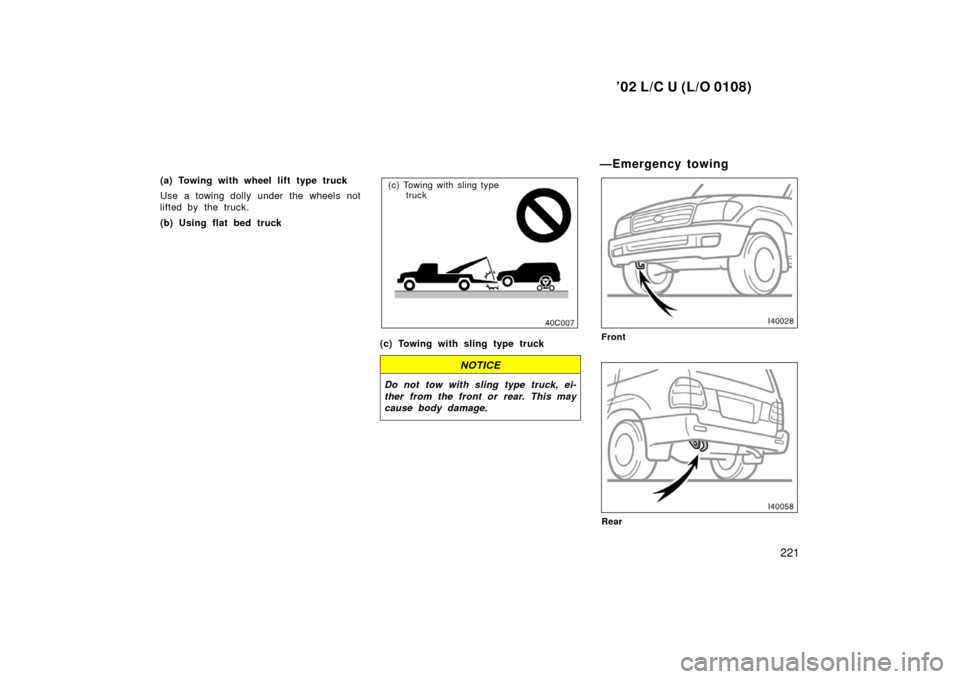
(a) Towing with wheel lift type truck—
—From rear
(b) Using flat bed truck —From frontIf towing is necessary, we recommend
you have it done by your Toyota dealer
or a commercial tow truck service. In
consultation with them, have your ve-
hicle towed using either (a) or (b).
Only when you cannot receive a towing
service from a Toyota dealer or com-
mercial tow truck service, tow your ve-
hicle carefully in accordance with the
instructions given in ”—Emergency tow-
ing” in this section.
Proper equipment will help ensure that
your vehicle is not damaged while being
towed. Commercial operators are generally
aware of the state/provincial and local
laws pertaining to towing.
Your vehicle can be damaged if it is
towed incorrectly. Although most operators
know the correct procedure, it is possible
to make a mistake. To avoid damage to
your vehicle, make sure the following pre-
cautions are observed. If necessary, show
this page to the tow truck driver.
TOWING PRECAUTIONS:
Use a safety chain system for all towing,
and abide by the state/provincial and local
laws. The wheels and axle on the ground
must be in good condition. If they are
damaged, use a towing dolly.
If your vehicle needs
to be towed—
Page 225 of 286
’02 L/C U (L/O 0108)
221
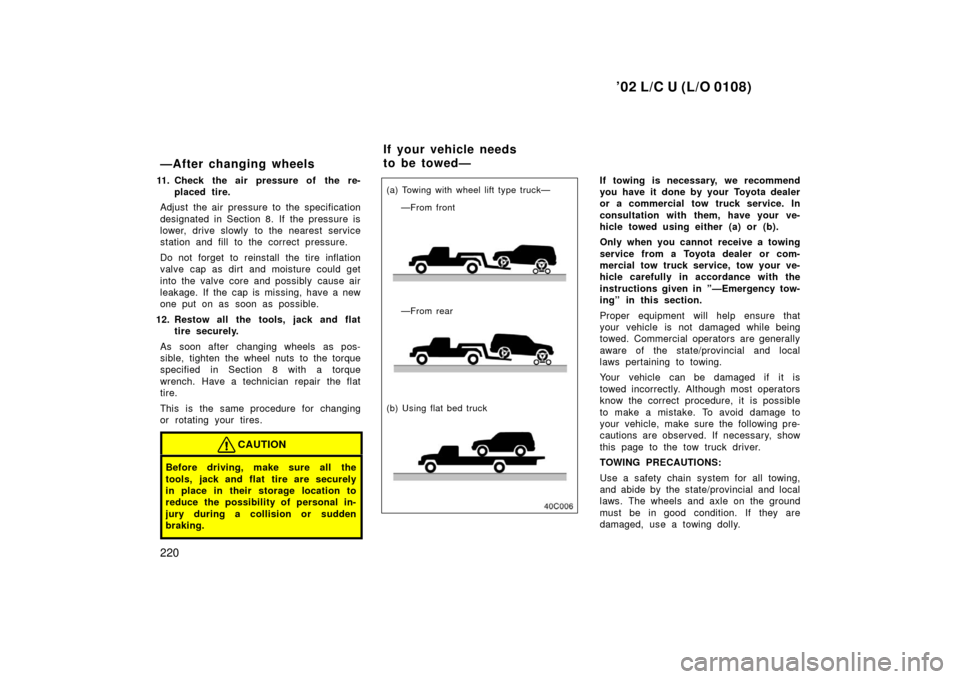
(a) Towing with wheel lift type truck
Use a towing dolly under the wheels not
lifted by the truck.
(b) Using flat bed truck(c) Towing with sling type truck
(c) Towing with sling type truck
NOTICE
Do not tow with sling type truck, ei-
ther from the front or rear. This may
cause body damage.
—Emergency towing
Front
Rear
Page 226 of 286
’02 L/C U (L/O 0108)
222
If towing is necessary, we recommend
you to have it done by your Toyota
dealer or a commercial tow truck ser-
vice.
If towing service is not available in an
emergency, your vehicle may be tempo-
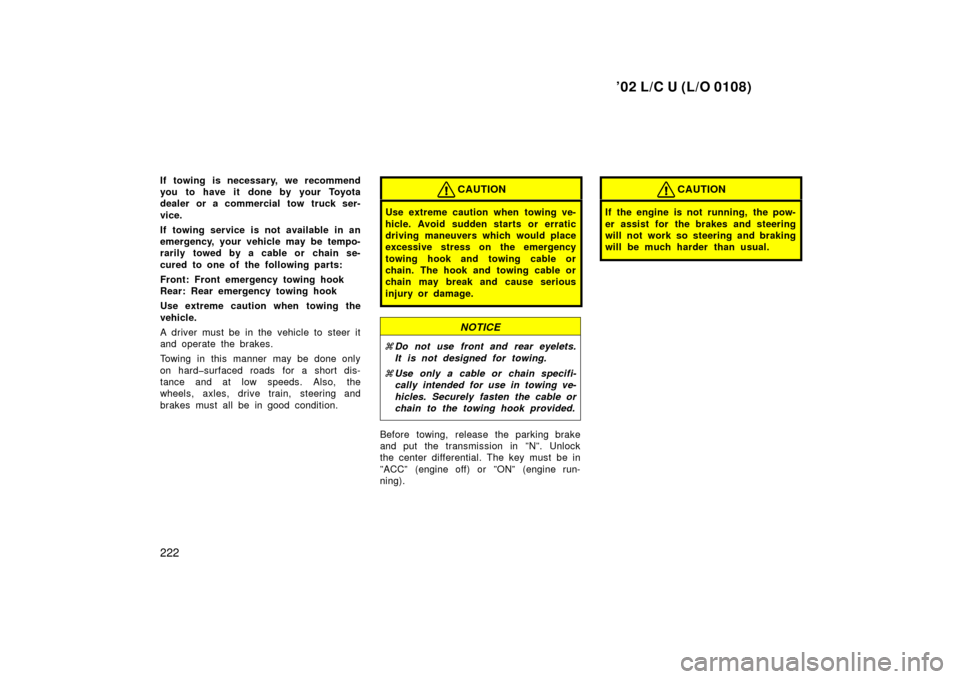
rarily towed by a cable or chain se-
cured to one of the following parts:
Front: Front emergency towing hook
Rear: Rear emergency towing hook
Use extreme caution when towing the
vehicle.
A driver must be in the vehicle to steer it
and operate the brakes.
Towing in this manner may be done only
on hardsurfaced roads for a short dis-
tance and at low speeds. Also, the
wheels, axles, drive train, steering and
brakes must all be in good condition.CAUTION
Use extreme caution when towing ve-
hicle. Avoid sudden starts or erratic
driving maneuvers which would place
excessive stress on the emergency
towing hook and towing cable or
chain. The hook and towing cable or
chain may break and cause serious
injury or damage.
NOTICE
�Do not use front and rear eyelets.
It is not designed for towing.
� Use only a cable or chain specifi-
cally intended for use in towing ve-
hicles. Securely fasten the cable or
chain to the towing hook provided.
Before towing, release the parking brake
and put the transmission in ”N”. Unlock
the center differential. The key must be in
”ACC” (engine off) or ”ON” (engine run-
ning).
CAUTION
If the engine is not running, the pow-
er assist for the brakes and steering
will not work so steering and braking
will be much harder than usual.
Page 227 of 286
’02 L/C U (L/O 0108)
223
�
Before emergency towing, check that
the hook is not broken or damage and
that the installation bolts are not loose.
�Fasten the towing cable or chain se-
curely to the hook.
�Do not jerk the hook. Apply steady and
even force.
�To avoid damaging the hook, do not
pull from the side or at a vertical
angle. Always pull straight ahead.
CAUTION
If the emergency towing hook is used
to get out when your vehicle becomes
struck in mud, sand or other condi-
tion from which the vehicle cannot be
driven out under its own power, make
sure to observe the precautions men-
tioned below. Otherwise, excessive
stress will be put on the hook and
the towing cable or chain may break,
causing serious injury or damage.
�If the towing vehicle can hardly
move, do not forcibly continue the
towing. Contact your Toyota dealer
or a commercial tow truck service
for assistance.
�Tow the vehicle as straight ahead
as possible.
�Keep away from the vehicle during
towing.
—Tips for towing a stuck vehicle
The following methods are effective to
use when your vehicle is stuck in the
mud, sand or other condition from
which the vehicle cannot be driven out
under its own power. Use extreme cau-
tion when towing the vehicles. In addi-
tion, keep away from the vehicles and
towing cable or chain when towing.
�Remove the sand soil in the front and
the back of the tires.
�Place stones or wood under the tires.
—Emergency towing hook
precautions