Page 32 of 286
’02 L/C U (L/O 0108)
28
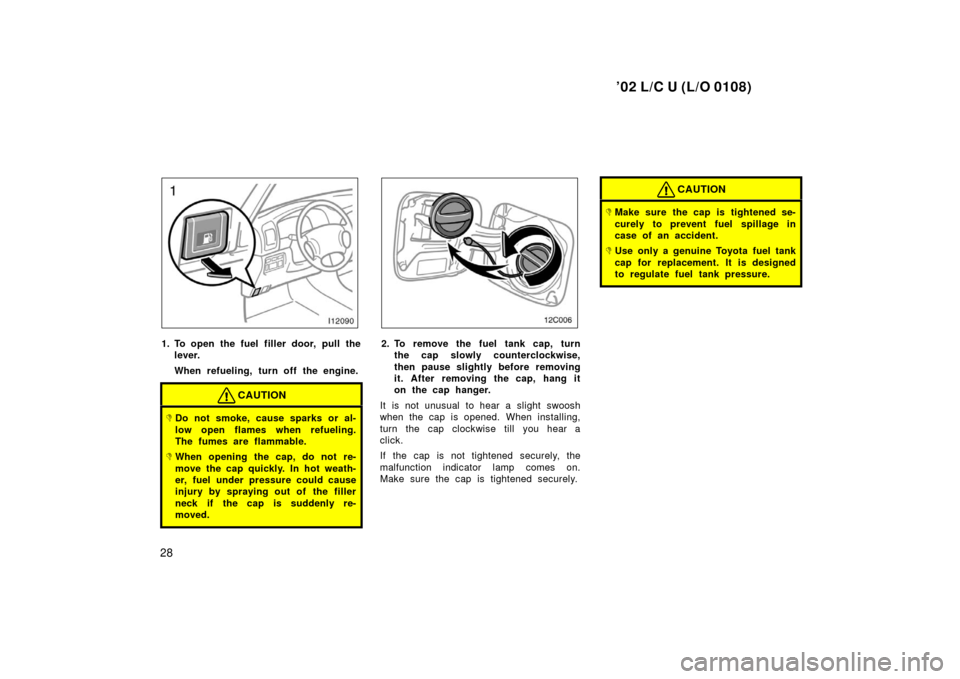
1. To open the fuel filler door, pull thelever.
When refueling, turn off the engine.
CAUTION
�Do not smoke, cause sparks or al-
low open flames when refueling.
The fumes are flammable.
�When opening the cap, do not re-
move the cap quickly. In hot weath-
er, fuel under pressure could cause
injury by spraying out of the filler
neck if the cap is suddenly re-
moved.
12C006
2. To remove the fuel tank cap, turnthe cap slowly counterclockwise,
then pause slightly before removing
it. After removing the cap, hang it
on the cap hanger.
It is not unusual to hear a slight swoosh
when the cap is opened. When insta lling,
turn the cap clockwise till you hear a
click.
If the cap is not tightened securely, the
malfunction indicator lamp comes on.
Make sure the cap is tightened securely.
CAUTION
�Make sure the cap is tightened se-
curely to prevent fuel sp illage in
case of an accident.
�Use only a genuine Toyota fuel tank
cap for replacement. It is designed
to regulate fuel tank pressure.
Page 36 of 286
’02 L/C U (L/O 0108)
32
Seats
While the vehicle is being driven, all ve-
hicle occupants should have the seatback
upright, sit well back in the seat and prop-
erly wear the seat belts provided.
CAUTION
�Do not drive the vehicle unless the
occupants are properly seated. Do
not allow sitting on top of a
foldeddown seatback, or in the
luggage compartment or cargo area.
Persons not properly seated and/or
not properly restrained by seat
belts can be severely injured in the
event of emergency braking or a
collision.
�During driving, do not allow pas-
sengers to stand up or move
around between seats. Severe inju-
ries can occur in the event of emer-
gency braking or a collision.
Adjust the driver’s seat so that the foot
pedals, steering wheel and instrument
panel controls are within easy reach of
the driver.
CAUTION
�Adjustments should not be made
while the vehicle is moving, as the
seat may unexpectedly move and
cause the driver to lose control of
the vehicle.
�When adjusting the seat, be careful
not to hit the seat against a pas-
senger or luggage.
�After adjusting the seat position,
try sliding it forward and backward
to make sure it is locked in posi-
tion.
�After adjusting the seatback, exert
body pressure to make sure it is
locked in position.
�Do not put objects under the seats.
The objects may interfere with the
seatlock mechanism or unexpect-
edly push up the seat position ad-
justing lever. Otherwise, the seat
may suddenly move, causing the
driver to lose control of the vehicle.
�While adjusting the seat, do not put
your hands under the seat or near
the moving parts. Otherwise, you
may catch and injure your hands or
fingers.
Front seats—
—Seat adjustment
precautions
Page 38 of 286
’02 L/C U (L/O 0108)
34
Armrest
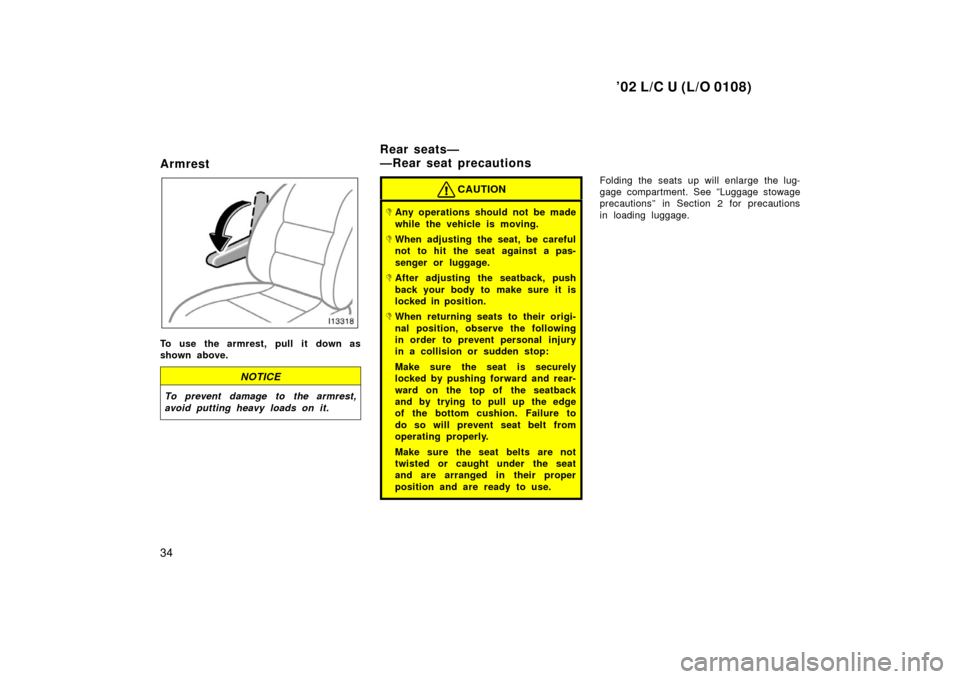
To use the armrest, pull it down as
shown above.
NOTICE
To prevent damage to the armrest,
avoid putting heavy loads on it.
CAUTION
�Any operations should not be made
while the vehicle is moving.
�When adjusting the seat, be careful
not to hit the seat against a pas-
senger or luggage.
�After adjusting the seatback, push
back your body to make sure it is
locked in position.
�When returning seats to their origi-
nal position, observe the following
in order to prevent personal injury
in a collision or sudden stop:
Make sure the seat is securely
locked by pushing forward and rear-
ward on the top of the seatback
and by trying to pull up the edge
of the bottom cushion. Failure to
do so will prevent seat belt from
operating properly.
Make sure the seat belts are not
twisted or caught under the seat
and are arranged in their proper
position and are ready to use.
Folding the seats up will enlarge the lug-
gage compartment. See ”Luggage stowage
precautions” in Section 2 for precautions
in loading luggage.
Rear seats—
—Rear seat precautions
Page 39 of 286
’02 L/C U (L/O 0108)
35
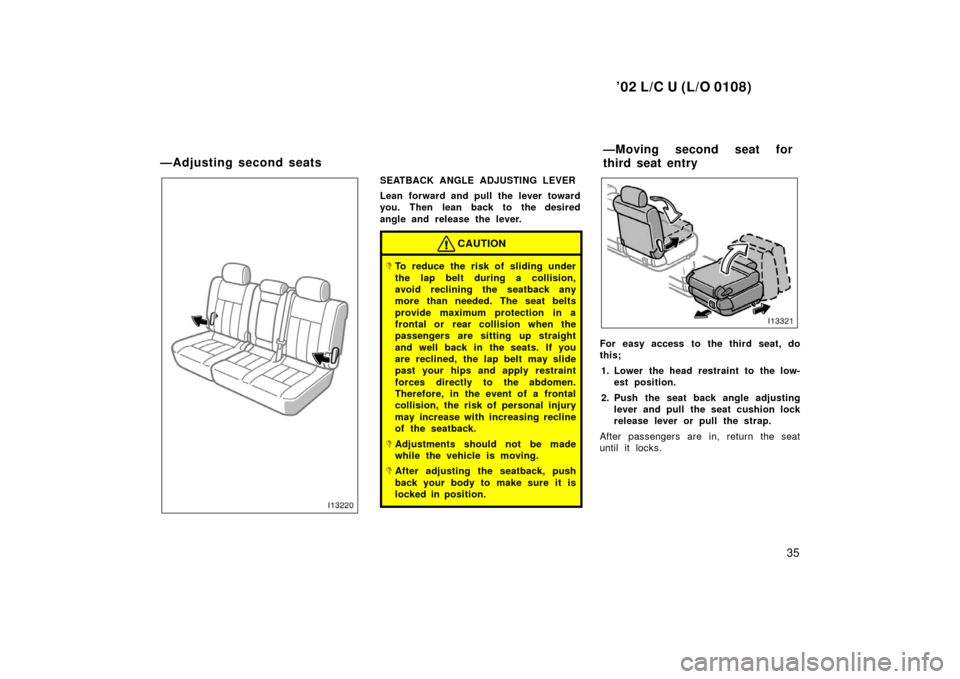
SEATBACK ANGLE ADJUSTING LEVER
Lean forward and pull the lever toward
you. Then lean back to the desired
angle and release the lever.
CAUTION
�To reduce the risk of sliding under
the lap belt during a collision,
avoid reclining the seatback any
more than needed. The seat belts
provide maximum protection in a
frontal or rear collision when the
passengers are sitting up straight
and well back in the seats. If you
are reclined, the lap belt may slide
past your hips and apply restraint
forces directly to the abdomen.
Therefore, in the event of a frontal
collision, the risk of personal injury
may increase with increasing recline
of the seatback.
�Adjustments should not be made
while the vehicle is moving.
�After adjusting the seatback, push
back your body to make sure it is
locked in position.
For easy access to the third seat, do
this;1. Lower the head restraint to the low- est position.
2. Push the seat back angle adjusting lever and pull the seat cushion lock
release lever or pull the strap.
After passengers are in, return the seat
until it locks.
—Adjusting second seats —Moving second seat for
third seat entry
Page 40 of 286
’02 L/C U (L/O 0108)
36
CAUTION
After returning the seat, make sure
the seat is securely locked by push-
ing forward and rearward on the top
of the seatback and by trying to pull
up the edge of the bottom cushion.
—Folding up second seat
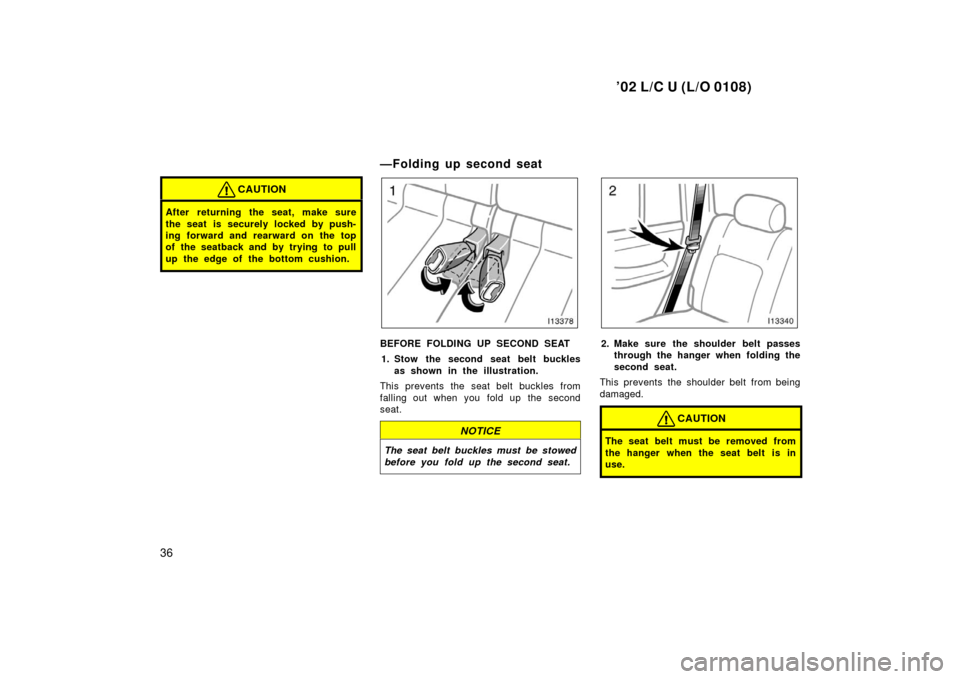
BEFORE FOLDING UP SECOND SEAT1. Stow the second seat belt buckles as shown in the illustration.
This prevents the seat belt buckles from
falling out when you fold up the second
seat.
NOTICE
The seat belt buckles must be stowed
before you fold up the second seat.
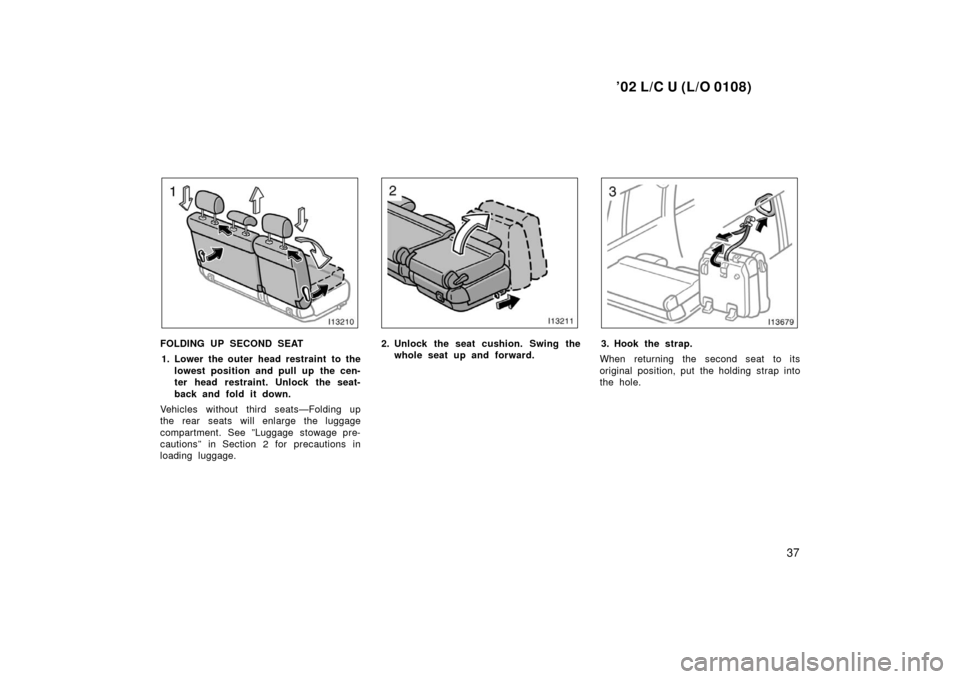
2. Make sure the shoulder belt passes through the hanger when folding the
second seat.
This prevents the shoulder belt from being
damaged.
CAUTION
The seat belt must be removed from
the hanger when the seat belt is in
use.
Page 41 of 286
’02 L/C U (L/O 0108)
37
FOLDING UP SECOND SEAT1. Lower the outer head restraint to the lowest position and pull up the cen-
ter head restraint. Unlock the seat-
back and fold it down.
Vehicles without third seats—Folding up
the rear seats will enlarge the luggage
compartment. See ”Luggage stowage pre-
cautions” in Section 2 for precautions in
loading luggage.2. Unlock the seat cushion. Swing the whole seat up and forward.3. Hook the strap.
When returning the second seat to its
original position, put the holding strap into
the hole.
Page 42 of 286
’02 L/C U (L/O 0108)
38
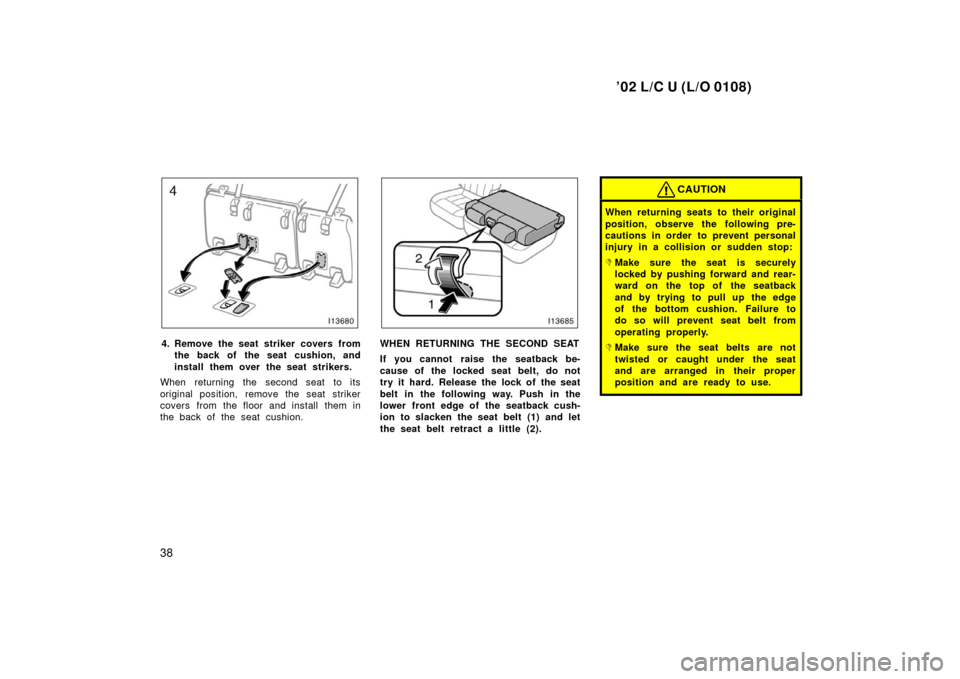
4. Remove the seat striker covers fromthe back of the seat cushion, and
install them over the seat strikers.
When returning the second seat to its
original position, remove the seat striker
covers from the floor and install them in
the back of the seat cushion.WHEN RETURNING THE SECOND SEAT
If you cannot raise the seatback be-
cause of the locked seat belt, do not
try it hard. Release the lock of the seat
belt in the following way. Push in the
lower front edge of the seatback cush-
ion to slacken the seat belt (1) and let
the seat belt retract a little (2).
CAUTION
When returning seats to their original
position, observe the following pre-
cautions in order to prevent personal
injury in a collision or sudden stop:
�Make sure the seat is securely
locked by pushing forward and rear-
ward on the top of the seatback
and by trying to pull up the edge
of the bottom cushion. Failure to
do so will prevent seat belt from
operating properly.
�Make sure the seat belts are not
twisted or caught under the seat
and are arranged in their proper
position and are ready to use.
Page 43 of 286
’02 L/C U (L/O 0108)
39
—Adjusting third seats
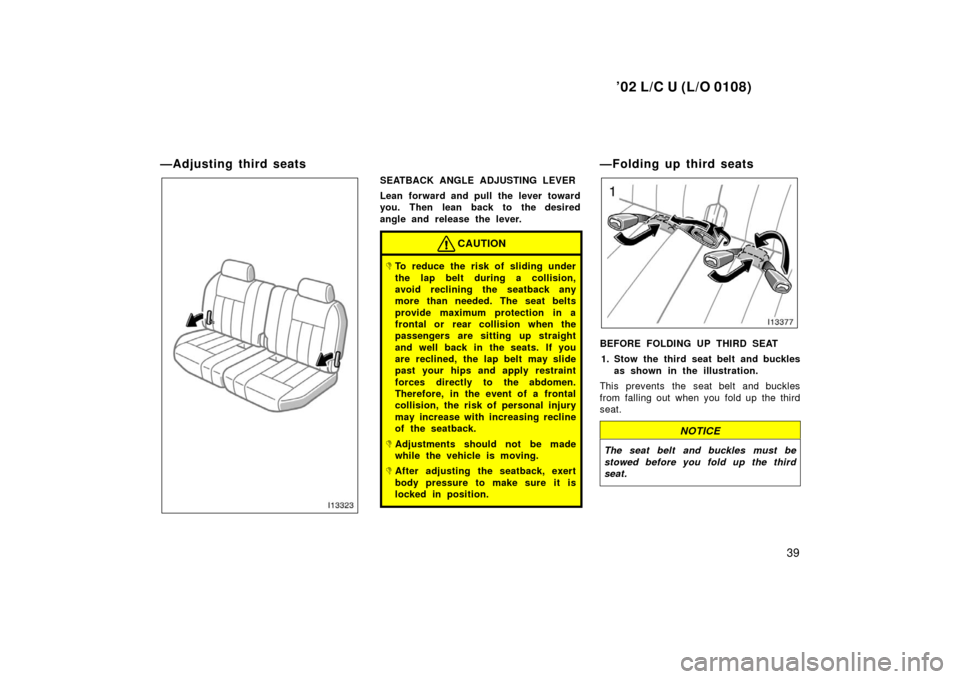
SEATBACK ANGLE ADJUSTING LEVER
Lean forward and pull the lever toward
you. Then lean back to the desired
angle and release the lever.
CAUTION
�To reduce the risk of sliding under
the lap belt during a collision,
avoid reclining the seatback any
more than needed. The seat belts
provide maximum protection in a
frontal or rear collision when the
passengers are sitting up straight
and well back in the seats. If you
are reclined, the lap belt may slide
past your hips and apply restraint
forces directly to the abdomen.
Therefore, in the event of a frontal
collision, the risk of personal injury
may increase with increasing recline
of the seatback.
�Adjustments should not be made
while the vehicle is moving.
�After adjusting the seatback, exert
body pressure to make sure it is
locked in position.
—Folding up third seats
BEFORE FOLDING UP THIRD SEAT1. Stow the third seat belt and buckles as shown in the illustration.
This prevents the seat belt and buckles
from falling out when you fold up the third
seat.
NOTICE
The seat belt and buckles must be
stowed before you fold up the third
seat.