Page 243 of 286
’02 L/C U (L/O 0108)
239
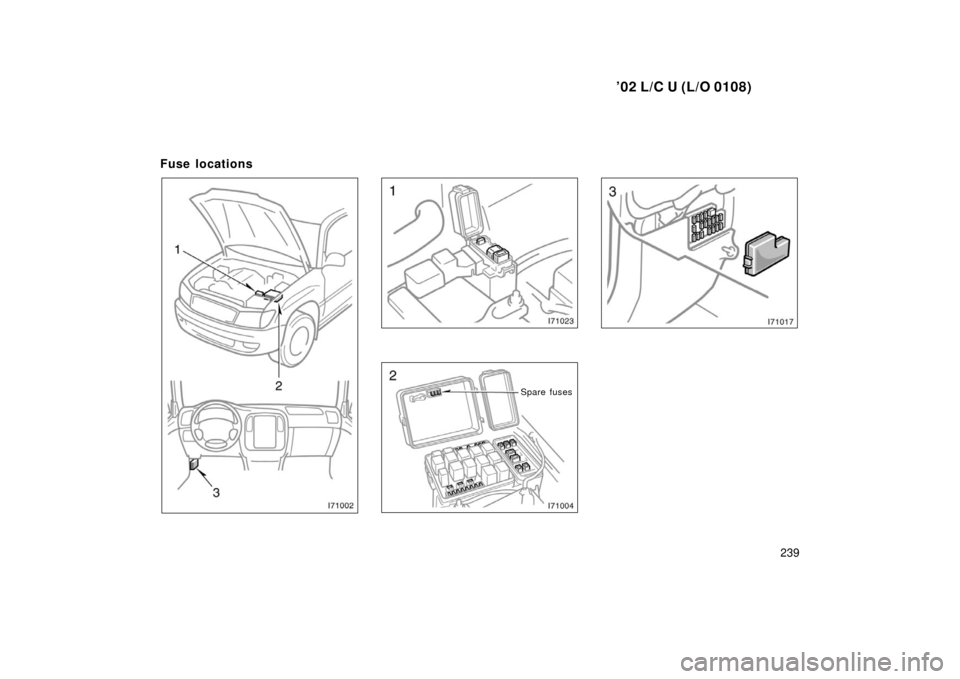
Fuse locations
Spare fuses
Page 253 of 286
’02 L/C U (L/O 0108)
249
Clean all dirt from outside of the reservoir
tank and look at the fluid level. If the fluid
is cold, the level should be in the ”COLD”
range. Similarly, if it is hot, the fluid level
should be in the ”HOT” range. If the level
is at the low side of either range, add
automatic transmission fluid DEXRON�II
or III to bring the level within the range.
To remove the reservoir cap, turn it coun-
terclockwise and lift up. To reinstall it,
turn it clockwise. After replacing the filler
cap, visually check the steering box case,
vane pump and hose connections for
leaks or damage.
CAUTION
The reservoir tank may be hot so be
careful not to burn yourself.
NOTICE
Avoid overfilling, or the power steer-
ing could be damaged.
Checking tire pressure
Keep your tire pressures at the proper
level.
The recommended cold tire pressures, tire
size and the vehicle capacity weight are
given in Section 8.
You should check the tire pressures every
two weeks, or at least once a month. And
don’t forget the spare!
Incorrect tire pressure can reduce tire
life and make your vehicle less safe to
drive.
Low tire pressure results in excessive
wear, poor handling, reduced fuel econo-
my, and the possibility of blowouts from
overheated tires. Also, low tire pressure
can cause poor sealing of the tire bead.
If the tire pressure is excessively low,
there is the possibility of w heel deforma-
tion and/or tire separation.
High tire pressure produces a harsh ride,
handling problems, excessive wear at the
center of the tire tread, and a greater
possibility of tire damage from road haz-
ards.
If a tire frequently needs ref illing, have it
checked by your Toyota dealer. The following instructions for checking
tire pressure should be observed:
�The pressure should be checked only
when the tires are cold.
If your ve-
hicle has been parked for at least 3
hours and has not been driven for
more than 1.5 km or 1 mile since, you
will get an accurate cold tire pressure
reading.
�Always use a tire pressure gauge.
The appearance of a tire can be mis-
leading. Besides, tire pressures that
are even just a few pounds off can
degrade ride and handling.
�Do not bleed or reduce tire pressure
after driving. It is normal for the tire
pressure to be higher after driving.
�Never exceed the vehicle capacity
weight. The passenger and luggage
weight should be located so that the
vehicle is balanced.
�Be sure to reinstall the tire inflation
valve caps. Without the valve caps,
dirt or moisture could get into the valve
core and cause air leakage. If the caps
have been lost, have new ones put on
as soon as possible.
Page 254 of 286
’02 L/C U (L/O 0108)
250
Checking and replacing tires
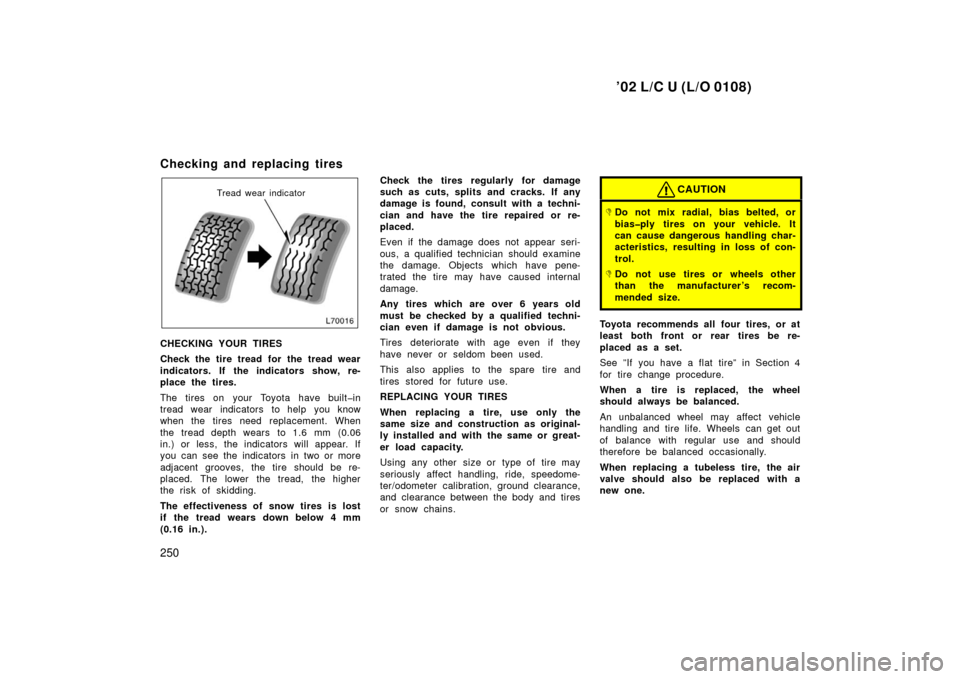
Tread wear indicator
CHECKING YOUR TIRES
Check the tire tread for the tread wear
indicators. If the indicators show, re-
place the tires.
The tires on your Toyota have builtin
tread wear indicators to help you know
when the tires need replacement. When
the tread depth wears to 1.6 mm (0.06
in.) or less, the indicators will appear. If
you can see the indicators in two or more
adjacent grooves, the tire should be re-
placed. The lower the tread, the higher
the risk of skidding.
The effectiveness of snow tires is lost
if the tread wears down below 4 mm
(0.16 in.).Check the tires regularly for damage
such as cuts, splits and cracks. If any
damage is found, consult with a techni-
cian and have the tire repaired or re-
placed.
Even if the damage does not appear seri-
ous, a qualified technician should examine
the damage. Objects which have pene-
trated the tire may have caused internal
damage.
Any tires which are over 6 years old
must be checked by a qualified techni-
cian even if damage is not obvious.
Tires deteriorate with age even if they
have never or seldom been used.
This also applies to the spare tire and
tires stored for future use.
REPLACING YOUR TIRES
When replacing a tire, use only the
same size and construction as original-
ly installed and with the same or great-
er load capacity.
Using any other size or type of tire may
seriously affect handling, ride, speedome-
ter/odometer calibration, ground clearance,
and clearance between the body and tires
or snow chains.
CAUTION
�Do not mix radial, bias belted, or
biasply tires on your vehicle. It
can cause dangerous handling char-
acteristics, resulting in loss of con-
trol.
�Do not use tires or wheels other
than the manufacturer ’s recom-
mended size.
Toyota recommends all four tires, or at
least both front or rear tires be re-
placed as a set.
See ”If you have a flat tire” in Section 4
for tire change procedure.
When a tire is replaced, the wheel
should always be balanced.
An unbalanced wheel may affect vehicle
handling and tire life. Wheels can get out
of balance with regular use and should
therefore be balanced occasionally.
When replacing a tubeless tire, the air
valve should also be replaced with a
new one.
Page 262 of 286
’02 L/C U (L/O 0108)
258
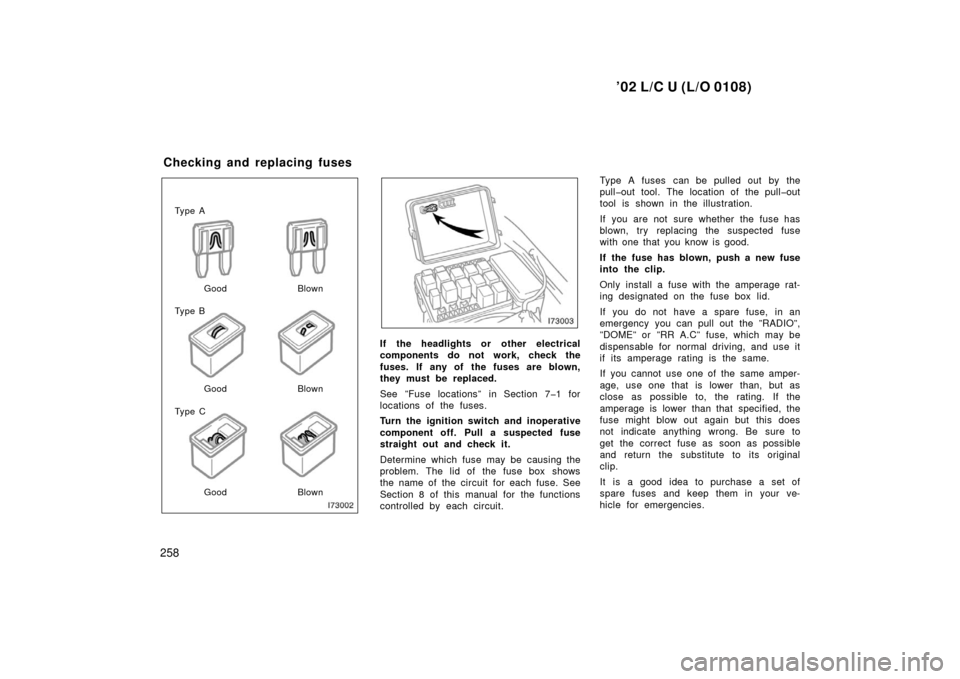
Ty p e A
Ty p e B
Ty p e CGood Blown
Good Blown
Good Blown
If the headlights or other electrical
components do not work, check the
fuses. If any of the fuses are blown,
they must be replaced.
See ”Fuse locations” in Section 71 for
locations of the fuses.
Turn the ignition switch and inoperative
component off. Pull a suspected fuse
straight out and check it.
Determine which fuse may be causing the
problem. The lid of the fuse box shows
the name of the circuit for each fuse. See
Section 8 of this manual for the functions
controlled by each circuit. Type A fuses can be pulled out by the
pullout tool. The location of the pullout
tool is shown in the illustration.
If you are not sure whether the fuse has
blown, try replacing the suspected fuse
with one that you know is good.
If the fuse has blown, push a new fuse
into the clip.
Only install a fuse with the amperage rat-
ing designated on the fuse box lid.
If you do not have a spare fuse, in an
emergency you can pull out the ”RADIO”,
”DOME” or ”RR A.C” fuse, which may be
dispensable for normal driving, and use it
if its amperage rating is the same.
If you cannot use one of the same amper-
age, use one that is lower than, but as
close as possible to, the rating. If the
amperage is lower than that specified, the
fuse might blow out again but this does
not indicate anything wrong. Be sure to
get the correct fuse as soon as possible
and return the substitute to its original
clip.
It is a good idea to purchase a set of
spare fuses and keep them in your ve-
hicle for emergencies.
Checking and replacing fuses