Page 90 of 308

’02 4Runner_U (L/O 0108)
842002 MY 4RUNNER_U (OM 35787U)
HEADLIGHTS
To turn on the following lights: Twist
the headlight/turn signal lever knob.
Position 1—Parking, tail, license plate,
side marker and instrument panel lights
Position 2—Headlights and all of the
above
The lights automatically turn off when the
driver ’s door is opened with the ignition
switch turned off. To turn them on again,
turn the key to the “ON” position or actu-
ate the headlight switch. If you are going
to park for over one week, make sure the
headlight switch is off.
NOTICE
To prevent the battery from being dis-
charged, do not leave the lights on
for a long period when the engine is
not running.
Daytime running light system (on some
models)
The headlights turn on when the parking
brake is released with the engine started,
even with the light switch in the “OFF”
position. They will not go off until the
ignition switch is turned off.
To turn on the other exterior lights and
instrument panel lights, twist the knob to
the position 1.
Under the daytime running light system,
the headlights turn on at reduced intensity.
Twist the knob to the position 2 to turn
to full intensity for driving at night.
HighLow beams— For high beams, turn
the headlights on and push the lever away
from you (position 1). Pull the lever to-
ward you (position 2) for low beams.
The headlight high beam indicator light
(blue light) on the instrument panel will
tell you that the high beams are on.
Flashing the high beam headlights
(position 3)—Pull the lever all the way
back. The high beam headlights turn off
when you release the lever.
You can flash the high beam headlights
with the knob turned to “OFF”.
Headlights and turn signals
Page 91 of 308

’02 4Runner_U (L/O 0108)
852002 MY 4RUNNER_U (OM 35787U)
TURN SIGNALS
To signal a turn, push the headlight/
turn signal lever up or down to position
1.
The key must be in the “ON” position.
The lever automatically returns after you
make a turn, but you may have to return
it by hand after you change lanes.
To signal a lane change, move the lever
up or down to the pressure point (position
2) and hold it.
If the turn signal indicator lights (green
lights) on the instrument panel flash faster
than normal, a front or rear turn signal
bulb is burned out.To turn on the emergency flashers,
push the switch.
All the turn signal lights will flash. To turn
them off, push the switch once again.
Turn on the emergency flashers to warn
other drivers if your vehicle must be
stopped where it might be a traffic hazard.
Always pull as far off the road as pos-
sible.
The turn signal light switch will not work
when the emergency flashers are operat-
ing.
NOTICE
To prevent the battery from being dis-
charged, do not leave the switch on
longer than necessary when the en-
gine is not running.
Emergency flashers
Page 92 of 308
’02 4Runner_U (L/O 0108)
862002 MY 4RUNNER_U (OM 35787U)
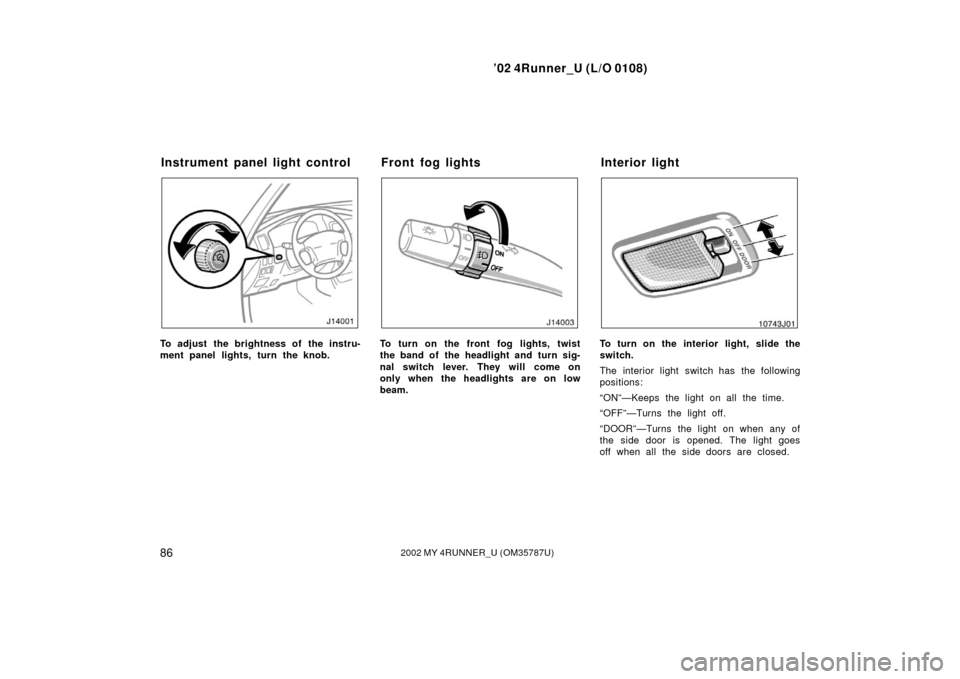
To adjust the brightness of the instru-
ment panel lights, turn the knob.To turn on the front fog lights, twist
the band of the headlight and turn sig-
nal switch lever. They will come on
only when the headlights are on low
beam.To turn on the interior light, slide the
switch.
The interior light switch has the following
positions:
“ON”—Keeps the light on all the time.
“OFF”—Turns the light off.
“DOOR”—Turns the light on when any of
the side door is opened. The light goes
off when all the side doors are closed.
Instrument panel light control Front fog lights Interior light
Page 132 of 308

’02 4Runner_U (L/O 0108)
1262002 MY 4RUNNER_U (OM 35787U)
“VSC TRAC” warning light
These light warns that when there is a
problem somewhere in the vehicle skid
control system, traction control system
(twowheel drive models), active traction
control system (fourwheel drive models).
The light will come on when the ignition
key is turned to “ON”, and will go off after
about a few seconds.
The light may come on for 60 seconds
after the ignition key is turned to the “ON”
position. It is normal if they go out after
a while. Depressing the brake pedal repeatedly
may turn on the light. It is normal if they
go out after a few seconds.
If the light comes on while driving, the
system does not work. However, as con-
ventional braking operates when applied,
there is no problem to continue your driv-
ing.
In the following cases, contact your Toyota
dealer:
�The warning light does not come on
after the ignition key is turned to “ON”.
�The warning light remains on after the
ignition key is turned to “ON”.
�The warning light comes on while driv-
ing.
When parking, firmly apply the parking
brake to avoid inadvertent creeping.
To set: Pull up the lever. For better hold-
ing power, first depress the brake pedal
and hold it while setting the parking
brake.
To release: Pull up the lever slightly (1),
press the lock release button (2), and low-
er (3).
To remind you that the parking brake is
set, the parking brake reminder light in
the instrument panel remains on until you
release the parking brake.
Parking brake
Page 133 of 308
’02 4Runner_U (L/O 0108)
1272002 MY 4RUNNER_U (OM 35787U)
CAUTION
Before driving, be sure the parking
brake is fully released and the park-
ing brake reminder light is off.
The cruise control allows you to cruise
the vehicle at a desired speed over 40
km/h (25 mph) even with your foot off
the accelerator pedal.
Your cruising speed can be maintained up
or down grades within the limits of engine
performance, although a slight speed
change may occur when driving up or
down the grades. On steeper h ills, a
greater speed change will occur so it is
better to drive without the cruise control.
CAUTION
�To help maintain maximum control
of your vehicle, do not use the
cruise control when driving in
heavy or varying traffic, or on slip-
pery (rainy, icy or snowcovered) or
winding roads.
�Avoid vehicle speed increases when
driving downhill. If the vehicle
speed is too fast in relation to the
cruise control set speed, cancel the
cruise control then downshift the
transmission to use engine braking
to slow down.
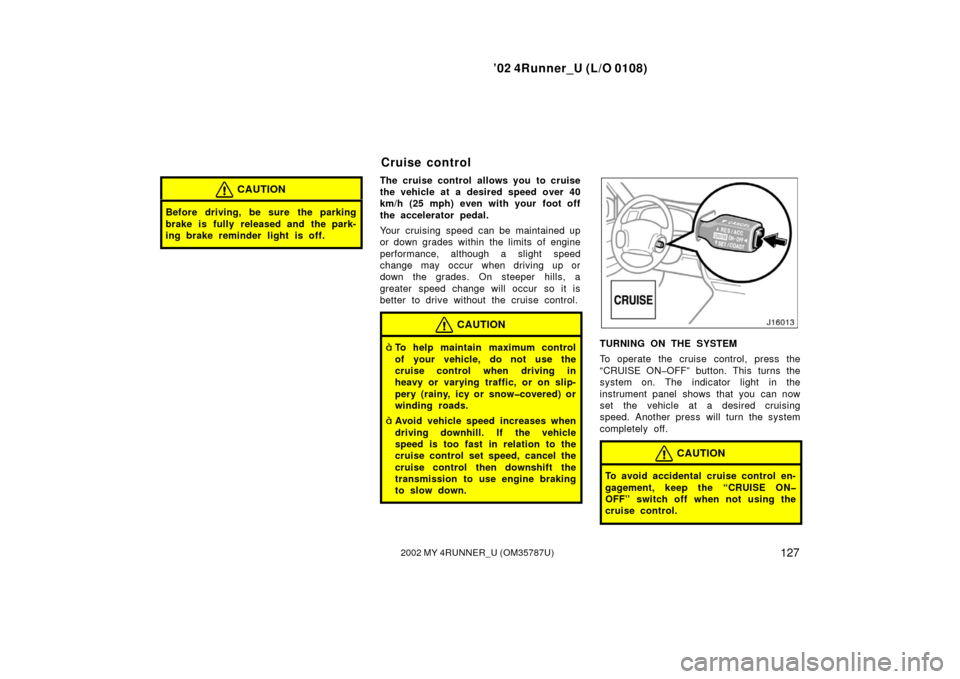
TURNING ON THE SYSTEM
To operate the cruise control, press the
“CRUISE ONOFF” button. This turns the
system on. The indicator light in the
instrument panel shows that you can now
set the vehicle at a desired cruising
speed. Another press will turn the system
completely off.
CAUTION
To avoid accidental cruise control en-
gagement, keep the “CRUISE ON
OFF” switch off when not using the
cruise control.
Cruise control
Page 165 of 308

’02 4Runner_U (L/O 0108)
1592002 MY 4RUNNER_U (OM 35787U)
OPERATION OF INSTRUMENTS AND
CONTROLS
Air conditioning system
Manual air conditioning system
Controls 160
. . . . . . . . . . . . . . . . . . . . . . . . . . . . . . . . . . . . .\
. . . . . . . . . . . .
Air flow selector settings 163
. . . . . . . . . . . . . . . . . . . . . . . . . . . . . . . . . .
Operating tips 163
. . . . . . . . . . . . . . . . . . . . . . . . . . . . . . . . . . . . \
. . . . . . .
Automatic air conditioning system Controls 166
. . . . . . . . . . . . . . . . . . . . . . . . . . . . . . . . . . . . \
. . . . . . . . . . . . .
Air flow selector settings 170
. . . . . . . . . . . . . . . . . . . . . . . . . . . . . . . . . .
Operating tips 170
. . . . . . . . . . . . . . . . . . . . . . . . . . . . . . . . . . . . \
. . . . . . .
Instrument panel vents 173
. . . . . . . . . . . . . . . . . . . . . . . . . . . . . . . . . . . . \
. .
Rear heater system 175
. . . . . . . . . . . . . . . . . . . . . . . . . . . . . . . . . . . . \
. . . . .
SECTION 1 8
Page 167 of 308
’02 4Runner_U (L/O 0108)
1612002 MY 4RUNNER_U (OM 35787U)
Fan speed selector
Move the knob to adjust the fan speed—to
the right to increase, to the left to de-
crease.
Temperature selector
Move the knob to adjust the tempera-
ture—to the right to warm, to the left to
cool.
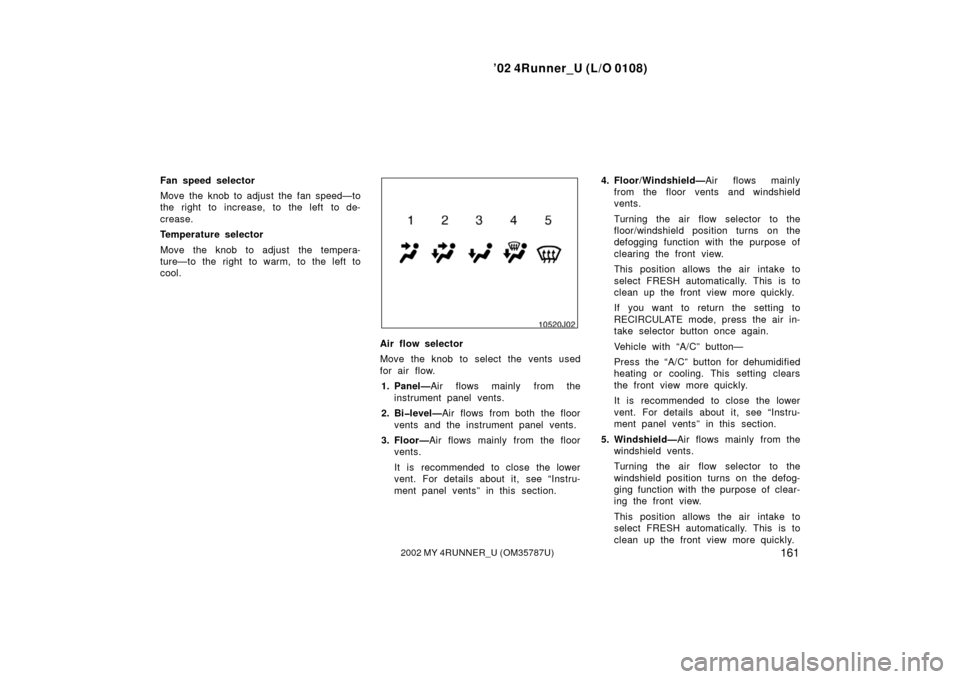
Air flow selector
Move the knob to select the vents used
for air flow.
1. Panel— Air flows mainly from the
instrument panel vents.
2. Bilevel— Air flows from both the floor
vents and the instrument panel vents.
3. Floor— Air flows mainly from the floor
vents.
It is recommended to close the lower
vent. For details about it, see “Instru-
ment panel vents” in this section. 4. Floor/Windshield—
Air flows mainly
from the floor vents and windshield
vents.
Turning the air flow selector to the
floor/windshield position turns on the
defogging function with the purpose of
clearing the front view.
This position allows the air intake to
select FRESH automatically. This is to
clean up the front view more quickly.
If you want to return the setting to
RECIRCULATE mode, press the air in-
take selector button once again.
Vehicle with “A/C” button—
Press the “A/C” button for dehumidified
heating or cooling. This setting clears
the front view more quickly.
It is recommended to close the lower
vent. For details about it, see “Instru-
ment panel vents” in this section.
5. Windshield— Air flows mainly from the
windshield vents.
Turning the air flow selector to the
windshield position turns on the defog-
ging function with the purpose of clear-
ing the front view.
This position allows the air intake to
select FRESH automatically. This is to
clean up the front view more quickly.
Page 169 of 308

’02 4Runner_U (L/O 0108)
1632002 MY 4RUNNER_U (OM 35787U)
�To cool off your Toyota after it has
been parked in the hot sun, drive with
the windows open for a few minutes.
This vents the hot air, allowing the air
conditioning to cool the interior more
quickly.
�Make sure the air intake grilles in front
of the windshield are not blocked (by
leaves or snow, for example).
�On humid days, do not blow cold air
on the windshield. The windshield could
fog up because of the difference in air
temperature on the inside and outside
of the windshield.
�Keep the area under the front seats
clear to allow air to circulate through-
out the vehicle.
�On cold days, set the fan speed to
high for a minute to help clear the
intake ducts of snow or moisture. This
can reduce the amount of fogging on
the windows.
�When driving on dusty roads, close all
windows. If dust thrown up by the ve-
hicle is still drawn into the vehicle after
closing the windows, it is recommended
that the air intake selector be set to
FRESH and the fan speed selector to
any setting except “OFF”.
—Air flow selector settings
: See “Instrument panel vents” in this section.
—Operating tips