Page 272 of 308

’02 4Runner_U (L/O 0108)
2662002 MY 4RUNNER_U (OM 35787U)
CAUTION
To prevent burning yourself, do not
remove the radiator cap when the en-
gine is hot.
Coolant type selection
Use of improper coolants may damage
your engine cooling system. Your coolant
must contain ethyleneglycol type coolant
for a proper corrosion protection of your
engine that contains aluminum
components. Use “TOYOTA Long Life
Coolant” or equivalent.
In addition to preventing freezing and
subsequent damage to the engine, this
type of coolant will also prevent corrosion.
Further supplemental inhibitors or additives
are neither needed nor recommended.
Read the coolant container for information
on freeze protection. Follow the manufac-
turer’s directions for how much to mix
with plain water (preferably demineralized
water or distilled water). The total c apacity
of the cooling system is given in Section
8. We recommend to use 50% solution for
your Toyota, to provide protection down to
about 35
�C (31 �F). When it is extreme-
ly cold, to provide protection down to
about 50 �C (58 �F), 60% solution is rec-
ommended. Do not use more than 70%
solution for better coolant performance.NOTICE
Do not use alcohol type antifreeze or
plain water alone.
If any of the above parts are extremely
dirty or you are not sure of their condi-
tion, take your vehicle to a Toyota dealer.
CAUTION
To prevent yourself from burning, be
careful not to touch the radiator or
condenser when the engine is hot.
NOTICE
To prevent damage to the radiator
and condenser, do not perform the
work by yourself.
Checking the radiator and
condenser
Page 274 of 308

’02 4Runner_U (L/O 0108)
2682002 MY 4RUNNER_U (OM 35787U)
If cold add
If cold O.K.
If hot add If hot O.K.
Check the fluid level on the dipstick. If
necessary, add automatic transmission
fluid DEXRON �II or III.
If the vehicle has been driven around 80
km/h (50 mph) for 20 minutes (a little
more in frigid temperatures), the fluid is
hot (60 �C—80 �C or 140 �F—175 �F). You
may also check the level when the fluid
is cold (about room temperature,
10 �C—30 �C or 50 �F—85 �F) if the engine
has not been run for about five hours.
a. Clean all dirt from outside of the reser-
voir tank.
b. Remove the reservoir cap by turning it
counterclockwise and wipe the dipstick
clean. c. Reinstall the reservoir cap.
d. Remove the reservoir cap again and
look at the fluid level. If the fluid is cold,
the level should be in the “COLD” range
on the dipstick. Similarly, if it is hot, the
fluid level should be in the “HOT” range.
If the level is at the low side of either
range, add automatic transmission fluid
DEXRON
�II or III to bring the level within
the range.
e. After replacing the reservoir cap, visu-
ally check the steering box case, vane
pump and hose connections for leaks or
damage.
CAUTION
The reservoir tank may be hot so be
careful not to burn yourself.
NOTICE
Avoid overfilling, or the power steer-
ing could be damaged.
Keep your tire pressures at the proper
level.
The recommended cold tire pressures, tire
size and the vehicle capacity weight are
given in Section 8. The recommended tire
pressures and tire size are also on the
tire pressure label as shown.
You should check the tire pressures every
two weeks, or at least once a month. And
do not forget the spare!
Checking power steering fluid Checking tire pressure
Page 283 of 308

’02 4Runner_U (L/O 0108)
2772002 MY 4RUNNER_U (OM 35787U)
NOTICE
�Be sure the engine and all accesso-
ries are off before performing main-
tenance.
� When checking the battery, remove
the ground cable from the negative
terminal (“” mark) first and rein-
stall it last.
� Be careful not to cause a short cir-
cuit with tools.
� Take care no solution gets into the
battery when washing it.
Ty p e A
Green Dark Clear or
light yellow
Ty p e B Blue White Red
CHECKING BY INDICATOR
Check the battery condition by the indi-
cator color.
Indicator color
ConditionTy p e ATy p e B
GreenBlueGood
DarkWhite
Charging necessary.
Have battery
checked by your
Toyota dealer.
Clear orlight
yellow
Red
Have battery
checked by your
Toyota dealer.
During recharging, the battery is pro-
ducing hydrogen gas.
Therefore, before recharging:
1. If recharging with the battery installed on the vehicle, be sure to disconnect
the ground cable.
2. Be sure the power switch on the re- charger is off when connecting the
charger cables to the battery and when
disconnecting them.
CAUTION
�Always charge the battery in an un-
confined area. Do not charge the
battery in a garage or closed room
where there is not sufficient ventila-
tion.
�Only do a slow charge (5 A or
less). Charging at a quicker rate is
dangerous. The battery may ex-
plode, causing personal injuries.
—Checking battery c ondition Battery recharging pr ecautions
Page 284 of 308
’02 4Runner_U (L/O 0108)
2782002 MY 4RUNNER_U (OM 35787U)
NOTICE
Never recharge the battery while the
engine is running. Also, be sure all
accessories are turned off.Ty p e A
Ty p e B
Ty p e CGood
Good
Good Blown
Blown
Blown
If the headlights or other electrical
components do not work, check the
fuses. If any of the fuses are blown,
they must be replaced.
See “Fuse locations” in Section 71 for
locations of the fuses.
Turn the ignition switch and inoperative
component off. Pull a suspected fuse
straight out and check it.
Determine which fuse may be causing the
problem. The lid of the fuse box shows
the name of the circuit for each fuse. See
Section 8 of this manual for the functions
controlled by each circuit.
Checking and replacing fuses
Page 285 of 308
’02 4Runner_U (L/O 0108)
2792002 MY 4RUNNER_U (OM 35787U)
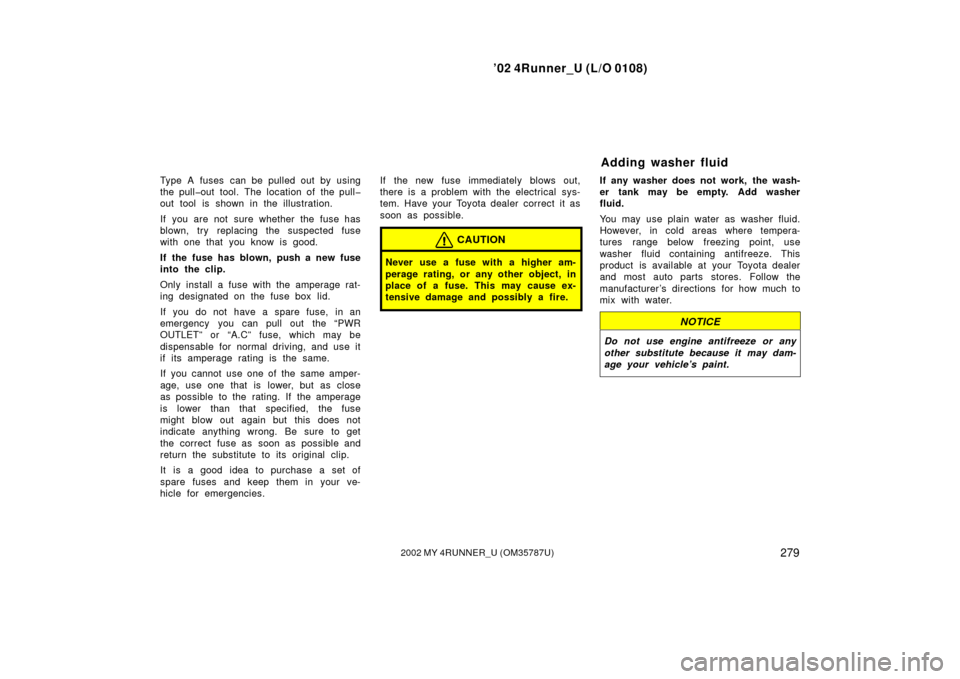
Type A fuses can be pulled out by using
the pullout tool. The location of the pull
out tool is shown in the illustration.
If you are not sure whether the fuse has
blown, try replacing the suspected fuse
with one that you know is good.
If the fuse has blown, push a new fuse
into the clip.
Only install a fuse with the amperage rat-
ing designated on the fuse box lid.
If you do not have a spare fuse, in an
emergency you can pull out the “PWR
OUTLET” or “A.C” fuse, which may be
dispensable for normal driving, and use it
if its amperage rating is the same.
If you cannot use one of the same amper-
age, use one that is lower, but as close
as possible to the rating. If the amperage
is lower than that specified, the fuse
might blow out again but this does not
indicate anything wrong. Be sure to get
the correct fuse as soon as possible and
return the substitute to its original clip.
It is a good idea to purchase a set of
spare fuses and keep them in your ve-
hicle for emergencies. If the new fuse immediately blows out,
there is a problem with the electrical sys-
tem. Have your Toyota dealer correct it as
soon as possible.
CAUTION
Never use a fuse with a higher am-
perage rating, or any other object, in
place of a fuse. This may cause ex-
tensive damage and possibly a fire.
If any washer does not work, the wash-
er tank may be empty. Add washer
fluid.
You may use plain water as washer fluid.
However, in cold areas where tempera-
tures range below freezing point, use
washer fluid containing antifreeze. This
product is available at your Toyota dealer
and most auto parts stores. Follow the
manufacturer ’s directions for how much to
mix with water.
NOTICE
Do not use engine antifreeze or any
other substitute because it may dam-
age your vehicle’s paint.
Adding washer fluid
Page 293 of 308
’02 4Runner_U (L/O 0108)
2872002 MY 4RUNNER_U (OM 35787U)
SPECIFICATIONS
Dimensions and weight 288
. . . . . . . . . . . . . . . . . . . . . . . . . . . . . . . . . . . . \
. .
Engine 288
. . . . . . . . . . . . . . . . . . . . . . . . . . . . . . . . . . . . \
. . . . . . . . . . . . . . . .
Fuel 289
. . . . . . . . . . . . . . . . . . . . . . . . . . . . . . . . . . . . \
. . . . . . . . . . . . . . . . . . .
Service specifications 289
. . . . . . . . . . . . . . . . . . . . . . . . . . . . . . . . . . . . \
. . .
Tires 292
. . . . . . . . . . . . . . . . . . . . . . . . . . . . . . . . . . . . \
. . . . . . . . . . . . . . . . . .
Fuses 292
. . . . . . . . . . . . . . . . . . . . . . . . . . . . . . . . . . . . \
. . . . . . . . . . . . . . . . .
SECTION 8
Page 294 of 308
’02 4Runner_U (L/O 0108)
2882002 MY 4RUNNER_U (OM 35787U)
Model: 5VZFE
Type:
6 cylinder V type 4 cycle, gasoline
Bore and stroke, mm (in.):
93.5 �82.0 (3.68 �3.23)
Displacement, cm
3 (cu. in.):
3378 (206.1)
Dimensions and weight
mm (in.)
P265/70R 16 tire
Without wheel
opening extension With wheel
opening extension
P225/75R 15 tire
Overall length 4655 (183.3) 4655 (183.3) 4655 (183.3)
Overall width 1690 (66.5) 1730 (68.1) 1800 (70.9)
Overall height 1715 (67.5)∗1740 (68.5)∗1740 (68.5)∗
Wheelbase2675 (105.3) 2675 (105.3) 2675 (105.3)
Front tread1505 (59.3) 1505 (59.3) 1505 (59.3)
Rear tread1495 (58.9) 1510 (59.5) 1510 (59.5)
Vehicle capacity weight (occupants + luggage) kg (lb.): 454 (1000)
∗: Unladen vehicle
Engine
Page 295 of 308
’02 4Runner_U (L/O 0108)
2892002 MY 4RUNNER_U (OM 35787U)
Fuel type:
Unleaded gasoline, Octane Rating 87
(Research Octane Number 91) or higher
Fuel tank capacity, L (gal., Imp. gal.): 70 (18.5, 15.4) ENGINE
Valve clearance (engine cold), mm (in.):
Intake 0.13—0.23 (0.006—0.009)
Exhaust 0.27—0.37 (0.011—0.014)
Spark plug type:
DENSO K16TR11
NGK BKR5EKB11
Spark plug gap, mm (in.): 1.1 (0.043)
Drive belt tension measured with Bor-
roughs drive belt tension gauge No.
BT3373F (used belt), Ibf: Generator belt100� 20
Air conditioning compressor belt 100� 20
Power steering pump belt
100
+20
15
ENGINE LUBRICATION
Oil capacity (drain and ref ill),
L (qt., Imp. qt.):
With filter 5.2 (5.5, 4.6)
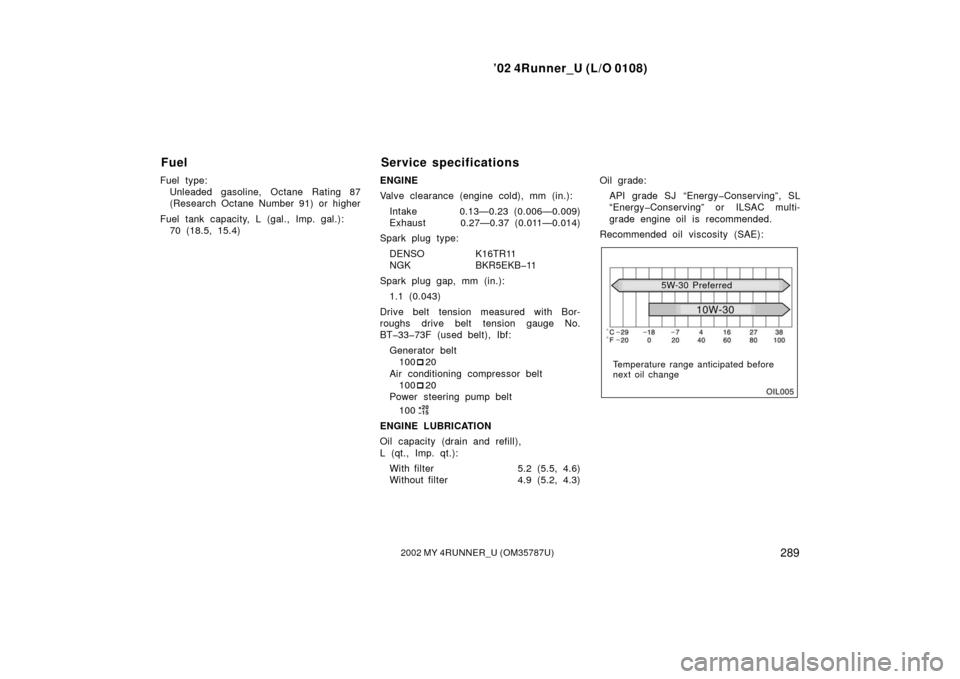
Without filter 4.9 (5.2, 4.3) Oil grade:
API grade SJ “EnergyConserving”, SL
“EnergyConserving” or ILSAC multi-
grade engine oil is recommended.
Recommended oil viscosity (SAE):
5W-30 Preferred
Temperature range anticipated before
next oil change
Fuel Service specifications


2872002 MY 4RUNNER_U (OM 35787U)
SPECIFICATIONS
Dimensions and weight 288
. . . . . . . . . . . . . . . . . . . . . . . . . . . . . . . . . . . . \
. .
Engine 288
. . . . .")