Page 307 of 801

YH4
GRAND
VITARA
1. Pin
2. Reservoir
3. Master cylinder
BRAKES PIPE / HOSE / MASTER CYLINDER 5A-13
5) Apply thin coat of brake fluid to all around new grommets (2pcs.)
and install them to cylinder body, then install reservoir.
6) Set a new pin in reservoir hole and drive it in. At this time, make
end of pin and end face margin of reservoir equal.
INSTALLATION
NOTE:
�See NOTE at the beginning of this section.
�Adjust clearance between booster piston rod and primary
piston with special tool, referring to CLEARANCE BETWEEN
BOOSTER PISTON AND MASTER CYLINDER PISTON AD-
JUSTMENT in this section.
1) Install master cylinder to brake booster.
2) Tighten master cylinder attaching nuts to specification.
Tightening Torque
(a): 13 N
.m (1.3 kg-m, 9.5 lb-ft)
3) Connect brake pipes to master cylinder.
�For vehicle with ABS
a) Connect brake pipes between master cylinder and ABS hy-
draulic unit.
b) For LH steering vehicle, connect ABS control module con-
nector.
c) For RH steering vehicle, install ABS hydraulic unit bracket
bolts and tighten it to specified torque.
Tightening Torque
(b): 10 N
.m (1.0 kg-m, 7.5 lb-ft)
4) Tighten flare nuts to specification.
Tightening Torque
(c): 16 N
.m (1.6 kg-m, 12.0 lb-ft)
5) Connect reservoir lead wire.
6) Fill reservoir with specified brake fluid.
7) Check brake pedal play and bleed air from system.
8) Perform brake test and check each installed part for fluid leak-
age.
Page 308 of 801
YH4
GRAND
VITARA
5
1
6
4
2
6
3
6
1. Brake master cylinder ass'y
2. Brake booster ass'y
3. Gasket
4. Push rod clevis
5. Nut
6. Clevis pin
7. Clip
8. Nut
9. Brake vacuum hose
1. Steering column
2. Push rod clevis
3. Brake pedal arm
4. Clevis pin
5. Clip
6. Nut
1. ABS hydraulic
unit
2. Brake pipes
5A-14 BRAKES PIPE / HOSE / MASTER CYLINDER
BRAKE BOOSTER
REMOVAL
NOTE:
Do not allow brake fluid to get on painted surfaces.
1) For vehicle equipped with ABS, disconnect brake pipes from
ABS hydraulic unit.
2) Remove master cylinder assembly, referring to MASTER CYL-
INDER ASSEMBLY REMOVAL in this section.
3) Disconnect brake vacuum hose from brake booster.
4) Disconnect push rod clevis from brake pedal arm.
5) Remove attaching nuts and then booster as shown.
CAUTION:
Never disassemble brake booster. Disassembly will spoil
its original function. If it is found faulty, replace it with
new one.
Page 311 of 801
YH4
GRAND
VITARA
1. LSPV
2. Brake pipe
1. LSPV assembly
2. LSPV spring
3. LSPV stay
4. Bolt
5. Stepper bole
BRAKES PIPE / HOSE / MASTER CYLINDER 5A-17
LSPV (Load Sensing Proportioning Valve)
ASSEMBLY (if equipped)
REMOVAL
1) Clean around reservoir cap and take out fluid with syringe or
such.
2) Hoist vehicle.
3) Disconnect brake pipes from LSPV.
4) Remove LSPV assembly with spring from vehicle body.
5) Remove spring from lever.
CAUTION:
�LSPV assembly must not be disassembled.
Replace with new one if defective.
�Stopper bolt should not be loosened or tightened. (if
equipped)
INSTALLATION
CAUTION:
Refer to above CAUTION.
Install by reversing removal procedure, noting the following.
1) Apply multi-purpose grease ªAº to upper and lower joint of coil
spring.
Page 312 of 801
YH4
GRAND
VITARA
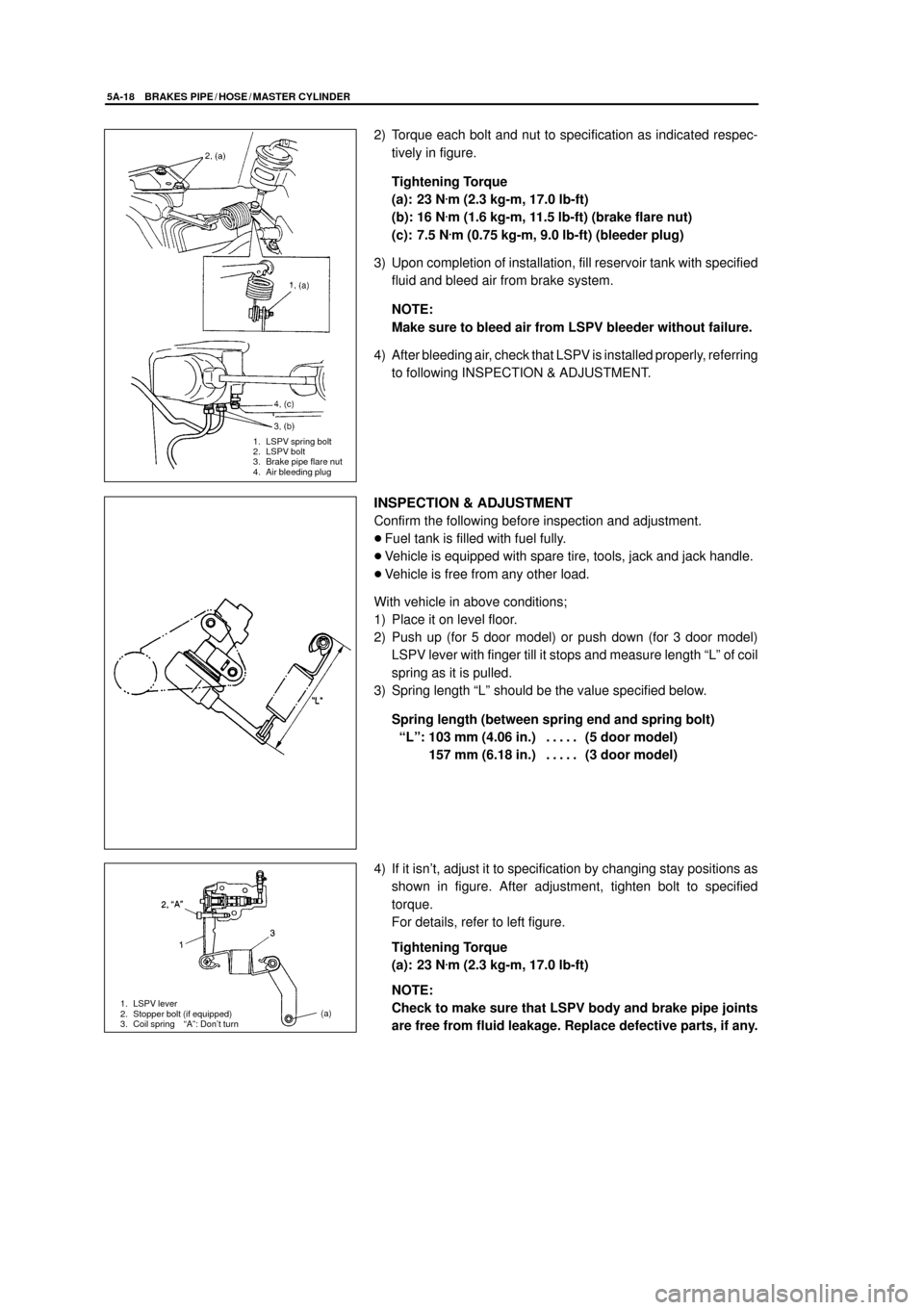
5A-18 BRAKES PIPE / HOSE / MASTER CYLINDER
1. LSPV spring bolt
2. LSPV bolt
3. Brake pipe flare nut
4. Air bleeding plug
1. LSPV lever
2. Stopper bolt (if equipped)
3. Coil spring ªAº: Don't turn(a)
2) Torque each bolt and nut to specification as indicated respec-
tively in figure.
Tightening Torque
(a): 23 N
.m (2.3 kg-m, 17.0 lb-ft)
(b): 16 N
.m (1.6 kg-m, 11.5 lb-ft) (brake flare nut)
(c): 7.5 N
.m (0.75 kg-m, 9.0 lb-ft) (bleeder plug)
3) Upon completion of installation, fill reservoir tank with specified
fluid and bleed air from brake system.
NOTE:
Make sure to bleed air from LSPV bleeder without failure.
4) After bleeding air, check that LSPV is installed properly, referring
to following INSPECTION & ADJUSTMENT.
INSPECTION & ADJUSTMENT
Confirm the following before inspection and adjustment.
�Fuel tank is filled with fuel fully.
�Vehicle is equipped with spare tire, tools, jack and jack handle.
�Vehicle is free from any other load.
With vehicle in above conditions;
1) Place it on level floor.
2) Push up (for 5 door model) or push down (for 3 door model)
LSPV lever with finger till it stops and measure length ªLº of coil
spring as it is pulled.
3) Spring length ªLº should be the value specified below.
Spring length (between spring end and spring bolt)
ªLº: 103 mm (4.06 in.) (5 door model). . . . .
ªLº: 157 mm (6.18 in.) (3 door model). . . . .
4) If it isn't, adjust it to specification by changing stay positions as
shown in figure. After adjustment, tighten bolt to specified
torque.
For details, refer to left figure.
Tightening Torque
(a): 23 N
.m (2.3 kg-m, 17.0 lb-ft)
NOTE:
Check to make sure that LSPV body and brake pipe joints
are free from fluid leakage. Replace defective parts, if any.
Page 313 of 801

YH4
GRAND
VITARA
BRAKES PIPE / HOSE / MASTER CYLINDER 5A-19
09922-85811
Connector pin remover09950-96010
Booster piston rod gauge09952-16010
Booster piston rod adjuster
TIGHTENING TORQUE SPECIFICATIONS
FasteningpartsTightening torqueFastening artsN.mkg-mlb-ft
Brake flexible hose bolt (Brake caliper / 2 (4) way joint)232.317.0
Master cylinder attaching nut131.39.5
Booster nut131.39.5
Clevis nut252.518
2-way (or 4-way) joint mounting bolt101.07.5
Brake pipe flare nut161.611.5
Front caliperM88.00.86.0
Brake bleederplug
Front cali erM108.50.856.5Brake bleeder lugWheel cylinder7.50.755.5
LSPV8.00.86.0
LSPV mounting bolt
LSPV stay bolt232.317.0
LSPV spring nut
Wheel nut10010.072.5
REQUIRED SERVICE MATERIAL
MATERIALSRECOMMENDED
SUZUKI PRODUCTUSE
Brake fluid
Indicated on reservoir
cap or described in owner's
manual of vehicle�To fill master cylinder reservoir.
�To clean and apply to inner parts of master
cylinder caliper and wheel cylinder when
they are disassembled.
SPECIAL TOOLS
Page 316 of 801

YH4
GRAND
VITARA
1. Caliper
2. Caliper pin bolts
3. Disc
1. Caliper
2. Wire hook
3. Pad
FRONT BRAKE 5B-3
DIAGNOSIS
Refer to Section 5 (BRAKES).
CHECK AND ADJUSTMENT
Refer to Section 5 (BRAKES).
ON-VEHICLE SERVICE
FRONT DISC BRAKE PAD
REMOVAL
1) Hoist vehicle and remove wheel.
2) Remove caliper pin bolts.
3) Remove E-ring from strut and then remove caliper from caliper
carrier.
NOTE:
Hang removed caliper with a wire hook or the like so as to
prevent brake hose from bending and twisting excessively
or being pulled. Don't operate brake pedal with pads re-
moved.
4) Remove pads.
INSPECTION
Brake Pad
Check pad lining for wear. When wear exceeds limit, replace with
new one.
CAUTION:
Never polish pad lining with sandpaper. If lining is polished
with sandpaper, hard particles of sandpaper will be depos-
ited in lining and may damage disc. When pad lining re-
quires correction, replace it with a new one.
Pad thickness (lining + rim) ªaº
Standard: 15.0 mm (0.590 in.) For SUMITOMO ELECTRIC. . .
brake calliper
15.5 mm (0.610 in.) For TOKICO brake caliper. . .
Service limit: 7.0 mm (0.275 in.) For SUMITOMO ELECTRIC. .
brake caliper
7.5 mm (0.295 in.) For TOKICO brake caliper. .
NOTE:
When pads are removed, visually inspect caliper for brake
fluid leak. Correct leaky point, if any.
Page 319 of 801
YH4
GRAND
VITARA
1. Caliper
2. Flexible hose
3. Hose mounting bolt
4. Wire hook
5. Container
1. Cloth
5B-6 FRONT BRAKE
FRONT DISC BRAKE CALIPER
REMOVAL
1) Hoist vehicle and remove wheel.
2) Remove brake flexible hose mounting bolt from caliper. As this
will allow fluid to flow out of hose, have a container ready before-
hand.
3) Remove caliper pin bolts.
4) Remove caliper.
DISASSEMBLY
Before disassembly, clean all around caliper with brake fluid.
1) Remove anti noise shim (if equipped) and blow compressed air
into cylinder through bolt hole where flexible hose was fitted.
With this air pressure, piston can be pushed out of cylinder.
WARNING:
Do not apply too highly compressed air which will cause
piston to jump out of cylinder. It should be taken out grad-
ually with moderately compressed air. Do not place your
fingers in front of piston when using compressed air.
Page 320 of 801

YH4
GRAND
VITARA
FRONT BRAKE 5B-7
2) Remove piston seal using a thin blade like a thickness gauge,
etc.
CAUTION:
Be careful not to damage inside (bore side) of cylinder.
INSPECTION
Cylinder Boot
Check boots for breakage, crack and damage. If defective, replace.
Piston Seal
Excessive or uneven wear of pad lining may indicate unsmooth re-
turn of the piston. In such a case, replace rubber seal.
ASSEMBLY
Reassemble front brake in reverse order of disassembly, noting the
following points.
CAUTION:
�Wash each part cleanly before installation in the same
fluid as the one used in master cylinder reservoir.
�Never use other fluid or thinner.
�Before installing piston and piston seal to cylinder, apply
fluid to them.
�After reassembling brake lines, bleed air from them.
Piston Seal
Piston seal is used to seal piston and cylinder and to adjust clear-
ance between pad and disc. Replace with a new one at every over-
haul. Fit piston seal into groove in cylinder taking care not to twist
it.


