Page 98 of 374
2-38
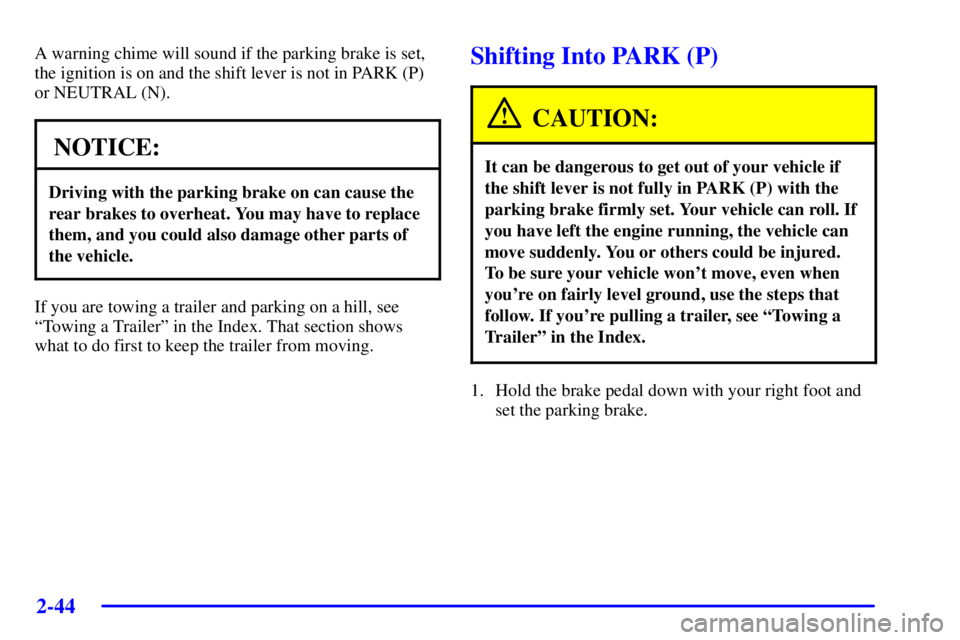
Engine Coolant Heater (Option)
In very cold weather, 0�F (-18�C) or colder, the engine
coolant heater can help. You'll get easier starting and
better fuel economy during engine warm
-up. Usually,
the coolant heater should be plugged in a minimum of
four hours prior to starting your vehicle. At temperatures
above 32�F (0�C), use of the coolant heater is
not required.
To Use the Engine Coolant Heater
1. Turn off the engine.
2. Open the hood and unwrap the electrical cord.
The cord is located below the engine air
cleaner/filter near the coolant reservoir bottle.
See ªEngine Compartment Overviewº in the
Index for more information on location.
3. Plug it into a normal, grounded 110
-volt AC outlet.
CAUTION:
Plugging the cord into an ungrounded outlet
could cause an electrical shock. Also, the wrong
kind of extension cord could overheat and cause
a fire. You could be seriously injured. Plug the
cord into a properly grounded three
-prong
11 0
-volt AC outlet. If the cord won't reach, use a
heavy
-duty three-prong extension cord rated for
at least 15 amps.
Page 104 of 374
2-44
A warning chime will sound if the parking brake is set,
the ignition is on and the shift lever is not in PARK (P)
or NEUTRAL (N).
NOTICE:
Driving with the parking brake on can cause the
rear brakes to overheat. You may have to replace
them, and you could also damage other parts of
the vehicle.
If you are towing a trailer and parking on a hill, see
ªTowing a Trailerº in the Index. That section shows
what to do first to keep the trailer from moving.
Shifting Into PARK (P)
CAUTION:
It can be dangerous to get out of your vehicle if
the shift lever is not fully in PARK (P) with the
parking brake firmly set. Your vehicle can roll. If
you have left the engine running, the vehicle can
move suddenly. You or others could be injured.
To be sure your vehicle won't move, even when
you're on fairly level ground, use the steps that
follow. If you're pulling a trailer, see ªTowing a
Trailerº in the Index.
1. Hold the brake pedal down with your right foot and
set the parking brake.
Page 105 of 374
2-45
2. Move the shift lever into PARK (P) like this:
�Press in and hold the shift lever button, located
on the front of the shift lever.
�Push the lever all the way toward the front of
the vehicle.
3. Turn the ignition key to LOCK.
4. Remove the key and take it with you. If you can
leave your vehicle with the ignition key in your
hand, your vehicle is in PARK (P).
Leaving Your Vehicle With the
Engine Running
CAUTION:
It can be dangerous to leave your vehicle with the
engine running. Your vehicle could move
suddenly if the shift lever is not fully in PARK (P)
with the parking brake firmly set. And, if you
leave the vehicle with the engine running, it could
overheat and even catch fire. You or others could
be injured. Don't leave your vehicle with the
engine running unless you have to.
If you have to leave your vehicle with the engine
running, be sure the vehicle is in PARK (P) and the
parking brake is firmly set before you leave it. After
you've moved the shift lever into PARK (P), hold the
regular brake pedal down. Then, see if you can move the
shift lever away from PARK (P) (without first pushing
the shift lever button). If you can, it means that the shift
lever wasn't fully locked into PARK (P).
Page 142 of 374

2-82
Traction Control System Warning Light
(3800 Supercharged V6 Engine Only)
The traction control
system warning light
may come on for the
following reasons:
�If you turn the system off by pressing the TCS
button located on the far right side of the trip
computer, the warning light will come on and
stay on. To turn the system back on, press the
button again. The warning light should go off.
See ªTraction Control Systemº in the Index
for more information.
�If there's a brake system problem that is specifically
related to traction control, the traction control system
will turn off and the warning light will come on. If
your brakes begin to overheat, the traction control
system will turn off and the warning light will come
on until your brakes cool down.
If the traction control system warning light comes on
and stays on for an extended period of time when the
system is turned on, your vehicle needs service.
Enhanced Traction System Warning Light
(3100 V6 or 3800 V6 Engine)
The Enhanced Traction
System warning light
may come on for the
following reasons:
�If you turn the system off by pressing the TRAC
button on the far right side of the Driver Information
Center or trip computer (if equipped), the warning
light will come on and stay on. To turn the system
back on, press the button again. The warning light
should go off. See ªEnhanced Traction Systemº in
the Index for more information.
�If the Enhanced Traction System warning light
comes on and stays on for an extended period of
time when the system is turned on, your vehicle
needs service. Adjust your driving accordingly.
�If the traction control system is affected by an
engine
-related problem, the system will turn off and
the warning light will come on.
When this warning light is on, the system will not limit
wheel spin. Adjust your driving accordingly.
Page 143 of 374

2-83 Low Traction Light
If you have the Enhanced
Traction System or the
Traction Control System,
this light will also come
on when the system is
limiting wheel spin.
You may feel or hear the system working, but this is
normal. Slippery road conditions may exist if the low
traction light comes on, so adjust your driving
accordingly. The light will stay on for a few seconds
after the Enhanced Traction System or the Traction
Control System stops limiting wheel spin. See
ªEnhanced Traction Systemº or ªTraction Control
Systemº in the Index.
The low traction light also comes on briefly when you
turn the ignition key to RUN. If the light doesn't come
on then, have it fixed so it will be there to tell you when
the Traction Control System or Enhanced Traction
System is active.
Engine Coolant Temperature Light
This light tells tells you that
the engine coolant has
overheated or the radiator
cooling fan is not working.
If you have been operating the vehicle under normal
driving conditions, you should pull of the road, stop the
vehicle and turn off the engine as soon as possible.
See ªEngine Overheatingº in the Index.
Page 144 of 374
2-84
Engine Coolant Temperature Gage
United States Canada
Your vehicle has a gage that shows the engine coolant
temperature. If the gage pointer moves into the shaded
area, the engine is too hot.
That reading means the same thing as the warning light.
It means that the engine coolant has overheated. If you
have been operating the vehicle under normal
conditions, you should pull off the road, stop the
vehicle, and turn off the engine as soon as possible.
See ªEngine Overheatingº in the Index.
Low Coolant Warning Light
If this light comes on,
the system is low on
coolant and the engine
may overheat.
See ªEngine Coolantº in the Index and have the vehicle
serviced as soon as possible.
Page 223 of 374
4-43 Driving On Grades
Reduce speed and shift to a lower gear before you start
down a long or steep downgrade. If you don't shift
down, you might have to use your brakes so much that
they would get hot and no longer work well.
On a long uphill grade, shift down and reduce your
speed to around 45 mph (70 km/h) to reduce the
possibility of engine and transaxle overheating.
If you have overdrive, you may have to drive in
THIRD (3) instead of AUTOMATIC OVERDRIVE (D).
Parking on Hills
CAUTION:
You really should not park your vehicle, with a
trailer attached, on a hill. If something goes
wrong, your rig could start to move. People can
be injured, and both your vehicle and the trailer
can be damaged.
But if you ever have to park your rig on a hill, here's
how to do it:
1. Apply your regular brakes, but don't shift into
PARK (P) yet.
2. Have someone place chocks under the trailer wheels.
3. When the wheel chocks are in place, release the
regular brakes until the chocks absorb the load.
4. Reapply the regular brakes. Then apply your parking
brake, and then shift to PARK (P).
5. Release the regular brakes.
Page 224 of 374

4-44 When You Are Ready to Leave After
Parking on a Hill
1. Apply your regular brakes and hold the pedal down
while you:
�start your engine,
�shift into a gear, and
�release the parking brake.
2. Let up on the brake pedal.
3. Drive slowly until the trailer is clear of the chocks.
4. Stop and have someone pick up and store the chocks.
Maintenance When Trailer Towing
Your vehicle will need service more often when you're
pulling a trailer. See the Maintenance Schedule for more
on this. Things that are especially important in trailer
operation are automatic transaxle fluid (don't overfill),
engine oil, drive belts, cooling system and brake system.
Each of these is covered in this manual, and the Index
will help you find them quickly. If you're trailering, it's
a good idea to review this information before you start
your trip.
Check periodically to see that all hitch nuts and bolts
are tight.
Engine Cooling When Trailer Towing
Your cooling system may temporarily overheat during
severe operating conditions. See ªEngine Overheatingº
in the Index.