Page 95 of 393

2-27 Leaving Your Vehicle With the
Engine Running
CAUTION:
It can be dangerous to leave your vehicle with
the engine running. Your vehicle could move
suddenly if the shift lever is not fully in PARK (P)
with the parking brake firmly set. And, if you
leave the vehicle with the engine running, it could
overheat and even catch fire. You or others could
be injured. Don't leave your vehicle with the
engine running unless you have to.
If you have to leave your vehicle with the engine
running, be sure your vehicle is in PARK (P) and your
parking brake is firmly set before you leave it. After
you've moved the shift lever into PARK (P), hold the
regular brake pedal down. Then, see if you can move the
shift lever away from PARK (P) without first pressing
the button on the console shift lever. If you can, it means
that the shift lever wasn't fully locked into PARK (P).
Torque Lock
If you are parking on a hill and you don't shift your
transmission into PARK (P) properly, the weight of the
vehicle may put too much force on the parking pawl in
the transmission. You may find it difficult to pull the
shift lever out of PARK (P). This is called ªtorque lock.º
To prevent torque lock, set the parking brake and then
shift into PARK (P) properly before you leave the
driver's seat. To find out how, see ªShifting Into
PARK (P)º in the Index.
When you are ready to drive, move the shift lever out
of PARK (P) before you release the parking brake.
If torque lock does occur, you may need to have
another vehicle push yours a little uphill to take some of
the pressure from the parking pawl in the transmission,
so you can pull the shift lever out of PARK (P).
Page 96 of 393

2-28
Shifting Out of PARK (P)
Your vehicle has an automatic transmission shift lock
control system. You have to fully apply your regular
brake before you can shift from PARK (P) when the
ignition is in RUN. See ªAutomatic Transmission
Operationº in the Index.
If you cannot shift out of PARK (P), ease pressure on
the shift lever
-- push the shift lever all the way into
PARK (P) as you maintain brake application. Then press
the shift lever button and move the shift lever into the
gear you want.
If you ever hold the brake pedal down but still can't
shift out of PARK (P), try this:
1. Turn the key to LOCK.
2. Apply and hold the brake until the end of Step 4.
3. Shift to NEUTRAL (N).
4. Start the vehicle and then shift to the drive gear
you want.
5. Have the vehicle fixed as soon as possible.
Parking Over Things That Burn
CAUTION:
Things that can burn could touch hot exhaust
parts under your vehicle and ignite. Don't park
over papers, leaves, dry grass or other things that
can burn.
Page 98 of 393

2-30
CAUTION:
It can be dangerous to get out of your vehicle if
the shift lever is not fully in PARK (P) with the
parking brake firmly set. Your vehicle can roll.
Don't leave your vehicle when the engine is
running unless you have to. If you've left the
engine running, the vehicle can move suddenly.
You or others could be injured. To be sure your
vehicle won't move, even when you're on fairly
level ground, always set your parking brake and
move the shift lever to PARK (P).
Follow the proper steps to be sure your vehicle won't move.
See ªShifting Into PARK (P)º in the Index.
If you're pulling a trailer, see ªTowing a Trailerº in
the Index.
Locking Rear Axle
Your locking rear axle can give you additional traction
on snow, mud, ice, sand or gravel. It works like a
standard axle most of the time, but when one of the rear
wheels has no traction and the other does, this feature
will allow the wheel with traction to move the vehicle.
All-Wheel Drive (Option)
There is no lever or switch to engage or disengage the
front axle. It is fully automatic and adjusts as needed
for road conditions. Your vehicle has an active transfer
case allowing two
-wheel-drive operation on dry roads.
The transfer case will shift automatically into all
-wheel
drive on slippery surfaces. You may feel an extra shift
when the all
-wheel drive engages.
Horn
To sound the horn, press on or near the horn symbols
on the center pad of the steering wheel.
Page 99 of 393
2-31
Tilt Wheel
You should adjust the
steering wheel before
you drive. The tilt lever
is located on the driver's
side of the steering column,
under the turn signal lever.
You can raise it to the highest level to give your legs
more room when you enter and exit the vehicle.
To tilt the wheel, hold the steering wheel and pull
the lever toward you. Move the steering wheel to a
comfortable level, then release the lever to lock the
wheel in place.
Do not adjust the steering wheel while driving.
Turn Signal/Multifunction Lever
The lever on the left side of the steering column
includes the following:
�
: Turn and Lane Change Signals
�
: Headlamp High/Low-Beam Changer
�Flash
-to-Pass Feature
�
: Windshield Wipers
�
: Windshield Washer
�
: Cruise Control
Page 103 of 393
2-35 Windshield Washer
There's a paddle marked with the windshield washer
symbol on the top of the multifunction lever.
To spray washer fluid on the windshield, push the
paddle. The wipers will clear the window and then
either stop or return to your preset speed.
CAUTION:
In freezing weather, don't use your washer until
the windshield is warmed. Otherwise the washer
fluid can form ice on the windshield, blocking
your vision.
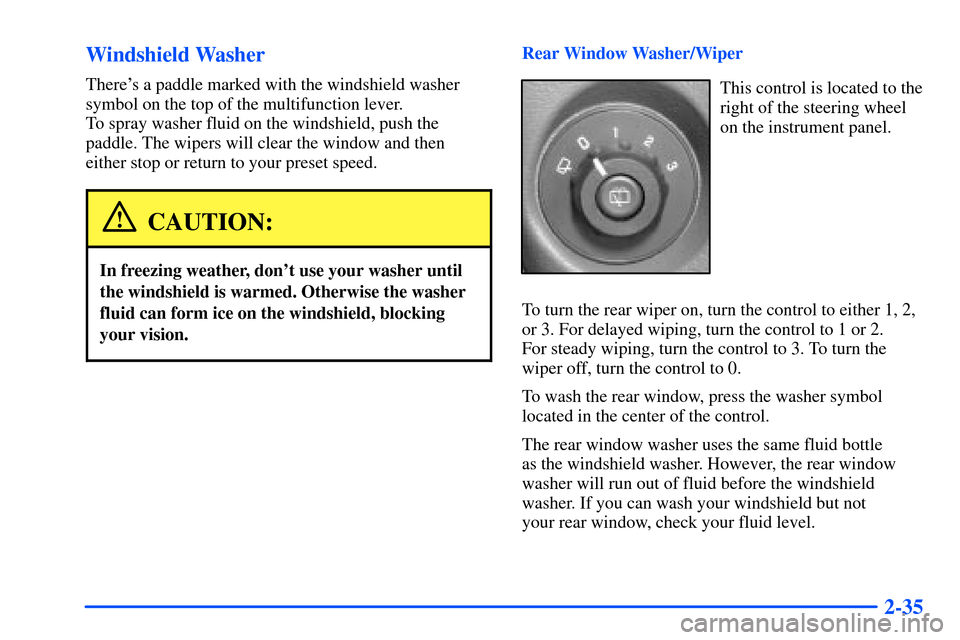
Rear Window Washer/Wiper
This control is located to the
right of the steering wheel
on the instrument panel.
To turn the rear wiper on, turn the control to either 1, 2,
or 3. For delayed wiping, turn the control to 1 or 2.
For steady wiping, turn the control to 3. To turn the
wiper off, turn the control to 0.
To wash the rear window, press the washer symbol
located in the center of the control.
The rear window washer uses the same fluid bottle
as the windshield washer. However, the rear window
washer will run out of fluid before the windshield
washer. If you can wash your windshield but not
your rear window, check your fluid level.
Page 107 of 393

2-39
Exterior Lamps
Your exterior lamps knob is
on the driver's side of your
instrument panel.
Turn the knob clockwise to the parking lamps
symbol to manually turn on the following:
�Parking Lamps
�Sidemarker Lamps
�Taillamps
�License Plate Lamps
�Instrument Panel Lights
Turn the knob clockwise to the master lamp symbol
to turn on all the lamps listed as well as the headlamps.
Turn the knob all the way counterclockwise to turn
off your lamps and put the system in automatic
headlamp mode.
Automatic Headlamp System
When it is dark enough outside, your automatic
headlamp system will turn on your headlamps at the
normal brightness along with other lamps such as the
taillamps, sidemarker, parking lamps and the instrument
panel lights. The radio lights will also be on.
Your vehicle is equipped with a light sensor on the top
of the instrument panel. Be sure it is not covered or
the system will be on whenever the ignition is on.
The system may also turn on your lights when driving
through a parking garage, heavy overcast weather or
a tunnel. This is normal.
There is a delay in the transition between the daytime
and nighttime operation of the Daytime Running Lamps
(DRL) and the automatic headlamp systems so that
driving under bridges or bright overhead street lights
does not affect the system. The DRL and automatic
headlamp system will only be affected when the light
sensor sees a change in lighting lasting longer than
the delay.
Page 108 of 393

2-40
To idle your vehicle with the automatic headlamp
system off, set the parking brake while the ignition is
off. Then start your vehicle. The automatic headlamp
system will stay off until you release the parking brake,
or until you shift out of park.
You may be able to turn off your automatic headlamp
system. See ªDaytime Running Lamps (DRL)º later in
this section for more information.
As with any vehicle, you should turn on the regular
headlamp system when you need it.
Lamps On Reminder
A reminder tone will sound when your headlamps or
parking lamps are manually turned on, the driver's door
is open and your ignition is in LOCK or ACCESSORY.
To turn the tone off, turn the knob all the way
counterclockwise. In the automatic mode, the headlamps
turn off once the ignition key is in LOCK.
Daytime Running Lamps
Daytime Running Lamps (DRL) can make it easier
for others to see the front of your vehicle during
the day. DRL can be helpful in many different
driving conditions, but they can be especially helpful
in the short periods after dawn and before sunset.
Fully functional daytime running lamps are required
on all vehicles first sold in Canada.
The DRL system will make your headlamps come on
at reduced brightness when the following conditions
are met:
�The ignition is on,
�the exterior lamps knob is in automatic
headlamp mode,
�the light sensor detects daytime light, and
�the transmission is not in PARK (P).
When the DRL are on, only your headlamps will be on.
The taillamps, sidemarker and other lamps won't be on.
The instrument panel won't be lit up either.
Page 109 of 393

2-41
When it begins to get dark, the headlamps will
automatically switch from DRL to the regular headlamps.
To idle your vehicle with the DRL off, put your vehicle's
transmission in PARK (P). The DRL will stay off until
you shift out of PARK (P).
The following does not apply to vehicles sold in Canada.
When necessary, you may turn off the automatic headlamp
system and the Daytime Running Lamps (DRL) feature
by following the steps below:
1. Turn the ignition to RUN.
2. Press the dome override button four times within
six seconds. After the fourth press of the button,
a chime will sound informing you that the system
is off.
3. To return to the automatic mode, push the dome
override button four times within six seconds (the
chime will sound), or turn the ignition to LOCK
and then to RUN again.
As with any vehicle, you should turn on the regular
headlamp system when you need it.Fog Lamps
Use your fog lamps for better vision in foggy or misty
conditions. Your ignition must be in RUN for your
fog lamps to work.
The fog lamp button is
located on the instrument
panel to the right of the
exterior lamps knob.
Press the button to turn
the fog lamps on. Press the
button again to turn them
off. A light will glow near
the button when the fog
lamps are on.
Fog lamps will go off whenever your high
-beam
headlamps come on. When the high beams go off,
the fog lamps will come on again.
