Page 39 of 393

1-26
CAUTION:
If something is between an occupant and an
air bag, the bag might not inflate properly or it
might force the object into that person causing
severe injury or even death. The path of an
inflating air bag must be kept clear. Don't put
anything between an occupant and an air bag,
and don't attach or put anything on the steering
wheel hub or on or near any other air bag
covering. Don't let seat covers block the inflation
path of a side impact air bag.
When should an air bag inflate?
The driver's and right front passenger's frontal air bags
are designed to inflate in moderate to severe frontal or
near
-frontal crashes. But they are designed to inflate
only if the impact speed is above the system's designed
ªthreshold level.º
If your vehicle goes straight into a wall that doesn't
move or deform, the threshold level is about 9 to 16 mph
(14 to 26 km/h). The threshold level can vary, however,
with specific vehicle design, so that it can be somewhat
above or below this range.
If your vehicle strikes something that will move or
deform, such as a parked car, the threshold level will be
higher. The driver's and right front passenger's frontal
air bags are not designed to inflate in rollovers, side
impacts, or rear impacts, because inflation would not
help the occupant.
Page 41 of 393

1-28
Side impact air bags would not help you in many types
of collisions, including frontal or near frontal collisions,
rollovers, and rear impacts, primarily because an
occupant's motion is not toward those air bags.
Air bags should never be regarded as anything more
than a supplement to safety belts, and then only in
moderate to severe frontal or near
-frontal collisions for
the driver's and right front passenger's frontal air bags,
and only in moderate to severe side collisions for the
driver's and right front passenger's side impact air bags.
What will you see after an air bag inflates?
After an air bag inflates, it quickly deflates, so quickly
that some people may not even realize the air bag
inflated. Some components of the air bag module
-- the
steering wheel hub for the driver's air bag, the
instrument panel for the right front passenger's bag, the
side of the seatback closest to the door for the driver and
right front passenger's side impact air bags
-- will be
hot for a short time. The parts of the bag that come into
contact with you may be warm, but not too hot to touch. There will be some smoke and dust coming from the
vents in the deflated air bags. Air bag inflation doesn't
prevent the driver from seeing or being able to steer the
vehicle, nor does it stop people from leaving the vehicle.
CAUTION:
When an air bag inflates, there is dust in the air.
This dust could cause breathing problems
for people with a history of asthma or other
breathing trouble. To avoid this, everyone in the
vehicle should get out as soon as it is safe to do so.
If you have breathing problems but can't get out
of the vehicle after an air bag inflates, then get
fresh air by opening a window or a door.
Your vehicle has a feature that will automatically unlock
the doors and turn the interior lamps on when the air
bags inflate (if battery power is available). You can lock
the doors again and turn the interior lamps off by using
the door lock and interior lamp controls.
Page 44 of 393
1-31
Lap-Shoulder Belt
All three rear seating positions have lap
-shoulder belts.
Here's how to wear one properly.
1. Pick up the latch plate and pull the belt across you.
Don't let it get twisted.
2. Push the latch plate into the buckle until it clicks.
Pull up on the latch plate to make sure it is secure.When the shoulder belt is pulled out all the way, it
will lock. If it does, let it go back all the way and
start again. If the belt is not long enough, see ªSafety
Belt Extenderº at the end of this section. Make sure
the release button on the buckle is positioned so you
would be able to unbuckle the safety belt quickly if
you ever had to.
3. To make the lap part tight, pull down on the buckle
end of the belt as you pull up on the shoulder part.
Page 60 of 393
1-47
3. Buckle the belt. Make sure the release button is
positioned so you would be able to unbuckle the
safety belt quickly if you ever had to.4. Pull the rest of the shoulder belt all the way out of
the retractor to set the lock.
Page 64 of 393
1-51
5. Pull the rest of the shoulder belt all the way out of
the retractor to set the lock.6. To tighten the belt, feed the shoulder belt back into the
retractor while you push down on the child restraint.
You may find it helpful to use your knee to push
down on the child restraint as you tighten the belt.
7. Push and pull the child restraint in different
directions to be sure it is secure.
To remove the child restraint, just unbuckle the vehicle's
safety belt and let it go back all the way. The safety belt
will move freely again and be ready to work for an adult
or larger child passenger.
Page 69 of 393

2-
2-1
Section 2 Features and Controls
Here you can learn about the many standard and optional features on your vehicle, and information on starting,
shifting and braking. Also explained are the instrument panel and the warning systems that tell you if everything is
working properly
-- and what to do if you have a problem.
2
-2 Windows
2
-4 Keys
2
-6 Door Locks
2
-10 Remote Keyless Entry System
2
-13 Liftgate/Liftglass
2
-14 Theft
2
-15 Content Theft-Deterrent (If Equipped)
2
-17 Passlock�
2-18 New Vehicle ªBreak-Inº
2
-18 Ignition Positions
2
-19 Starting Your Engine
2
-21 Engine Coolant Heater (If Equipped)
2
-22 Automatic Transmission Operation
2
-25 Parking Brake
2
-26 Shifting Into PARK (P)
2
-28 Shifting Out of PARK (P)
2
-28 Parking Over Things That Burn
2
-29 Engine Exhaust
2
-29 Running Your Engine While You're Parked2
-30 Locking Rear Axle
2
-30 All-Wheel Drive (Option)
2
-30 Horn
2
-31 Tilt Wheel
2
-31 Turn Signal/Multifunction Lever
2
-39 Exterior Lamps
2
-42 Interior Lamps
2
-44 Mirrors
2
-48 Storage Compartments
2
-53 Ashtrays and Cigarette Lighter
2
-55 Accessory Power Outlets
2
-56 OnStar� System (If Equipped)
2
-60 Sunroof (Option)
2
-60 HomeLink� Transmitter
2
-64 Instrument Panel -- Your Information System
2
-66 Instrument Panel Cluster
2
-68 Warning Lights, Gages and Indicators
2
-82 Driver Information Center (DIC)
Page 71 of 393

2-3 Power Windows
The controls for the power windows are located on the
armrest on each of the side doors. With power windows,
the switches operate the windows when the ignition is
in RUN, ACCESSORY or when Retained Accessory
Power (RAP) is active. (See ªRetained Accessory
Powerº in the Index.) The driver's door has a switch
for each of the passenger's windows as well.
Press the bottom of the switch to lower the window.
Press the top of the switch to raise the window.Express
-Down Window
The driver's and front passenger's window switches
have an express
-down feature that allows you to lower
the window without holding the switch down. Press the
bottom of the driver's window switch down briefly to
activate the express
-down feature. Lightly tap the
switch to open the window slightly. The express
-down
feature can be interrupted at any time by pressing the
top of the switch.
Lockout Switch
Your vehicle has a lockout feature to prevent passengers
from operating the power windows. A small light in the
lockout switch will come on to show that the switch has
been activated. Press the lockout switch again to return
to normal operation.
Page 73 of 393
2-5
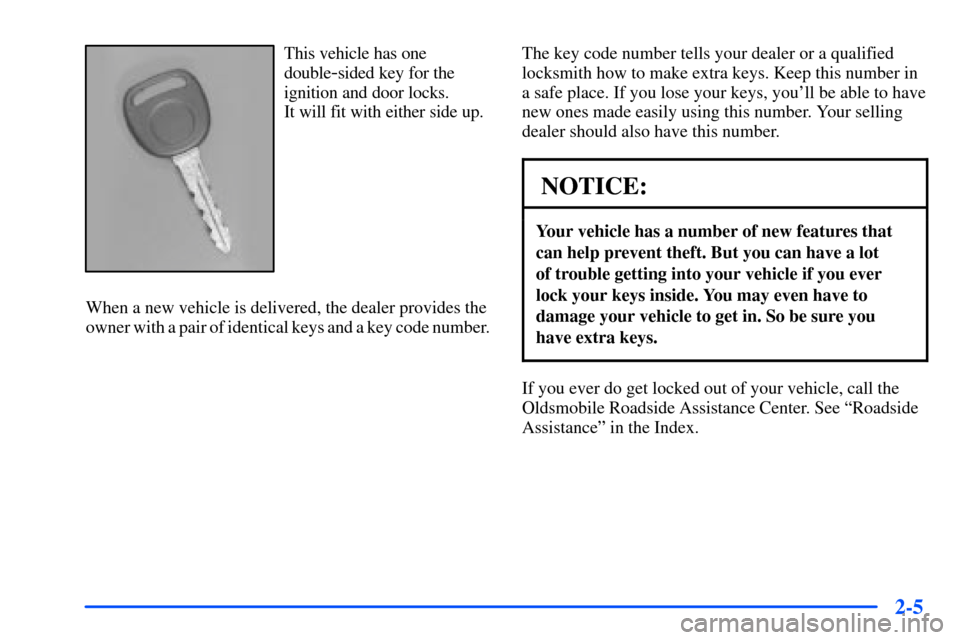
This vehicle has one
double
-sided key for the
ignition and door locks.
It will fit with either side up.
When a new vehicle is delivered, the dealer provides the
owner with a pair of identical keys and a key code number.The key code number tells your dealer or a qualified
locksmith how to make extra keys. Keep this number in
a safe place. If you lose your keys, you'll be able to have
new ones made easily using this number. Your selling
dealer should also have this number.
NOTICE:
Your vehicle has a number of new features that
can help prevent theft. But you can have a lot
of trouble getting into your vehicle if you ever
lock your keys inside. You may even have to
damage your vehicle to get in. So be sure you
have extra keys.
If you ever do get locked out of your vehicle, call the
Oldsmobile Roadside Assistance Center. See ªRoadside
Assistanceº in the Index.