Page 103 of 343

2-41
INT (Intermittent): Move the lever to INT to choose a
delayed wiping cycle. Turn the INT ADJ band down for a
longer delay or up for a shorter delay. The further the INT
ADJ band is turned upward, the shorter the delay will be
and the further the INT ADJ band is turned downward,
the longer the delay will be. The wiper speed can only be
adjusted when the lever is in the INT position. Use this
position for light rain or snow.
LO (Low Speed): Move the lever up to the first
setting past INT, for steady wiping at low speed.
HI (High Speed): Move the lever up to the second
setting past INT, for steady wiping at high speed.
MIST: Move the lever all the way down to MIST for
a single wiping cycle. Hold it there until the windshield
wipers start; then let go. The windshield wipers will stop
after one wipe. If you want more wipes, hold the band
on mist longer.
Remember that damaged wiper blades may prevent you
from seeing well enough to drive safely. To avoid damage,
be sure to clear ice and snow from the wiper blades before
using them. If they're frozen to the windshield, carefully
loosen or thaw them. If your blades do become damaged,
get new blades or blade inserts.Heavy snow or ice can overload your wiper motor. A
circuit breaker will stop the motor until it cools. Clear
away snow or ice to prevent an overload.
Windshield Washer
To wash your windshield, push in the button at the end
of the lever until the washers begin.
CAUTION:
In freezing weather, don't use your washer until
the windshield is warmed. Otherwise the washer
fluid can form ice on the windshield, blocking
your vision.
When you release the button, the washers will stop,
but the wipers will continue to wipe about three times
or will resume the speed you were using before.
Page 136 of 343
2-74 Security Light
This light will come on
when you turn the key to
ON and will stay on until
the vehicle starts.
If you're driving and the security light comes on and
remains on, your Passlock
� system is not working
properly. Your vehicle is not protected by Passlock and
you should see your dealer.
Cruise Light
The CRUISE light comes
on whenever you set your
cruise control.
Low Washer Light
United States Canada
This light will come on briefly when you turn on the
ignition. It will also stay on, or come on and a chime
will sound, if the windshield washer fluid reservoir is
less than one
-third full.
Page 183 of 343
4-18
The heavier the rain, the harder it is to see. Even if your
windshield wiper blades are in good shape, a heavy rain
can make it harder to see road signs and traffic signals,
pavement markings, the edge of the road and even
people walking.
It's wise to keep your windshield wiping equipment in
good shape and keep your windshield washer tank
filled with washer fluid. Replace your windshield wiper
inserts when they show signs of streaking or missing
areas on the windshield, or when strips of rubber start to
separate from the inserts.Driving too fast through large water puddles or even
going through some car washes can cause problems, too.
The water may affect your brakes. Try to avoid puddles.
But if you can't, try to slow down before you hit them.
CAUTION:
Wet brakes can cause accidents. They won't work
as well in a quick stop and may cause pulling to
one side. You could lose control of the vehicle.
After driving through a large puddle of water or
a car wash, apply your brake pedal lightly until
your brakes work normally.
Hydroplaning
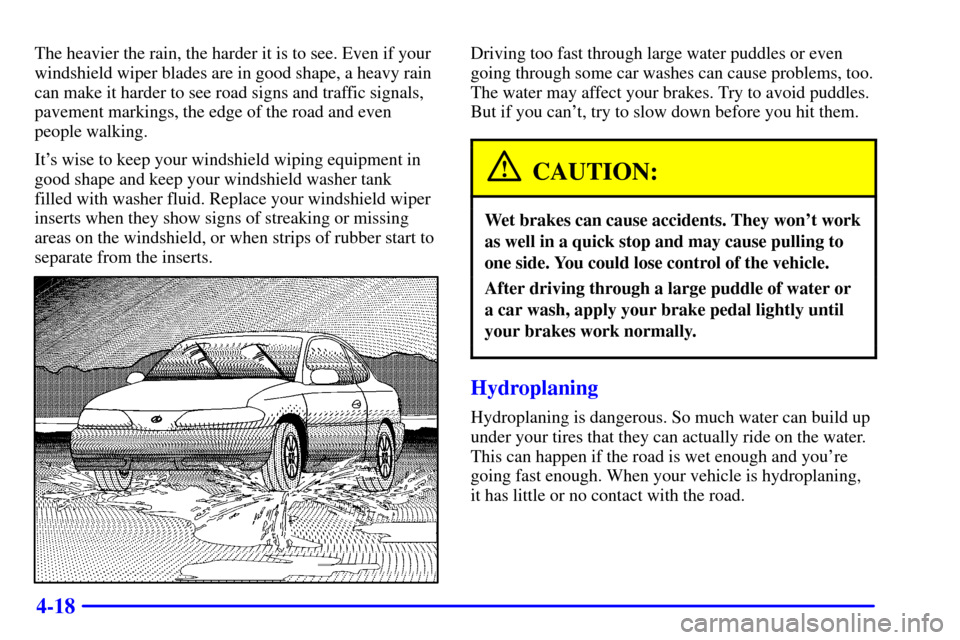
Hydroplaning is dangerous. So much water can build up
under your tires that they can actually ride on the water.
This can happen if the road is wet enough and you're
going fast enough. When your vehicle is hydroplaning,
it has little or no contact with the road.
Page 188 of 343

4-23
Here are some things you can check before a trip:
�Windshield Washer Fluid: Is the reservoir full?
Are all windows clean inside and outside?
�Wiper Blades: Are they in good shape?
�Fuel, Engine Oil, Other Fluids: Have you checked
all levels?
�Lamps: Are they all working? Are the lenses clean?
�Tires: They are vitally important to a safe,
trouble
-free trip. Is the tread good enough for
long
-distance driving? Are the tires all inflated
to the recommended pressure?
�Weather Forecasts: What's the weather outlook
along your route? Should you delay your trip a
short time to avoid a major storm system?
�Maps: Do you have up
-to-date maps?
Highway Hypnosis
Is there actually such a condition as ªhighway hypnosisº?
Or is it just plain falling asleep at the wheel? Call it
highway hypnosis, lack of awareness, or whatever.
There is something about an easy stretch of road with
the same scenery, along with the hum of the tires on the
road, the drone of the engine, and the rush of the wind
against the vehicle that can make you sleepy. Don't let it
happen to you! If it does, your vehicle can leave the
road in less than a second, and you could crash and
be injured.
What can you do about highway hypnosis? First, be
aware that it can happen.
Then here are some tips:
�Make sure your vehicle is well ventilated, with a
comfortably cool interior.
�Keep your eyes moving. Scan the road ahead
and to the sides. Check your rearview mirrors
and your instruments frequently.
�If you get sleepy, pull off the road into a rest, service
or parking area and take a nap, get some exercise, or
both. For safety, treat drowsiness on the highway as
an emergency.
Page 191 of 343
4-26
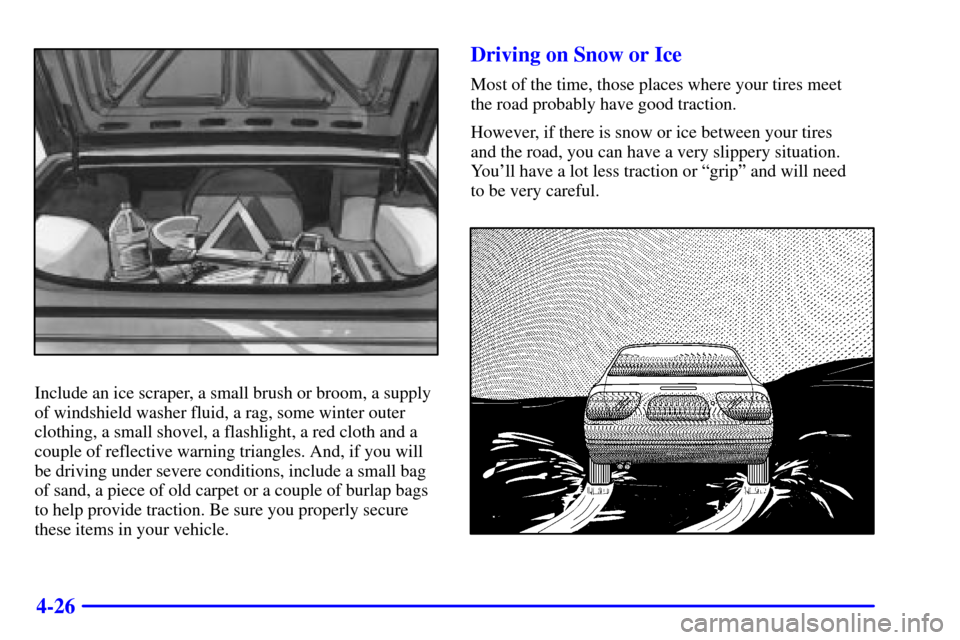
Include an ice scraper, a small brush or broom, a supply
of windshield washer fluid, a rag, some winter outer
clothing, a small shovel, a flashlight, a red cloth and a
couple of reflective warning triangles. And, if you will
be driving under severe conditions, include a small bag
of sand, a piece of old carpet or a couple of burlap bags
to help provide traction. Be sure you properly secure
these items in your vehicle.
Driving on Snow or Ice
Most of the time, those places where your tires meet
the road probably have good traction.
However, if there is snow or ice between your tires
and the road, you can have a very slippery situation.
You'll have a lot less traction or ªgripº and will need
to be very careful.
Page 238 of 343

6-
6-1
Section 6 Service and Appearance Care
Here you will find information about the care of your vehicle. This section begins with service and fuel information,
and then it shows how to check important fluid and lubricant levels. There is also technical information about your
vehicle, and a part devoted to its appearance care.
6
-2 Service
6
-3 Fuel
6
-5 Fuels in Foreign Countries
6
-6 Filling Your Tank
6
-8 Filling a Portable Fuel Container
6
-9 Checking Things Under the Hood
6
-13 Engine Oil
6
-20 Engine Air Cleaner/Filter
6
-22 Automatic Transaxle Fluid
6
-23 Manual Transaxle Fluid
6
-23 Hydraulic Clutch
6
-24 Engine Coolant
6
-28 Power Steering Fluid
6
-28 Windshield Washer Fluid
6
-30 Brakes6
-33 Battery
6
-34 Bulb Replacement
6
-39 Windshield Wiper Blade Replacement
6
-40 Tires
6
-51 Appearance Care
6
-51 Cleaning the Inside of Your Vehicle
6
-54 Care of Safety Belts
6
-55 Cleaning the Outside of Your Vehicle
6
-58 Finish Damage
6
-59 GM Vehicle Care/Appearance Materials
6
-60 Vehicle Identification Number (VIN)
6
-61 Electrical System
6
-66 Replacement Bulbs
6
-66 Capacities and Specifications
6
-68 Normal Maintenance Replacement Parts
Page 246 of 343
6-9
Checking Things Under the Hood
CAUTION:
An electric fan under the hood can start up and
injure you even when the engine is not running.
Keep hands, clothing and tools away from any
underhood electric fan.
CAUTION:
Things that burn can get on hot engine parts and
start a fire. These include liquids like gasoline,
oil, coolant, brake fluid, windshield washer and
other fluids, and plastic or rubber. You or others
could be burned. Be careful not to drop or spill
things that will burn onto a hot engine.
Hood Release
To open the hood, do the following:
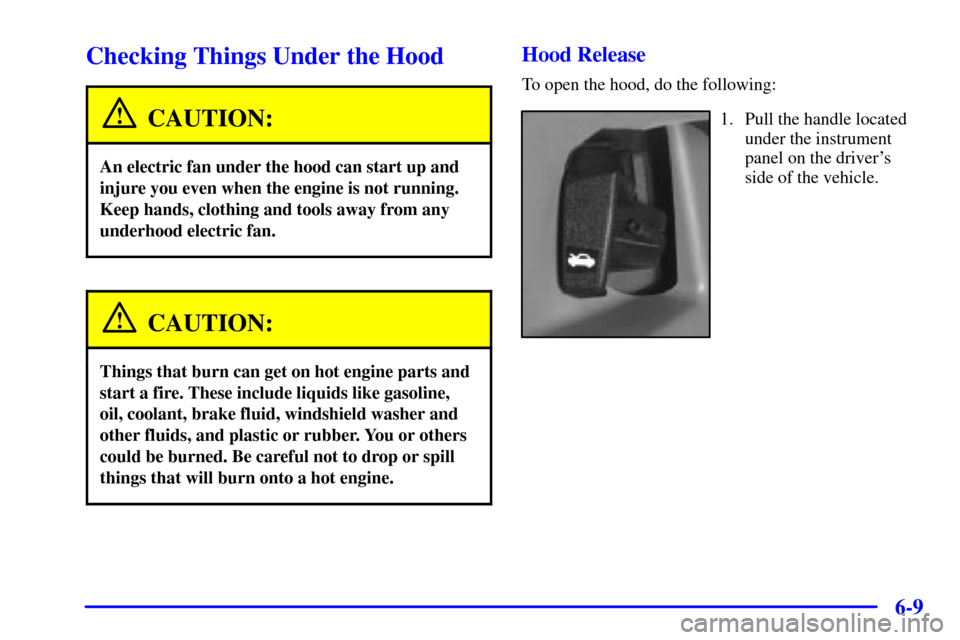
1. Pull the handle located
under the instrument
panel on the driver's
side of the vehicle.
Page 248 of 343
6-11 Engine Compartment Overview
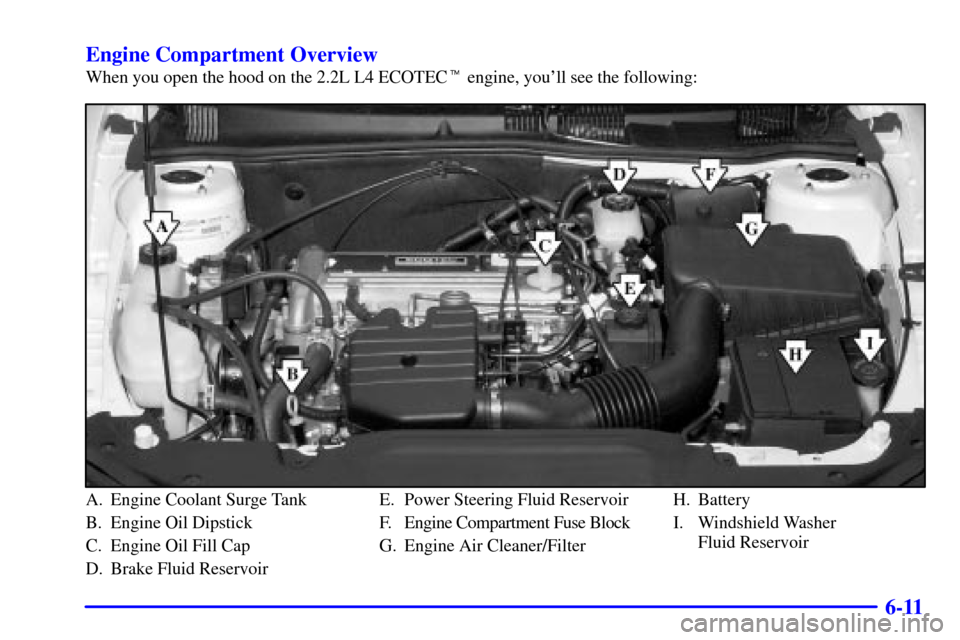
When you open the hood on the 2.2L L4 ECOTEC� engine, you'll see the following:
A. Engine Coolant Surge Tank
B. Engine Oil Dipstick
C. Engine Oil Fill Cap
D. Brake Fluid ReservoirE. Power Steering Fluid Reservoir
F. Engine Compartment Fuse Block
G. Engine Air Cleaner/FilterH. Battery
I. Windshield Washer
Fluid Reservoir