Page 125 of 343
2-63
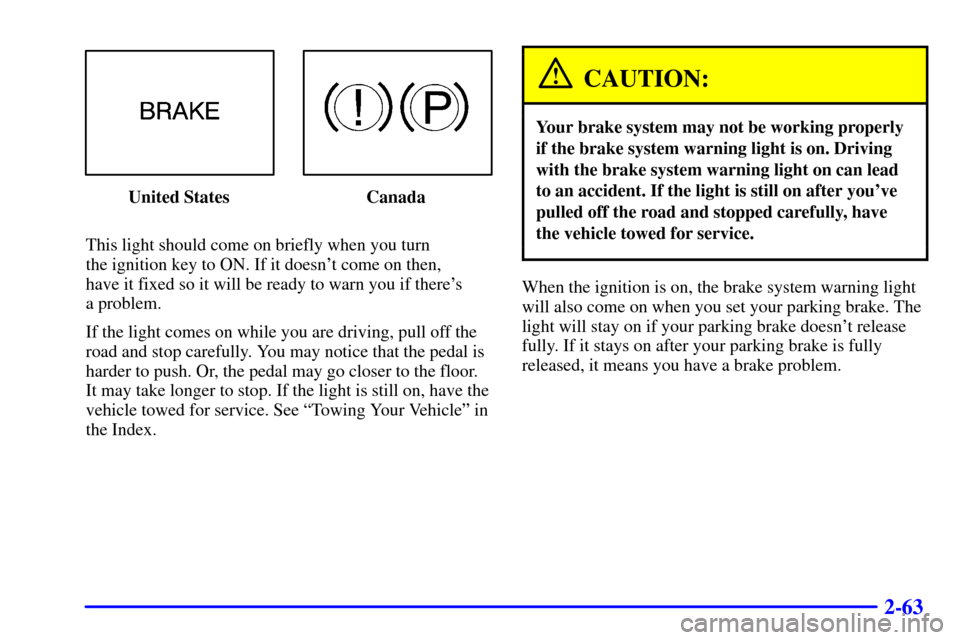
United States Canada
This light should come on briefly when you turn
the ignition key to ON. If it doesn't come on then,
have it fixed so it will be ready to warn you if there's
a problem.
If the light comes on while you are driving, pull off the
road and stop carefully. You may notice that the pedal is
harder to push. Or, the pedal may go closer to the floor.
It may take longer to stop. If the light is still on, have the
vehicle towed for service. See ªTowing Your Vehicleº in
the Index.
CAUTION:
Your brake system may not be working properly
if the brake system warning light is on. Driving
with the brake system warning light on can lead
to an accident. If the light is still on after you've
pulled off the road and stopped carefully, have
the vehicle towed for service.
When the ignition is on, the brake system warning light
will also come on when you set your parking brake. The
light will stay on if your parking brake doesn't release
fully. If it stays on after your parking brake is fully
released, it means you have a brake problem.
Page 127 of 343

2-65
The Enhanced Traction System warning light may come
on for the following reasons:
�If you turn the system off by pressing the ETS button
on the center console near the gear shift lever, the
warning light will come on and stay on. To turn the
system back on, press the button again. The warning
light should go off. See ªEnhanced Traction Systemº
in the Index for more information.
�If the traction control system is affected by an
engine
-related problem, the system will turn off
and the warning light will come on.
�If the vehicle is driven on an extremely rough road, the
warning light may come on momentarily but will go
off again when the vehicle leaves the rough surface.
If the Enhanced Traction System warning light comes
on and stays on for an extended period of time when the
system is turned on and the parking brake is fully
released, your vehicle needs service.
Enhanced Traction System Active Light
When your Enhanced
Traction System is
limiting wheel spin,
this light will come on.
Slippery road conditions may exist if the Enhanced
Traction System active light comes on, so adjust your
driving accordingly.
The light will stay on for a few seconds after the
Enhanced Traction System stops limiting wheel spin.
The Enhanced Traction System active light also comes
on briefly when you turn the ignition key to ON. If the
light doesn't come on then, have it fixed so it will be
there to tell you when the system is active.
Page 175 of 343
4-10
The Enhanced Traction System operates in all transaxle
shift lever positions. But the system can upshift the
transaxle only as high as the shift lever position you've
chosen, so you should use the lower gears only when
necessary. See ªAutomatic Transaxleº in the Index.
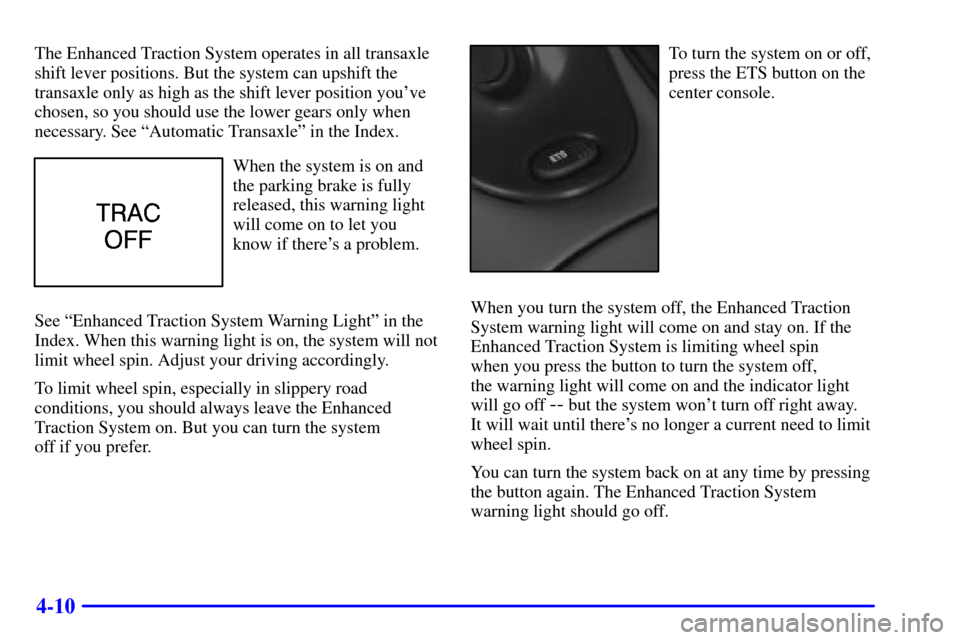
When the system is on and
the parking brake is fully
released, this warning light
will come on to let you
know if there's a problem.
See ªEnhanced Traction System Warning Lightº in the
Index. When this warning light is on, the system will not
limit wheel spin. Adjust your driving accordingly.
To limit wheel spin, especially in slippery road
conditions, you should always leave the Enhanced
Traction System on. But you can turn the system
off if you prefer.
To turn the system on or off,
press the ETS button on the
center console.
When you turn the system off, the Enhanced Traction
System warning light will come on and stay on. If the
Enhanced Traction System is limiting wheel spin
when you press the button to turn the system off,
the warning light will come on and the indicator light
will go off
-- but the system won't turn off right away.
It will wait until there's no longer a current need to limit
wheel spin.
You can turn the system back on at any time by pressing
the button again. The Enhanced Traction System
warning light should go off.
Page 196 of 343
4-31 Dinghy Towing
To tow your vehicle with all four wheels on the ground,
follow these steps:
1. Position the vehicle to tow and then secure it.
2. Turn the ignition switch to OFF.
3. Set the parking brake.
4. To prevent your battery from draining while the
vehicle is being towed, remove the following fuses
from the left side instrument panel fuse block:
WIPER, PCM ACC and IPC/BFC ACC. See
ªInstrument Panel Fuse Block
-- Driver's Sideº in
the Index for the location of these fuses.
5. Turn the ignition switch to ACCESSORY.
6. Shift your transaxle to NEUTRAL (N).
7. Release the parking brake.
Page 197 of 343
4-32
Remember to reinstall the fuses once you reach your
destination. To reinstall a fuse do the following:
1. Set the parking brake.
2. Remove the key from the ignition switch.
3. Put the fuse back in.
NOTICE:
Make sure that the towing speed does not exceed
65 mph (110 km/h), or your vehicle could be
badly damaged.
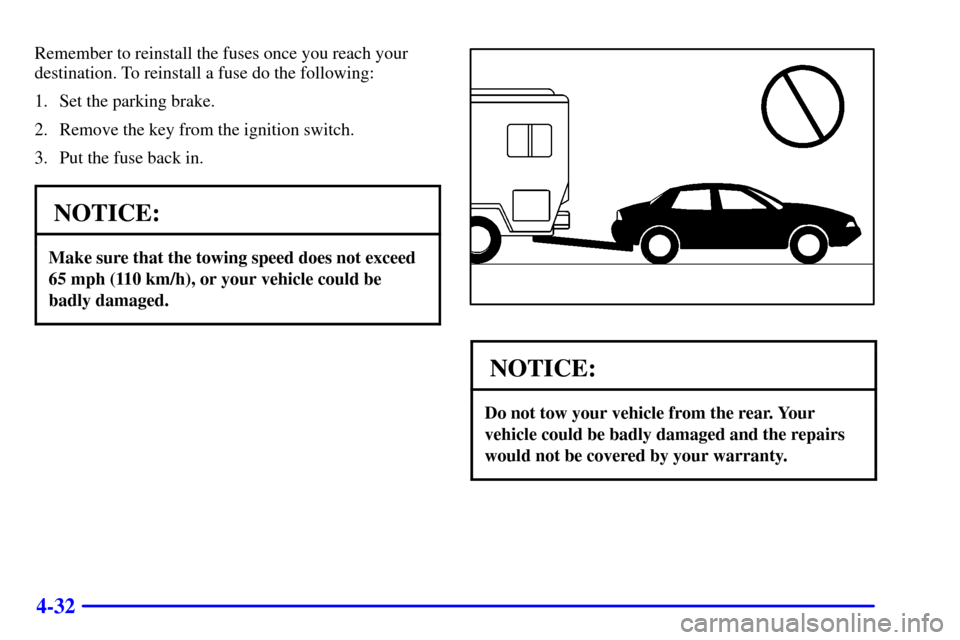
NOTICE:
Do not tow your vehicle from the rear. Your
vehicle could be badly damaged and the repairs
would not be covered by your warranty.
Page 198 of 343
4-33 Dolly Towing
To tow your vehicle with two wheels on the ground and
a dolly, do the following:
1. Put the front wheels on a dolly.
2. Put the vehicle in PARK (P) for automatic transaxles
and NEUTRAL for manual transaxles.
3. Set the parking brake and then remove the key.
(For manual transaxle vehicles, the shift lever must
be in REVERSE (R) before removing the key.)
4. Clamp the steering wheel in a straight
-ahead position
with a clamping device designed for towing.
5. Release the parking brake.
Page 207 of 343
4-42 Driving On Grades
Reduce speed and shift to a lower gear before you
start down a long or steep downgrade. If you don't
shift down, you might have to use your brakes so
much that they would get hot and no longer work well.
On a long uphill grade, shift down and reduce your
speed to around 45 mph (70 km/h) to reduce the
possibility of engine and transaxle overheating.
Parking on Hills
CAUTION:
You really should not park your vehicle, with a
trailer attached, on a hill. If something goes
wrong, your rig could start to move. People can
be injured, and both your vehicle and the trailer
can be damaged.
But if you ever have to park your rig on a hill, here's
how to do it:
1. Apply your regular brakes, but don't shift into
PARK (P) for an automatic transaxle or into a
gear for a manual transaxle, yet. When parking
uphill, turn your wheels away from the curb.
When parking downhill, turn your wheels into
the curb.
2. Have someone place chocks under the trailer wheels.
3. When the chocks are in place, release the regular
brakes until the chocks absorb the load.
4. Reapply the regular brakes. Then apply your parking
brake and shift into PARK (P) for an automatic
transaxle or REVERSE (R) for a manual transaxle.
5. Release the regular brakes.
Page 208 of 343
4-43 When You Are Ready to Leave After
Parking on a Hill
1. Apply your regular brakes and hold the pedal down
while you:
�start your engine,
�shift into a gear, and
�release the parking brake.
2. Let up on the brake pedal.
3. Drive slowly until the trailer is clear of the chocks.
4. Stop and have someone pick up and store the chocks.
Maintenance When Trailer Towing
Your vehicle will need service more often when you're
pulling a trailer. See the Maintenance Schedule for more
on this. Things that are especially important in trailer
operation are automatic transaxle fluid (don't overfill),
engine oil, drive belt, cooling system and brake system.
Each of these is covered in this manual, and the Index
will help you find them quickly. If you're trailering,
it's a good idea to review this information before you
start your trip.
Check periodically to see that all hitch nuts and bolts
are tight.
Engine Cooling When Trailer Towing
Your cooling system may temporarily overheat during
severe operating conditions. See ªEngine Overheatingº
in the Index.