2002 NISSAN TERRANO Condition
[x] Cancel search: ConditionPage 86 of 1767
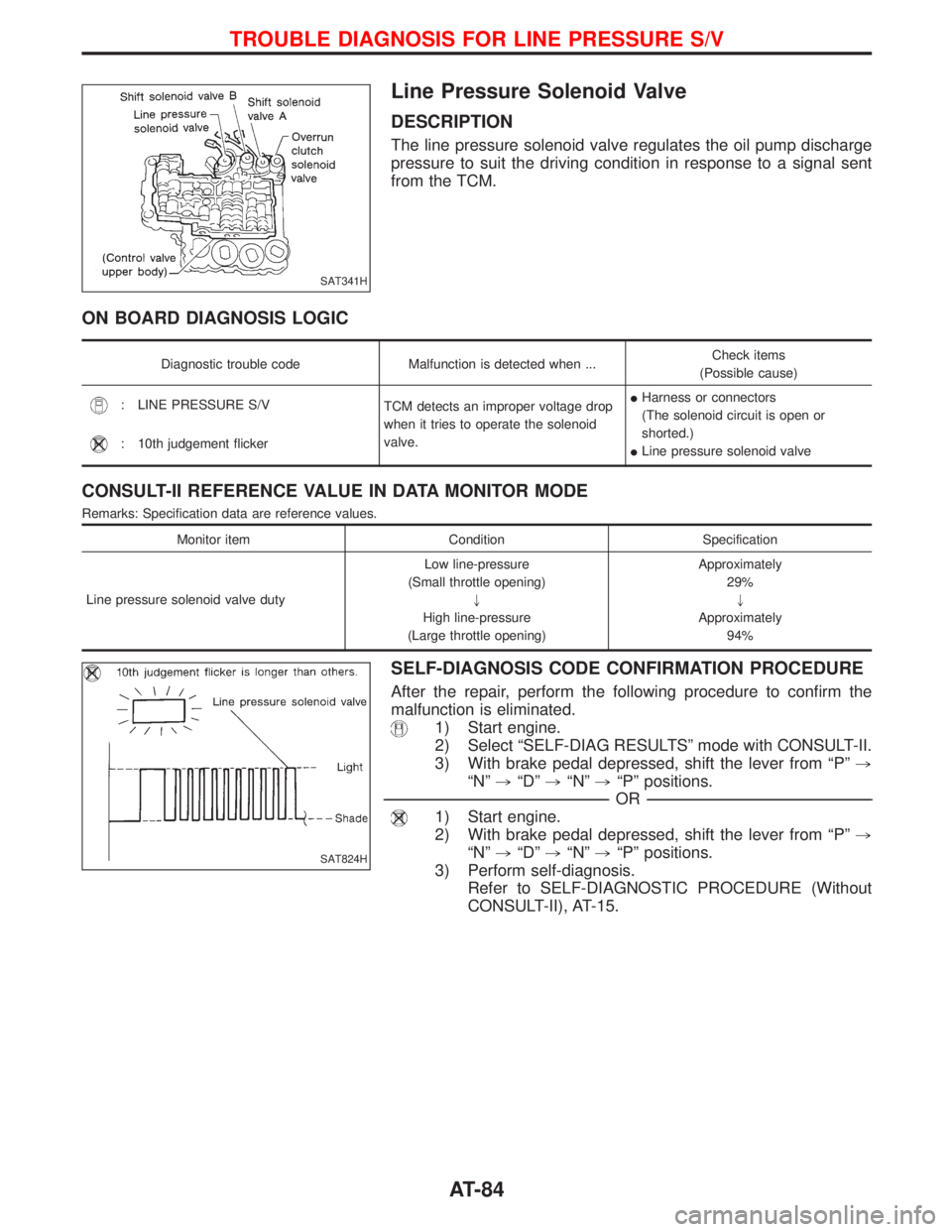
Line Pressure Solenoid Valve
DESCRIPTION
The line pressure solenoid valve regulates the oil pump discharge
pressure to suit the driving condition in response to a signal sent
from the TCM.
ON BOARD DIAGNOSIS LOGIC
Diagnostic trouble code Malfunction is detected when ...Check items
(Possible cause)
: LINE PRESSURE S/V
TCM detects an improper voltage drop
when it tries to operate the solenoid
valve.IHarness or connectors
(The solenoid circuit is open or
shorted.)
ILine pressure solenoid valve
: 10th judgement flicker
CONSULT-II REFERENCE VALUE IN DATA MONITOR MODE
Remarks: Specification data are reference values.
Monitor item Condition Specification
Line pressure solenoid valve dutyLow line-pressure
(Small throttle opening)
"
High line-pressure
(Large throttle opening)Approximately
29%
"
Approximately
94%
SELF-DIAGNOSIS CODE CONFIRMATION PROCEDURE
After the repair, perform the following procedure to confirm the
malfunction is eliminated.
1) Start engine.
2) Select ªSELF-DIAG RESULTSº mode with CONSULT-II.
3) With brake pedal depressed, shift the lever from ªPº,
ªNº,ªDº,ªNº,ªPº positions.
------------------------------------------------------------------------------------------------------------------------------------------------------------------------------------------------------------------------------------------------------------OR------------------------------------------------------------------------------------------------------------------------------------------------------------------------------------------------------------------------------------------------------------
1) Start engine.
2) With brake pedal depressed, shift the lever from ªPº,
ªNº,ªDº,ªNº,ªPº positions.
3) Perform self-diagnosis.
Refer to SELF-DIAGNOSTIC PROCEDURE (Without
CONSULT-II), AT-15.
SAT341H
SAT824H
TROUBLE DIAGNOSIS FOR LINE PRESSURE S/V
AT-84
Page 93 of 1767
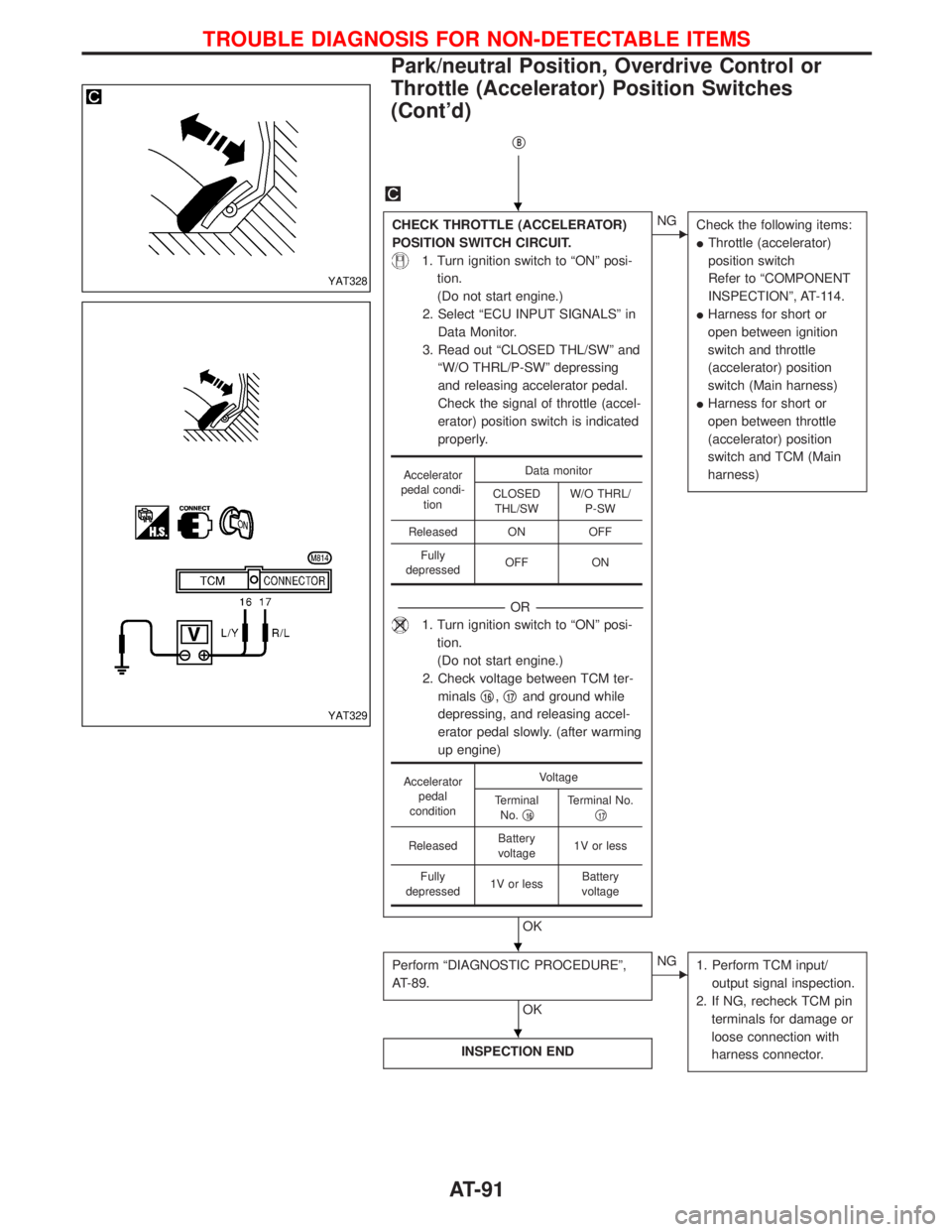
qB
CHECK THROTTLE (ACCELERATOR)
POSITION SWITCH CIRCUIT.
1. Turn ignition switch to ªONº posi-
tion.
(Do not start engine.)
2. Select ªECU INPUT SIGNALSº in
Data Monitor.
3. Read out ªCLOSED THL/SWº and
ªW/O THRL/P-SWº depressing
and releasing accelerator pedal.
Check the signal of throttle (accel-
erator) position switch is indicated
properly.
-----------------------------------------------------------------------------------------------------------------------OR -----------------------------------------------------------------------------------------------------------------------
1. Turn ignition switch to ªONº posi-
tion.
(Do not start engine.)
2. Check voltage between TCM ter-
minalsq
16,q17and ground while
depressing, and releasing accel-
erator pedal slowly. (after warming
up engine)
OK
ENG
Check the following items:
IThrottle (accelerator)
position switch
Refer to ªCOMPONENT
INSPECTIONº, AT-114.
IHarness for short or
open between ignition
switch and throttle
(accelerator) position
switch (Main harness)
IHarness for short or
open between throttle
(accelerator) position
switch and TCM (Main
harness)
Perform ªDIAGNOSTIC PROCEDUREº,
AT-89.
OK
ENG
1. Perform TCM input/
output signal inspection.
2. If NG, recheck TCM pin
terminals for damage or
loose connection with
harness connector.
INSPECTION END
Accelerator
pedal condi-
tionData monitor
CLOSED
THL/SWW/O THRL/
P-SW
Released ON OFF
Fully
depressedOFF ON
Accelerator
pedal
conditionVoltage
Terminal
No.q
16Terminal No.
q17
ReleasedBattery
voltage1V or less
Fully
depressed1V or lessBattery
voltage
YAT328
YAT329
H
H
H
TROUBLE DIAGNOSIS FOR NON-DETECTABLE ITEMS
Park/neutral Position, Overdrive Control or
Throttle (Accelerator) Position Switches
(Cont'd)
AT-91
Page 95 of 1767
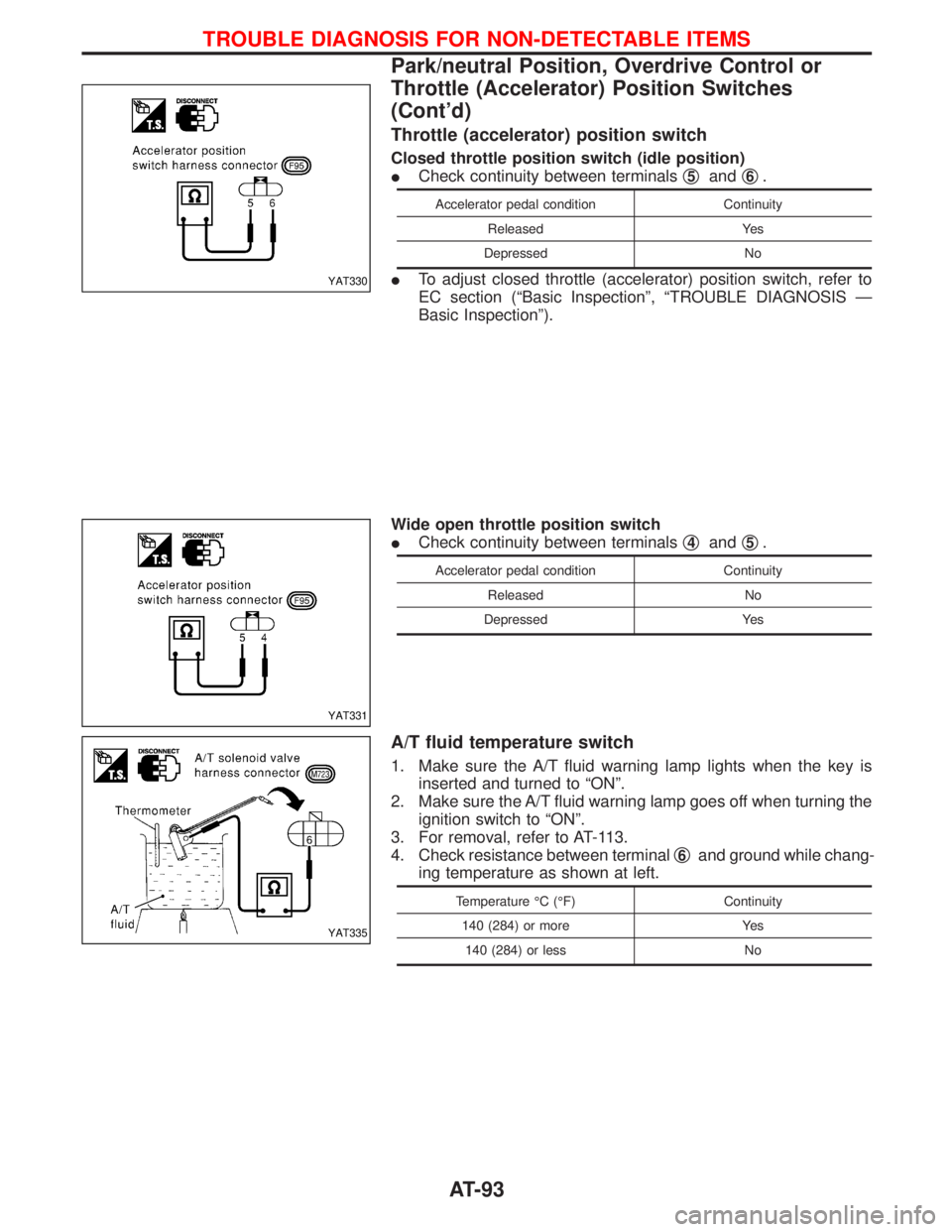
Throttle (accelerator) position switch
Closed throttle position switch (idle position)
ICheck continuity between terminalsq
5andq6.
Accelerator pedal condition Continuity
Released Yes
Depressed No
ITo adjust closed throttle (accelerator) position switch, refer to
EC section (ªBasic Inspectionº, ªTROUBLE DIAGNOSIS Ð
Basic Inspectionº).
Wide open throttle position switch
ICheck continuity between terminalsq
4andq5.
Accelerator pedal condition Continuity
Released No
Depressed Yes
A/T fluid temperature switch
1. Make sure the A/T fluid warning lamp lights when the key is
inserted and turned to ªONº.
2. Make sure the A/T fluid warning lamp goes off when turning the
ignition switch to ªONº.
3. For removal, refer to AT-113.
4. Check resistance between terminalq
6and ground while chang-
ing temperature as shown at left.
Temperature ÉC (ÉF) Continuity
140 (284) or more Yes
140 (284) or less No
YAT330
YAT331
YAT335
TROUBLE DIAGNOSIS FOR NON-DETECTABLE ITEMS
Park/neutral Position, Overdrive Control or
Throttle (Accelerator) Position Switches
(Cont'd)
AT-93
Page 100 of 1767
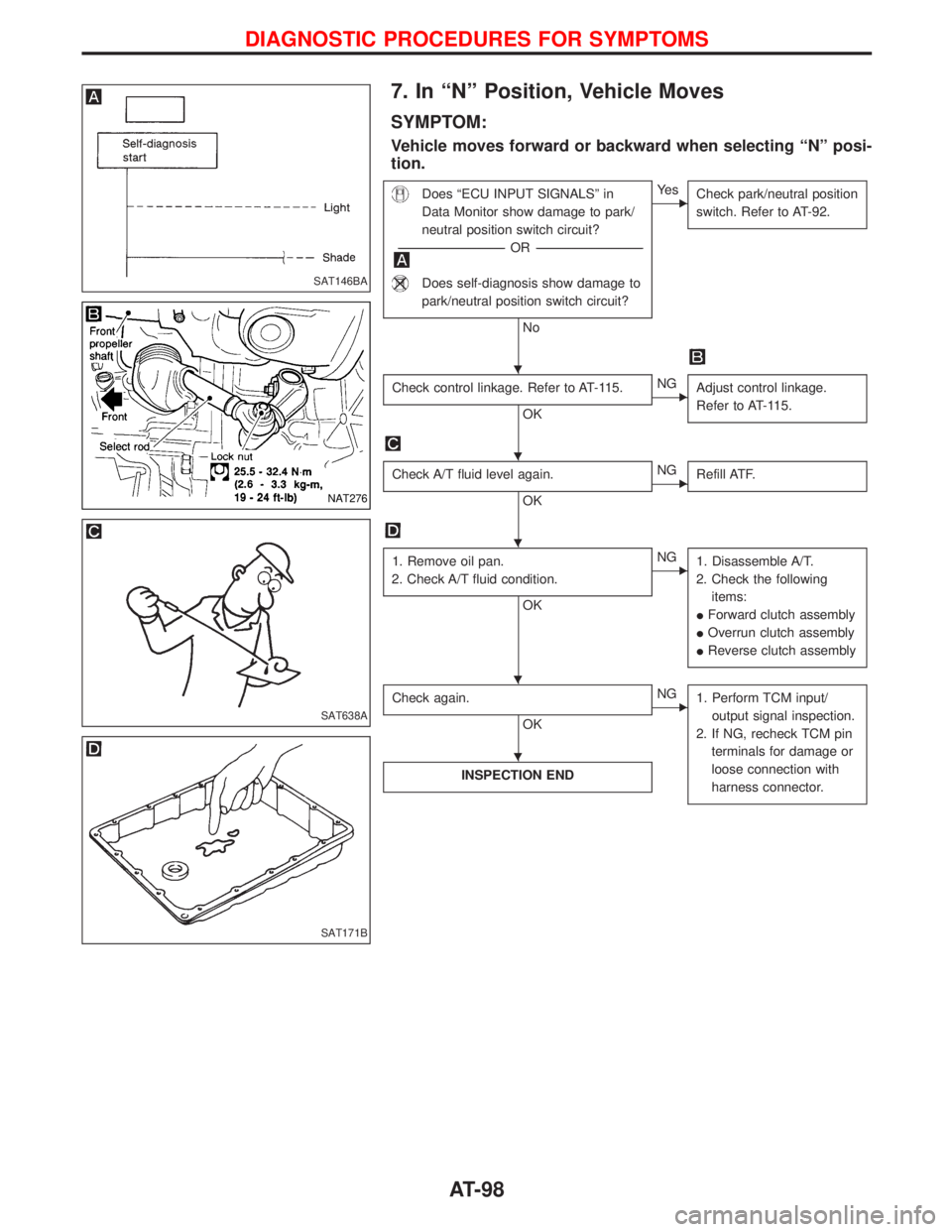
7. In ªNº Position, Vehicle Moves
SYMPTOM:
Vehicle moves forward or backward when selecting ªNº posi-
tion.
Does ªECU INPUT SIGNALSº in
Data Monitor show damage to park/
neutral position switch circuit?
-----------------------------------------------------------------------------------------------------------------------OR -----------------------------------------------------------------------------------------------------------------------
Does self-diagnosis show damage to
park/neutral position switch circuit?
No
EYe s
Check park/neutral position
switch. Refer to AT-92.
Check control linkage. Refer to AT-115.
OK
ENG
Adjust control linkage.
Refer to AT-115.
Check A/T fluid level again.
OK
ENG
Refill ATF.
1. Remove oil pan.
2. Check A/T fluid condition.
OK
ENG
1. Disassemble A/T.
2. Check the following
items:
IForward clutch assembly
IOverrun clutch assembly
IReverse clutch assembly
Check again.
OK
ENG
1. Perform TCM input/
output signal inspection.
2. If NG, recheck TCM pin
terminals for damage or
loose connection with
harness connector.
INSPECTION END
SAT146BA
NAT276
SAT638A
SAT171B
H
H
H
H H
H
DIAGNOSTIC PROCEDURES FOR SYMPTOMS
AT-98
Page 102 of 1767
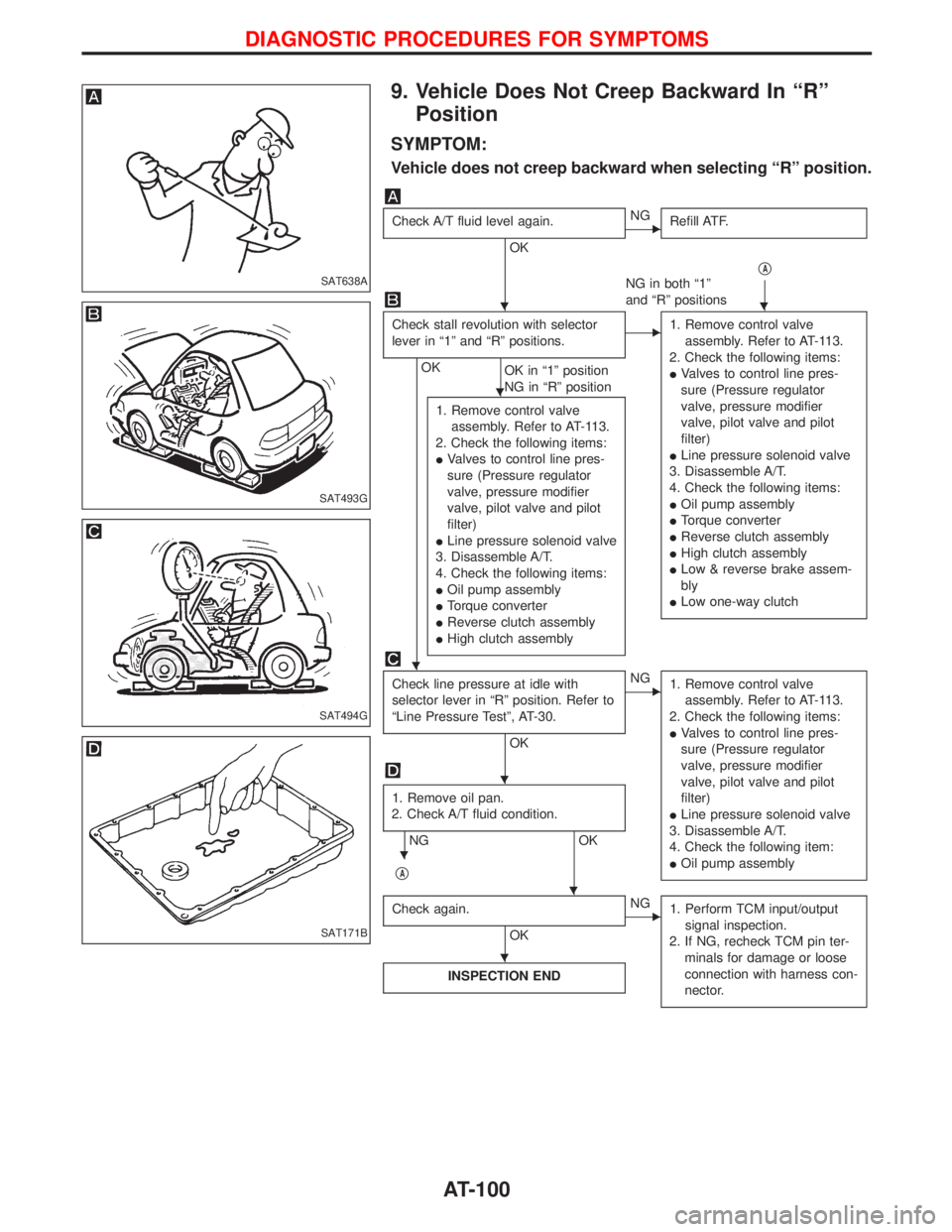
9. Vehicle Does Not Creep Backward In ªRº
Position
SYMPTOM:
Vehicle does not creep backward when selecting ªRº position.
Check A/T fluid level again.
OK
ENG
Refill ATF.
qA
NG in both ª1º
and ªRº positions
Check stall revolution with selector
lever in ª1º and ªRº positions.
OK
OK in ª1º position
NG in ªRº position
E1. Remove control valve
assembly. Refer to AT-113.
2. Check the following items:
IValves to control line pres-
sure (Pressure regulator
valve, pressure modifier
valve, pilot valve and pilot
filter)
ILine pressure solenoid valve
3. Disassemble A/T.
4. Check the following items:
IOil pump assembly
ITorque converter
IReverse clutch assembly
IHigh clutch assembly
ILow & reverse brake assem-
bly
ILow one-way clutch
1. Remove control valve
assembly. Refer to AT-113.
2. Check the following items:
IValves to control line pres-
sure (Pressure regulator
valve, pressure modifier
valve, pilot valve and pilot
filter)
ILine pressure solenoid valve
3. Disassemble A/T.
4. Check the following items:
IOil pump assembly
ITorque converter
IReverse clutch assembly
IHigh clutch assembly
Check line pressure at idle with
selector lever in ªRº position. Refer to
ªLine Pressure Testº, AT-30.
OK
ENG
1. Remove control valve
assembly. Refer to AT-113.
2. Check the following items:
IValves to control line pres-
sure (Pressure regulator
valve, pressure modifier
valve, pilot valve and pilot
filter)
ILine pressure solenoid valve
3. Disassemble A/T.
4. Check the following item:
IOil pump assembly
1. Remove oil pan.
2. Check A/T fluid condition.
NG OK
q
A
Check again.
OK
ENG
1. Perform TCM input/output
signal inspection.
2. If NG, recheck TCM pin ter-
minals for damage or loose
connection with harness con-
nector.
INSPECTION END
SAT638A
SAT493G
SAT494G
SAT171B
HH
H
H
H
H
H
H
DIAGNOSTIC PROCEDURES FOR SYMPTOMS
AT-100
Page 103 of 1767
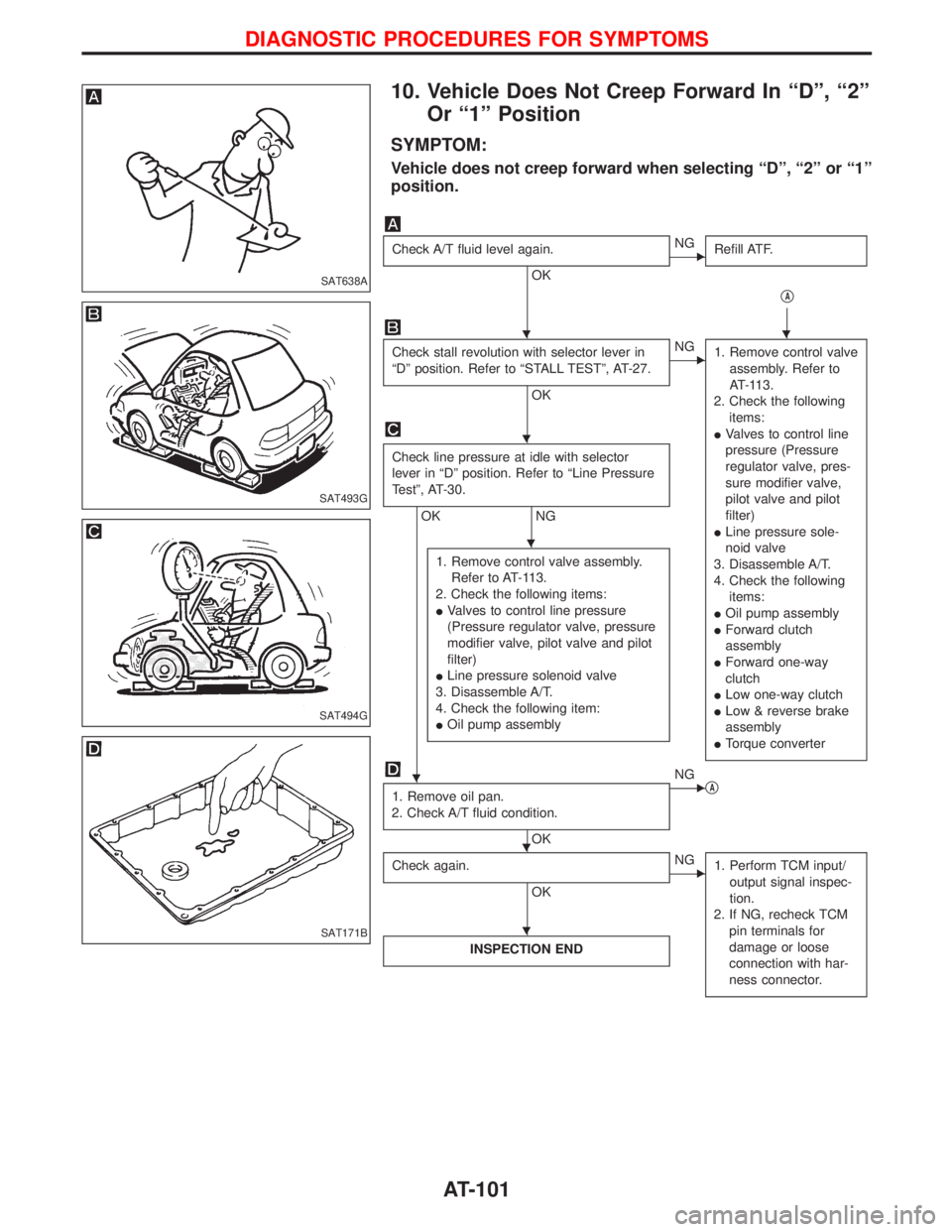
10. Vehicle Does Not Creep Forward In ªDº, ª2º
Or ª1º Position
SYMPTOM:
Vehicle does not creep forward when selecting ªDº, ª2º or ª1º
position.
Check A/T fluid level again.
OK
ENG
Refill ATF.
qA
Check stall revolution with selector lever in
ªDº position. Refer to ªSTALL TESTº, AT-27.
OK
ENG
1. Remove control valve
assembly. Refer to
AT-113.
2. Check the following
items:
IValves to control line
pressure (Pressure
regulator valve, pres-
sure modifier valve,
pilot valve and pilot
filter)
ILine pressure sole-
noid valve
3. Disassemble A/T.
4. Check the following
items:
IOil pump assembly
IForward clutch
assembly
IForward one-way
clutch
ILow one-way clutch
ILow & reverse brake
assembly
ITorque converter
Check line pressure at idle with selector
lever in ªDº position. Refer to ªLine Pressure
Testº, AT-30.
OK NG
1. Remove control valve assembly.
Refer to AT-113.
2. Check the following items:
IValves to control line pressure
(Pressure regulator valve, pressure
modifier valve, pilot valve and pilot
filter)
ILine pressure solenoid valve
3. Disassemble A/T.
4. Check the following item:
IOil pump assembly
1. Remove oil pan.
2. Check A/T fluid condition.
OK
ENG
qA
Check again.
OK
ENG
1. Perform TCM input/
output signal inspec-
tion.
2. If NG, recheck TCM
pin terminals for
damage or loose
connection with har-
ness connector.
INSPECTION END
SAT638A
SAT493G
SAT494G
SAT171B
HH
H
H
H
H H
H
DIAGNOSTIC PROCEDURES FOR SYMPTOMS
AT-101
Page 104 of 1767
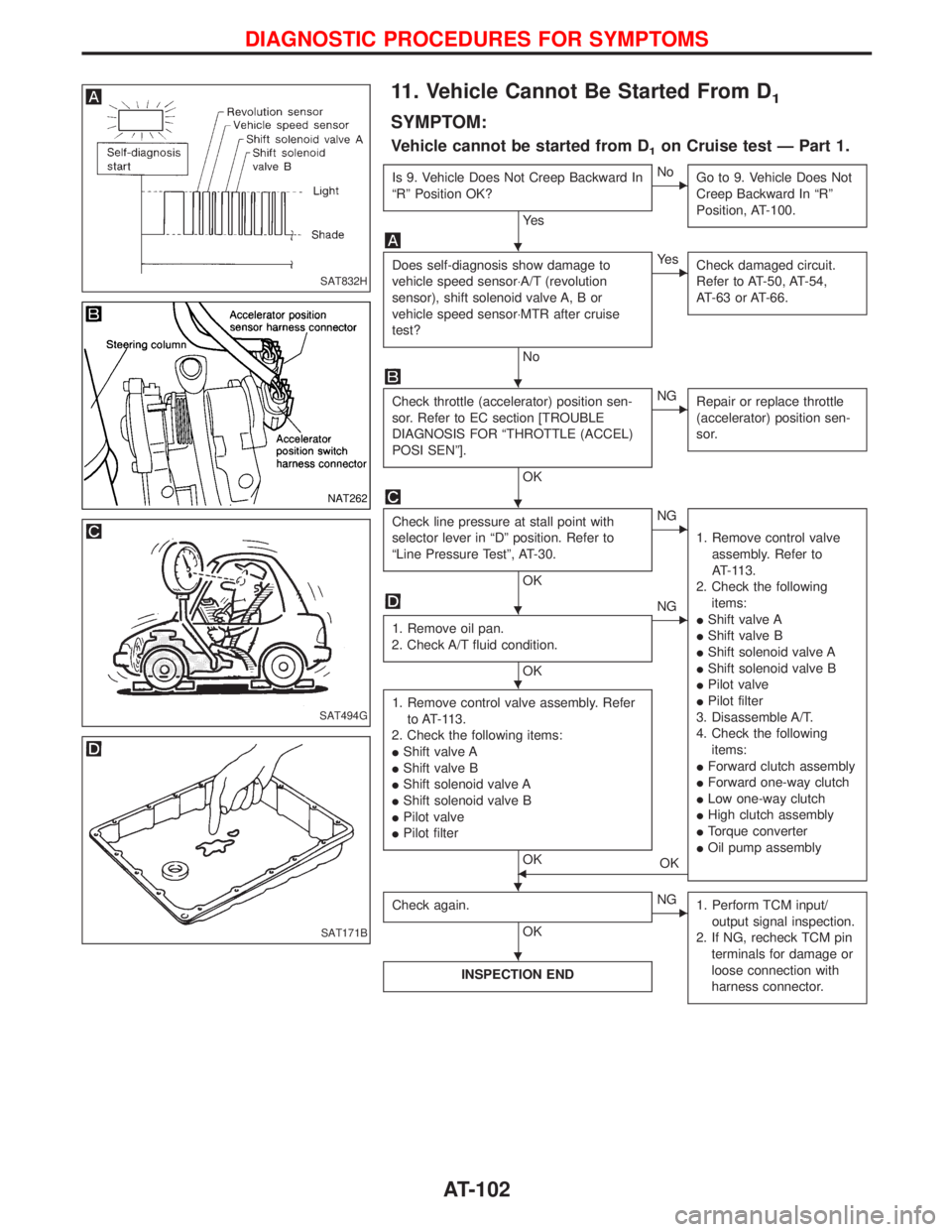
11. Vehicle Cannot Be Started From D1
SYMPTOM:
Vehicle cannot be started from D1on Cruise test Ð Part 1.
Is 9. Vehicle Does Not Creep Backward In
ªRº Position OK?
Ye s
ENo
Go to 9. Vehicle Does Not
Creep Backward In ªRº
Position, AT-100.
Does self-diagnosis show damage to
vehicle speed sensor×A/T (revolution
sensor), shift solenoid valve A, B or
vehicle speed sensor×MTR after cruise
test?
No
EYe s
Check damaged circuit.
Refer to AT-50, AT-54,
AT-63 or AT-66.
Check throttle (accelerator) position sen-
sor. Refer to EC section [TROUBLE
DIAGNOSIS FOR ªTHROTTLE (ACCEL)
POSI SENº].
OK
ENG
Repair or replace throttle
(accelerator) position sen-
sor.
Check line pressure at stall point with
selector lever in ªDº position. Refer to
ªLine Pressure Testº, AT-30.
OK
ENG
1. Remove control valve
assembly. Refer to
AT-113.
2. Check the following
items:
IShift valve A
IShift valve B
IShift solenoid valve A
IShift solenoid valve B
IPilot valve
IPilot filter
3. Disassemble A/T.
4. Check the following
items:
IForward clutch assembly
IForward one-way clutch
ILow one-way clutch
IHigh clutch assembly
ITorque converter
IOil pump assembly
1. Remove oil pan.
2. Check A/T fluid condition.
OK
ENG
1. Remove control valve assembly. Refer
to AT-113.
2. Check the following items:
IShift valve A
IShift valve B
IShift solenoid valve A
IShift solenoid valve B
IPilot valve
IPilot filter
OKFOK
Check again.
OK
ENG
1. Perform TCM input/
output signal inspection.
2. If NG, recheck TCM pin
terminals for damage or
loose connection with
harness connector.
INSPECTION END
SAT832H
NAT262
SAT494G
SAT171B
H
H
H
H
H
H H
H
DIAGNOSTIC PROCEDURES FOR SYMPTOMS
AT-102
Page 105 of 1767
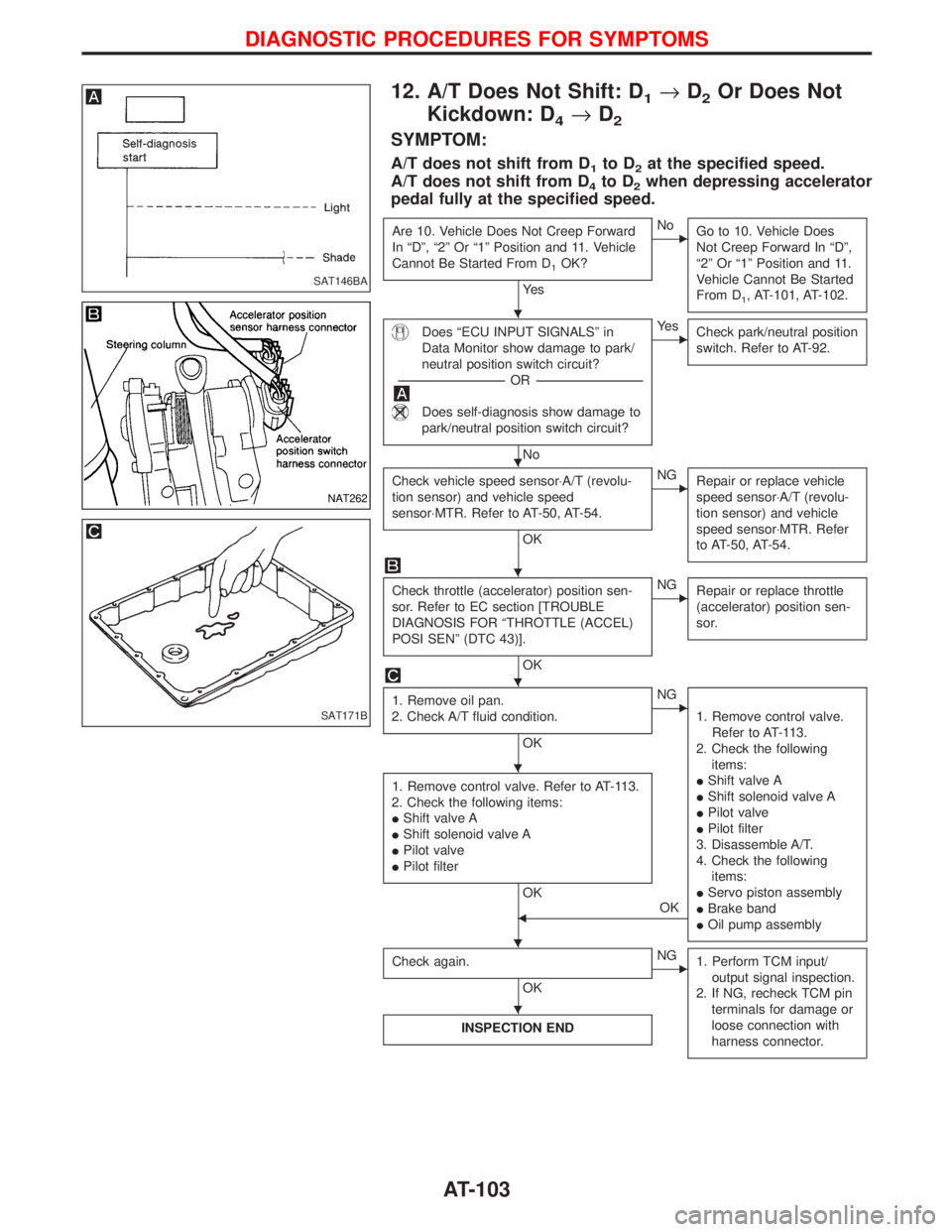
12. A/T Does Not Shift: D1®D2Or Does Not
Kickdown: D
4®D2
SYMPTOM:
A/T does not shift from D1to D2at the specified speed.
A/T does not shift from D
4to D2when depressing accelerator
pedal fully at the specified speed.
Are 10. Vehicle Does Not Creep Forward
In ªDº, ª2º Or ª1º Position and 11. Vehicle
Cannot Be Started From D
1OK?
Ye s
ENo
Go to 10. Vehicle Does
Not Creep Forward In ªDº,
ª2º Or ª1º Position and 11.
Vehicle Cannot Be Started
From D
1, AT-101, AT-102.
Does ªECU INPUT SIGNALSº in
Data Monitor show damage to park/
neutral position switch circuit?
-----------------------------------------------------------------------------------------------------------------------OR -----------------------------------------------------------------------------------------------------------------------
Does self-diagnosis show damage to
park/neutral position switch circuit?
No
EYe s
Check park/neutral position
switch. Refer to AT-92.
Check vehicle speed sensor×A/T (revolu-
tion sensor) and vehicle speed
sensor×MTR. Refer to AT-50, AT-54.
OK
ENG
Repair or replace vehicle
speed sensor×A/T (revolu-
tion sensor) and vehicle
speed sensor×MTR. Refer
to AT-50, AT-54.
Check throttle (accelerator) position sen-
sor. Refer to EC section [TROUBLE
DIAGNOSIS FOR ªTHROTTLE (ACCEL)
POSI SENº (DTC 43)].
OK
ENG
Repair or replace throttle
(accelerator) position sen-
sor.
1. Remove oil pan.
2. Check A/T fluid condition.
OK
ENG
1. Remove control valve.
Refer to AT-113.
2. Check the following
items:
IShift valve A
IShift solenoid valve A
IPilot valve
IPilot filter
3. Disassemble A/T.
4. Check the following
items:
IServo piston assembly
IBrake band
IOil pump assembly
1. Remove control valve. Refer to AT-113.
2. Check the following items:
IShift valve A
IShift solenoid valve A
IPilot valve
IPilot filter
OK
FOK
Check again.
OK
ENG
1. Perform TCM input/
output signal inspection.
2. If NG, recheck TCM pin
terminals for damage or
loose connection with
harness connector.
INSPECTION END
SAT146BA
NAT262
SAT171B
H
H
H
H
H
H H
H
DIAGNOSTIC PROCEDURES FOR SYMPTOMS
AT-103