Page 189 of 235
CAUTION
Never use a fuse of higher amperage
rating than specified. This could dam-
age the electrical system or cause a
fire.
PASSENGER COMPARTMENT
If any electrical equipment does not oper-
ate, check for an open fuse.
1. Be sure the ignition switch and the head-
light switch are OFF.
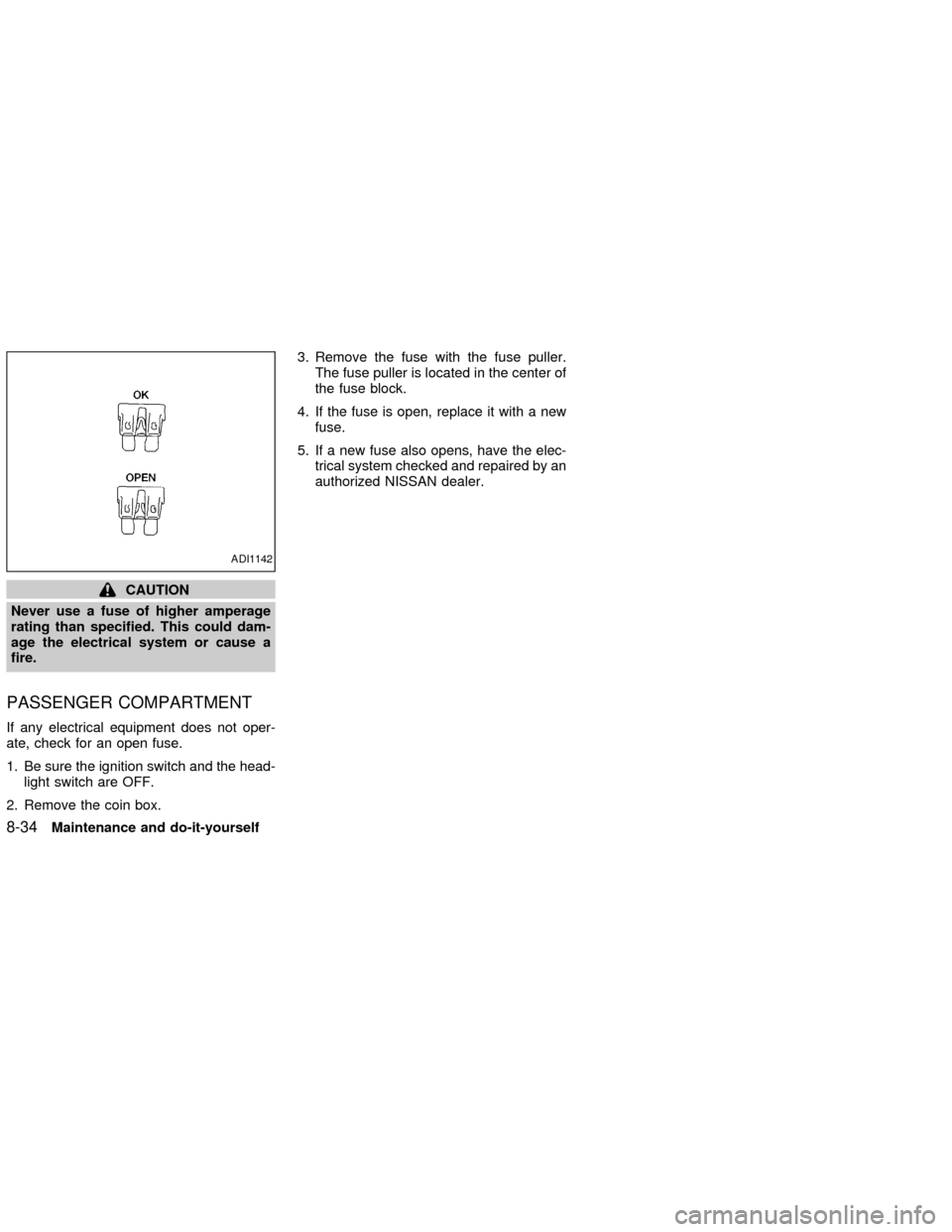
2. Remove the coin box.3. Remove the fuse with the fuse puller.
The fuse puller is located in the center of
the fuse block.
4. If the fuse is open, replace it with a new
fuse.
5. If a new fuse also opens, have the elec-
trical system checked and repaired by an
authorized NISSAN dealer.
ADI1142
8-34Maintenance and do-it-yourself
ZX
Page 191 of 235
HEADLIGHTS
The headlight is a semi-sealed beam type
which uses a replaceable headlight (halo-
gen) bulb. A bulb can be replaced from
inside the engine compartment without re-
moving the headlight assembly.
CAUTION
cHigh pressure halogen gas is sealed
inside the halogen bulb. The bulb
may break if the glass envelope is
scratched or the bulb is dropped.
cWhen handling the bulb, do not
touch the glass envelope.
cDO NOT TOUCH THE BULB
cUse the same number and wattage
as originally installed:
Wattage 65/55
Bulb no. 9007 (HB5)
cDo not leave the bulb out of the
headlight reflector for a long period
of time as dust, moisture, and smoke
may enter the headlight body and
affect the performance of the head-
light.
Removing the headlight bulb
1. Open the hood.
2. Disconnect the negative (-) battery cable.
3. Disconnect the electrical connector from
the rear end of the bulb.
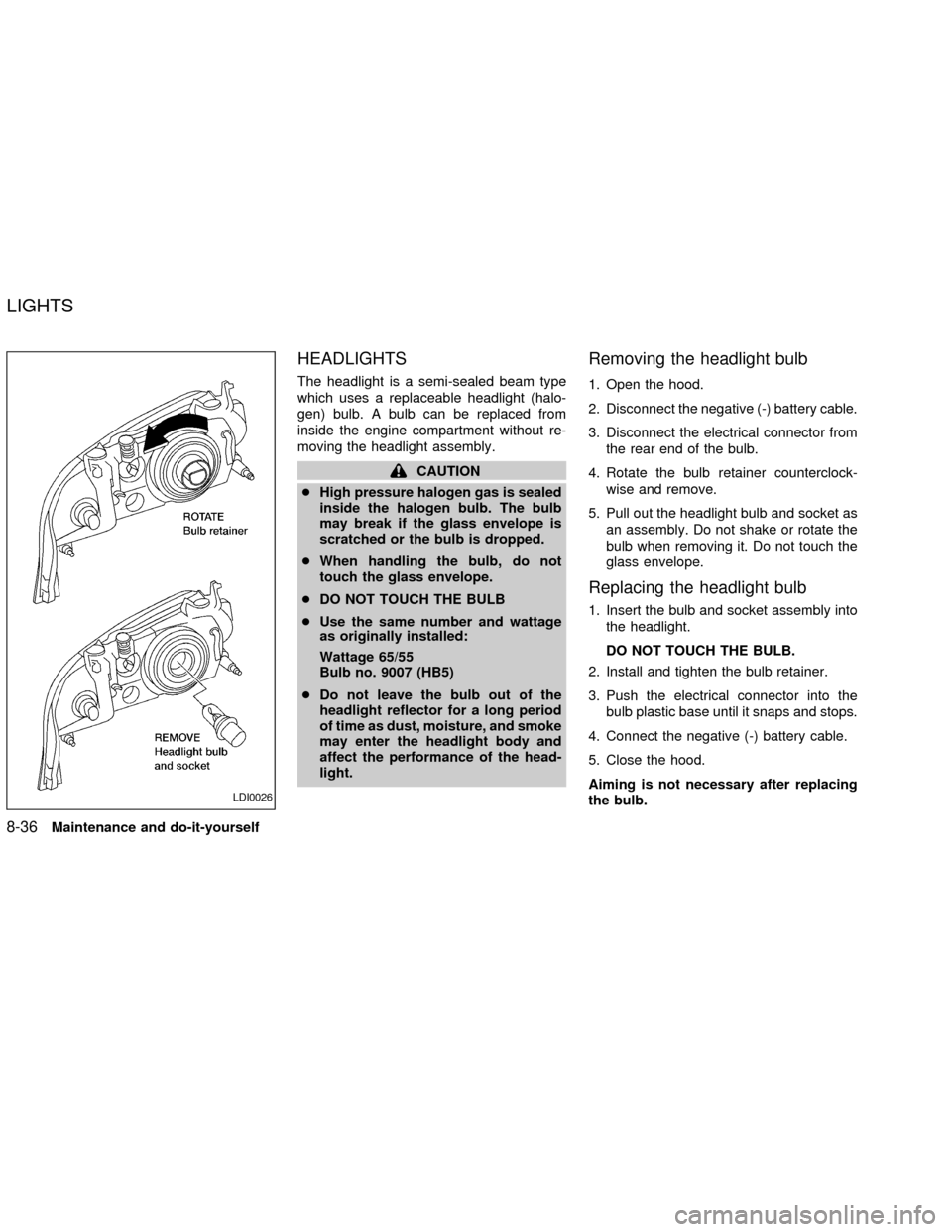
4. Rotate the bulb retainer counterclock-
wise and remove.
5. Pull out the headlight bulb and socket as
an assembly. Do not shake or rotate the
bulb when removing it. Do not touch the
glass envelope.
Replacing the headlight bulb
1. Insert the bulb and socket assembly into
the headlight.
DO NOT TOUCH THE BULB.
2. Install and tighten the bulb retainer.
3. Push the electrical connector into the
bulb plastic base until it snaps and stops.
4. Connect the negative (-) battery cable.
5. Close the hood.
Aiming is not necessary after replacing
the bulb.
LDI0026
LIGHTS
8-36Maintenance and do-it-yourself
ZX
Page 192 of 235
Adjusting the headlight aim
Before performing aiming adjustment, make
sure of the following:
a. Use an aiming wall screen.
b. Keep all of the tires inflated to the correct
pressure.
c. Place the vehicle and screen on level
ground.
d. See that the vehicle is unloaded (except
for full levels of coolant, engine oil and
fuel, and that the spare tire, jack, and
tools are stored). Have the driver or anequivalent weight placed in the driver's
seat.
1. Open the hood. Turn headlight low beam
on.
2. Adjust the vertical aim by turning the
adjustment screw.
cCover the opposite light and ensure the
fog lights (if so equipped) are turned off.
cAdjust beam pattern until cutoff line is
positioned at the same height off ground
as bulb center (on H-line).
LDI0027
Maintenance and do-it-yourself8-37
ZX
Page 194 of 235
If the vehicle front body has been repaired
and/or the headlight assembly has been
replaced, check aiming. Use the aiming
chart shown in the illustration.
cBasic illuminating area should be within
the range shown. Adjust headlights ac-
cordingly.
FOG LIGHTS (if so equipped)
Replacing the fog light bulb
1. Remove screw.
2. Disconnect connector.
3. Push the fog light assembly towards the
front of the vehicle and pull out to expose
the rear of the assembly.
4. Rotate the bulb cover counterclockwise
and remove.
5. Lift the spring retainer.
6. Remove the fog light bulb from housing.
7. Disconnect the electrical connector.
LDI0028
Maintenance and do-it-yourself8-39
ZX
Page 195 of 235
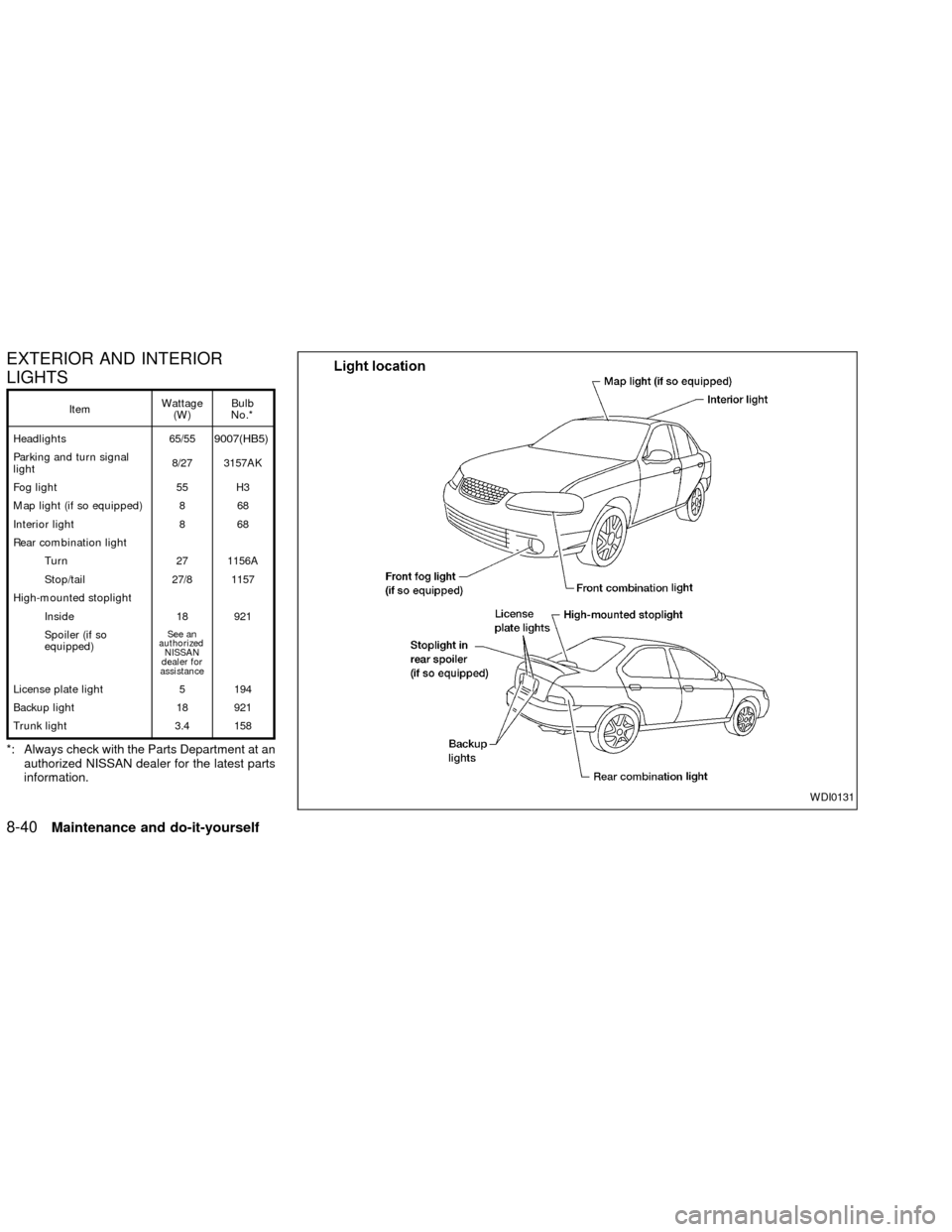
EXTERIOR AND INTERIOR
LIGHTS
ItemWattage
(W)Bulb
No.*
Headlights 65/55
9007(HB5)
Parking and turn signal
light8/27 3157AK
Fog light 55 H3
Map light (if so equipped) 8 68
Interior light 8 68
Rear combination light
Turn 27 1156A
Stop/tail 27/8 1157
High-mounted stoplight
Inside 18 921
Spoiler (if so
equipped)See an
authorized
NISSAN
dealer for
assistance
License plate light 5 194
Backup light 18 921
Trunk light 3.4 158
*: Always check with the Parts Department at an
authorized NISSAN dealer for the latest parts
information.
WDI0131
8-40Maintenance and do-it-yourself
ZX
Page 196 of 235
Replacement procedures
All other lights are either type A, B, C or D.
When replacing a bulb, first remove the lens
and/or cover.
MDI0006
Maintenance and do-it-yourself8-41
ZX
Page 202 of 235
braking, handling, ground clearance,
body-to-tire clearance, tire chain
clearance, speedometer calibration,
headlight aim and bumper height.
Some of these effects may lead to
accidents and could result in serious
personal injury.
cIf the wheels are changed for any
reason, always replace with wheels
which have the same off-set dimen-
sion. Wheels of a different offset
could cause premature tire wear, de-
grade vehicle handling characteris-
tics and/or interference with the
brake discs/drums. Such interfer-
ence can lead to decreased braking
efficiency and/or early brake
pad/shoe wear. Refer to ªWheel/tire
sizeº in the ªTechnical and con-
sumer informationº section of this
manual for wheel off-set dimen-
sions.
cDo not install a deformed wheel or
tire even if it has been repaired. Such
wheels or tires could have unknown
structural damage and could fail
without warning.cThe use of retread tires is not recom-
mended.
cFor additional information regarding
tires, refer to ``Important Tire Safety
Information'' in the Warranty Infor-
mation Booklet (US) or ``Tire Safety
Information'' in the Warranty and
Roadside Assistance Information
booklet (Canada).
Wheel balance
Unbalanced wheels may affect vehicle han-
dling and tire life. Even with regular use,
wheels can get out of balance. Therefore,
they should be balanced as required.
Wheel balance service should be per-
formed with the wheels off the vehicle. Spin
balancing the front wheels on the vehicle
could lead to transmission damage.
cFor additional information regarding
tires, refer to ``Important Tire Safety
Information'' in the Warranty Informa-
tion Booklet (US) or ``Tire Safety In-
formation'' in the Warranty and Road-
side Assistance Information booklet
(Canada).
Care of wheels
cWash the wheels when washing the
vehicle to maintain their appearance.
cClean the inner side of the wheels when
the wheel is changed or the underside of
the vehicle is washed.
cDo not use abrasive cleaners when
washing the wheels.
c
Inspect wheel rims regularly for dents or
corrosion. Such damage may cause loss
of pressure or poor seal at the tire bead.
cNISSAN recommends waxing the road
wheels to protect against road salt in
areas where it is used during winter.
Spare tire (TEMPORARY USE
ONLY)
Observe the following precautions if the TEM-
PORARY USE ONLY spare tire must be used,
otherwise your vehicle could be damaged or
involved in an accident:
Maintenance and do-it-yourself8-47
ZX
Page 207 of 235
![NISSAN SENTRA 2002 B15 / 5.G Owners Manual ever, you may use unleaded gasoline with
an octane rating as low as 85 AKI (Anti-
Knock Index) in high altitude areas (over
4,000 ft [1,219 m]) such as: Colorado, Mon-
tana, New Mexico, Utah, Wyoming,](/manual-img/5/656/w960_656-206.png "NISSAN SENTRA 2002 B15 / 5.G Owners Manual ever, you may use unleaded gasoline with
an octane rating as low as 85 AKI (Anti-
Knock Index) in high altitude areas (over
4,000 ft [1,219 m]) such as: Colorado, Mon-
tana, New Mexico, Utah, Wyoming,")
ever, you may use unleaded gasoline with
an octane rating as low as 85 AKI (Anti-
Knock Index) in high altitude areas (over
4,000 ft [1,219 m]) such as: Colorado, Mon-
tana, New Mexico, Utah, Wyoming, north-
eastern Nevada, southern Idaho, western
South Dakota, western Nebraska, and the
part of Texas which is directly south of New
Mexico.
Using unleaded gasoline with an octane
rating lower than stated above can cause
persistent, heavy ``spark knock.'' (``Spark
knock'' is a metallic rapping noise.) If
severe, this can lead to engine damage. If
you detect a persistent heavy spark
knock even when using gasoline of the
stated octane rating, or if you hear steady
spark knock while holding a steady
speed on level roads, have an authorized
NISSAN dealer correct the condition.
Failure to correct the condition is misuse
of the vehicle, for which NISSAN is not
responsible.
Incorrect ignition timing may result in spark
knock, after-run and/or overheating, which
may cause excessive fuel consumption or
engine damage. If any of the above symp-
toms are encountered, have your vehiclechecked at an authorized NISSAN dealer or
other competent service facility.
However, now and then you may notice
light spark knock for a short time while
accelerating or driving up hills. This is
not a cause for concern, because you
get the greatest fuel benefit when there
is light spark knock for a short time
under heavy engine load.
9-4Technical and consumer information
ZX