2002 NISSAN PATHFINDER luggage rack
[x] Cancel search: luggage rackPage 53 of 288

2 Instruments and controlsInstrument panel ....................................................... 2-2
Meters and gauges ................................................... 2-3
Speedometer and odometer ................................ 2-3
Tachometer .......................................................... 2-4
Engine coolant temperature gauge ...................... 2-4
Fuel gauge ........................................................... 2-5
Compass and outside temperature display (if so
equipped) .................................................................. 2-6
Outside temperature display ................................ 2-6
Compass display .................................................. 2-7
Warning/indicator lights and audible reminders ........ 2-9
Checking bulbs ..................................................... 2-9
Warning lights....................................................... 2-9
Indicator lights .................................................... 2-13
Audible reminders .............................................. 2-15
Security systems ..................................................... 2-15
Vehicle security system ...................................... 2-15
Nissan vehicle immobilizer system .................... 2-17
Windshield wiper and washer switch ...................... 2-18
Rear window wiper and washer switch................... 2-18
Glass hatch and outside mirror (if so equipped)
defogger switch ...................................................... 2-19
Headlight and turn signal switch ............................. 2-19
Headlight switch ................................................. 2-20Turn signal switch .............................................. 2-22
Fog light switch (if so equipped) ............................. 2-23
Front fog light switch .......................................... 2-23
Hazard warning flasher switch ................................ 2-23
Horn......................................................................... 2-24
Heated seats (if so equipped) ................................. 2-24
Clock ....................................................................... 2-25
Adjusting the time............................................... 2-25
Power outlet (if so equipped) .................................. 2-25
Cigarette lighter and ashtray (if so equipped) ........ 2-26
Storage .................................................................... 2-27
Tray .................................................................... 2-27
Coin box (if so equipped) ................................... 2-27
Glasses case ...................................................... 2-28
Cup holders ........................................................ 2-28
Glove box ........................................................... 2-29
Console box ....................................................... 2-30
Luggage hooks ................................................... 2-32
Cargo net............................................................ 2-33
Tonneau cover (if so equipped) ......................... 2-33
Luggage rack (if so equipped) ........................... 2-34
Windows .................................................................. 2-35
Power windows .................................................. 2-35
Sunroof (if so equipped) ......................................... 2-36
Z
01.9.21/R50-D/V5
X
Page 87 of 288
ject on it could cause an injury in an
accident or sudden stop.
IDo not leave the tonneau cover in the
vehicle with it disengaged from the
holder.
IProperly secure all cargo to help pre-
vent it from sliding or shifting. Do not
place cargo higher than the seat-
backs. In a sudden stop or collision,
unsecured cargo could cause per-
sonal injury.
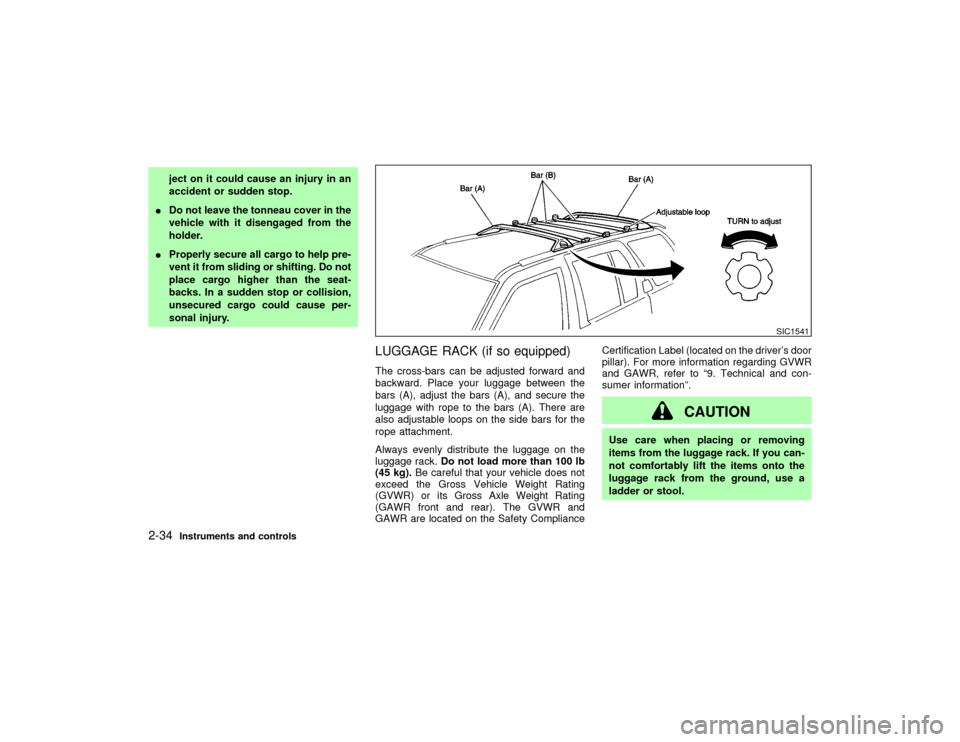
LUGGAGE RACK (if so equipped)The cross-bars can be adjusted forward and
backward. Place your luggage between the
bars (A), adjust the bars (A), and secure the
luggage with rope to the bars (A). There are
also adjustable loops on the side bars for the
rope attachment.
Always evenly distribute the luggage on the
luggage rack.Do not load more than 100 lb
(45 kg).Be careful that your vehicle does not
exceed the Gross Vehicle Weight Rating
(GVWR) or its Gross Axle Weight Rating
(GAWR front and rear). The GVWR and
GAWR are located on the Safety ComplianceCertification Label (located on the driver's door
pillar). For more information regarding GVWR
and GAWR, refer to ª9. Technical and con-
sumer informationº.
CAUTION
Use care when placing or removing
items from the luggage rack. If you can-
not comfortably lift the items onto the
luggage rack from the ground, use a
ladder or stool.
SIC1541
2-34
Instruments and controls
Z
01.9.21/R50-D/V5
X
Page 266 of 288
WARNING
IIt is extremely dangerous to ride in a
cargo area inside of a vehicle. In a
collision, people riding in these areas
are more likely to be seriously injured
or killed.
IDo not allow people to ride in any
area of your vehicle that is not
equipped with seats and seat belts.
IBe sure everyone in your vehicle is in
a seat and using a seat belt properly.TERMSIt is important to familiarize yourself with the
following terms before loading your vehicle:
ICurb Weight (actual weight of your vehicle)
- vehicle weight including: standard and
optional equipment, fluids, emergency
tools, and spare tire assembly. This weight
does notinclude passengers and cargo.
IGVW (Gross Vehicle Weight) - curb weight
plus the combined weight of passengers
and cargo.IGVWR (Gross Vehicle Weight Rating) -
maximum total weight (load) limit specified
for the vehicle.
IGAWR (Gross Axle Weight Rating) - maxi-
mum weight (load) limit specified for the
front or rear axle.
DETERMINING VEHICLE
PAYLOAD CAPACITYThe payload capacity of this vehicle is deter-
mined by weight, not by available cargo space.
For example, a luggage rack, bike carrier,
cartop carrier or similar equipment does not
increase payload carrying capacity of your
vehicle.
To determine vehicle payload capacity:
Vehicle weight can be determined by using a
commercial-grade scale, found at places such
as a truck stop, gravel quarry, grain elevator,
or a scrap metal recycling facility.
1) Determine the curb weight of your vehicle.
2) Compare the curb weight amount to the
GVWR specified for your vehicle to deter-
mine how much more weight your vehicle
can carry.
3) After loading (cargo and passengers), re-
weigh your vehicle to determine if eitherGVWR or GAWR for your vehicle is ex-
ceeded. If GVWR is exceeded, remove
cargo as necessary. If either the front or
rear GAWR is exceeded, shift the load or
remove cargo as necessary.
VEHICLE LOADING
INFORMATION
Technical and consumer information
9-15
Z
01.9.21/R50-D/V5
X
Page 283 of 288

Vanity mirror light ...................................... 2-40
Warning/indicator lights and audible
reminders ........................................... 2-9, 2-13
Loading information (See vehicle loading
information) ..................................................... 9-15
Lock
Door locks ................................................... 3-2
Glass hatch lock ........................................ 3-11
Glove box lock........................................... 2-29
Power door lock .......................................... 3-2
Rear door lock ........................................... 3-10
Rear door opener ...................................... 3-10
Low fuel warning light ..................................... 2-12
Luggage hooks ............................................... 2-32
Luggage rack .................................................. 2-34
M
Maintenance
Battery ....................................................... 8-21
General maintenance .................................. 8-2
Inside the vehicle ........................................ 8-3
Maintenance precautions ............................ 8-5
Outside the vehicle...................................... 8-2
Seat belt maintenance .............................. 1-31
Under the hood and vehicle ........................ 8-4
Manual front seat adjustment ........................... 1-2
Meters and gauges ........................................... 2-3
Mirror
Inside mirror .............................................. 3-15
Outside mirror control................................ 3-15
Outside mirrors .......................................... 3-15N
Net, Cargo net ................................................ 2-33
New vehicle break-in ...................................... 5-19
Nissan vehicle Immobilizer System ................ 2-15
Nissan Vehicle Immobilizer System, Engine
start ................................................................... 5-8
O
Odometer .......................................................... 2-3
Oil
Capacities and recommended fuel/
lubricants ..................................................... 9-2
Changing engine oil .................................. 8-14
Changing engine oil filter .......................... 8-15
Checking engine oil level .......................... 8-13
Engine oil................................................... 8-13
Engine oil viscosity ...................................... 9-6
Outside mirror control ..................................... 3-15
Outside mirrors ............................................... 3-15
Outside temperature display ............................. 2-6
Overdrive switch ............................................. 5-13
Overheat, If your vehicle overheats................ 6-11
P
Parking
Brake check............................................... 8-25
Parking brake check.................................. 5-16
Parking brake operation ............................ 5-16
Parking on hills .......................................... 5-16
Parking/parking on hills .................................. 5-30Personal lights ................................................ 2-39
Phone, Car phone or CB radio ....................... 4-32
Power
Front seat adjustment ................................. 1-4
Power door lock .......................................... 3-2
Power outlet .............................................. 2-25
Power steering fluid................................... 8-18
Power steering system .............................. 5-31
Power windows ......................................... 2-35
Pre-tensioner seat belt system ....................... 1-19
Precautions
Audio operation precautions ..................... 4-12
Braking precautions................................... 5-32
Cruise control operations .......................... 5-18
Cruise control precautions ........................ 5-17
Driving safety............................................... 5-4
Maintenance precautions ............................ 8-5
On child restraints ..................................... 1-31
On seat belt usage .................................... 1-23
On-pavement and offroad driving
precautions .................................................. 5-3
Precautions on supplemental restraint
system ....................................................... 1-10
Precautions when starting and driving ........ 5-2
Push starting ................................................... 6-10
R
Rack, Luggage rack ........................................ 2-34
Radio
Car phone or CB radio .............................. 4-32
Steering wheel audio controls ................... 4-30
Readiness for inspection/maintenance (I/M) test
(US only) ......................................................... 9-23
Z
01.9.21/R50-D/V5
X
10-4