2002 MINI Hardtop 2 Door ignition
[x] Cancel search: ignitionPage 39 of 140

37
OVERVIEW REPAIRS OPERATIONCONTROLS DATA INDEX
MIRRORS AIRBAGS Interior rearview mirror, automatic
dimming feature* The mirror dims automatically as required.
The mirror becomes clear again when you
engage reverse gear or select selector lever
position R.
Keep the photocells free and clean to
ensure that the mirror functions perfectly.
There is one photocell in the mirror frame;
the other is on the back of the mirror.
Do not cover the area between the
inside rearview mirror and the wind-
shield, and do not place stickers or toll tags
on the windshield in front of the mirror.<
1 Side airbags in seats on the driver and
passenger sides (front)
2 Head airbags on the driver and
passenger sides for both rows of seats
(front/rear)
3 Front airbags on the driver and
passenger sidesProtective effectThe front airbags supplement the safety
belts by helping to provide additional
protection for the driver and front
passenger in the event of a frontal collision
in which the protection afforded by the
belts alone may no longer be sufficient.
When needed, the head and side airbags
help to furnish protection in the event of
side impact. Each of the side airbags is
designed to help support the seat occu-
pant's upper body.
For information on sitting posture, refer to
page 31.
The airbags do not deploy in response
to minor collisions, rear impacts and
certain kinds of vehicle rollover.<
Even when all safety guidelines are
observed, there is a small residual risk that
passengers will sustain facial, hand or arm
injuries in isolated instances. The ignition
and inflation noise may induce a mild
temporary hearing loss in sensitive individ-
uals.
Do not apply adhesive materials to
the cover panels of the airbags, cover
them or modify them in any other way. Do
not fit covers, cushions or other items to
the front seats that have not been specially
approved for seats with side airbags. Do
not hang clothing, e. g. jackets, over the
backrests. Do not attempt to remove the
airbag restraint system from the vehicle. In
the event of malfunctions, immobilization
or use (triggering) of the airbag restraint
system in accordance with its intended
function, only commission a MINI center
with the inspection, repair or disassembly.
Page 44 of 140
42
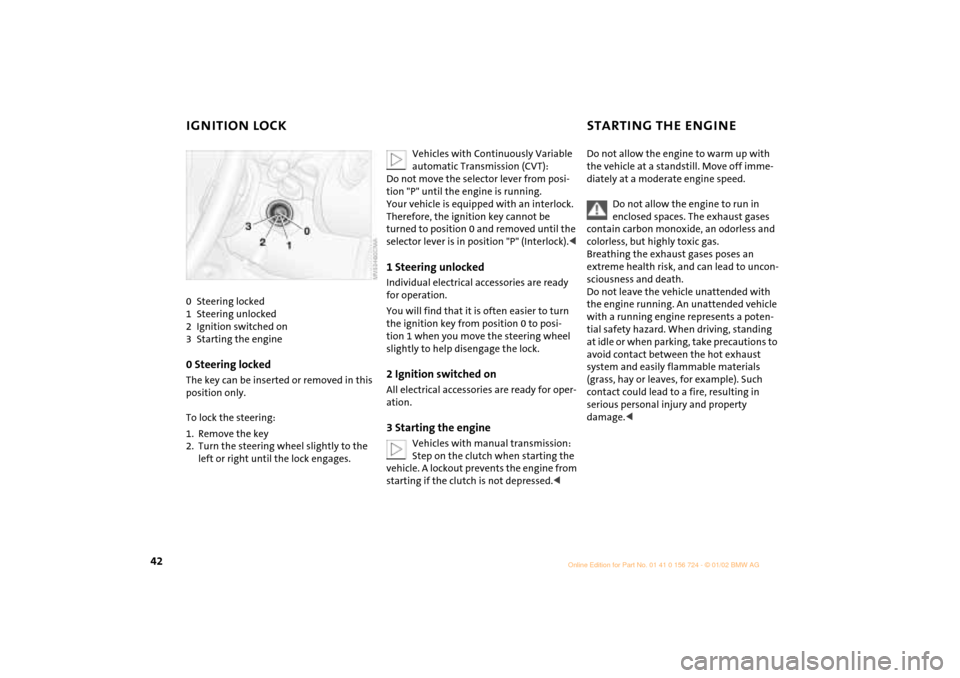
IGNITION LOCK STARTING THE ENGINE 0 Steering locked
1 Steering unlocked
2 Ignition switched on
3 Starting the engine0 Steering locked The key can be inserted or removed in this
position only.
To lock the steering:
1. Remove the key
2. Turn the steering wheel slightly to the
left or right until the lock engages.
Vehicles with Continuously Variable
automatic Transmission (CVT):
Do not move the selector lever from posi-
tion "P" until the engine is running.
Your vehicle is equipped with an interlock.
Therefore, the ignition key cannot be
turned to position 0 and removed until the
selector lever is in position "P" (Interlock).<
1 Steering unlocked Individual electrical accessories are ready
for operation.
You will find that it is often easier to turn
the ignition key from position 0 to posi-
tion 1 when you move the steering wheel
slightly to help disengage the lock.2 Ignition switched onAll electrical accessories are ready for oper-
ation.3 Starting the engine
Vehicles with manual transmission:
Step on the clutch when starting the
vehicle. A lockout prevents the engine from
starting if the clutch is not depressed.<
Do not allow the engine to warm up with
the vehicle at a standstill. Move off imme-
diately at a moderate engine speed.
Do not allow the engine to run in
enclosed spaces. The exhaust gases
contain carbon monoxide, an odorless and
colorless, but highly toxic gas.
Breathing the exhaust gases poses an
extreme health risk, and can lead to uncon-
sciousness and death.
Do not leave the vehicle unattended with
the engine running. An unattended vehicle
with a running engine represents a poten-
tial safety hazard. When driving, standing
at idle or when parking, take precautions to
avoid contact between the hot exhaust
system and easily flammable materials
(grass, hay or leaves, for example). Such
contact could lead to a fire, resulting in
serious personal injury and property
damage.<
Page 45 of 140
43
OVERVIEW REPAIRS OPERATIONCONTROLS DATA INDEX
STARTING THE ENGINE SWITCHING OFF THE ENGINE StartingWhen starting the engine, do not press the
accelerator pedal.
Do not actuate the starter for too
short a time. Do not turn it for more
than approx. 20 seconds. Release the igni-
tion key immediately when the engine
starts.
Extended starting attempts, characterized
by excessively frequent or long periods
with the starter engaged, can lead to
damage in the catalytic converter.<
If the engine does not start on the first
attempt (the engine is very hot or cold, for
instance):
>Press the accelerator pedal halfway
down while engaging the starter.
Cold starts at extremely low temperatures
(as of approx. +5 7(Ð15 6)):
>Press the accelerator pedal halfway
down while engaging the starter
>For the initial start attempt, allow the
starter to remain engaged somewhat
longer (approx. 10 seconds).
Manual transmission1. Engage the parking brake
2. Put the manual gearshift lever in neutral
3. Press the clutch pedal
4. Start the engine.Continuously Variable automatic
Transmission (CVT)*1. Press the footbrake
2. Put the selector lever in position P or N
3. Starting the engine.
Move the selector lever to position N
and engage the parking brake before
leaving your vehicle with the engine
running.
Do not leave the vehicle with the engine
running. An unattended vehicle with a
running engine represents a potential
safety hazard.<
You should never remove the ignition
key when the vehicle is in motion, as
the steering lock could engage.
When you leave the vehicle, always remove
the ignition key and engage the steering
lock.
When you park on downward slopes,
engage the parking brake.<
Manual transmissionTurn the ignition key to position 1 or 0.Continuously Variable automatic
Transmission (CVT)*Engage selector lever position P, turn the
ignition key to position 1 or 0.
Page 46 of 140
44
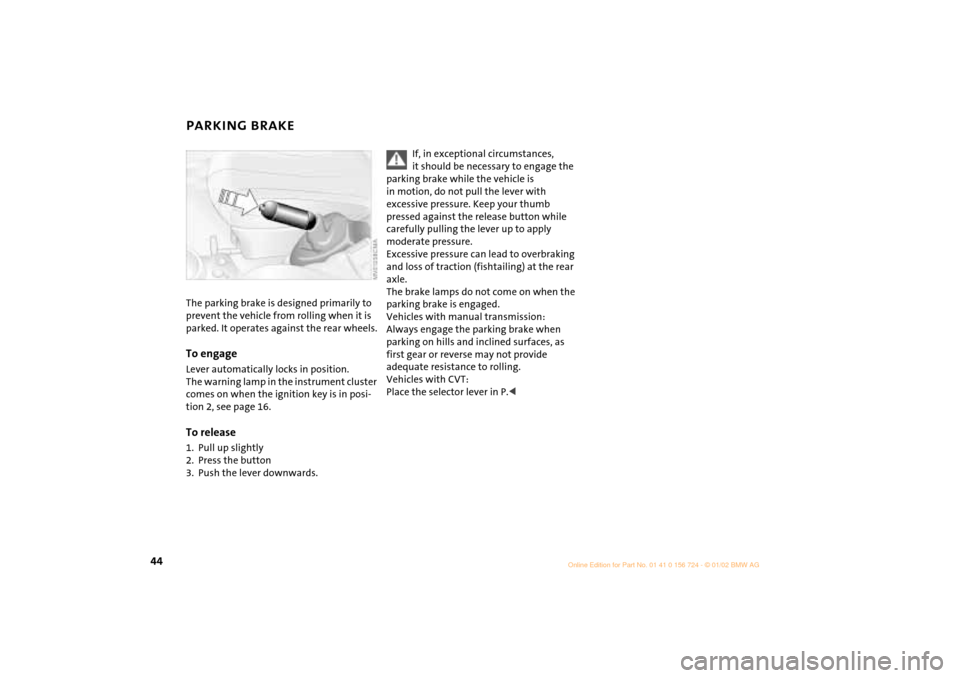
PARKING BRAKE The parking brake is designed primarily to
prevent the vehicle from rolling when it is
parked. It operates against the rear wheels.To engageLever automatically locks in position.
The warning lamp in the instrument cluster
comes on when the ignition key is in posi-
tion 2, see page 16.To release1. Pull up slightly
2. Press the button
3. Push the lever downwards.
If, in exceptional circumstances,
it should be necessary to engage the
parking brake while the vehicle is
in motion, do not pull the lever with
excessive pressure. Keep your thumb
pressed against the release button while
carefully pulling the lever up to apply
moderate pressure.
Excessive pressure can lead to overbraking
and loss of traction (fishtailing) at the rear
axle.
The brake lamps do not come on when the
parking brake is engaged.
Vehicles with manual transmission:
Always engage the parking brake when
parking on hills and inclined surfaces, as
first gear or reverse may not provide
adequate resistance to rolling.
Vehicles with CVT:
Place the selector lever in P.<
Page 47 of 140
45
OVERVIEW REPAIRS OPERATIONCONTROLS DATA INDEX
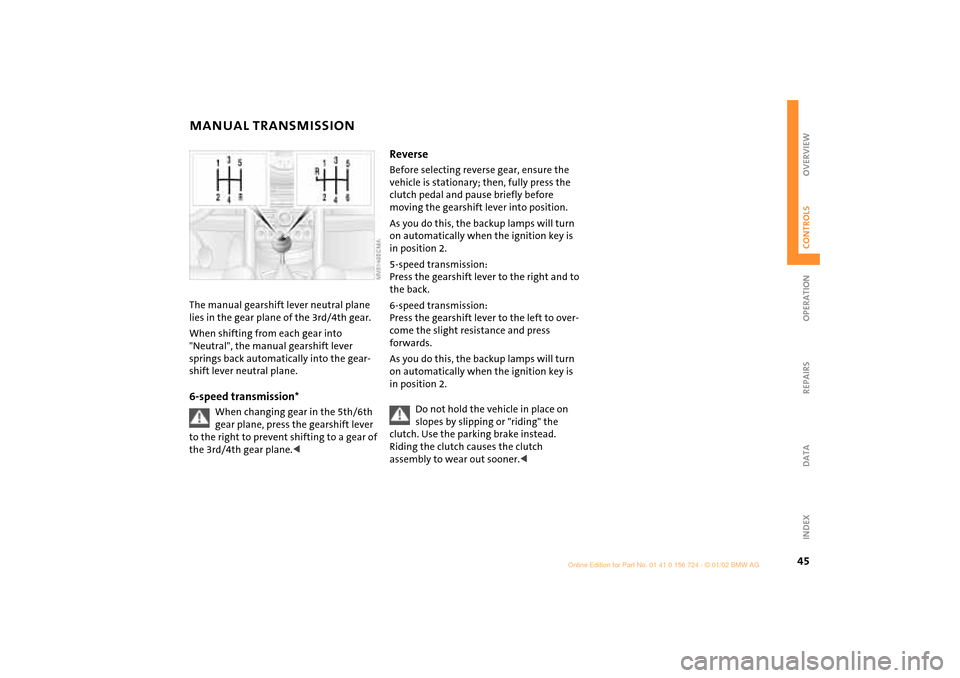
MANUAL TRANSMISSION The manual gearshift lever neutral plane
lies in the gear plane of the 3rd/4th gear.
When shifting from each gear into
"Neutral", the manual gearshift lever
springs back automatically into the gear-
shift lever neutral plane.6-speed transmission*
When changing gear in the 5th/6th
gear plane, press the gearshift lever
to the right to prevent shifting to a gear of
the 3rd/4th gear plane.<
Reverse Before selecting reverse gear, ensure the
vehicle is stationary; then, fully press the
clutch pedal and pause briefly before
moving the gearshift lever into position.
As you do this, the backup lamps will turn
on automatically when the ignition key is
in position 2.
5-speed transmission:
Press the gearshift lever to the right and to
the back.
6-speed transmission:
Press the gearshift lever to the left to over-
come the slight resistance and press
forwards.
As you do this, the backup lamps will turn
on automatically when the ignition key is
in position 2.
Do not hold the vehicle in place on
slopes by slipping or "riding" the
clutch. Use the parking brake instead.
Riding the clutch causes the clutch
assembly to wear out sooner.<
Page 51 of 140

49
OVERVIEW REPAIRS OPERATIONCONTROLS DATA INDEX
PARKING LAMPS/LOW BEAMS SIGNAL/HEADLAMP FLASHER Switching on the parking lampsTurn to the first position.
The front, rear and side vehicle lighting is
switched on.
One-sided standing lamps, see next
column.Switching on the low beamsTurn to the second position.
With the low beams on and with the igni-
tion switched off, only the parking lamps
will remain on."Follow me home" lampsIf you switch off the engine with the low
beams on, and then switch off the low
beams, they remain lit for approx. one
minute.
You can also have this function acti-
vated.<
Switching on the standing lampsFor parking, you can activate lights on one
side of the vehicle (observe local laws).
In ignition key position 0:
Move the lever into the relevant turn signal
indicator position."Lights on" warningIf the lights have not been switched off and
the ignition key is in position 0, an acoustic
signal sounds for a few seconds when you
open the driver's door to remind you that
the lights have not been switched off.Daytime driving lamps*If you desire, the light switch can be left in
the second position:
When the ignition is switched off, the
external lighting is also switched off.
You can have this function set by
your MINI center.<
1 Turn signal indicator (green indicator
accompanied by periodic clicking sound
from the relay)
2 High beams/Headlamp flasher (blue
indicator lamp)To signal brieflyPress the lever up to but not beyond the
detent.
If the indicator lamp of the indicators
and the clicking from the relay are
both faster than normal: one of the turn
signal indicators has failed.<
Page 53 of 140

51
OVERVIEW REPAIRS OPERATIONCONTROLS DATA INDEX
LIGHT-EMITTING DIODES WASHER/WIPER SYSTEM Light-emitting diodes (LEDs) installed
behind translucent lenses serve as the light
source for many of the controls and
displays in your vehicle. These light-emit-
ting diodes are related to conventional
lasers, and legislation defines them as
"light-emitting diodes, Class 1".
Do not remove the protective lens
and avoid staring directly at the unfil-
tered beam for several hours, as inflamma-
tion of the iris could result.<
0 Wipers parked
1 Intermittent operation or rain sensor
2 Normal wiper speed
3 Fast wiper speed
4 Brief wipe
5 Clean windshield and headlampsIntermittent operation(not on vehicles with rain sensor)
The interval varies depending on the speed
being driven.
You can have this function set by
your MINI center.<
Rain sensor*The rain sensor is located on the wind-
shield, directly in front of the interior rear-
view mirror. When the rain sensor is
activated, the windshield wipers are auto-
matically controlled depending on the
amount of water (or snow) landing on the
windshield.
To activate the rain sensor:
From ignition key position 1:
Lever in position 1.
The wipers move across the windshield
once.
To deactivate the rain sensor:
Put lever in position 0.
Switch the rain sensor off when
passing through an automatic car
wash. Failure to do so could result in
damage caused by undesired wiper activa-
tion.
speed.
You can have this function activated/
deactivated by your MINI center.<
Page 54 of 140

52
WASHER/WIPER SYSTEMCleaning windshield and headlamps* The system sprays washer fluid against the
windshield. The wipers are automatically
activated for a brief period.
When the vehicle lighting is on, the head-
lamps are also cleaned at appropriate inter-
vals.
Do not use the washers if there is any
danger that the fluid will freeze on
the windshield. If you do so, your vision
could be obscured. For this reason, use an
antifreeze agent, see page 89.
Do not use the washers when the reservoir
is empty, since this could cause damage to
the washing pump.
position 2.
Rear window wiper6 Intermittent operation:
Turn the cap to position 6
The rear window wiper moves across the
window a number of times before
switching to intermittent operationCleaning the rear window7 Intermittent operation:
Turn the cap to position 7 and hold in
place
8 In lever position 0:
Turn the cap to position 8 and hold in
place