Page 2 of 256
Seating and Safety Restraints 115
Seating 115
Safety restraints 129
Air bags 136
Child restraints 141
Driving 155
Starting 155
Brakes 158
Transmission operation 162
Vehicle loading 167
Trailer towing 169
Recreational towing 172
Roadside Emergencies 173
Getting roadside assistance 173
Hazard flasher switch 174
Fuel pump shut-off switch 174
Fuses and relays 175
Changing tires 182
Jump starting 188
Wrecker towing 193
Customer Assistance 194
The dispute settlement board 197
Utilizing the mediation/arbitration 200
Getting assistance outside the U.S. and Canada 200
Ordering additional owner’s literature 201
Reporting safety defects (U.S. only) 202
Table of Contents
2
Page 5 of 256

Additional owner information is given in separate publications.
This Owner’s Guide describes every option and model variant available
and therefore some of the items covered may not apply to your
particular vehicle. Furthermore, due to printing cycles it may describe
options before they are generally available.
Remember to pass on the Owner’s Guide when reselling the vehicle. It is
an integral part of the vehicle.
Fuel pump shut-off switchIn the event of an accident the
safety switch will automatically cut off the fuel supply to the
engine. The switch can also be activated through sudden vibration (e.g.
collision when parking). To reset the switch, refer to theFuel pump
shut-off switchin theRoadside emergencieschapter.
SAFETY AND ENVIRONMENT PROTECTION
Warning symbols in this guide
How can you reduce the risk of personal injury and prevent possible
damage to others, your vehicle and its equipment? In this guide, answers
to such questions are contained in comments highlighted by the warning
triangle symbol. These comments should be read and observed.
Warning symbols on your vehicle
When you see this symbol, it is
imperative that you consult the
relevant section of this guide before
touching or attempting adjustment
of any kind.
Introduction
5
Page 8 of 256
These are some of the symbols you may see on your vehicle.
Vehicle Symbol Glossary
Safety Alert
See Owner’s Guide
Fasten Safety BeltAir Bag-Front
Air Bag-SideChild Seat
Child Seat Installation
WarningChild Seat Tether
Anchorage
Brake SystemAnti-Lock Brake System
Brake Fluid -
Non-Petroleum BasedTraction Control
AdvanceTracMaster Lighting Switch
Hazard Warning FlasherFog Lamps-Front
Fuse CompartmentFuel Pump Reset
Windshield Wash/WipeWindshield
Defrost/Demist
Rear Window
Defrost/DemistPower Windows
Front/Rear
Introduction
8
Page 101 of 256

Message center functions
Outside temp
Press SELECT until the menu
displays OUTSIDE TEMP. This will
display the temperature of the air
outside of your vehicle. The
accurate temperature will be
displayed after the vehicle has
reached the outside temperature
and is driven at speeds of 48 km/h
(30 mph) or greater.
Inst economy
Press SELECT until the menu
displays INST ECONOMY. This will
display your fuel economy in
liters/100 km or miles/gallon based
on the type of traffic you are in.
Your vehicle must be moving to
calculate instantaneous fuel
economy. When your vehicle is not
moving, this function shows 99 L/100km or 0 MILES/GAL. Instantaneous
fuel economy cannot be reset.
Avg economy
Press SELECT until the menu
displays AVG ECONOMY. This will
display your average fuel economy
in liters/100 km or miles/gallon.
If you calculate your average fuel
economy by dividing liters of fuel
used by 100 kilometers traveled
(miles traveled by gallons used),
your figure may be different than displayed for the following reasons:
•your vehicle was not perfectly level during fill-up
•differences in the automatic shut-off points on the fuel pumps at
service stations
•rounding of the displayed values to the nearest 0.1 liter (gallon)
OUTSIDE TEMPINST ECONOMY
AVG ECONOMY
TO EMPTY
˚F ˚C
MILES/GAL
L/100 km
MILES km
OUTSIDE TEMPINST ECONOMY
AVG ECONOMY
TO EMPTY
˚F ˚C
MILES/GAL
L/100 km
MILES km
OUTSIDE TEMPINST ECONOMY
AVG ECONOMY
TO EMPTY
˚F ˚C
MILES/GAL
L/100 km
MILES km
Driver Controls
101
Page 161 of 256
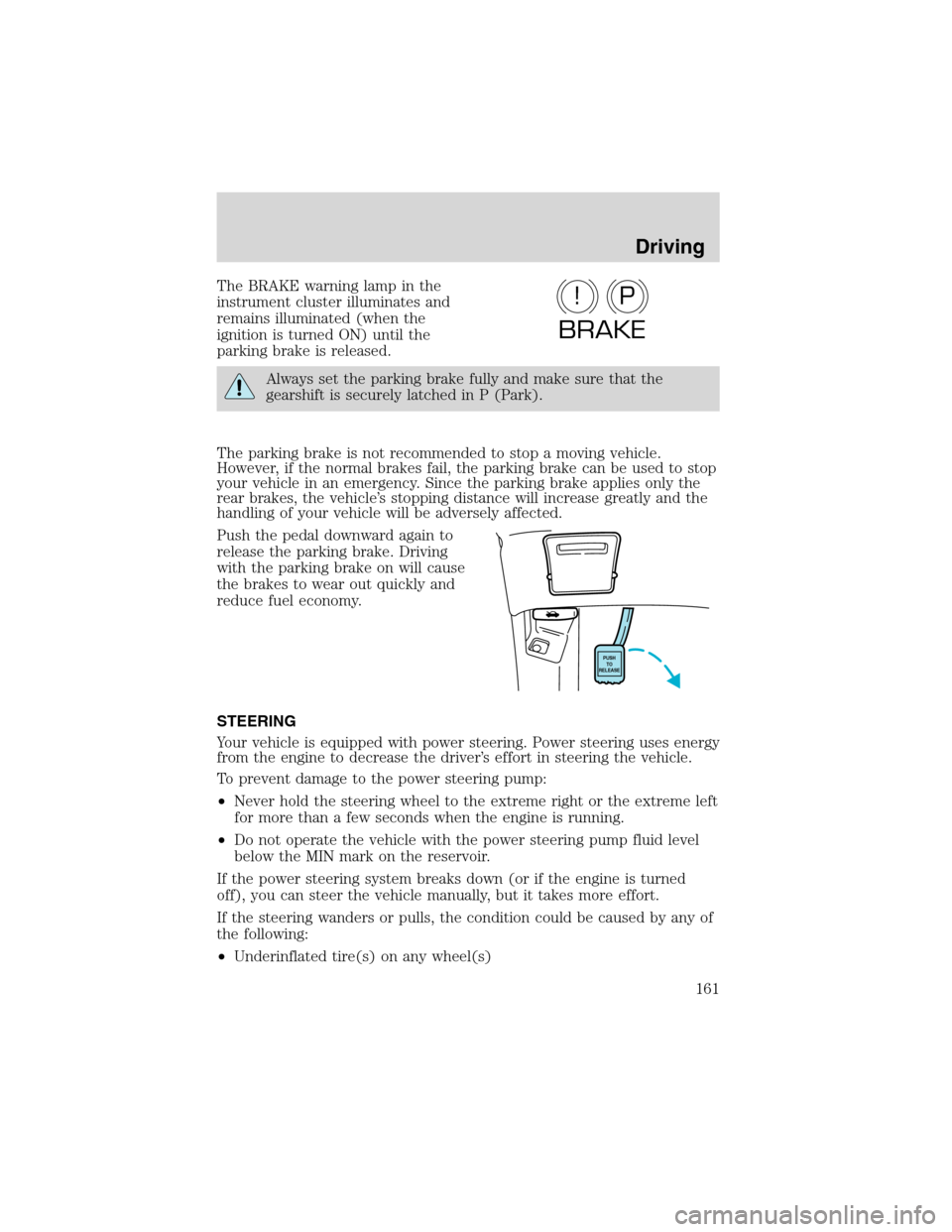
The BRAKE warning lamp in the
instrument cluster illuminates and
remains illuminated (when the
ignition is turned ON) until the
parking brake is released.
Always set the parking brake fully and make sure that the
gearshift is securely latched in P (Park).
The parking brake is not recommended to stop a moving vehicle.
However, if the normal brakes fail, the parking brake can be used to stop
your vehicle in an emergency. Since the parking brake applies only the
rear brakes, the vehicle’s stopping distance will increase greatly and the
handling of your vehicle will be adversely affected.
Push the pedal downward again to
release the parking brake. Driving
with the parking brake on will cause
the brakes to wear out quickly and
reduce fuel economy.
STEERING
Your vehicle is equipped with power steering. Power steering uses energy
from the engine to decrease the driver’s effort in steering the vehicle.
To prevent damage to the power steering pump:
•Never hold the steering wheel to the extreme right or the extreme left
for more than a few seconds when the engine is running.
•Do not operate the vehicle with the power steering pump fluid level
below the MIN mark on the reservoir.
If the power steering system breaks down (or if the engine is turned
off), you can steer the vehicle manually, but it takes more effort.
If the steering wanders or pulls, the condition could be caused by any of
the following:
•Underinflated tire(s) on any wheel(s)
P!
BRAKE
PUSH
TO
RELEASE
Driving
161
Page 174 of 256

If you need to arrange roadside assistance for yourself, Ford Motor
Company will reimburse a reasonable amount. To obtain reimbursement
information, U.S. Ford or Mercury vehicles customers call
1-800-241-3673; Lincoln vehicle customers call 1–800–521–4140.
Canadian customers who need to obtain reimbursement information, call
1–800–665–2006.
ROADSIDE COVERAGE BEYOND BASIC WARRANTY
In the United States, you may purchase additional roadside assistance
coverage beyond this period through the Ford Auto Club by contacting
your Ford or Lincoln Mercury dealer.
Similarly in Canada, for uninterrupted Roadside Assistance coverage, you
may purchase extended coverage prior to your Basic Warranty’s Roadside
Assistance expiring. For more information and enrollment, contact
1–877–294–2582 or visit our website at www.ford.ca.
HAZARD FLASHER
Use only in an emergency to warn traffic of vehicle breakdown,
approaching danger, etc. The hazard flashers can be operated when the
ignition is off.
•The hazard lights control is
located on the instrument panel.
•Depress hazard lights control to
activate all hazard flashers
simultaneously.
•Depress control again to turn the
flashers off.
FUEL PUMP SHUT-OFF SWITCH
FUEL
RESET
The fuel pump shut-off switch is a device intended to stop the electric
fuel pump when your vehicle has been involved in a substantial jolt.
After a collision, if the engine cranks but does not start, the fuel pump
shut-off switch may have been activated.
SECURITYHAZARD
RR DEFOGRR WIPER RR WASH
Roadside Emergencies
174
Page 175 of 256

The fuel pump shut-off switch is
located in the driver’s foot well,
behind the kick panel. The reset
button (RED) for the fuel pump
shut-off switch is accessible through
an opening in the kick panel.
Use the following procedure to reset the fuel pump shut-off switch.
1. Turn the ignition to the OFF position.
2. Check the fuel system for leaks.
3. If no fuel leak is apparent, reset the fuel pump shut-off switch by
pushing in on the reset button.
4. Turn the ignition to the RUN position. Pause for a few seconds and
return the key to the OFF position.
5. Make a further check for leaks in the fuel system.
FUSES AND RELAYS
Fuses
If electrical components in the
vehicle are not working, a fuse may
have blown. Blown fuses are
identified by a broken wire within
the fuse. Check the appropriate
fuses before replacing any electrical
components.
Note:Always replace a fuse with one that has the specified amperage
rating. Using a fuse with a higher amperage rating can cause severe wire
damage and could start a fire.
15
Roadside Emergencies
175
Page 180 of 256
The high-current fuses are coded as follows.
Fuse/Relay
LocationFuse Amp
RatingPower Distribution Box
Description
Fog Lamp 7.5A* Fog Lamps
FUEL PUMP 15A* Fuel Pump Relay
INJ 10A* Powertrain Control Module
(PCM), Injectors
SEC 7.5A* Anti-Theft Relay, Smart Entry
Control (SEC)/Timer Module
RAD 7.5A* Radiator Fan Sensing
ECCS 10A* Data Link Connector (DLC) #1,
PCM Power Relay
——Not Used
——Not Used
ALT 10A* Generator
ABS 20A* ABS Control Module
USE SPECIFIED FUSES OR FUSIBLE LINKS ONLY
ALT
100A
MAIN140A
ALT65A
FR
BLW
45A
RR
DEF75A
RAD
FA N
JOINT CONN. RAD FAN
H1RAD FAN
H2RAD FAN
LO 30A
IGN
SW20A
RAD
FA N
LO 30A
PWR
WND40A
ABS20A
ABS
15A
HORN7.5A
SEC7.5A
LAMP
15A
H/L
LH15A
H/L
RH10A
ALT10A
ECCS10A
INJ 15A
FUEL
PUMP 7.5A
RAD
FRONT
FOG
Roadside Emergencies
180


