2002 MERCEDES-BENZ CLK320 CABRIOLET high
[x] Cancel search: highPage 18 of 346

15 Introduction
For the USA only:
The following text is published as required of manufacturers under Title 49, Code of U.S. Federal Regulations,
Part 575 pursuant to the “National Traffic and Motor Vehicle Safety Act of 1966”.Reporting Safety Defects
If you believe that your vehicle has a defect which could cause a crash or could cause injury or
death, you should immediately inform the National Highway Traffic Safety Administration
(NHTSA) in addition to notifying Mercedes-Benz USA, LLC.
If NHTSA receives similar complaints, it may open an investigation, and if it finds that a safety
defect exists in a group of vehicles, it may order a recall and remedy campaign. However, NHTSA
cannot become involved in individual problems between you, your dealer, or Mercedes-Benz USA,
LLC.
To contact NHTSA, you may either call the Auto Safety Hotline toll-free at 1-888-327-4236 or write
to: NHTSA, U.S. Department of Transportation, Washington, D.C. 20590. You can also obtain other
information about motor vehicle safety from the Hotline.
J_A208.book Seite 15 Donnerstag, 31. Mai 2001 9:35 09
Page 54 of 346

51 Seats
Technical
data Instruments
and controlsOperationDrivingInstrument
cluster displayPractical hints Car care Index Front head restraints
Removal:
Tilt the backrest rearward for easier removal of the front
head restraints.
Push button (1) up to bring the power adjustable head
restraint to its highest position.
Pull out head restraint completely with both hands.Installation:
Push button (1) of the power adjustable head restraint
up for approximately 5 seconds.
Insert the head restraint and push it down to the stop.
Adjust head restraint to the desired position.
For positioning of head restraints see also power seats,
front on page 45, and head restraints, rear on page 53.
Wa r n i n g !
For your protection, drive only with properly
positioned head restraints.Adjust head restraint to support the back of the
head approximately at ear level.Do not drive the vehicle without the seat head
restraints. Head restraints are intended to help
reduce injuries during an accident.
J_A208.book Seite 51 Donnerstag, 31. Mai 2001 9:35 09
Page 76 of 346

73 Restraint systems
Technical
data Instruments
and controlsOperationDrivingInstrument
cluster displayPractical hints Car care IndexSafety guidelines for the seat belt,
emergency tensioning retractor and airbag
Wa r n i n g !
Accident research shows that the safest place for
children in an automobile is in the rear seat.
Should you choose to place a child 12 years old or
under in the front passenger seat of your vehicle,
you must properly use a BabySmart
TM child
restraint which will turn off the passenger side
front airbag. BabySmart
TM will not, however, turn
off the passenger’s side impact airbag.
It should be noted however that there is a
possibility for a side airbag related injury if
occupants, especially children, are not properly
seated or restrained when next to a side airbag
which needs to deploy rapidly in a side impact in
order to do its job.To help avoid the possibility of injury, please follow
these guidelines: (1) occupants, especially
children, should never place their bodies or lean
their heads in the area of the door where the side
airbag inflates. This could result in serious
injuries or death should the side airbag be
activated; (2) always sit upright, properly use the
seat belts and use an appropriately sized infant or
child restraint system for all children 12 years old
or under; and (3) always wear seat belts properly.
Wa r n i n g !
• Damaged seat belts or belts that were highly
stressed in an accident must be replaced and
their anchoring points must also be checked.
Use only belts installed or supplied by an
authorized Mercedes-Benz Center.• Do not pass belts over sharp edges.• Do not make any modification that could
change the effectiveness of the belts.• Airbags and ETR’s are designed to function on
a one-time-only basis. An airbag or emergency
tensioning retractor (ETR) that was activated
must be replaced.
J_A208.book Seite 73 Donnerstag, 31. Mai 2001 9:35 09
Page 87 of 346
84 Instrument cluster
Technical
data Instruments
and controlsOperationDrivingInstrument
cluster displayPractical hints Car care Index
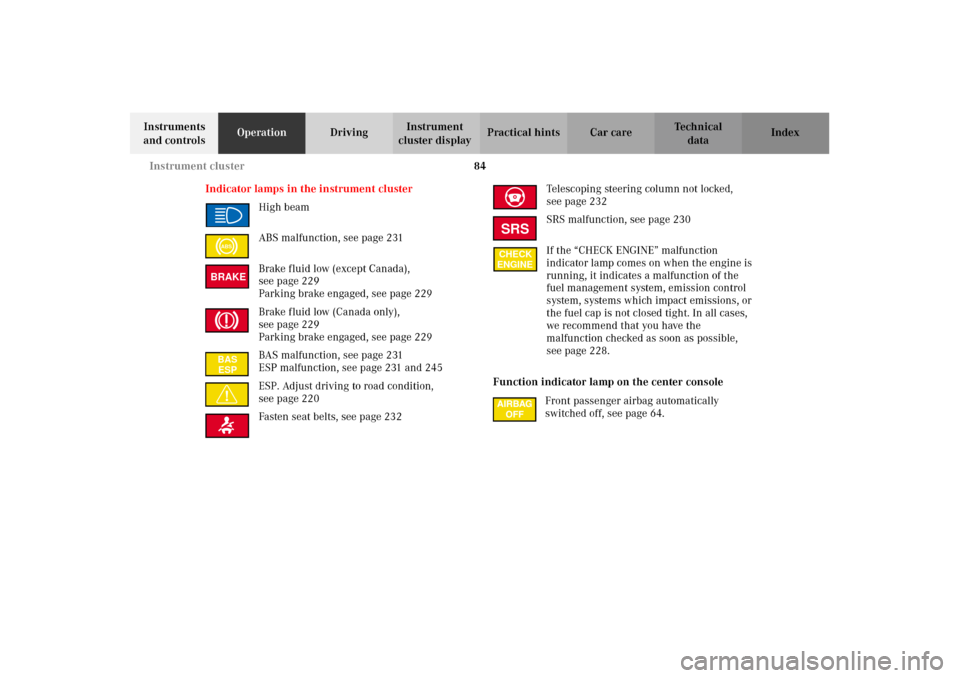
Indicator lamps in the instrument cluster
High beam
ABS malfunction, see page 231
Brake fluid low (except Canada),
seepage229
Parking brake engaged, see page 229
Brake fluid low (Canada only),
seepage229
Parking brake engaged, see page 229
BAS malfunction, see page 231
ESP malfunction, see page 231 and 245
ESP. Adjust driving to road condition,
seepage220
Fasten seat belts, see page 232Telescoping steering column not locked,
seepage232
SRS malfunction, see page 230
If the “CHECK ENGINE” malfunction
indicator lamp comes on when the engine is
running, it indicates a malfunction of the
fuel management system, emission control
system, systems which impact emissions, or
the fuel cap is not closed tight. In all cases,
we recommend that you have the
malfunction checked as soon as possible,
seepage228.
Function indicator lamp on the center console
Front passenger airbag automatically
switched off, see page 64.
ABSBRAKEBAS
ESP
SRSCHECK
ENGINE
J_A208.book Seite 84 Donnerstag, 31. Mai 2001 9:35 09
Page 116 of 346
113 Engine oil level indicator
Technical
data Instruments
and controlsOperationDrivingInstrument
cluster displayPractical hints Car care Index One of the following messages will subseq uently appear
on the indicator:
“ENGINE OIL LEVEL – O.K.”
No oil needs to be added.
“ENGINE OIL LEVEL – ADD 1.0 QUART”
(Canada: 1.0 L)
“ENGINE OIL LEVEL – ADD 1.5 QUART”
(Canada: 1.5 L)
“ENGINE OIL LEVEL – ADD 2.0 QUART”
(Canada: 2.0 L)
See page 256 for instructions on adding engine oil.
“ENGINE OIL LEVEL – REDUCE OIL LEVEL”
Do not overfill the engine.
Excessive oil must be siphoned or drained off. It could
cause damage to the engine and catalytic converter not
covered by the Mercedes-Benz Limited Warranty.
The message “MEASURING NOT POSSIBLE” will be
displayed if a proper oil level check cannot be
performed. The engine oil level check can be repeated
after a short time.Perform the engine oil level check with the dipstick, if it
cannot be completed via the multifunction display.
Seepage256.
In this case we recommend that you have the system
checked at a Mercedes-Benz Center.
Note:
See malfunction and warning messages on page 234
and page 244 if an engine oil level indicator appears on
the multifunction display when the engine is running.
The engine oil level cannot be checked while the engine
is running. The “ENGINE OIL LEVEL – NOT WHEN
ENGINE ON” message will appear.
Engine oil consumption
Engine oil consumption checks should only be made
after the break-in period. During the break-in period,
higher oil consumption may be noticed and is normal.
Frequent driving at high engine speeds results in
increased consumption.
J_A208.book Seite 113 Donnerstag, 31. Mai 2001 9:35 09
Page 117 of 346
114 Exterior lamp switch
Technical
data Instruments
and controlsOperationDrivingInstrument
cluster displayPractical hints Car care Index
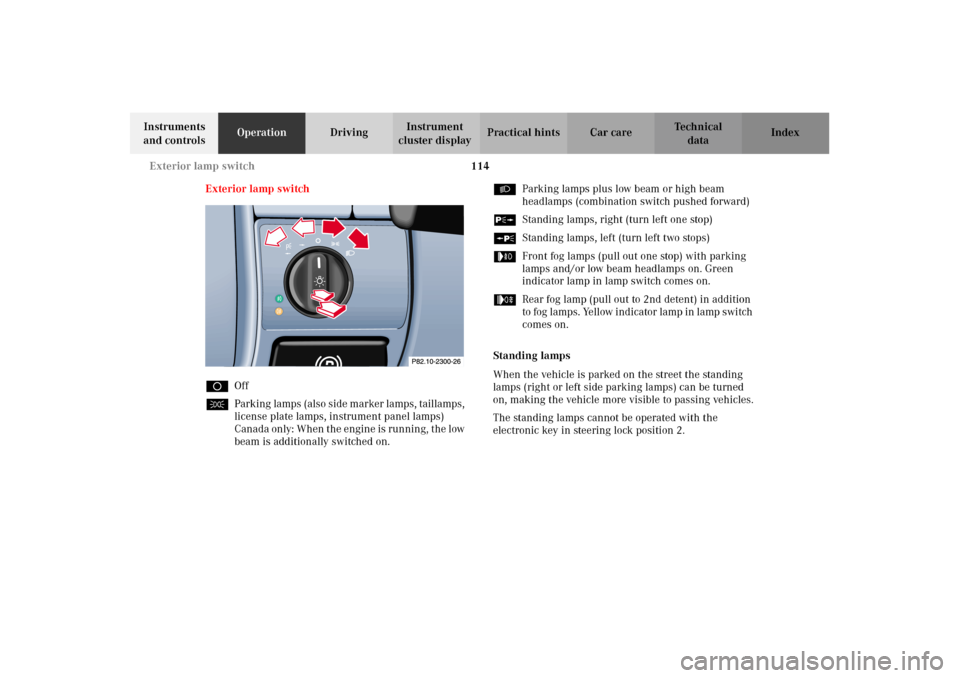
Exterior lamp switch
DOff
CParking lamps (also side marker lamps, taillamps,
license plate lamps, instrument panel lamps)
Canada only: When the engine is running, the low
beam is additionally switched on.BParking lamps plus low beam or high beam
headlamps (combination switch pushed forward)
ˆStanding lamps, right (turn left one stop)
‚Standing lamps, left (turn left two stops)
…Front fog lamps (pull out one stop) with parking
lamps and/or low beam headlamps on. Green
indicator lamp in lamp switch comes on.
„Rear fog lamp (pull out to 2nd detent) in addition
to fog lamps. Yellow indicator lamp in lamp switch
comes on.
Standing lamps
When the vehicle is parked on the street the standing
lamps (right or left side parking lamps) can be turned
on, making the vehicle more visible to passing vehicles.
The standing lamps cannot be operated with the
electronic key in steering lock position 2.
J_A208.book Seite 114 Donnerstag, 31. Mai 2001 9:35 09
Page 118 of 346
115 Exterior lamp switch
Technical
data Instruments
and controlsOperationDrivingInstrument
cluster displayPractical hints Car care Index Notes:
With the electronic key removed and the driver’s door
open, a warning sounds and the message “SWITCH OFF
LIGHTS” in the multifunction indicator appears if the
vehicle’s exterior lamps (except standing lamps) are not
switched off.
Fog lamps will operate with the parking lamps and/or
the low beam headlamps on. Fog lamps should only be
used in conjunction with low beam headlamps. Consult
your State or Province Motor Vehicle Regulations
regarding allowable lamp operation.
Fog lamps are automatically switched off when the
exterior lamp switch is turned to position D.Daytime running lamps (Canada only)
When the engine is running and the selector lever is in
a driving position, the low beam headlamps (includes
parking lamps, side marker lamps, taillamps and
license plate lamps) are automatically switched on.
When shifting from a driving position to position “N”
or “P”, the low beam switches off (2 seconds delay).
For nighttime driving the exterior lamp switch should
be turned to position B to permit activation of the
high beam headlamps.
Night security illumination
When exiting the vehicle after driving with the exterior
lamps on, they switch on again for added illumination
for approximately 30 seconds after closing the last door.
The lamp-on time period can be changed at your
Mercedes-Benz Center.
J_A208.book Seite 115 Donnerstag, 31. Mai 2001 9:35 09
Page 120 of 346

117 Combination switch
Technical
data Instruments
and controlsOperationDrivingInstrument
cluster displayPractical hints Car care Index Combination switch
1Low beam (exterior lamp switch position B)
2High beam (exterior lamp switch position B)3High beam flasher (high beam available
independent of exterior lamp switch position)
4Turn signals, right
5Turn signals, left
To signal minor directional changes, such as changing
lanes on a highway, move combination switch to the
point of resistance only and hold it there.
To operate the turn signals continuously, move the
combination switch past the point of resistance (up or
down). The switch is automatically canceled when the
steering wheel is turned to a large enough degree.
Turn signal failure
If one of the turn signals fails, the turn signal indicator
system flashes and sounds at a faster than normal rate.
P54.25-2034-26
2
3
4
4
5
5
1
J_A208.book Seite 117 Donnerstag, 31. Mai 2001 9:35 09