2002 MERCEDES-BENZ C320 WAGON power steering
[x] Cancel search: power steeringPage 9 of 390

6 Contents
Vehicle careCleaning and care of the vehicle .354
Power washer ..............................355
Tar stains .....................................355
Paintwork, painted body
components .................................355
Engine cleaning ..........................356
Vehicle washing .........................356
Ornamental moldings ................357
Headlamps, taillamps,
turn signal lenses ......................357
Window cleaning ........................357
Wiper blade .................................357
Light alloy wheels ......................358
Instrument cluster .....................358
Steering wheel and
gear selector lever ......................358
Cup holder ...................................358
Seat belts .....................................359
Headliner and
shelf below rear window ...........359Leather upholstery .................... 359
Hard plastic trim items ............. 359
Plastic and rubber parts ........... 359
Technical dataSpare parts service ....................... 362
Warranty coverage ........................ 362
Identification labels ...................... 363
Layout of poly-V-belt drive ........... 364
Technical data ................................ 365
Fuels, coolants, lubricants etc. -
capacities ................................... 368
Engine oils ...................................... 370
Engine oil additives ...................... 370
Air conditioner refrigerant .......... 370
Brake fluid ...................................... 370
Premium unleaded gasoline .........371
Fuel requirements .........................371
Gasoline additives ......................... 372
Coolants .......................................... 372
Consumer information ..................374
Uniform tire quality grading ........374
IndexIndex ................................................ 376
S203.book Seite 6 Freitag, 19. Oktober 2001 1:25 13
Page 23 of 390
20 Instruments and controls
Te ch n i c a l
data Instruments
and controlsOperation DrivingInstrument
cluster displayPractical hints Car care Index
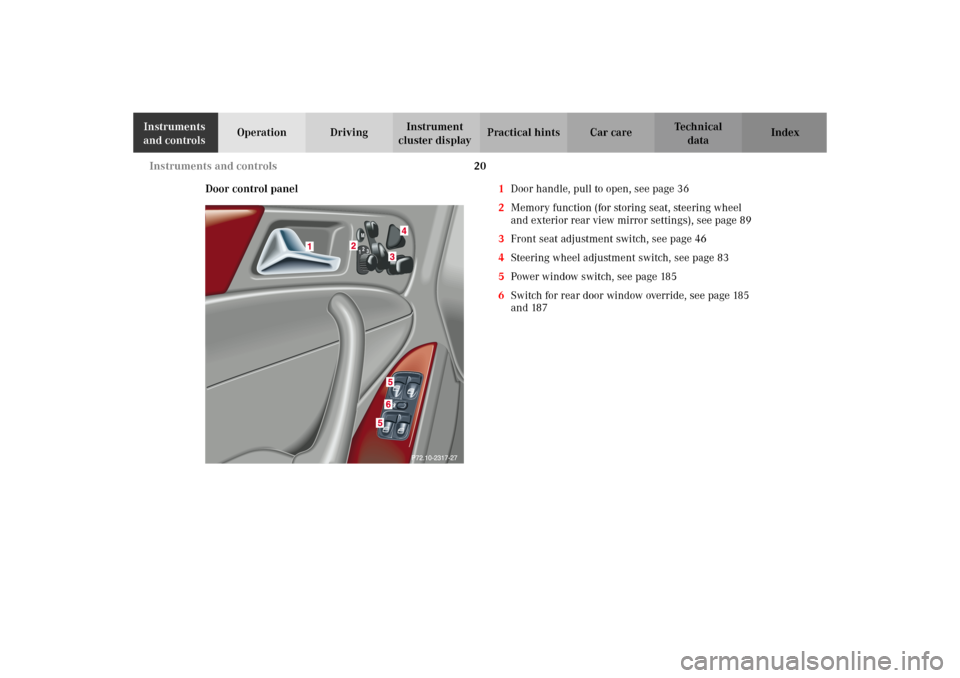
Door control panel1Door handle, pull to open, see page 36
2Memory function (for storing seat, steering wheel
and exterior rear view mirror settings), see page 89
3Front seat adjustment switch, see page 46
4Steering wheel adjustment switch, see page 83
5Power window switch, see page 185
6Switch for rear door window override, see page 185
and 187
S203.book Seite 20 Freitag, 19. Oktober 2001 1:25 13
Page 50 of 390
47 Seats
Te ch n i c a l
data Instruments
and controlsOperationDrivingInstrument
cluster displayPractical hints Car care Index Power seat
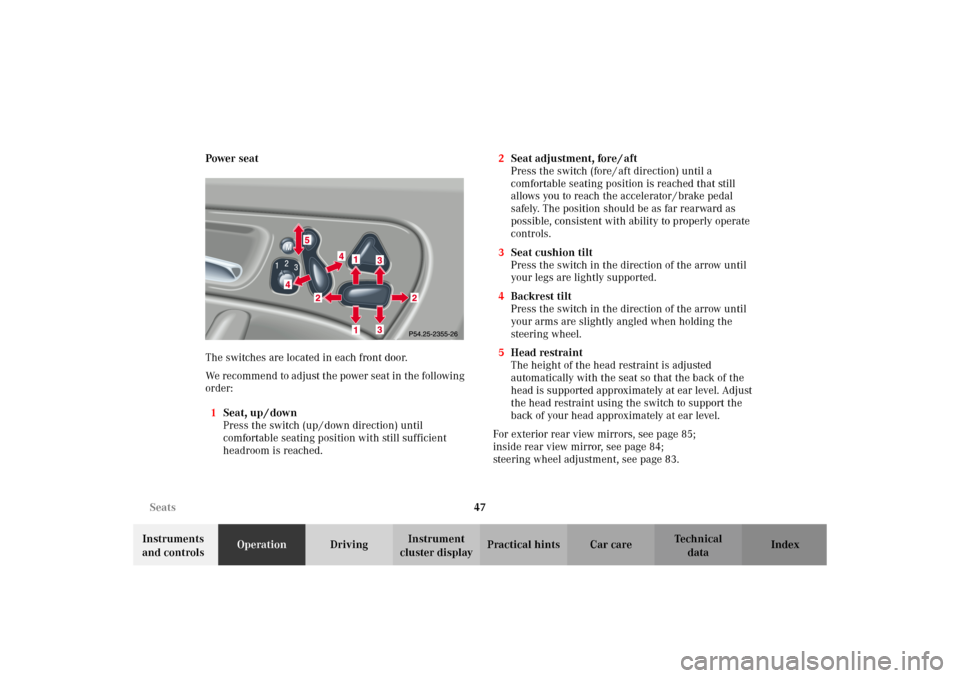
The switches are located in each front door.
We recommend to adjust the power seat in the following
order:
1Seat, up / down
Press the switch (up / down direction) until
comfortable seating position with still sufficient
headroom is reached.2Seat adjustment, fore / aft
Press the switch (fore / aft direction) until a
comfortable seating position is reached that still
allows you to reach the accelerator / brake pedal
safely. The position should be as far rearward as
possible, consistent with ability to properly operate
controls.
3Seat cushion tilt
Press the switch in the direction of the arrow until
your legs are lightly supported.
4Backrest tilt
Press the switch in the direction of the arrow until
your arms are slightly angled when holding the
steering wheel.
5Head restraint
The height of the head restraint is adjusted
automatically with the seat so that the back of the
head is supported approximately at ear level. Adjust
the head restraint using the switch to support the
back of your head approximately at ear level.
For exterior rear view mirrors, see page 85;
inside rear view mirror, see page 84;
steering wheel adjustment, see page 83.
S203.book Seite 47 Freitag, 19. Oktober 2001 1:25 13
Page 93 of 390
90 Memory function
Te ch n i c a l
data Instruments
and controlsOperationDrivingInstrument
cluster displayPractical hints Car care Index
Storing positions into memory:
With the electronic key in starter switch position 1 or 2
or with the relevant door open and the electronic key
inserted in the starter switch.
Adjust the seat to the desired position.
Driver’s seat:
You can also adjust the steering wheel and the exterior
rear view mirrors electrically for the driver’s seat. See
page 85 for exterior rear view mirror adjustment and
page 83 for steering wheel adjustment.
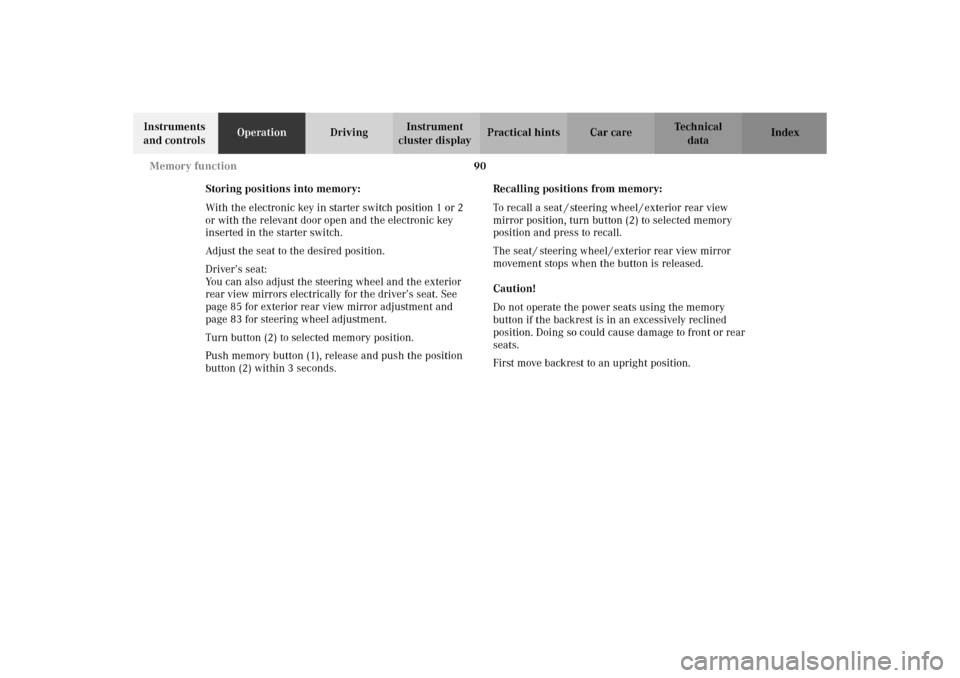
Turn button (2) to selected memory position.
Push memory button (1), release and push the position
button (2) within 3 seconds.Recalling positions from memory:
To recall a seat / steering wheel / exterior rear view
mirror position, turn button (2) to selected memory
position and press to recall.
The seat / steering wheel / exterior rear view mirror
movement stops when the button is released.
Caution!
Do not operate the power seats using the memory
button if the backrest is in an excessively reclined
position. Doing so could cause damage to front or rear
seats.
First move backrest to an upright position.
S203.book Seite 90 Freitag, 19. Oktober 2001 1:25 13
Page 257 of 390

254 Driving instructions
Te ch n i c a l
data Instruments
and controlsOperationDrivingInstrument
cluster displayPractical hints Car care Index
Power assistance
BrakesExcessive use of road salt and other snow melting
chemicals spread on roads during the winter months
may cause a build up of moisture or residue to form on
the braking components. This build up or residue could
cause light corrosion of the braking components if the
vehicle is parked with the brakes cold. Apply steady and
even braking pressure when stopping the vehicle to
warm up and dry the brake components.
Important!
Please pay attention to the function of the brake assist
system (BAS), see page 267.
The condition of the parking brake system is checked
each time the vehicle is in the shop for the required
maintenance service.
If the parking brake is released and the brake warning
lamp in the instrument cluster stays on, the brake fluid
level in the reservoir is too low.
Brake pad wear or a leak in the system may be the
reason for low brake fluid in the reservoir.
Have the brake system inspected at an authorized
Mercedes-Benz Center immediately.
Wa r n i n g !
When the engine is not running, the brake and
steering systems are without power assistance.
Under these circumstances, a much greater effort is
necessary to stop or steer the vehicle.Wa r n i n g !
After driving in heavy rain for some time without
applying the brakes or through water deep enough
to wet brake components or salty road conditions,
the first braking action may be somewhat reduced
and increased pedal pressure may be necessary to
obtain expected braking effect. Be sure to maintain
a safe distance from vehicles in front.Resting your foot on the brake pedal will cause
excessive and premature wear of the brake pads.It can also result in the brakes overheating thereby
significantly reducing their effectiveness. It may
not be possible to stop the vehicle in sufficient time
to avoid an accident.
S203.book Seite 254 Freitag, 19. Oktober 2001 1:25 13
Page 271 of 390
268 Driving systems
Te ch n i c a l
data Instruments
and controlsOperationDrivingInstrument
cluster displayPractical hints Car care Index
Antilock brake system (ABS)
Important!
The ABS improves steering control of the vehicle during
hard braking maneuvers.
The ABS prevents the wheels from locking up above a
vehicle speed of approximately 5 mph (8 km / h)
independent of road surface conditions.At the instant one of the wheels is about to lock up, a
slight pulsation can be felt in the brake pedal,
indicating that the ABS is in the regulating mode. Keep
firm and steady pressure on the brake pedal while
experiencing the pulsation.
Continuous steady brake pedal pressure results in
applying the advantages of the ABS, namely braking
power and ability to steer the vehicle.
In the case of an emergency brake maneuver keep
continuous full pressure on the brake pedal. In this
manner only can the ABS be most effective.
On slippery road surfaces, the ABS will respond even
with light brake pedal pressure because of the
increased likelihood of locking wheels. The pulsating
brake pedal can be an indication of hazardous road
conditions and functions as a reminder to take extra
care while driving.
Wa r n i n g !
Do not pump the brake pedal, rather use firm,
steady brake pedal pressure. Pumping the brake
pedal defeats the purpose for ABS and significantly
reduces braking effectiveness.
S203.book Seite 268 Freitag, 19. Oktober 2001 1:25 13
Page 274 of 390
271 Driving systems
Te ch n i c a l
data Instruments
and controlsOperationDrivingInstrument
cluster displayPractical hints Car care Index Notes:
The yellow ESP warning lampv in the speedometer
dial comes on with the electronic key in starter switch
position 2. It should go out with the engine running.
If the ESP warning message is displayed, a malfunction
has been detected in the system. Only partial engine
output will be available.
Have the ESP checked at your authorized
Mercedes-Benz Center as soon as possible.
For ESP warning message, see page 284.
With the ABS malfunctioning, the ESP is also switched
off.
Driving the vehicle with varied size tires will cause the
wheels to rotate at different speeds, therefore the ESP
may activate (yellow ESP warning lamp in speedometer
d ial com es on ). For t his reas on, all wheels, in cludin g t he
spare wheel, must have the same tire size.When testing the parking brake on a brake test
dynamometer, the engine must be shut off. Otherwise,
the ESP will immediately be engaged and will apply the
rear wheel brakes.
In winter operation, the maximum effectiveness of the
ESP is on ly achieved wit h Me rced es -B enz re comm end ed
M+S rated radial-ply tires and / or snow chains.
Synchronizing ESP
If the power supply was interrupted (battery
disconnected or empty), the ESP warning message may
be displayed with the engine running.
Turn steering wheel completely to the left and then to
the right. The ESP warning message should go out.
S203.book Seite 271 Freitag, 19. Oktober 2001 1:25 13
Page 299 of 390
296 Malfunction and warning messages
Te ch n i c a l
data Instruments
and controlsOperation DrivingInstrument
cluster displayPractical hints Car care Index
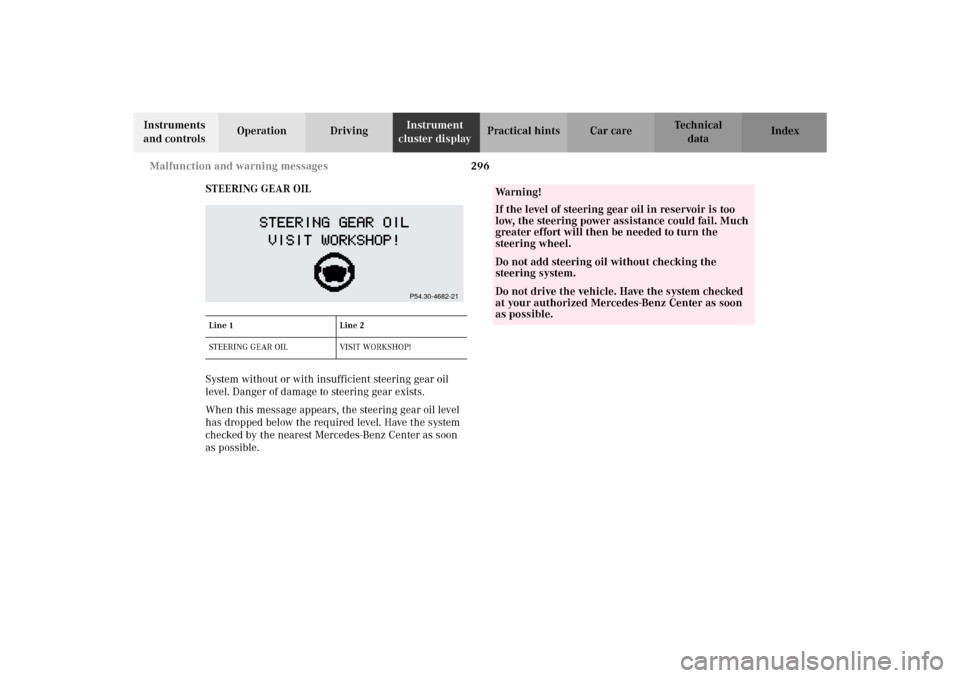
STEERING GEAR OIL
System without or with insufficient steering gear oil
level. Danger of damage to steering gear exists.
When this message appears, the steering gear oil level
has dropped below the required level. Have the system
checked by the nearest Mercedes-Benz Center as soon
as possible.
Line 1 Line 2
STEERING GEAR OIL VISIT WORKSHOP!
P54.30-4682-21
Wa r n i n g !
If the level of steering gear oil in reservoir is too
low, the steering power assistance could fail. Much
greater effort will then be needed to turn the
steering wheel.Do not add steering oil without checking the
steering system.Do not drive the vehicle. Have the system checked
at your authorized Mercedes-Benz Center as soon
as possible.
S203.book Seite 296 Freitag, 19. Oktober 2001 1:25 13