2002 LAND ROVER DISCOVERY Oil cooler
[x] Cancel search: Oil coolerPage 591 of 1672

COOLING SYSTEM - TD5
26-1-8 DESCRIPTION AND OPERATION
The coolant pump is attached on the left hand side of the engine, behind the PAS pump. A cast housing, bolted to the
cylinder block provides a common attachment point for both pumps. The housing has galleries which connect the
coolant pump to the cylinder block and the oil cooler housing. The coolant pump comprises a shaft, a housing and a
cover.
The shaft, which passes through the alloy housing, is supported at each end by bearings. Seals at each end of the
shaft protect the bearings from the coolant. The forward end of the shaft has two lugs which engage with the PAS
pump shaft. The opposite end of the shaft is fitted with an impeller which draws coolant from the feed pipe and
circulates it through galleries in the cylinder block. The shaft is driven by the auxiliary drive belt at the same rotational
speed as the crankshaft by a pulley attached to the PAS pump.
The pump is sealed in the cast housing with two 'O' rings. An outer cover is positioned over the pump and secured
with six bolts and sealed to the pump with an 'O' ring. The cover provides the attachment for the feed pipe connecting
hose.
Page 593 of 1672

COOLING SYSTEM - TD5
26-1-10 DESCRIPTION AND OPERATION
Operation
Coolant flow - Engine warm up
Refer to illustration.
+ COOLING SYSTEM - Td5, DESCRIPTION AND OPERATION, Cooling system coolant flow.
During warm up the coolant pump moves fluid through the cylinder block and it emerges from the outlet housing. From
the outlet housing, the warm coolant flow is prevented from flowing through the upper and lower radiators because
both thermostats are closed. The coolant is directed into the heater circuit.
Some coolant from the by-pass pipe can pass through small sensing holes in the flow valve. The warm coolant enters
a tube in the thermostat housing and surrounds 90% of the thermostat sensitive area. Cold coolant returning from the
radiator bottom hose conducts through 10% of the thermostat sensitive area. In cold ambient temperatures the engine
temperature can be raised by up to 10
°C (50°F) to compensate for the heat loss of the 10% exposure to the cold
coolant return from the radiator bottom hose.
At engine speeds below 1500 rev/min, the by-pass valve is closed only allowing the small flow through the sensing
holes. As the engine speed increases above 1500 rev/min, the greater flow and pressure from pump overcomes the
light spring and opens the by-pass flow valve. The flow valve opens to meet the engine's cooling needs at higher
engine speeds and prevents excess pressure in the cooling system. With both thermostats closed, maximum flow is
directed through the heater circuit.
The heater matrix acts as a heat exchanger reducing the coolant temperature as it passes through the matrix. Coolant
emerges from the heater matrix and flows to the fuel cooler 'T' connection via the heater return hose. From the fuel
cooler the coolant is directed into the coolant pump feed pipe and recirculated around the heater circuit. In this
condition the cooling system is operating at maximum heater performance.
Coolant flow - Engine hot
As the coolant temperature increases the main thermostat opens. This allows some coolant from the outlet housing
to flow through the top hose and into the radiator to be cooled. The hot coolant flows from the left tank in the radiator,
along the tubes to the right tank. The air flowing through the fins between the tubes cools the coolant as it passes
through the radiator.
A controlled flow of the lower temperature coolant is drawn by the pump and blended with hot coolant from the by-
pass and the heater return pipes in the pump feed pipe. The pump then passes this coolant, via the cylinder block, to
the oil cooler housing, cooling the engine oil before entering the block to cool the cylinders.
When the fuel temperature increases, the heat from the fuel conducts through the fuel cooler 'T' connection and
causes the fuel thermostat to open.
Pre EU3 models: Coolant from the cylinder block flows through the oil cooler and via a pipe and hose enters the
lower radiator. The coolant in the lower radiator is subjected to an additional two passes through the lower radiator to
further reduce the coolant temperature. From the lower radiator the coolant flows , via a hose, to the fuel cooler.
As the hot fuel cools, travelling slowly forwards through the cooler, it meets the progressively colder coolant travelling
in the opposite direction from the lower radiator.
EU3 models: Coolant from the cylinder block flows through the oil cooler to the EGR cooler and then back to the
expansion tank. and via a pipe and hose enters the lower radiator. The lower temperature coolant from the oil cooler
housing is subjected to an additional two passes through the lower radiator to further reduce the coolant temperature.
From the lower radiator the coolant flows , via a hose, to the fuel cooler.
As the hot fuel cools, travelling slowly forwards through the cooler, it meets the progressively colder coolant travelling
in the opposite direction from the lower radiator.
Page 598 of 1672

COOLING SYSTEM - TD5
REPAIRS 26-1-15
REPAIRS
Fan - viscous
$% 26.25.19
Remove
1.Release fixings and remove battery cover.
2.Disconnect battery earth lead.
3.Remove 3 bolts and remove engine acoustic
cover.
4.Remove upper fan cowl.
5.Remove viscous fan using tool LRT-12-093
and tool LRT-12-094.
RH thread.
Refit
1.Position viscous fan and tighten using tool
LRT-12-093 and tool LRT-12-094.
2.Fit upper fan cowl.
3. Fit engine acoustic cover and tighten bolts.
4.Connect battery earth lead.
5.Fit battery cover and secure with fixings.
Radiator
$% 26.40.01
Remove
1.Drain cooling system.
+ COOLING SYSTEM - Td5,
ADJUSTMENTS, Drain and refill.
2.Remove intercooler.
+ ENGINE MANAGEMENT SYSTEM -
Td5, REPAIRS, Intercooler.
3.Remove clip and disconnect bleed hose from
radiator.
4.Release clip and disconnect top hose from
radiator.
5.Release clip and disconnect bottom hose from
radiator.
6.Release clip and disconnect engine oil cooler
hose from radiator.
7.Release clip and disconnect fuel cooler hose
from radiator.
Page 599 of 1672

COOLING SYSTEM - TD5
26-1-16 REPAIRS
8.Remove securing screw and release gearbox
oil cooler from radiator.
9.Remove radiator.
10.Remove rubber mountings from base of
radiator.
11.Remove 2 captive nuts from radiator.
12.Remove sealing strip from radiator.
13.Remove cowl retaining clips from radiator. Refit
1.Fit cowl retaining clips to radiator.
2.Fit sealing strip to radiator.
3.Fit nuts and rubber mountings to new radiator.
4.Fit radiator.
5.Fit gearbox oil cooler to radiator and secure
with screw.
6.Connect fuel and engine oil cooler hoses to
radiator and secure with clips.
7.Connect bottom and top hoses to radiator
secure with clips.
8.Connect bleed hose to radiator and fit clip.
9.Fit intercooler.
+ ENGINE MANAGEMENT SYSTEM -
Td5, REPAIRS, Intercooler.
10.Refill cooling system.
+ COOLING SYSTEM - Td5,
ADJUSTMENTS, Drain and refill.
Page 604 of 1672

COOLING SYSTEM - V8
DESCRIPTION AND OPERATION 26-2-3
1Heater matrix
2Heater return hose
3Heater inlet hose
4Heater inlet pipe
5Throttle housing
6Connecting hose
7Throttle housing inlet hose
8Throttle housing return pipe
9Manifold outlet pipe
10Heater return pipe
11Coolant pump
12Radiator top hose
13Connecting hose
14Radiator bleed pipe15Viscous fan
16Radiator
17Gearbox oil cooler
18Engine oil cooler (Only applicable to vehicles
up to VIN 756821)
19Radiator bottom hose
20Thermostat housing
21Bleed screw
22Coolant pump feed hose
23Expansion tank
24Pressure cap
25Connecting hose
26Overflow pipe
Page 617 of 1672

COOLING SYSTEM - V8
26-2-16 REPAIRS
8.Remove 6 scrivets and remove LH and RH air
deflectors from front panel. Disconnect
multiplug of gearbox oil temperature sensor
(arrowed).
9.Remove nut and move horn aside. 10.Remove 2 bolts securing radiator LH and RH
upper mounting brackets to body panel and
remove brackets.
11.Remove 4 screws securing air conditioning
condenser LH and RH upper mounting
brackets to condenser.
12.Remove brackets with rubber mounts from
radiator extension brackets.
13.Position absorbent cloth under each cooler
hose to collect oil spillage.
14.Push against coupling release rings and
disconnect hoses from gearbox oil cooler.
CAUTION: Always fit plugs to open
connections to prevent contamination.
15. If fitted: Push against coupling release rings
and disconnect hoses from engine oil cooler.
Page 618 of 1672
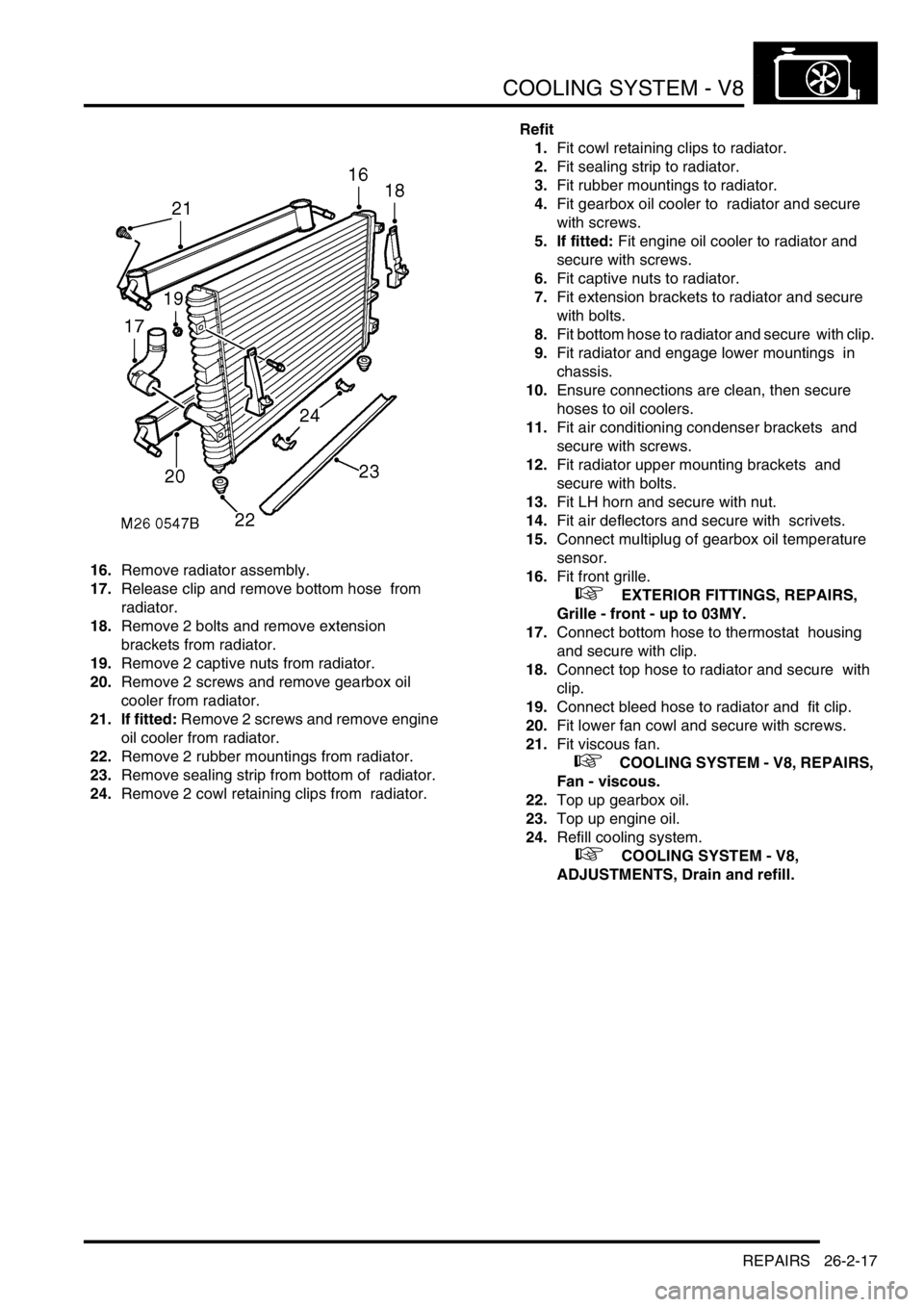
COOLING SYSTEM - V8
REPAIRS 26-2-17
16.Remove radiator assembly.
17.Release clip and remove bottom hose from
radiator.
18.Remove 2 bolts and remove extension
brackets from radiator.
19.Remove 2 captive nuts from radiator.
20.Remove 2 screws and remove gearbox oil
cooler from radiator.
21. If fitted: Remove 2 screws and remove engine
oil cooler from radiator.
22.Remove 2 rubber mountings from radiator.
23.Remove sealing strip from bottom of radiator.
24.Remove 2 cowl retaining clips from radiator. Refit
1.Fit cowl retaining clips to radiator.
2.Fit sealing strip to radiator.
3.Fit rubber mountings to radiator.
4.Fit gearbox oil cooler to radiator and secure
with screws.
5. If fitted: Fit engine oil cooler to radiator and
secure with screws.
6.Fit captive nuts to radiator.
7.Fit extension brackets to radiator and secure
with bolts.
8.Fit bottom hose to radiator and secure with clip.
9.Fit radiator and engage lower mountings in
chassis.
10.Ensure connections are clean, then secure
hoses to oil coolers.
11.Fit air conditioning condenser brackets and
secure with screws.
12.Fit radiator upper mounting brackets and
secure with bolts.
13.Fit LH horn and secure with nut.
14.Fit air deflectors and secure with scrivets.
15.Connect multiplug of gearbox oil temperature
sensor.
16.Fit front grille.
+ EXTERIOR FITTINGS, REPAIRS,
Grille - front - up to 03MY.
17.Connect bottom hose to thermostat housing
and secure with clip.
18.Connect top hose to radiator and secure with
clip.
19.Connect bleed hose to radiator and fit clip.
20.Fit lower fan cowl and secure with screws.
21.Fit viscous fan.
+ COOLING SYSTEM - V8, REPAIRS,
Fan - viscous.
22.Top up gearbox oil.
23.Top up engine oil.
24.Refill cooling system.
+ COOLING SYSTEM - V8,
ADJUSTMENTS, Drain and refill.
Page 690 of 1672

MANUAL GEARBOX - R380
DESCRIPTION AND OPERATION 37-7
Description
General
The R380 all synchromesh gearbox has five forward speeds and reverse and is mounted in line with the engine. The
clutch bell housing is bolted to the front of the gearbox and the transfer box is mounted at the rear.
Gearbox casings
Gearbox casings consist of a front cover, gearcase, centre plate and extension housing. All casings with the exception
of the front cover are located to each other by dowels and sealed. Gearbox filler/level and drain plugs are located in
the gearcase.
Reverse lamp switch
A reverse lamp switch is inserted into the extension housing. Selection of reverse gear will close the switch allowing
current from fuse 25 to flow through the switch to illuminate the reverse lamps. The switch also provides a feed to the
BCU and the automatic interior mirror - if fitted; the mirror moving to the dimming position.
Gearchange assembly
The gearchange assembly is bolted to the top of the gearcase, the upper gear lever being attached to the lower gear
lever by means of a clamp bolt. The lower gear lever ball is housed in a Railko bush inserted in the gear change
housing, the end of the lever locating in the selector yoke which is attached to the end of the selector shaft. Bias
springs provide a positive return of the gear lever to the neutral position with selection of 1st/2nd and 5th/reverse gears
being against bias spring pressure. Spring loaded detent balls fitted in the centre plate locate in grooves in the selector
shaft to provide positive gear and neutral selection.
Lubrication
Lubrication is by an oil pump located in the extension housing and driven by the layshaft with additional lubrication
being provided by splash. The pump directs oil via a filter and internal drillings in the output shaft to lubricate the
components. On non UK and non European models, provision for oil cooling is by means of a thermostat housed in
a cover bolted to the side of the extension housing. The cover incorporates tappings for connections to an oil cooler.
On UK and European models, the thermostat and cover are replaced by an oil by-pass block.
Internal pressures produced within the gearbox are vented to atmosphere via a plastic breather pipe. The pipe is
attached to the extension housing and is routed across the top of the gearcase and secured at the open end by a clip
attached to the engine cylinder block.
Selector shaft and forks
Selector forks for 1st/2nd, 3rd/4th and 5th/reverse gears are located on a single selector shaft; the 1st/2nd and 3rd/
4th selector forks are inside the main gearcase whilst the 5th/reverse selector fork is inside the extension housing.
Each of the selector forks locates inside its corresponding synchromesh hub.
Synchromesh assemblies
Each synchromesh assembly is located on the output shaft adjacent to its corresponding gears and comprises a
synchromesh ring, hub, slippers and sleeve. The hubs and slippers are retained in the sleeves by means of spring
clips. 1st/2nd and 3rd synchromesh assemblies are fitted with double synchromesh rings whilst 4th, 5th and reverse
assemblies are fitted with single rings.