2002 LAND ROVER DISCOVERY air condition
[x] Cancel search: air conditionPage 1420 of 1672
AIR CONDITIONING
REPAIRS 82-47
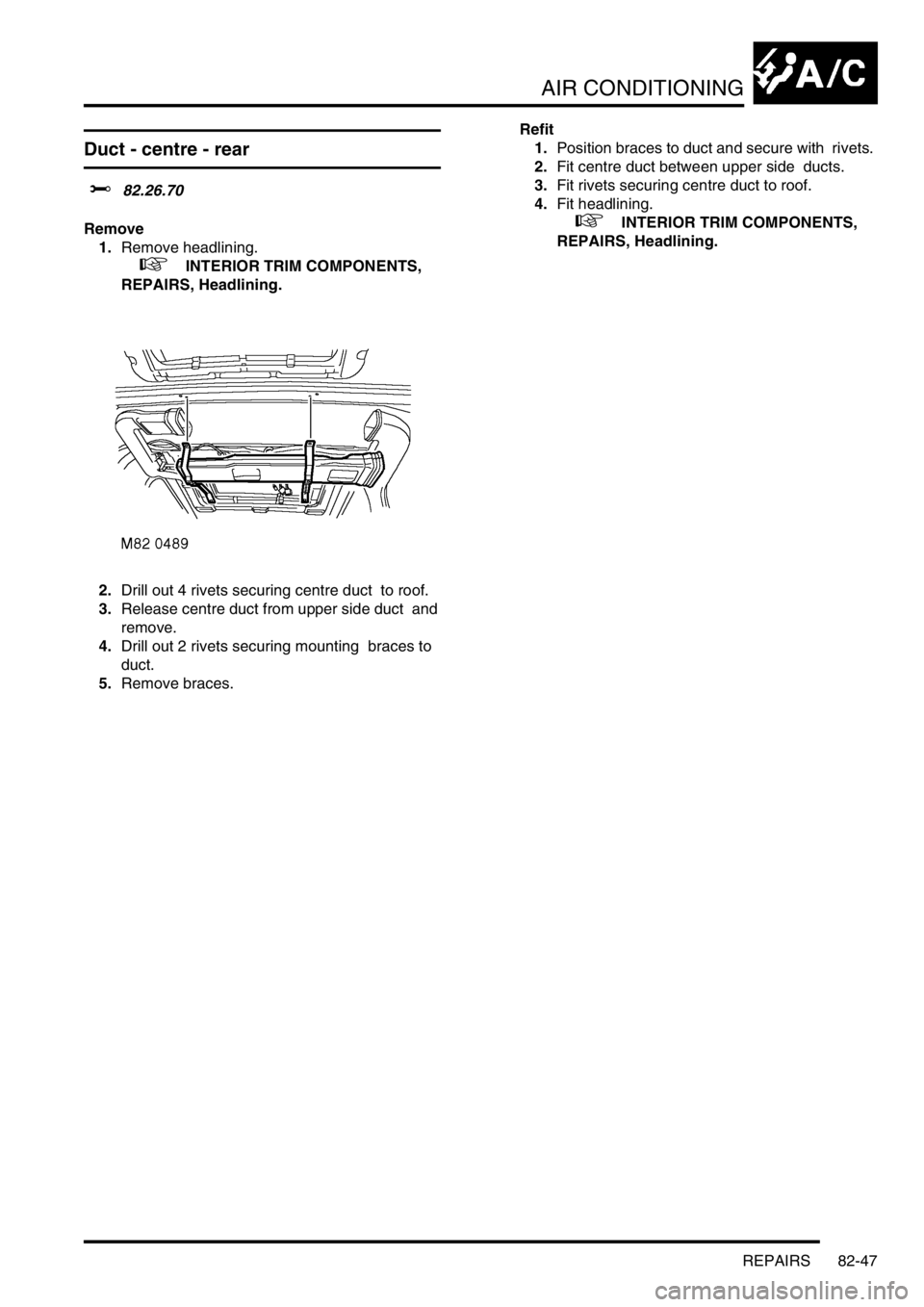
Duct - centre - rear
$% 82.26.70
Remove
1.Remove headlining.
+ INTERIOR TRIM COMPONENTS,
REPAIRS, Headlining.
2.Drill out 4 rivets securing centre duct to roof.
3.Release centre duct from upper side duct and
remove.
4.Drill out 2 rivets securing mounting braces to
duct.
5.Remove braces. Refit
1.Position braces to duct and secure with rivets.
2.Fit centre duct between upper side ducts.
3.Fit rivets securing centre duct to roof.
4.Fit headlining.
+ INTERIOR TRIM COMPONENTS,
REPAIRS, Headlining.
Page 1421 of 1672

AIR CONDITIONING
82-48REPAIRS
Page 1487 of 1672

BODY CONTROL UNIT
86-3-18 DESCRIPTION AND OPERATION
Self levelling suspension and ABS
The BCU communicates with the SLABS ECU for several functions:
lAn output is provided from the SLABS ECU to the BCU to provide the logic conditions for issuing the SLS audible
warning.
lThe BCU receives an input from the SLABS ECU relating to the raise/ lower command from the remote handset.
+ REAR SUSPENSION, DESCRIPTION AND OPERATION, Description - SLS.
Hill descent control
The BCU provides an output signal to the SLABS ECU for automatic transmission in neutral for HDC control. The
BCU checks the status of the ignition and 'gearbox state' inputs and provides a 'Neutral selected' output. If the ignition
is on and 'gearbox state' is Neutral, the 'Neutral selected' output is on, otherwise 'Neutral selected' is off.
+ BRAKES, DESCRIPTION AND OPERATION, Description.
Heated screens
The Heated Front Screen (HFS) is fitted for some market destinations and is operated from a non-latching switch
located on the instrument pack cowl. The BCU will only allow the heated front screen to operate when the engine is
running and controls the time-out period for switching the circuit off.
The heated front screen operation can also be controlled from the Automatic Temperature Control (ATC) ECU on
vehicles fitted with air conditioning.
The heated rear window will only function when the engine is running, and is operated by a non-latching switch on the
instrument pack cowl. The heated rear window can also be operated by the ATC ECU on vehicles fitted with air
conditioning.
Interior courtesy lamps
The BCU controls the operation of the interior courtesy lamps. The courtesy lamps are situated in the front, mid and
rear areas of the headlining.
Fuel flap actuator
The BCU provides an earth path to the fuel flap release solenoid to allow the fuel filler flap to be opened. This is only
allowed if the alarm system is not set and all other conditions have been satisfied. The fuel flap release switch is
located in the fascia switch pack and it receives a voltage supply from the passenger compartment fuse box.
Audible warnings
The BCU can request the instrument pack to generate an audible warning in response to conditions it has detected
and which need to be drawn to the driver's attention. One of six different audible warnings can be requested by the
BCU.
Sound request number Sound functions Priority (1 = lowest, 6 = highest)
0Off 1
1 Seat belt warning 6
2 Key-in warning 3
3 SLABS/ HDC warning 4
4 Transfer box in neutral warning 5
5 Lights on warning 2
Page 1493 of 1672

BODY CONTROL UNIT
86-3-24 DESCRIPTION AND OPERATION
Heated screens
The heated screen time-outs and logical operations are controlled by the BCU.
Heated front screen
The BCU provides an output to the heated front screen relay and a 'heated front screen active signal' for the heated
front screen warning lamp. The BCU uses the status of the following inputs to determine the appropriate logical
operations for this feature:
lIgnition state.
lEngine running (link from instrument pack).
lHeated front screen selected (non-latched button pressed).
If the ignition switch is not in position II, or the engine running signal is OFF, the heated front screen will not be active.
The heated front screen operation period and voltage supply is controlled by the BCU. The BCU receives a voltage
supply feed from the engine compartment fuse box and an ignition switched supply through a fuse in the passenger
compartment fuse box. When the heated front screen switch is operated, it completes a path to earth, signalling a
request for heated screen operation to the BCU. The BCU then supplies a feed to the heated front screen switch to
light the switch indicator, and earths the supply from the coil of the heated screen relay to turn the heated front screen
on. The BCU maintains a supply for a predetermined time (5 minutes), then opens the earth path after the time out
period to turn the heated screen off. During the timeout period, if the heated front screen switch is pressed a second
time, the circuit is also interrupted to turn off the supply to the heated front screen.
On vehicles fitted with air conditioning, the heated front screen is also operated by the ATC ECU when DEF (defrost)
is selected. In this case the ATC ECU provides the trigger signal to the BCU to turn the heated front screen circuit on
or, if it is already on, to re-start the time out period.
+ AIR CONDITIONING, DESCRIPTION AND OPERATION, Description.
In the event of a communications link failure occurring while the heated front screen relay is on, the relay and lamp
will remain on until the ignition switch is turned off or the time-out period elapses or the heated front screen switch is
pressed.
Heated rear window
The heated rear window will only function when the engine is running, and is operated by a non-latching switch on the
instrument pack cowl.
The BCU provides a 'heated rear window enable output' and a 'heated rear window active warning lamp signal' based
on the logic status of the following inputs:
lIgnition state.
lEngine running (link from instrument pack).
lHeated rear window selected (non-latched button pressed).
If the ignition switch is not in position II, or the engine running signal is OFF, the heated rear window will not be active.
The heated rear window operation period and voltage supply is controlled by the BCU. The BCU receives a voltage
supply feed from the engine compartment fuse box and an ignition switched supply through a fuse in the passenger
compartment fuse box. When the heated rear window switch is operated, it completes a path to earth, signalling a
request for heated rear window operation to the BCU. The BCU then supplies a feed to the heated rear window switch
to light the switch indicator, and earths the supply from the coil of the heated rear window relay via the IDM to turn the
heated rear window elements on. The BCU maintains a supply for a predetermined time (15 minutes), then opens the
earth path after the time-out period to turn the heated rear window operation off. If the heated rear window switch is
pressed a second time, the circuit is also interrupted to turn off the supply to the heated front screen.
On vehicles fitted with air conditioning, the heated rear window is also operated by the ATC ECU when DEF (defrost)
is selected. In this case the ATC ECU provides the trigger signal to the BCU to turn the heated rear window circuit on
or, if it is already on, to re-start the time out period.
+ AIR CONDITIONING, DESCRIPTION AND OPERATION, Description.
In the event of a communications link failure occurring while the heated rear window enable is on, the relay and lamp
will be de-activated.
Page 1527 of 1672

ALARM SYSTEM AND HORN
86-4-18 DESCRIPTION AND OPERATION
Perimetric alarm
The perimetric alarm is used by the BCU to detect unauthorised opening of a door or hinged panel. Switches
incorporated into the door latch assemblies and the bonnet determine the state of the panels.
There are two perimetric alarm configurations:
lAlarm not active.
lAlarm active.
Arming: To arm the perimetric alarm, press the lock button on the handset or lock the vehicle using the key in the
driver's door. Once the alarm has been set, the BCU monitors the state of the doors and the bonnet.
In order to arm the perimetric alarm the following conditions must be met:
lDrivers door closed.
lKey not inserted in ignition switch.
lFuel cut-off switch not tripped.
Disarming: To prevent the alarm from triggering when entering the vehicle, the alarm system must be disarmed with
the key or the handset.
There are two perimetric alarm disarming configurations:
lAlways disarm with key.
lOnly disarm with key if locked with key.
The perimetric alarm can be disarmed by unlocking the vehicle with the handset or by using the key in the driver's
door lock, depending on system configuration.
NOTE: The “only disarm with key if locked with key” configuration prevents the alarm from being disarmed by
unlocking the vehicle with the handset if the vehicle has been locked by the key. In this situation the Emergency Key
Access (EKA) code must be entered to disarm the alarm.
In order for the alarm to trigger, the following conditions must be met:
lPerimetric alarm armed.
lBonnet or door opened.
Once triggered, the alarm will remain triggered for 30 seconds before resetting.
Volumetric alarm
The volumetric alarm is used by the BCU to detect movement within the vehicle. This allows the alarm to be triggered
if a window is smashed in an attempt to gain access to the vehicle.
There are two volumetric alarm configurations:
lVolumetric alarm not active.
lVolumetric alarm active.
Two sensors, which transmit and receive ultrasonic signals, detect movement within the vehicle. Theses sensors
detect any change in air movement within the vehicle and then supply the BCU a signal to activate the alarm. Fifteen
seconds after the vehicle is locked with the handset or the key the volumetric alarm is armed. This delay is
incorporated into the BCU software to prevent accidental or nuisance triggering of the alarm.
In order to arm the volumetric alarm, the following conditions must be met:
lDriver's door closed.
lKey not inserted in ignition.
lFuel cut-off switch not tripped.
To prevent the alarm from triggering when entering the vehicle, the alarm system must be disarmed with the key or
the handset.
There are two volumetric alarm disarming configurations:
lAlways disarm with key.
lOnly disarm with key if locked with key.
Page 1574 of 1672
HARNESSES
REPAIRS 86-7-3
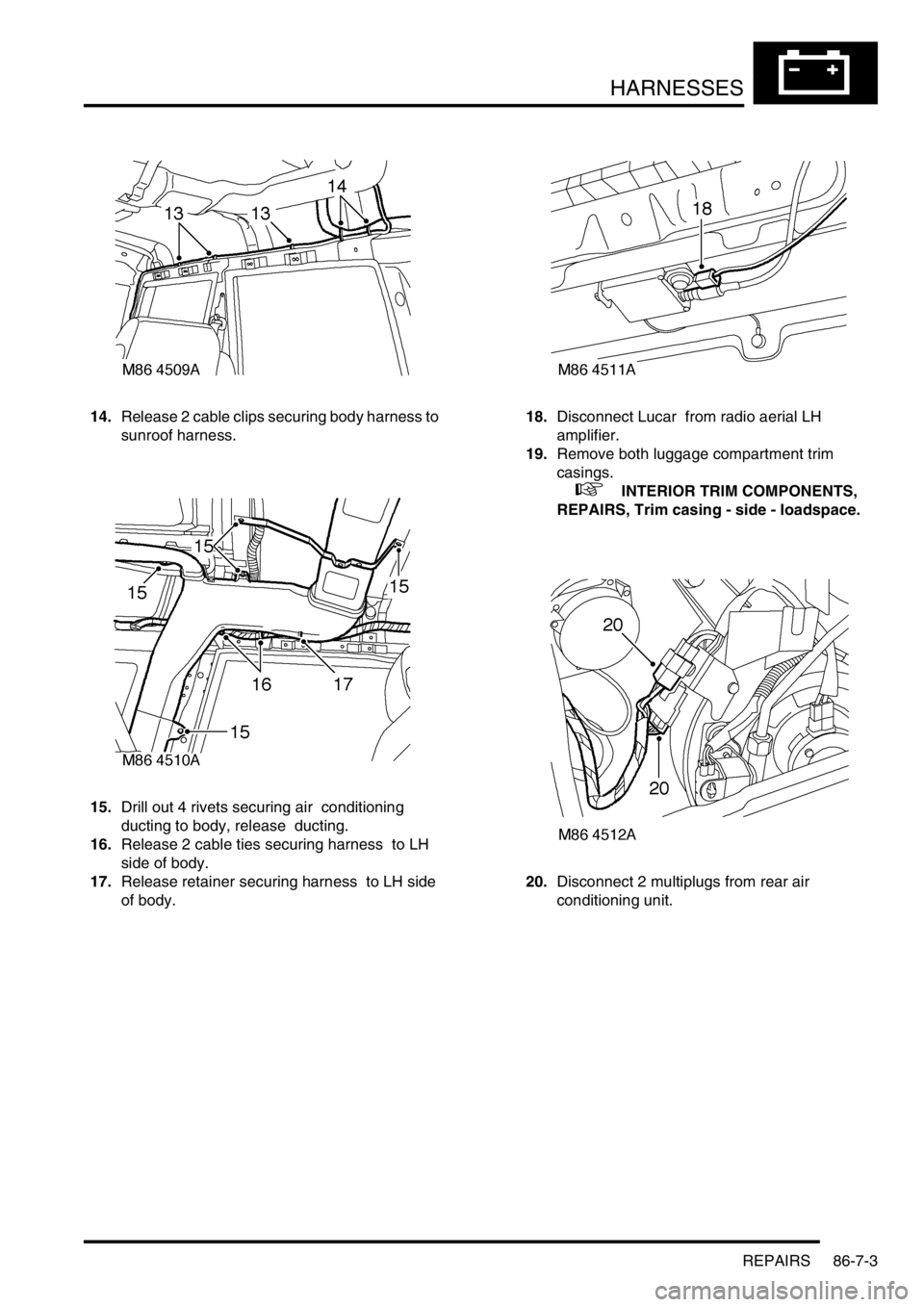
14.Release 2 cable clips securing body harness to
sunroof harness.
15.Drill out 4 rivets securing air conditioning
ducting to body, release ducting.
16.Release 2 cable ties securing harness to LH
side of body.
17.Release retainer securing harness to LH side
of body. 18.Disconnect Lucar from radio aerial LH
amplifier.
19.Remove both luggage compartment trim
casings.
+ INTERIOR TRIM COMPONENTS,
REPAIRS, Trim casing - side - loadspace.
20.Disconnect 2 multiplugs from rear air
conditioning unit.
Page 1575 of 1672
HARNESSES
86-7-4 REPAIRS
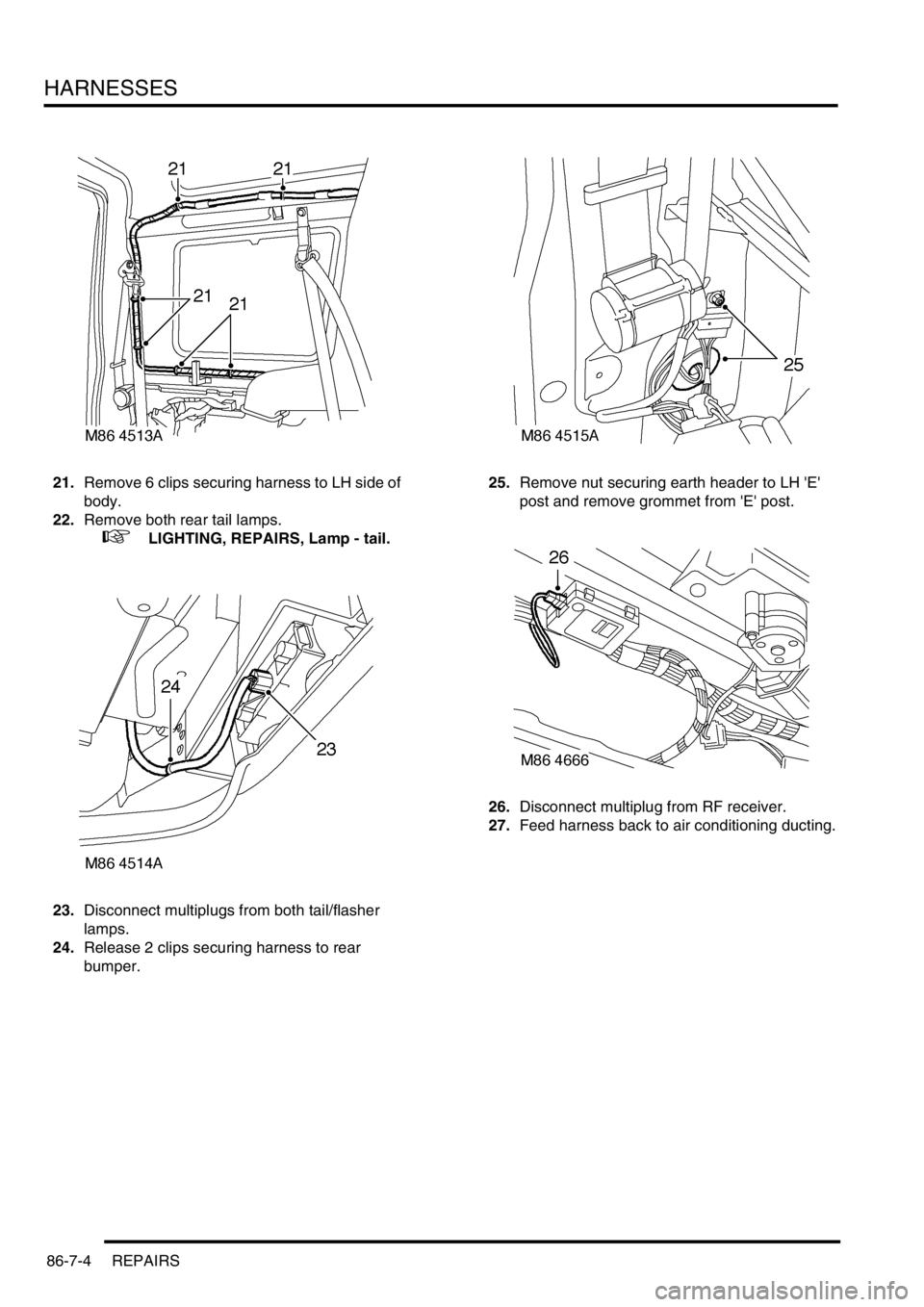
21.Remove 6 clips securing harness to LH side of
body.
22.Remove both rear tail lamps.
+ LIGHTING, REPAIRS, Lamp - tail.
23.Disconnect multiplugs from both tail/flasher
lamps.
24.Release 2 clips securing harness to rear
bumper. 25.Remove nut securing earth header to LH 'E'
post and remove grommet from 'E' post.
26.Disconnect multiplug from RF receiver.
27.Feed harness back to air conditioning ducting.
Page 1578 of 1672
HARNESSES
REPAIRS 86-7-7
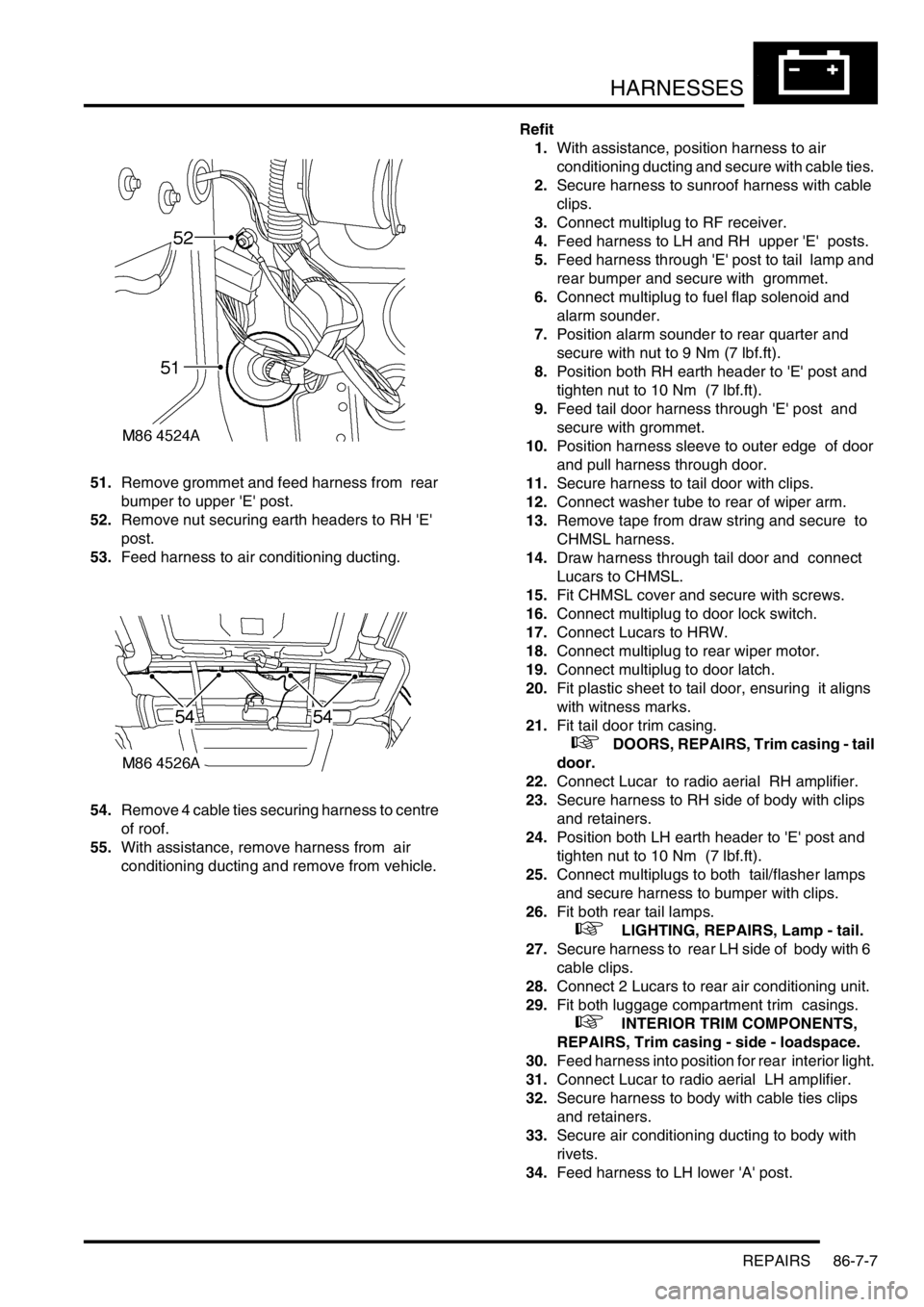
51.Remove grommet and feed harness from rear
bumper to upper 'E' post.
52.Remove nut securing earth headers to RH 'E'
post.
53.Feed harness to air conditioning ducting.
54.Remove 4 cable ties securing harness to centre
of roof.
55.With assistance, remove harness from air
conditioning ducting and remove from vehicle. Refit
1.With assistance, position harness to air
conditioning ducting and secure with cable ties.
2.Secure harness to sunroof harness with cable
clips.
3.Connect multiplug to RF receiver.
4.Feed harness to LH and RH upper 'E' posts.
5.Feed harness through 'E' post to tail lamp and
rear bumper and secure with grommet.
6.Connect multiplug to fuel flap solenoid and
alarm sounder.
7.Position alarm sounder to rear quarter and
secure with nut to 9 Nm (7 lbf.ft).
8.Position both RH earth header to 'E' post and
tighten nut to 10 Nm (7 lbf.ft).
9.Feed tail door harness through 'E' post and
secure with grommet.
10.Position harness sleeve to outer edge of door
and pull harness through door.
11.Secure harness to tail door with clips.
12.Connect washer tube to rear of wiper arm.
13.Remove tape from draw string and secure to
CHMSL harness.
14.Draw harness through tail door and connect
Lucars to CHMSL.
15.Fit CHMSL cover and secure with screws.
16.Connect multiplug to door lock switch.
17.Connect Lucars to HRW.
18.Connect multiplug to rear wiper motor.
19.Connect multiplug to door latch.
20.Fit plastic sheet to tail door, ensuring it aligns
with witness marks.
21.Fit tail door trim casing.
+ DOORS, REPAIRS, Trim casing - tail
door.
22.Connect Lucar to radio aerial RH amplifier.
23.Secure harness to RH side of body with clips
and retainers.
24.Position both LH earth header to 'E' post and
tighten nut to 10 Nm (7 lbf.ft).
25.Connect multiplugs to both tail/flasher lamps
and secure harness to bumper with clips.
26.Fit both rear tail lamps.
+ LIGHTING, REPAIRS, Lamp - tail.
27.Secure harness to rear LH side of body with 6
cable clips.
28.Connect 2 Lucars to rear air conditioning unit.
29.Fit both luggage compartment trim casings.
+ INTERIOR TRIM COMPONENTS,
REPAIRS, Trim casing - side - loadspace.
30.Feed harness into position for rear interior light.
31.Connect Lucar to radio aerial LH amplifier.
32.Secure harness to body with cable ties clips
and retainers.
33.Secure air conditioning ducting to body with
rivets.
34.Feed harness to LH lower 'A' post.