2002 LAND ROVER DISCOVERY rubber outlet pipe
[x] Cancel search: rubber outlet pipePage 426 of 1672

ENGINE MANAGEMENT SYSTEM - TD5
DESCRIPTION AND OPERATION 18-1-33
The turbocharger is exposed to extremely high operating temperatures (up to 1,000 °C (1832 °F)) because of the hot
exhaust gases and the high speed revolution of the turbine (up to 150,000 rev/min). In order to resist wear of the
turbine bearings a flow of lubrication oil is supplied from the engine lubrication system to keep the bearings cool. Oil
is supplied from a tapping at the front of the full-flow filter adaptor housing via a metal pipe with banjo connections.
Oil is returned to the sump via a metal pipe which connects to the cylinder block at a port below the turbocharger
assembly.
A heatshield is attached to the left hand side of the engine to protect adjacent components from the heat generated
at the turbocharger. The heatshield is attached to the engine by two bolts an additional bolt attaches the heatshield
to the turbocharger casting.
The engine control module controls the amount of boost pressure the engine receives by way of the turbocharger.
When full boost is reached a control signal is sent to the wastegate modulator, and a vacuum is applied to the
wastegate valve. The wastegate valve opens, bypassing some of the exhaust gas away from the turbine to be output
to the exhaust system.
The engine should be allowed to idle for 15 seconds following engine start up and before the engine is switched off
to protect the turbocharger by maintaining oil supply to the turbine bearings.
Intercooler
The intercooler is an air-to-air heat exchanger which lowers the intake air temperature to obtain a higher air density
for better combustion efficiency. The intercooler receives compressed air from the turbocharger via a metal pipe; it
cools the intake air via the intercooler matrix and delivers it to the intake manifold by means of a rubber hose which
connects between the intercooler outlet and the intake manifold outlet. The rubber hose is connected to ports at each
end by metal band clips.
+ COOLING SYSTEM - Td5, DESCRIPTION AND OPERATION, Description.
The intercooler is located at the front of the engine bay, forward of the radiator.
Page 625 of 1672

MANIFOLDS AND EXHAUST SYSTEMS - TD5
30-1-4 DESCRIPTION AND OPERATION
Front pipe assembly
The front pipe is of welded and fabricated tubular construction. The front pipe is connected to a flange on the
turbocharger and secured with three flanged nuts and sealed with a metal laminated gasket. The front pipe
incorporates a flexible pipe near the connection with the turbocharger and terminates in a flanged connection with the
intermediate pipe.
The flexible pipe is formed into a concertina shape with woven metal strands around its outer diameter. The flexible
pipe allows for ease of exhaust system alignment and also absorbs engine vibration. The woven metal strands also
increase the longevity of the flexible pipe.
The front pipe is attached via a bracket and a mounting rubber to the chassis. The mounting rubber allows ease of
alignment and vibration absorption.
Intermediate pipe and silencer
The intermediate pipe is of welded and fabricated tubular construction. It connects at its forward end to the front pipe
flange. Two captive studs on the intermediate pipe flange allow for attachment to the front pipe with locknuts. The rear
section of intermediate pipe connects to the tail pipe assembly via a flanged joint, sealed with a metal gasket and
secured with locknuts and studs.
The forward and rear sections are joined by a silencer. The silencer is fabricated from stainless steel sheet to form
the body of the silencer. An end plate closes each end of the silencer and is attached to the body with seam joints.
Perforated baffle tubes, inside the silencer, are connected to the inlet and outlet pipes on each end plate. Internal
baffle plates support the baffle tubes and, together with a stainless steel fibre packing, absorb combustion noise as
the exhaust gases pass through the silencer.
The intermediate pipe is attached by two brackets, positioned at each end of the silencer, and two mounting rubbers
to the chassis. The mounting rubber allows for ease of alignment and vibration absorption.
Tail pipe assembly
The tail pipe is of welded and fabricated construction. The tail pipe connects to the intermediate pipe with a flanged
joint secured with locknuts and sealed with a metal gasket. The pipe is shaped to locate above the rear axle allowing
clearance for axle articulation. The pipe is also curved to clear the left hand side of the fuel tank which has a reflective
shield to protect the tank from heat generated from the pipe.
A fabricated silencer is located at the rear of the tail pipe. The silencer is circular in section and is constructed from
stainless steel sheet. A baffle tube is located inside the silencer and the space around the baffle tube is packed with
a stainless steel fibre. The holes in the baffle tube allow the packing to further reduce combustion noise from the
engine. The tail pipe from the silencer is curved downwards at the rear of the vehicle and directs exhaust gases
towards the ground. The curved pipe allows the exhaust gases to be dissipated by the airflow under the vehicle and
prevents the gases from being drawn behind the vehicle.
The tail pipe is attached by a bracket, positioned forward of the silencer, and a mounting rubber to the chassis. The
mounting rubber allows ease of alignment and vibration absorption.
Page 635 of 1672

MANIFOLDS AND EXHAUST SYSTEMS - V8
30-2-6 DESCRIPTION AND OPERATION
Inlet plenum
The plenum is mounted transversely on the front of the upper manifold. The plenum divides into two galleries which
connect with the galleries on the upper manifold. The plenum is secured to the upper manifold with four bolts and
sealed with a coated metal gasket.
The plenum provides attachment for the throttle housing, which is secured with four bolts and sealed with a coated
metal gasket. The plenum also has vacuum connections for brake servo, rocker cover breather and fuel vapour from
the charcoal canister. A port on the top of the plenum connects via a hose to the IAC valve.
Exhaust manifolds
Two handed, cast iron exhaust manifolds are used on the V8 engine. Each manifold has four ports which merge into
one flanged outlet positioned centrally on the manifold.
Each manifold is attached to its cylinder head with eight Torx bolts. Each bolt is fitted with a 'cotton reel' shaped spacer
which allows for a longer bolt resulting in increased torque loading on each bolt. Two laminated metal gaskets seal
each manifold to its cylinder head. The flanged outlet on each manifold provides the attachment for the front pipe of
the exhaust system.
Exhaust system
The exhaust system comprises a front pipe assembly with two front pipes each incorporating a catalytic converter, an
intermediate pipe incorporating a silencer and a tail pipe assembly which also has a silencer. The exhaust system is
constructed mainly of 63 mm (2.48 in) diameter extruded pipe with a 1.5 mm (0.06 in) wall thickness. All pipes are
aluminized to resist corrosion and the silencers are fabricated from stainless steel sheet.
Front pipe assembly
The front pipe assembly is of welded and fabricated construction. A front pipe from each exhaust manifold merges
into one flanged connection. Two captive studs on the flange provide attachment to the intermediate pipe with
locknuts. Each front pipe has a welded flange which is attached to each manifold and secured with three studs and
flanged nuts and sealed with a metal laminated gasket. The gasket comprises a heat resistant fibre between two thin
metallic layers to enhance the sealing properties of the gasket.
A catalytic converter is located in each front pipe. The catalytic converters are different shapes to allow clearance
between the body and transmission. Both catalytic converters are of similar internal construction.
+ EMISSION CONTROL - V8, DESCRIPTION AND OPERATION, Emission Control Systems.
CAUTION: Ensure the exhaust system is free from leaks. Exhaust gas leaks upstream of the catalytic
converter could cause internal damage to the catalytic converter.
From the catalytic converters, the front pipes merge into one pipe which terminates at a flanged joint. The flange
connects with the intermediate pipe, sealed with an olive and secured with studs and locknuts.
Intermediate pipe and silencer
The intermediate pipe is of welded and fabricated tubular construction. It connects at its forward end with a flange on
the front pipe assembly and is secured with locknuts to captive studs in the front pipe assembly flange. The rear
section of the intermediate pipe connects to the tail pipe assembly via a flanged joint, sealed with a metal gasket and
secured with locknuts and studs.
The forward and rear sections are joined by a silencer. The silencer is fabricated from stainless steel sheet to form
the body of the silencer. An end plate closes each end of the silencer and is attached to the body with seam joints.
Perforated baffle tubes inside the silencer are connected to the inlet and outlet pipes on each end plate. Internal baffle
plates support the baffle tubes and together with a stainless steel fibre absorb combustion noise as the exhaust gases
pass through the silencer.
The intermediate pipe is attached by two brackets, positioned at each end of the silencer, and mounting rubbers to
the chassis. The mounting rubbers allow ease of alignment and vibration absorption. The two mounting rubbers are
fitted with removable heat deflectors to prevent heat from the silencer damaging the material.
Page 901 of 1672

STEERING
57-14 DESCRIPTION AND OPERATION
The PAS pump is located on the auxiliary housing, two bolts go through the PAS pump, mounting bracket and into
the auxiliary housing. One bolt also attaches the mounting bracket to the PAS pump, two bolts secure the mounting
bracket to the auxiliary housing. An inlet adaptor pipe with a seal is secured to the bottom of the pump with two bolts.
A drive pulley is attached to the pump drive shaft with three bolts, and is belt driven at a ratio of 1.35 crankshaft
revolutions to 1 of the drive pulley. A coupling on the rear of the PAS pump rotates the water pump impeller located
in the auxiliary housing. Fluid is supplied to the PAS pump inlet from the reservoir through a flexible hose at low
(suction) pressure. Fluid at high pressure from the PAS pump outlet is supplied to the rotary control valve on the
steering box.
The PAS pump is a roller vane type and has an internal pressure regulator and flow control valve. The roller vanes
can move in slots in the pumps rotor and are moved outwards by centrifugal force as the pump rotates. The pump
rotor rotates in the pump housing, the internal shape of the housing forms a 'cam' shape. Due to the 'cam' shape the
volume of the housing decreases between the inlet and outlet ports.
As the pump rotor rotates towards the pump inlet the volume between the roller vanes and the pump housing
increases, this action causes a depression in the chamber between the pump roller vanes and the housing. As the
rotation continues the chamber is opened to the pump inlet, and the depression in the chamber causes fluid to be
drawn in. The roller vanes continue past the inlet port, closing off the inlet port and trapping the fluid in the chamber
between the rollers and the pump housing.
The internal 'cam' shape of the pump housing causes the rollers to move closer together as the pump rotor rotates
towards the outlet port. The reduced volume of the chamber between the roller vanes causes the fluid to become
pressurised. When the chamber is opened to the outlet port of the pump the fluid escapes at high pressure. The roller
vanes continue turning and go past the outlet port, closing off the chamber between the two roller vanes.
As rotation continues the inlet sequence begins again. The inlet and pressurisation/outlet sequences continue as the
pump rotates, and is repeated between each two roller vanes. The pump is a positive displacement type and the
potential pump output increases with engine (drive pulley) speed. The pressure relief and flow control valve regulates
flow/pressure by diverting fluid back to the pump inlet through internal recirculation passages in the pump body.
Steering damper
The steering damper is located behind and just below the first cross member of the chassis. The ends of the steering
damper have steel 'eyes' welded on, rubber bushes are installed in each 'eye'. The steering damper is attached
between brackets on the chassis rail and the drag link. Each end of the steering damper is secured by a bolt and
locknut. The hydraulic damper absorbs shocks in the steering, caused by road wheel deflections when operating on
rough terrain.
Page 1092 of 1672
BRAKES
REPAIRS 70-47
Sensor – ABS – rear
$% 70.65.31
ABS sensor is supplied fitted to wheel hub and
must not be removed.
Remove
1.Remove wheel hub.
+ REAR SUSPENSION, REPAIRS,
Wheel hub.
Refit
1.Fit wheel hub.
+ REAR SUSPENSION, REPAIRS,
Wheel hub.
Modulator unit - ABS
$% 70.65.49
Remove
1.Position cloth under modulator to absorb fluid
spillage.
CAUTION: Brake fluid will damage paint
finished surfaces. If spilled, immediately
remove fluid and clean area with water.
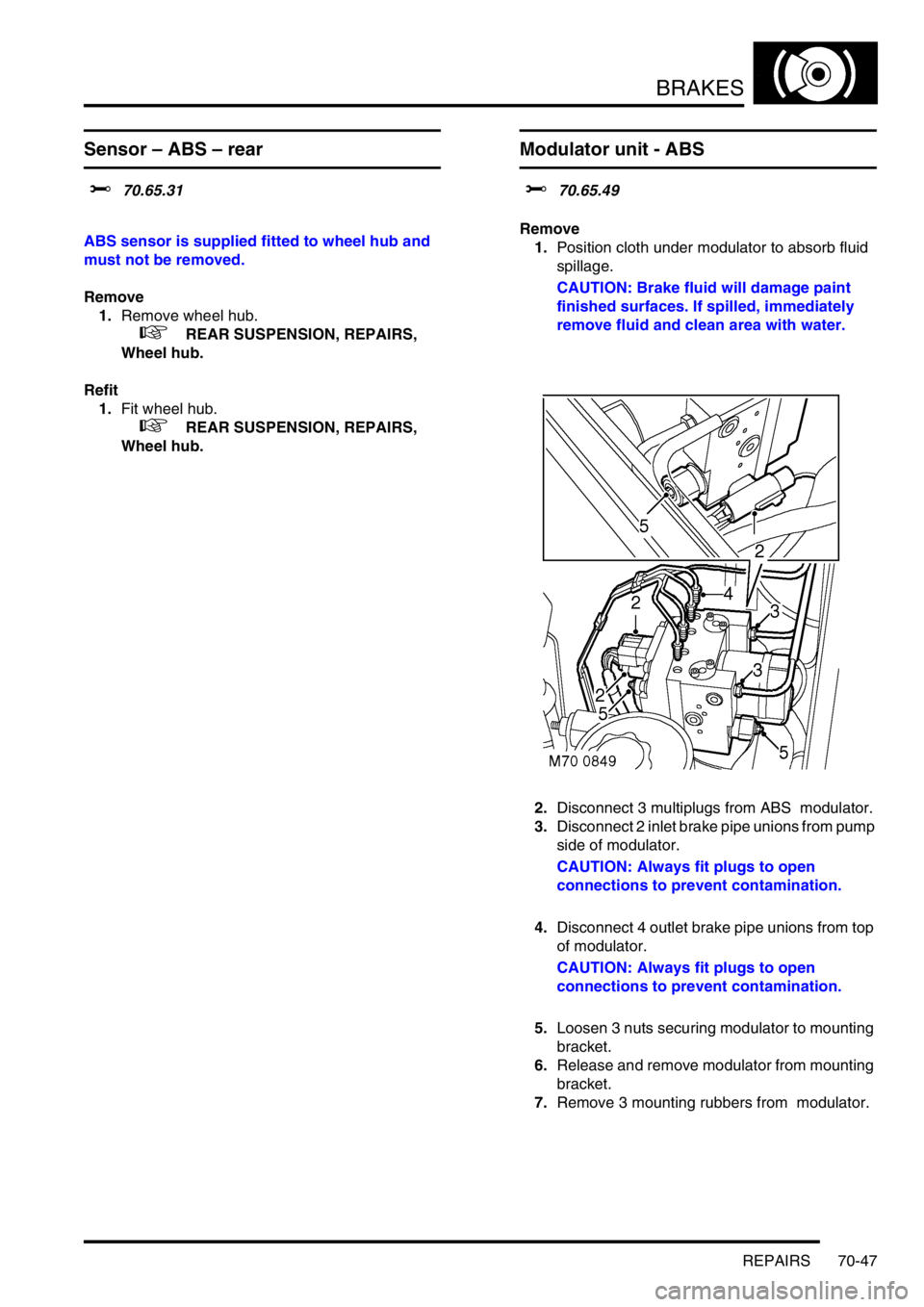
2.Disconnect 3 multiplugs from ABS modulator.
3.Disconnect 2 inlet brake pipe unions from pump
side of modulator.
CAUTION: Always fit plugs to open
connections to prevent contamination.
4.Disconnect 4 outlet brake pipe unions from top
of modulator.
CAUTION: Always fit plugs to open
connections to prevent contamination.
5.Loosen 3 nuts securing modulator to mounting
bracket.
6.Release and remove modulator from mounting
bracket.
7.Remove 3 mounting rubbers from modulator.