2002 LAND ROVER DISCOVERY mirror
[x] Cancel search: mirrorPage 1128 of 1672
DOORS
REPAIRS 76-1-5
Refit
1.Fit glass to frame.
2.Position frame to door and tighten bolts
securing front door frame to 10 Nm (7 lbf.ft) and
bolts securing rear door frame to 22 Nm (16
lbf.ft).
3.Secure regulator to glass with bolts and tighten
to 6 Nm (4.4 lbf.ft).
4.Fit inner and outer waist seal and secure with
clips.
5. Front door glass only: Fit exterior door mirror.
+ EXTERIOR FITTINGS, REPAIRS,
Mirror - exterior - electric.
6.Fit water shedder to door.
7.Fit door trim casing.
+ DOORS, REPAIRS, Trim casing -
front door.
+ DOORS, REPAIRS, Trim casing -
rear door.
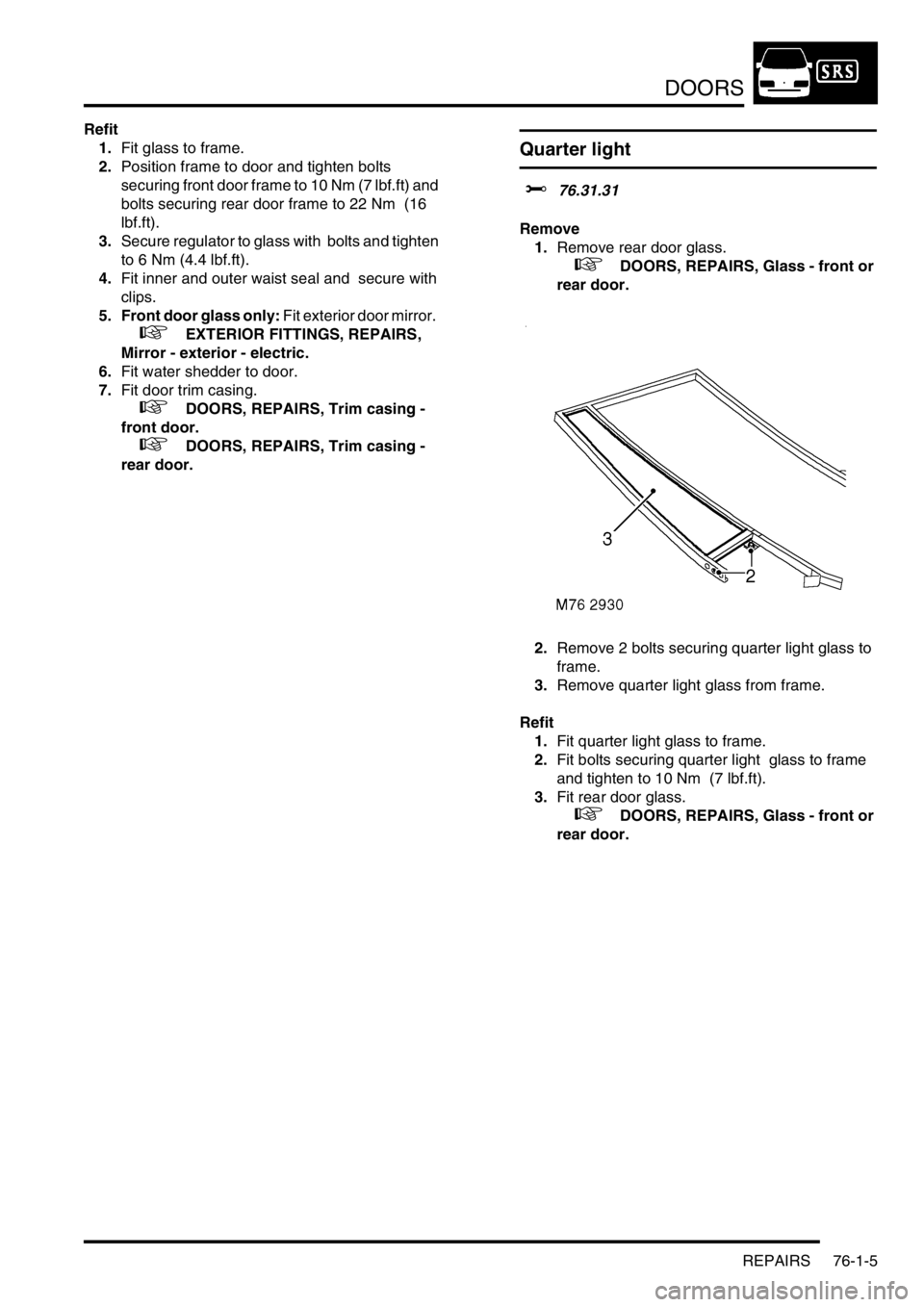
Quarter light
$% 76.31.31
Remove
1.Remove rear door glass.
+ DOORS, REPAIRS, Glass - front or
rear door.
2.Remove 2 bolts securing quarter light glass to
frame.
3.Remove quarter light glass from frame.
Refit
1.Fit quarter light glass to frame.
2.Fit bolts securing quarter light glass to frame
and tighten to 10 Nm (7 lbf.ft).
3.Fit rear door glass.
+ DOORS, REPAIRS, Glass - front or
rear door.
Page 1144 of 1672
EXTERIOR FITTINGS
REPAIRS 76-2-7
Mirror - exterior - electric
$% 76.10.57
Remove
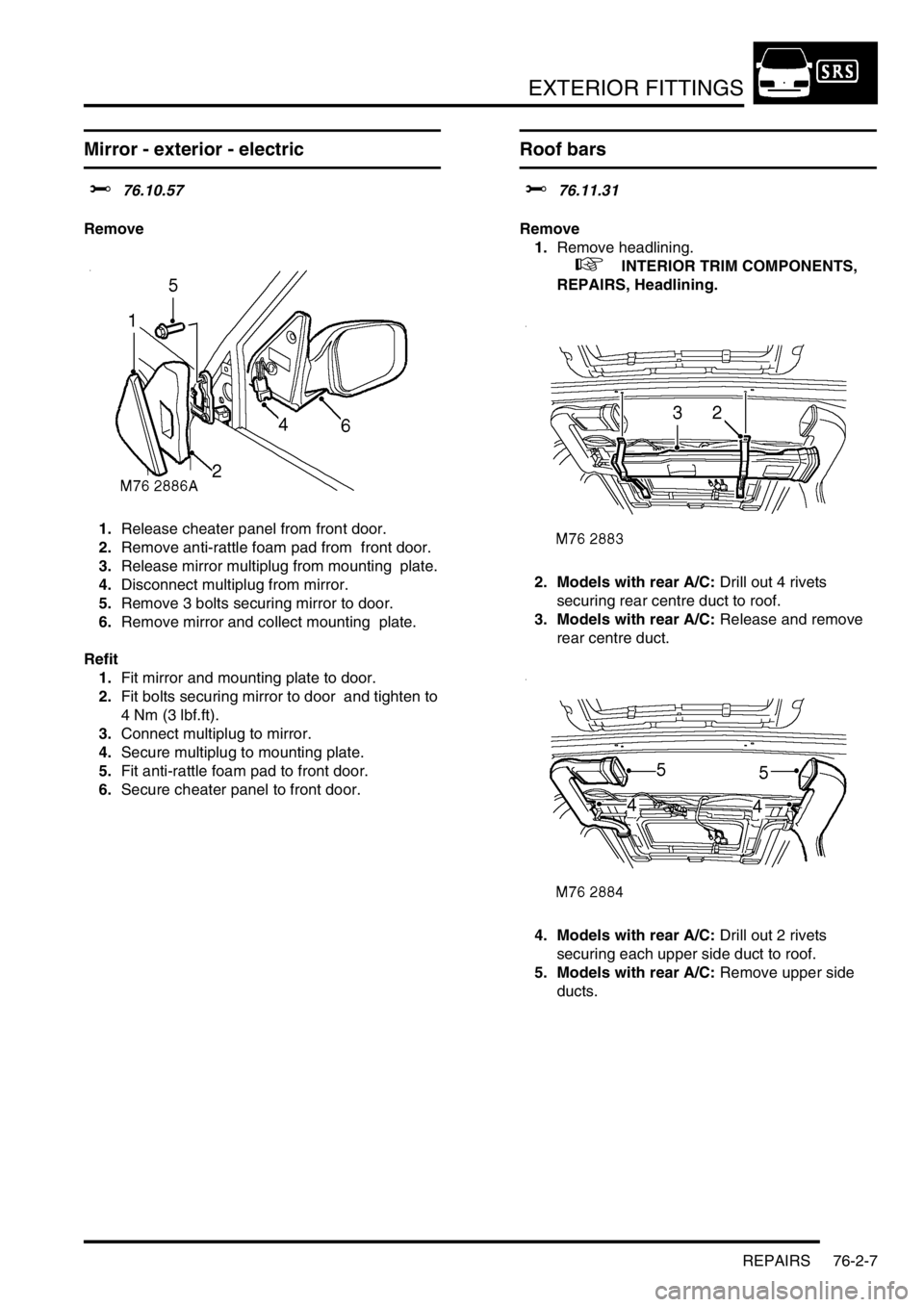
1.Release cheater panel from front door.
2.Remove anti-rattle foam pad from front door.
3.Release mirror multiplug from mounting plate.
4.Disconnect multiplug from mirror.
5.Remove 3 bolts securing mirror to door.
6.Remove mirror and collect mounting plate.
Refit
1.Fit mirror and mounting plate to door.
2.Fit bolts securing mirror to door and tighten to
4 Nm (3 lbf.ft).
3.Connect multiplug to mirror.
4.Secure multiplug to mounting plate.
5.Fit anti-rattle foam pad to front door.
6.Secure cheater panel to front door.
Roof bars
$% 76.11.31
Remove
1.Remove headlining.
+ INTERIOR TRIM COMPONENTS,
REPAIRS, Headlining.
2. Models with rear A/C: Drill out 4 rivets
securing rear centre duct to roof.
3. Models with rear A/C: Release and remove
rear centre duct.
4. Models with rear A/C: Drill out 2 rivets
securing each upper side duct to roof.
5. Models with rear A/C: Remove upper side
ducts.
Page 1166 of 1672
INTERIOR TRIM COMPONENTS
REPAIRS 76-3-13
Panel - auxiliary switch
$% 76.46.38
Remove
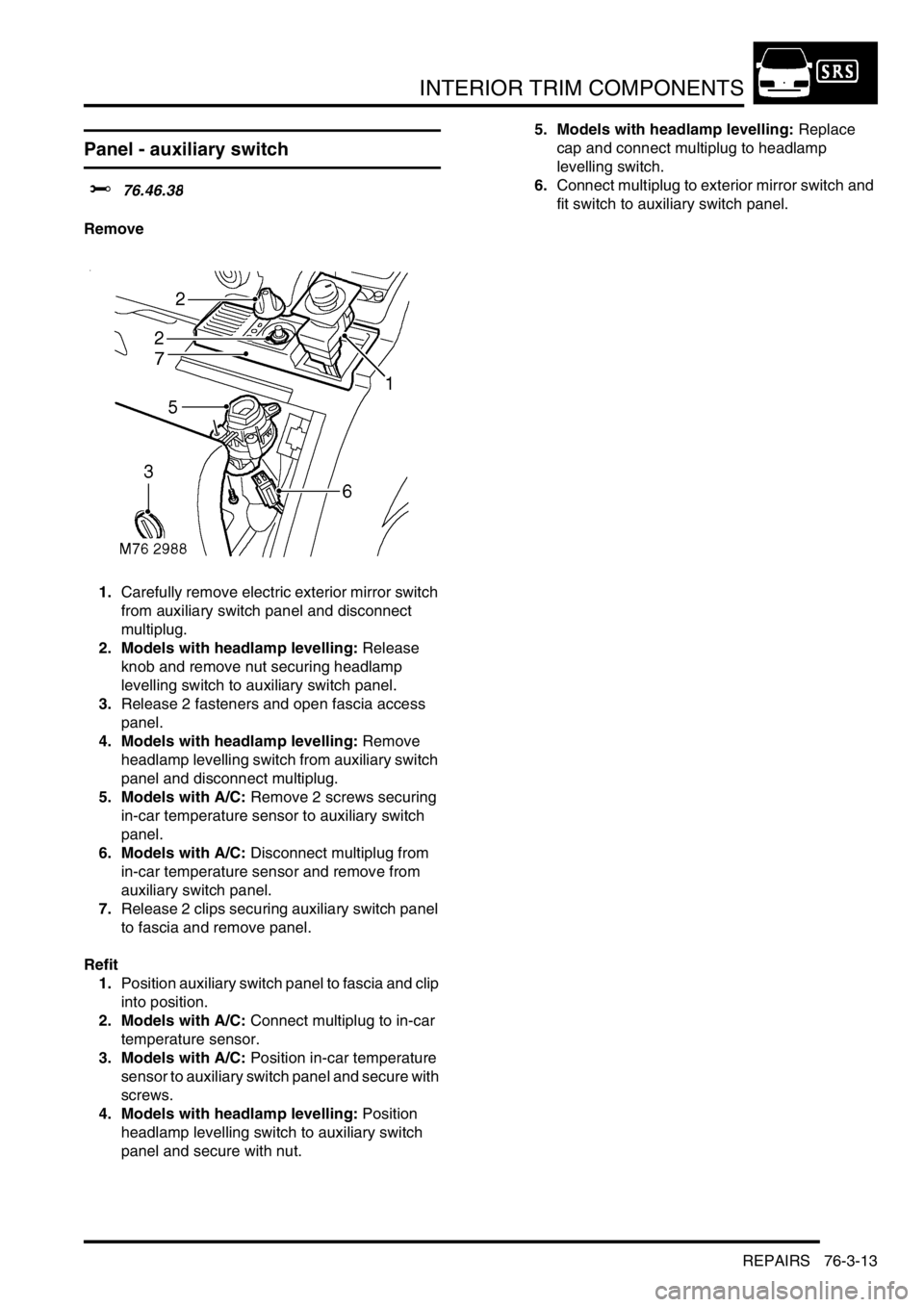
1.Carefully remove electric exterior mirror switch
from auxiliary switch panel and disconnect
multiplug.
2. Models with headlamp levelling: Release
knob and remove nut securing headlamp
levelling switch to auxiliary switch panel.
3.Release 2 fasteners and open fascia access
panel.
4. Models with headlamp levelling: Remove
headlamp levelling switch from auxiliary switch
panel and disconnect multiplug.
5. Models with A/C: Remove 2 screws securing
in-car temperature sensor to auxiliary switch
panel.
6. Models with A/C: Disconnect multiplug from
in-car temperature sensor and remove from
auxiliary switch panel.
7.Release 2 clips securing auxiliary switch panel
to fascia and remove panel.
Refit
1.Position auxiliary switch panel to fascia and clip
into position.
2. Models with A/C: Connect multiplug to in-car
temperature sensor.
3. Models with A/C: Position in-car temperature
sensor to auxiliary switch panel and secure with
screws.
4. Models with headlamp levelling: Position
headlamp levelling switch to auxiliary switch
panel and secure with nut.5. Models with headlamp levelling: Replace
cap and connect multiplug to headlamp
levelling switch.
6.Connect multiplug to exterior mirror switch and
fit switch to auxiliary switch panel.
Page 1179 of 1672
SCREENS
76-4-2 REPAIRS
Windscreen
$% 76.81.01
Introduction
The following equipment is required:
lCutting wire and handles.
lKent cutting knife.
lGlazing knife.
lWindscreen repair kit.
lSealant applicator gun.
lSuction cups.
lA felt covered table or stand to support glass.
WARNING: Wear protective gloves when
handling glass, solvents and primers.
WARNING: Wear suitable eye protection when
removing and refitting glass.
WARNING: If glass has splintered, protect eyes
and operate demister blower to remove glass
from heater ducts. Use a vacuum cleaner to
remove glass from fascia, carpet and seats.
Remove
1.Remove air intake plenum.
+ HEATING AND VENTILATION,
REPAIRS, Plenum Air Intake.
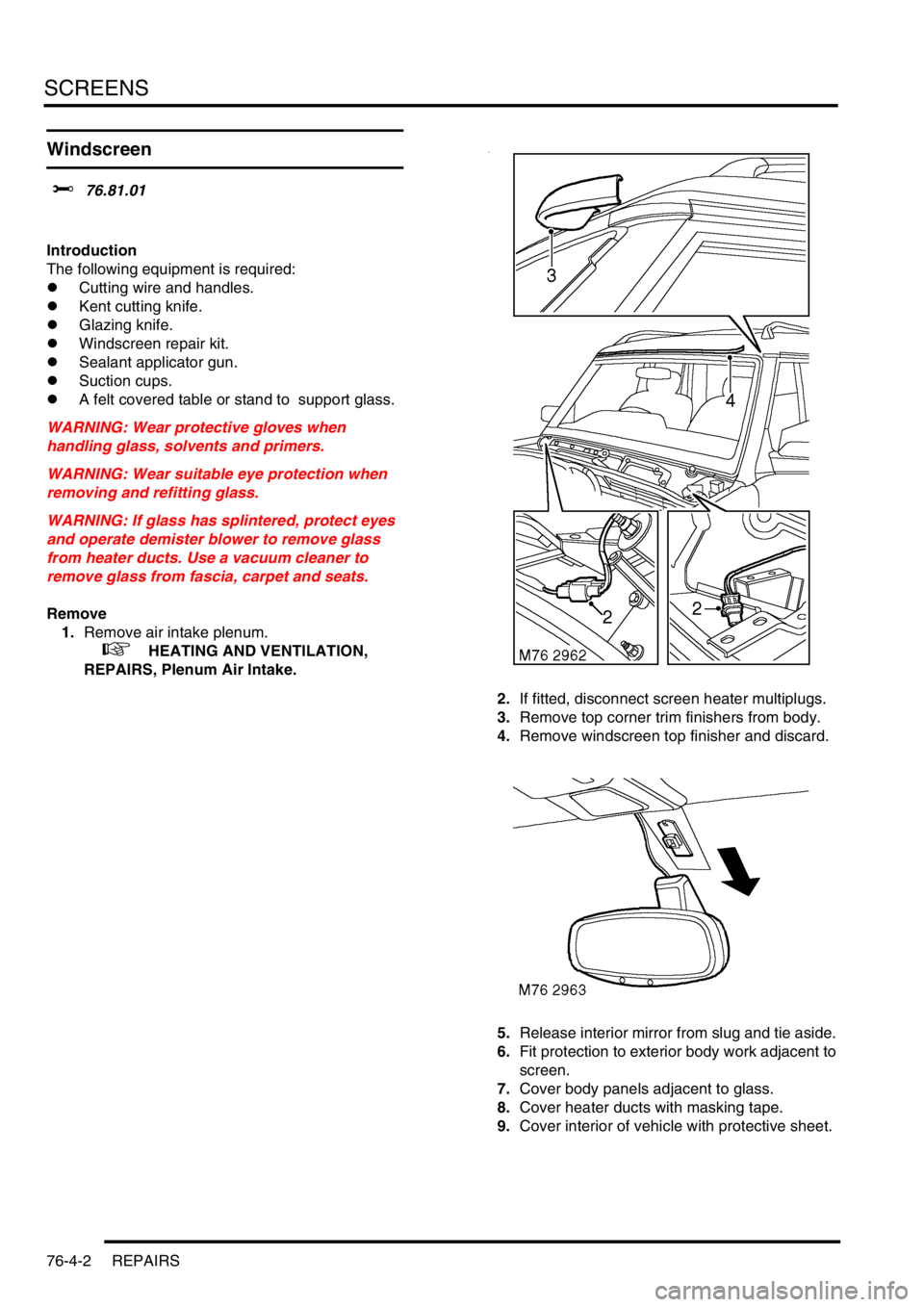
2.If fitted, disconnect screen heater multiplugs.
3.Remove top corner trim finishers from body.
4.Remove windscreen top finisher and discard.
5.Release interior mirror from slug and tie aside.
6.Fit protection to exterior body work adjacent to
screen.
7.Cover body panels adjacent to glass.
8.Cover heater ducts with masking tape.
9.Cover interior of vehicle with protective sheet.
Page 1181 of 1672
SCREENS
76-4-4 REPAIRS
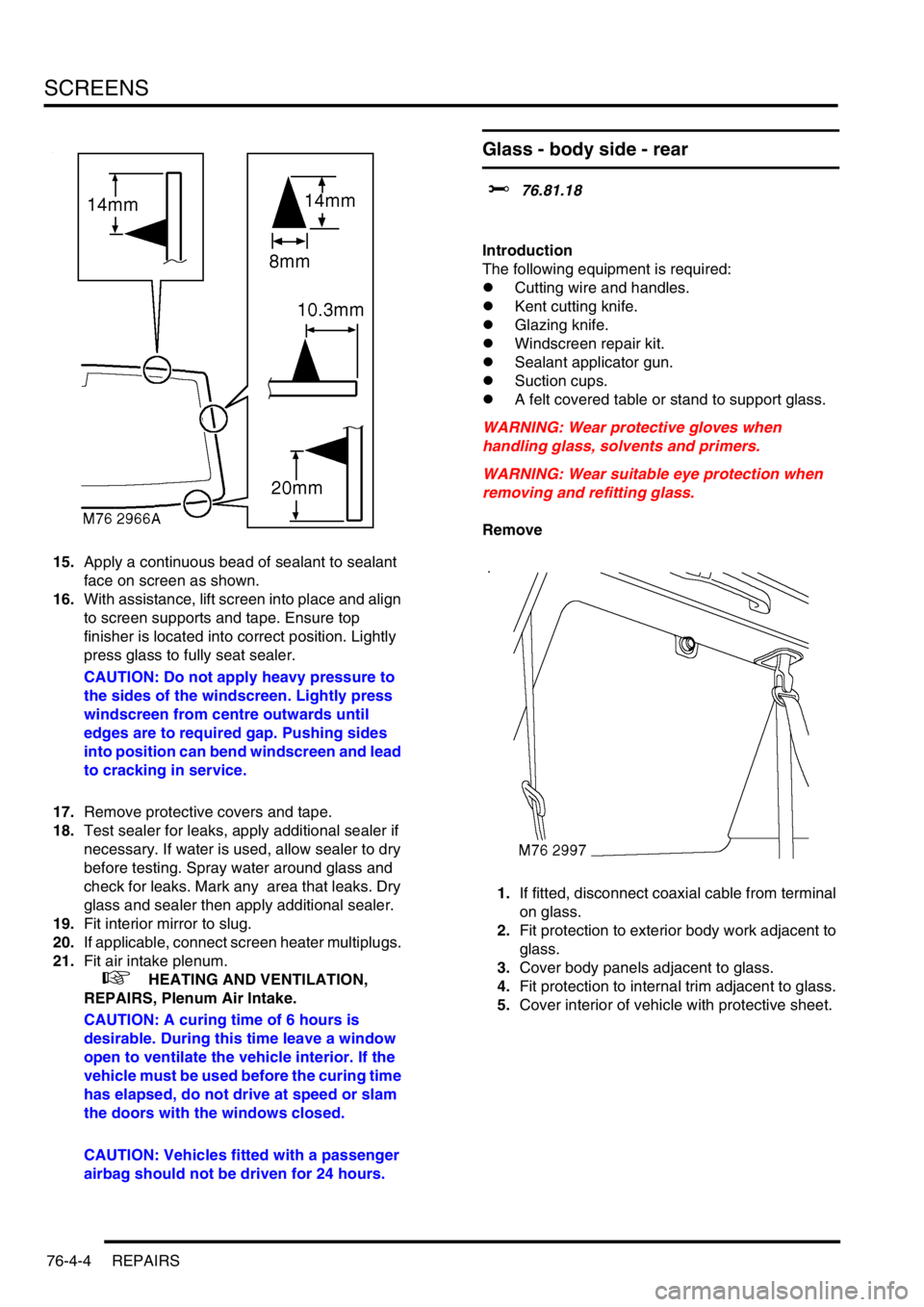
15.Apply a continuous bead of sealant to sealant
face on screen as shown.
16.With assistance, lift screen into place and align
to screen supports and tape. Ensure top
finisher is located into correct position. Lightly
press glass to fully seat sealer.
CAUTION: Do not apply heavy pressure to
the sides of the windscreen. Lightly press
windscreen from centre outwards until
edges are to required gap. Pushing sides
into position can bend windscreen and lead
to cracking in service.
17.Remove protective covers and tape.
18.Test sealer for leaks, apply additional sealer if
necessary. If water is used, allow sealer to dry
before testing. Spray water around glass and
check for leaks. Mark any area that leaks. Dry
glass and sealer then apply additional sealer.
19.Fit interior mirror to slug.
20.If applicable, connect screen heater multiplugs.
21.Fit air intake plenum.
+ HEATING AND VENTILATION,
REPAIRS, Plenum Air Intake.
CAUTION: A curing time of 6 hours is
desirable. During this time leave a window
open to ventilate the vehicle interior. If the
vehicle must be used before the curing time
has elapsed, do not drive at speed or slam
the doors with the windows closed.
CAUTION: Vehicles fitted with a passenger
airbag should not be driven for 24 hours.
Glass - body side - rear
$% 76.81.18
Introduction
The following equipment is required:
lCutting wire and handles.
lKent cutting knife.
lGlazing knife.
lWindscreen repair kit.
lSealant applicator gun.
lSuction cups.
lA felt covered table or stand to support glass.
WARNING: Wear protective gloves when
handling glass, solvents and primers.
WARNING: Wear suitable eye protection when
removing and refitting glass.
Remove
1.If fitted, disconnect coaxial cable from terminal
on glass.
2.Fit protection to exterior body work adjacent to
glass.
3.Cover body panels adjacent to glass.
4.Fit protection to internal trim adjacent to glass.
5.Cover interior of vehicle with protective sheet.
Page 1226 of 1672
SUNROOF
DESCRIPTION AND OPERATION 76-6-11
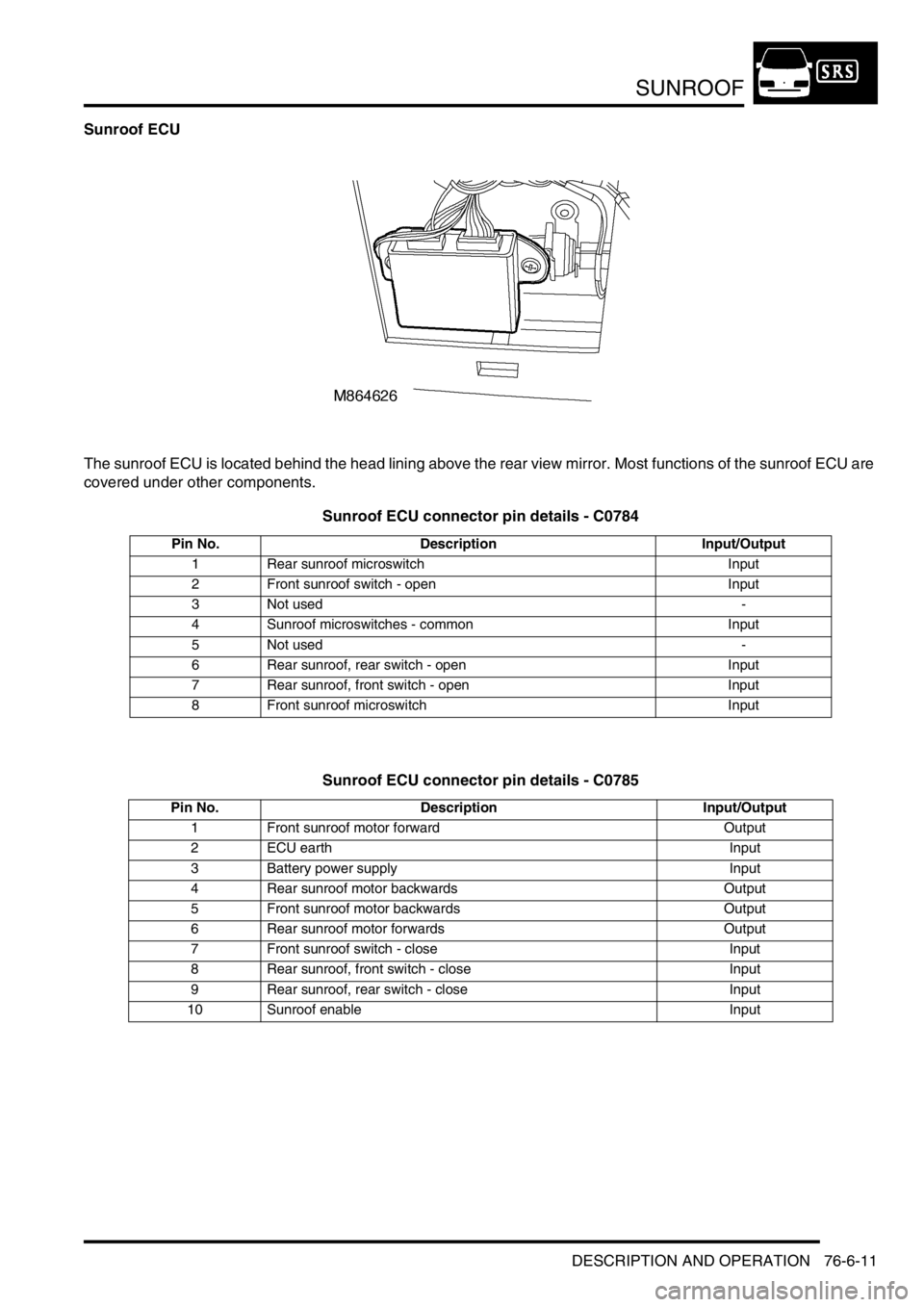
Sunroof ECU
The sunroof ECU is located behind the head lining above the rear view mirror. Most functions of the sunroof ECU are
covered under other components.
Sunroof ECU connector pin details - C0784
Sunroof ECU connector pin details - C0785
Pin No. Description Input/Output
1 Rear sunroof microswitch Input
2 Front sunroof switch - open Input
3 Not used -
4 Sunroof microswitches - common Input
5 Not used -
6 Rear sunroof, rear switch - open Input
7 Rear sunroof, front switch - open Input
8 Front sunroof microswitch Input
Pin No. Description Input/Output
1 Front sunroof motor forward Output
2 ECU earth Input
3 Battery power supply Input
4 Rear sunroof motor backwards Output
5 Front sunroof motor backwards Output
6 Rear sunroof motor forwards Output
7 Front sunroof switch - close Input
8 Rear sunroof, front switch - close Input
9 Rear sunroof, rear switch - close Input
10 Sunroof enable Input
Page 1339 of 1672

CORROSION PREVENTION AND SEALING
77-4-24 SEALING
Water leaks
Where water leakage is involved, always adopt a logical approach to the problem using a combination of skill,
experience and intuition. Do not reach a conclusion based only on visual evidence, such as assuming that a wet
footwell is caused by a leak emanating from the windscreen. It will often be found that the source of the leak is
elsewhere. Use of the correct procedure will increase the chance of locating a leak, however obscure it may seem.
Tools and equipment
The following tools and equipment are recommended for the purpose of detection and rectification of water leaks:
1Garden sprayer (hand-operated)
2Wet/dry vacuum cleaner
3Dry, absorbent cloths
4Battery torch
5Small mirror
6Weatherstrip locating tool
7Trim panel remover
8Small wooden or plastic wedges
9Dry compressed air supply
10Hot air blower
11Sealer applicators
12Ultrasonic leak detector
During leak detection, the vehicle should be considered in three basic sections:
lThe front interior space;
lThe rear passenger space;
lThe loadspace or boot.
Testing
From the information supplied by the customer it should be possible for the bodyshop operator to locate the starting
point from which the leak may be detected. After the area of the leak has been identified, find the actual point of entry
into the vehicle.
A simple and effective means in the first instance is an ordinary garden spray with provision for pressure and jet
adjustment, which will allow water to be directed in a jet or turned into a fine spray. Use a mirror and a battery-powered
torch (NOT a mains voltage inspection lamp) to see into dark corners.
The sequence of testing is particularly important. Start at the lowest point and work slowly upwards, to avoid testing
in one area while masking the leak in another. For example, if testing started at the level of the windscreen, any water
cascading into the plenum chamber could leak through a bulkhead grommet and into the footwells. Even at this point
it could still be wrongly assumed that the windscreen seal was at fault.
Another important part of identifying a water leak is by visual examination of door aperture seals, grommets and
weatherstrips for damage, deterioration or misalignment, together with the fit of the door itself against the seals.
Sealing
When the point of the leak has been detected, it will then be necessary to rectify it using the following procedure:
1Renew all door aperture seals and weatherstrips which have suffered damage, misalignment or deterioration
2Check all body seals to ensure that they are correctly located on their mounting flanges/faces using a lipping
tool if necessary
3Dry out body seams to be treated using compressed air and/or a hot air blower as necessary
4Apply sealant on the outside of the joint wherever possible to ensure the exclusion of water
5When rectifying leaks between a screen glass and it's weatherstrip (or in the case of direct glazing, between the
glass and bodywork), avoid removing the glass if possible. Apply the approved material at the appropriate
location (i.e. glass to weatherstrip or glass to body)
Page 1573 of 1672
HARNESSES
86-7-2 REPAIRS
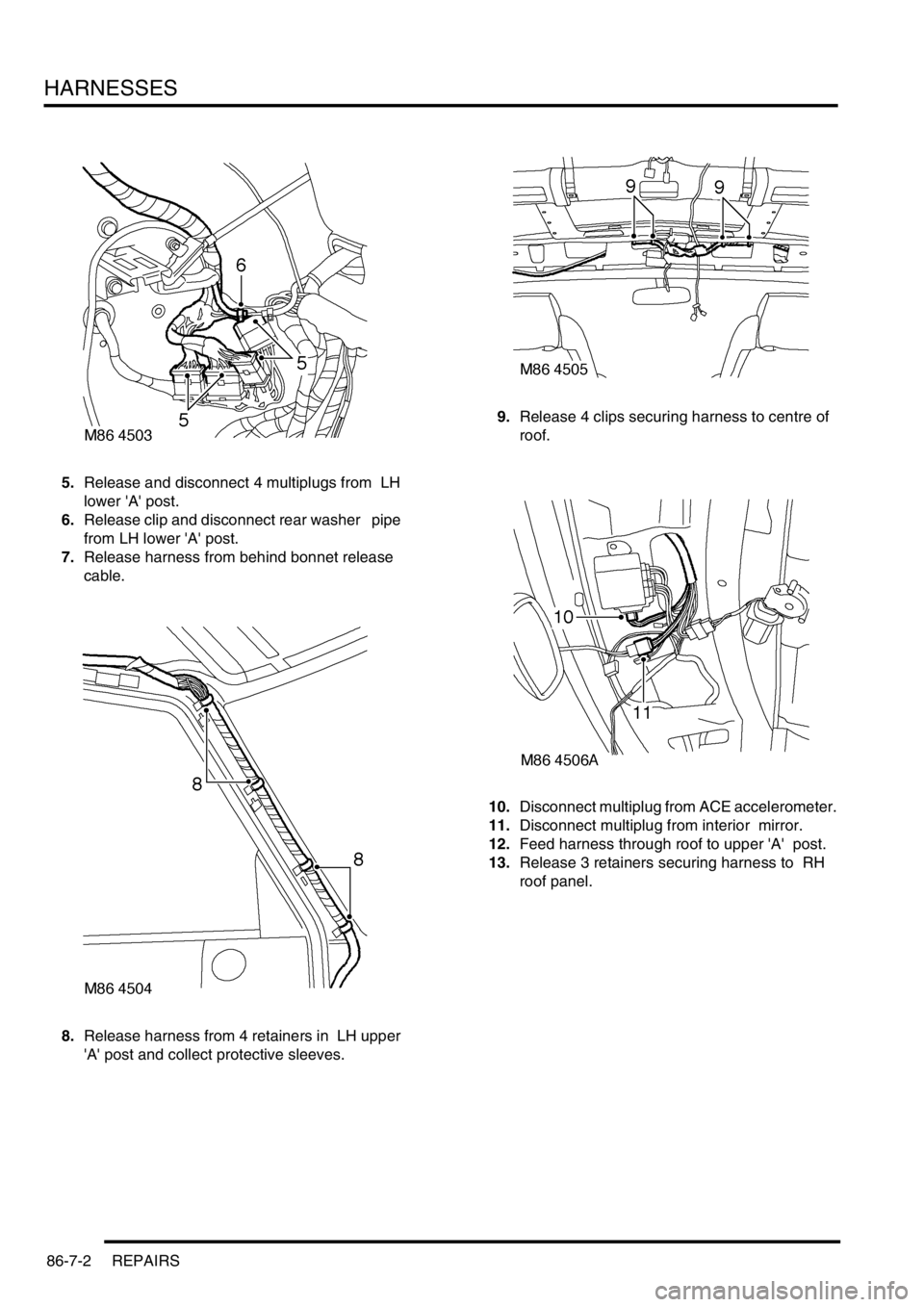
5.Release and disconnect 4 multiplugs from LH
lower 'A' post.
6.Release clip and disconnect rear washer pipe
from LH lower 'A' post.
7.Release harness from behind bonnet release
cable.
8.Release harness from 4 retainers in LH upper
'A' post and collect protective sleeves. 9.Release 4 clips securing harness to centre of
roof.
10.Disconnect multiplug from ACE accelerometer.
11.Disconnect multiplug from interior mirror.
12.Feed harness through roof to upper 'A' post.
13.Release 3 retainers securing harness to RH
roof panel.