2002 JEEP LIBERTY hitch
[x] Cancel search: hitchPage 446 of 1803

trols for both the exterior and interior lighting sys-
tems.
²Park Lamp Relay- A park lamp relay is
located in the Junction Block (JB) of all vehicles.
²Rear Fog Lamp Relay- Vehicles manufac-
tured for certain markets where rear fog lamps are
required equipment have a rear fog lamp relay
located in the Junction Block (JB).
²Trailer Tow Adapter- Vehicles equipped with
a factory-installed trailer towing package have an
adapter provided that adapts the factory-installed
heavy duty 7-way trailer tow connector to a conven-
tional 4-way light duty connector.
²Trailer Tow Connector- Vehicles equipped
with a factory-installed trailer towing package have a
heavy duty 7-way trailer tow connector installed in a
bracket on the trailer hitch receiver.
²Trailer Tow Relays- Vehicles equipped with a
factory-installed trailer towing package have a con-
nector bank containing four relays located behind the
right quarter trim panel and over the right rear
wheel housing. The four relays are used to supply
fused ignition switch output (run), brake lamps, right
turn signal, and left turn signal outputs to a trailer
through the trailer tow wiring and connectors.
Hard wired circuitry connects the exterior lighting
system components to the electrical system of the
vehicle. These hard wired circuits are integral to sev-
eral wire harnesses, which are routed throughout the
vehicle and retained by many different methods.
These circuits may be connected to each other, to the
vehicle electrical system and to the exterior lighting
system components through the use of a combination
of soldered splices, splice block connectors, and many
different types of wire harness terminal connectors
and insulators. Refer to the appropriate wiring infor-
mation. The wiring information includes wiring dia-
grams, proper wire and connector repair procedures,
further details on wire harness routing and reten-
tion, as well as pin-out and location views for the
various wire harness connectors, splices and grounds.
OPERATION
Following are paragraphs that briefly describe the
operation of each of the major exterior lighting sys-
tems. The hard wired circuits and components of the
exterior lighting systems may be diagnosed and
tested using conventional diagnostic tools and proce-
dures. However, conventional diagnostic methods
may not prove conclusive in the diagnosis of the Body
Control Module (BCM), the ElectroMechanical
Instrument Cluster (EMIC), the Powertrain Control
Module (PCM), or the Programmable Communica-
tions Interface (PCI) data bus network. The most
reliable, efficient, and accurate means to diagnose
the BCM, the EMIC, the PCM, and the PCI data busnetwork inputs and outputs related to the various
exterior lighting systems requires the use of a
DRBIIItscan tool. Refer to the appropriate diagnos-
tic information.
BACKUP LAMPS
The backup (or reverse) lamps have a path to
ground at all times through their connection to the
rear lighting wire harness from a take out of the rear
body wire harness with an eyelet terminal connector
that is secured by a ground screw to the base of the
right D-pillar behind the quarter trim panel. The
backup lamps receive battery current from a fused
ignition switch output (run) fuse in the Junction
Block (JB) on the back-up lamp feed circuit only
when the backup lamp switch (manual transmission),
or backup lamp switch circuit of the Transmission
Range Sensor (TRS - electronic automatic transmis-
sion) is closed by the gearshift mechanism within the
transmission.
BRAKE LAMPS
The brake (or stop) lamps have a path to ground at
all times through their connection to the rear light-
ing wire harness from a take out of the rear body
wire harness with an eyelet terminal connector that
is secured by a screw to the base of the right D-pillar
behind the quarter trim panel. The Center High
Mounted Stop Lamp (CHMSL) has a path to ground
at all times through its connection to the rear body
wire harness from a take out of the rear body wire
harness with an eyelet terminal connector that is
secured by a ground screw to the driver side D-pillar
(left side D-pillar for left-hand drive, right side D-pil-
lar for right-hand drive) behind the quarter trim
panel. The brake lamps and CHMSL receive battery
current from a fused B(+) fuse in the Junction Block
(JB) on the brake lamp switch output circuit only
when the brake lamp switch circuit of the brake
lamp switch is closed by the brake pedal arm.
DAYTIME RUNNING LAMPS
Vehicles manufactured for sale in Canada illumi-
nate the high beam filament at a reduced intensity
when the engine is running and the exterior lamps
are turned off. This feature is enabled by the Body
Control Module (BCM) and a solid state Daytime
Running Lamps (DRL) relay, which is installed in the
Junction Block (JB) and the high beam relay is omit-
ted. When the BCM monitors an engine speed signal
of greater than 450 RPM and the status of the exte-
rior lighting switch input from the multi-function
switch is Off, the BCM duty cycles the DRL relay to
produce illumination of the headlamp high beam fil-
aments at a reduced intensity. The BCM also pro-
vides normal headlamp high beam operation through
the DRL relay on vehicles so equipped. When the
KJLAMPS/LIGHTING - EXTERIOR 8L - 5
LAMPS/LIGHTING - EXTERIOR (Continued)
Page 502 of 1803

repeater lamp wire harness connector from the con-
nector receptacle on the back of the repeater lamp
unit socket.
(4) Remove the repeater lamp unit from the front
fender panel.
INSTALLATION
Side repeater lamps are used only on vehicles man-
ufactured for certain markets where these lamps are
required.
(1) Position the repeater lamp unit to the front
fender panel (Fig. 62).
(2) Reconnect the repeater lamp wire harness con-
nector to the connector receptacle on the back of the
repeater lamp unit socket.
(3) Position the repeater lamp unit into the mount-
ing hole in the front fender panel. Be certain that the
clearance notch on the edge of the repeater lamp lens
is oriented toward the bottom.
(4) Using hand pressure, press on the repeater
lamp unit firmly and evenly until the snap features
of the lens are fully engaged in the mounting hole of
the front fender panel.
(5) Reconnect the battery negative cable.
TRAILER TOW CONNECTOR
REMOVAL
(1) Disconnect and isolate the battery negative
cable.
(2) Remove the four screws that secure the trailer
tow connector to the bracket on the trailer hitch
receiver (Fig. 63).(3) Pull the trailer tow connector rearward from
the bracket on the trailer hitch receiver far enough to
access and disconnect the rear body wire harness
connector from the receptacle on the back of the
trailer tow connector.
(4) Remove the trailer tow connector from the
trailer hitch receiver.
INSTALLATION
(1) Position the trailer tow connector to the trailer
hitch receiver (Fig. 63).
(2) Reconnect the rear body wire harness connec-
tor to the receptacle on the back of the trailer tow
connector.
(3) Position the trailer tow connector into the
bracket on the trailer hitch receiver.
(4) Install and tighten the four screws that secure
the trailer tow connector to the bracket on the trailer
hitch receiver. Tighten the screws to 4 N´m (35 in.
lbs.).
(5) Reconnect the battery negative cable.
TRAILER TOW RELAY
DESCRIPTION
The trailer tow relays are located in a connector
bank above the right rear wheelhouse and behind the
quarter trim panel on vehicles equipped with the
optional factory-installed trailer towing package.
Four individual relays are used, one each for fused
ignition switch output (run), brake lamps, right turn
signal, and left turn signal outputs to a trailer
through the rear body wiring and connectors. The
trailer tow relays are conventional International
Standards Organization (ISO) micro relays (Fig. 64).
Fig. 62 Repeater Lamp Unit Remove/Install
1 - REPEATER LAMP UNIT
2 - FRONT FENDER PANEL
3 - INNER FENDER
4 - FRONT FASCIA WIRE HARNESS
Fig. 63 Trailer Tow Connector Remove/Install
1 - HITCH RECEIVER
2 - 7-WAY TRAILER TOW CONNECTOR
3 - SCREW (4)
4 - BRACKET
5 - WIRE HARNESS CONNECTOR
KJLAMPS/LIGHTING - EXTERIOR 8L - 61
REPEATER LAMP UNIT (Continued)
Page 505 of 1803

INSTALLATION
The trailer tow relay bank contains four relays.
The service procedures for each relay are the same.
Be certain any removed relay is replaced with the
same relay size and type that was removed.
WARNING: ON VEHICLES EQUIPPED WITH AIR-
BAGS, DISABLE THE SUPPLEMENTAL RESTRAINT
SYSTEM BEFORE ATTEMPTING ANY STEERING
WHEEL, STEERING COLUMN, DRIVER AIRBAG,
PASSENGER AIRBAG, SEAT BELT TENSIONER,
FRONT IMPACT SENSORS, SIDE CURTAIN AIRBAG,
OR INSTRUMENT PANEL COMPONENT DIAGNOSIS
OR SERVICE. DISCONNECT AND ISOLATE THE
BATTERY NEGATIVE (GROUND) CABLE, THEN
WAIT TWO MINUTES FOR THE SYSTEM CAPACI-
TOR TO DISCHARGE BEFORE PERFORMING FUR-
THER DIAGNOSIS OR SERVICE. THIS IS THE ONLY
SURE WAY TO DISABLE THE SUPPLEMENTAL
RESTRAINT SYSTEM. FAILURE TO TAKE THE
PROPER PRECAUTIONS COULD RESULT IN ACCI-
DENTAL AIRBAG DEPLOYMENT AND POSSIBLE
PERSONAL INJURY.
(1) Position the trailer tow relay to the proper con-
nector in the connector bank (Fig. 67).
(2) Align the trailer tow relay terminals with the
terminal cavities in the connector.
(3) Push firmly and evenly on the top of the trailer
tow relay until the terminals are fully seated in the
terminal cavities in the connector.
(4) Carefully restore the foam wrap around the
trailer tow relay connector bank (Fig. 66).
(5) Reach through the access hole in the quarter
inner panel behind the right rear wheelhouse to
place the trailer tow relay connector bank on the top
of the right rear wheelhouse between the quarter
inner and outer panels.
(6) Reinstall the trim onto the right side quarter
inner panel. (Refer to 23 - BODY/INTERIOR/QUAR-
TER TRIM PANEL - INSTALLATION).
(7) Reconnect the battery negative cable.
TRAILER TOW WIRING
DESCRIPTION
Vehicles equipped with an optional factory-in-
stalled (not dealer-installed or port-installed) trailer
towing package have a rear body wire harness that
includes an integral trailer tow wiring take out that
connects to a heavy duty, sealed, 7-pin trailer tow
connector located on a bracket on the trailer hitch
receiver (Fig. 68). This harness includes a second
take out with a trailer tow relay connector bank and
four trailer tow relays that isolate the right turn sig-
nal, left turn signal, and brake lamp circuits of the
vehicle from the electrical system of the trailer. The
fourth relay in the connector bank provides a fused
ignition switch output (run) source of battery current
to the trailer tow connector through a trailer tow
relay output circuit. The package also includes an
adapter harness (stored beneath the left rear seat
cushion of the vehicle when it is shipped from the
factory) that adapts the 7-pin trailer tow connector to
a standard, light-duty, 4-pin trailer tow connector.
Refer to the appropriate wiring information. The wir-
ing information includes wiring diagrams, proper
wire and connector repair procedures, further details
on wire harness routing and retention, as well as
pin-out and location views for the various wire har-
ness connectors, splices and grounds.
Fig. 68 Trailer Tow Wiring
1 - RETAINER CLIP (4)
2 - REAR BODY HARNESS (TRAILER TOW TAKE OUT)
3 - RETAINER CLIP (2)
4 - WIRE HARNESS CONNECTOR
8L - 64 LAMPS/LIGHTING - EXTERIORKJ
TRAILER TOW RELAY (Continued)
Page 530 of 1803

²Trailer Tow Adapter- Vehicles equipped with
a factory-installed trailer towing package have an
adapter provided that adapts the factory-installed
heavy duty 7-way trailer tow connector to a conven-
tional 4-way light duty connector.
²Trailer Tow Connector- Vehicles equipped
with a factory-installed trailer towing package have a
heavy duty 7-way trailer tow connector installed in a
bracket on the trailer hitch receiver.
²Trailer Tow Relays- Vehicles equipped with a
factory-installed trailer towing package have a con-
nector bank containing four relays located behind the
right quarter trim panel and over the right rear
wheel housing. The four relays are used to supply
fused ignition switch output (run), brake lamps, right
turn signal, and left turn signal outputs to a trailer
through the trailer tow wiring and connectors.
Hard wired circuitry connects the exterior lighting
system components to the electrical system of the
vehicle. These hard wired circuits are integral to sev-
eral wire harnesses, which are routed throughout the
vehicle and retained by many different methods.
These circuits may be connected to each other, to the
vehicle electrical system and to the exterior lighting
system components through the use of a combination
of soldered splices, splice block connectors, and many
different types of wire harness terminal connectors
and insulators. Refer to the appropriate wiring infor-
mation. The wiring information includes wiring dia-
grams, proper wire and connector repair procedures,
further details on wire harness routing and reten-
tion, as well as pin-out and location views for the
various wire harness connectors, splices and grounds.
OPERATION
Following are paragraphs that briefly describe the
operation of each of the major exterior lighting sys-
tems. The hard wired circuits and components of the
exterior lighting systems may be diagnosed and
tested using conventional diagnostic tools and proce-
dures. However, conventional diagnostic methods
may not prove conclusive in the diagnosis of the Body
Control Module (BCM), the ElectroMechanical
Instrument Cluster (EMIC), the Powertrain Control
Module (PCM), or the Programmable Communica-
tions Interface (PCI) data bus network. The most
reliable, efficient, and accurate means to diagnose
the BCM, the EMIC, the PCM, and the PCI data bus
network inputs and outputs related to the various
exterior lighting systems requires the use of a
DRBIIItscan tool. Refer to the appropriate diagnos-
tic information.BACKUP LAMPS
The backup (or reverse) lamps have a path to
ground at all times through their connection to the
rear lighting wire harness from a take out of the rear
body wire harness with an eyelet terminal connector
that is secured by a ground screw to the base of the
right D-pillar behind the quarter trim panel. The
backup lamps receive battery current from a fused
ignition switch output (run) fuse in the Junction
Block (JB) on the back-up lamp feed circuit only
when the backup lamp switch (manual transmission),
or backup lamp switch circuit of the Transmission
Range Sensor (TRS - electronic automatic transmis-
sion) is closed by the gearshift mechanism within the
transmission.
BRAKE LAMPS
The brake (or stop) lamps have a path to ground at
all times through their connection to the rear light-
ing wire harness from a take out of the rear body
wire harness with an eyelet terminal connector that
is secured by a screw to the base of the right D-pillar
behind the quarter trim panel. The Center High
Mounted Stop Lamp (CHMSL) has a path to ground
at all times through its connection to the rear body
wire harness from a take out of the rear body wire
harness with an eyelet terminal connector that is
secured by a ground screw to the driver side D-pillar
(left side D-pillar for left-hand drive, right side D-pil-
lar for right-hand drive) behind the quarter trim
panel. The brake lamps and CHMSL receive battery
current from a fused B(+) fuse in the Junction Block
(JB) on the brake lamp switch output circuit only
when the brake lamp switch circuit of the brake
lamp switch is closed by the brake pedal arm.
DAYTIME RUNNING LAMPS
Vehicles manufactured for sale in Canada illumi-
nate the high beam filament at a reduced intensity
when the engine is running and the exterior lamps
are turned off. This feature is enabled by the Body
Control Module (BCM) and a solid state Daytime
Running Lamps (DRL) relay, which is installed in the
Junction Block (JB) and the high beam relay is omit-
ted. When the BCM monitors an engine speed signal
of greater than 450 RPM and the status of the exte-
rior lighting switch input from the multi-function
switch is Off, the BCM duty cycles the DRL relay to
produce illumination of the headlamp high beam fil-
aments at a reduced intensity. The BCM also pro-
vides normal headlamp high beam operation through
the DRL relay on vehicles so equipped. When the
DRL relay is energized, it provides battery current
from a fused B(+) fuse in the JB to the headlamp
high beam filament through the DRL relay output
circuit.
KJLAMPS8Ls-5
LAMPS/LIGHTING - EXTERIOR (Continued)
Page 586 of 1803

REPEATER LAMP UNIT
REMOVAL
Side repeater lamps are used only on vehicles man-
ufactured for certain markets where these lamps are
required.
(1) Disconnect and isolate the battery negative
cable.
(2) Using a trim stick or another suitable wide
flat-bladed tool, carefully pry at the clearance notch
in the lower edge of the repeater lamp lens to disen-
gage the snap features of the lens from the mounting
hole in the front fender panel (Fig. 62).
(3) Pull the repeater lamp unit out from the front
fender panel far enough to access and disconnect the
repeater lamp wire harness connector from the con-
nector receptacle on the back of the repeater lamp
unit socket.
(4) Remove the repeater lamp unit from the front
fender panel.
INSTALLATION
Side repeater lamps are used only on vehicles man-
ufactured for certain markets where these lamps are
required.
(1) Position the repeater lamp unit to the front
fender panel (Fig. 62).
(2) Reconnect the repeater lamp wire harness con-
nector to the connector receptacle on the back of the
repeater lamp unit socket.
(3) Position the repeater lamp unit into the mount-
ing hole in the front fender panel. Be certain that the
clearance notch on the edge of the repeater lamp lens
is oriented toward the bottom.(4) Using hand pressure, press on the repeater
lamp unit firmly and evenly until the snap features
of the lens are fully engaged in the mounting hole of
the front fender panel.
(5) Reconnect the battery negative cable.
TRAILER TOW CONNECTOR
REMOVAL
(1) Disconnect and isolate the battery negative
cable.
(2) Remove the four screws that secure the trailer
tow connector to the bracket on the trailer hitch
receiver (Fig. 63).
(3) Pull the trailer tow connector rearward from
the bracket on the trailer hitch receiver far enough to
access and disconnect the rear body wire harness
connector from the receptacle on the back of the
trailer tow connector.
(4) Remove the trailer tow connector from the
trailer hitch receiver.
INSTALLATION
(1) Position the trailer tow connector to the trailer
hitch receiver (Fig. 63).
(2) Reconnect the rear body wire harness connec-
tor to the receptacle on the back of the trailer tow
connector.
(3) Position the trailer tow connector into the
bracket on the trailer hitch receiver.
(4) Install and tighten the four screws that secure
the trailer tow connector to the bracket on the trailer
hitch receiver. Tighten the screws to 4 N´m (35 in.
lbs.).
(5) Reconnect the battery negative cable.
Fig. 62 Repeater Lamp Unit Remove/Install
1 - REPEATER LAMP UNIT
2 - FRONT FENDER PANEL
3 - INNER FENDER
4 - FRONT FASCIA WIRE HARNESS
Fig. 63 Trailer Tow Connector Remove/Install
1 - HITCH RECEIVER
2 - 7-WAY TRAILER TOW CONNECTOR
3 - SCREW (4)
4 - BRACKET
5 - WIRE HARNESS CONNECTOR
KJLAMPS8Ls-61
Page 589 of 1803

WARNING: ON VEHICLES EQUIPPED WITH AIR-
BAGS, DISABLE THE SUPPLEMENTAL RESTRAINT
SYSTEM BEFORE ATTEMPTING ANY STEERING
WHEEL, STEERING COLUMN, DRIVER AIRBAG,
PASSENGER AIRBAG, SEAT BELT TENSIONER,
FRONT IMPACT SENSORS, SIDE CURTAIN AIRBAG,
OR INSTRUMENT PANEL COMPONENT DIAGNOSIS
OR SERVICE. DISCONNECT AND ISOLATE THE
BATTERY NEGATIVE (GROUND) CABLE, THEN
WAIT TWO MINUTES FOR THE SYSTEM CAPACI-
TOR TO DISCHARGE BEFORE PERFORMING FUR-
THER DIAGNOSIS OR SERVICE. THIS IS THE ONLY
SURE WAY TO DISABLE THE SUPPLEMENTAL
RESTRAINT SYSTEM. FAILURE TO TAKE THE
PROPER PRECAUTIONS COULD RESULT IN ACCI-
DENTAL AIRBAG DEPLOYMENT AND POSSIBLE
PERSONAL INJURY.
(1) Position the trailer tow relay to the proper con-
nector in the connector bank (Fig. 67).
(2) Align the trailer tow relay terminals with the
terminal cavities in the connector.
(3) Push firmly and evenly on the top of the trailer
tow relay until the terminals are fully seated in the
terminal cavities in the connector.
(4) Carefully restore the foam wrap around the
trailer tow relay connector bank (Fig. 66).
(5) Reach through the access hole in the quarter
inner panel behind the right rear wheelhouse to
place the trailer tow relay connector bank on the top
of the right rear wheelhouse between the quarter
inner and outer panels.(6) Reinstall the trim onto the right side quarter
inner panel. (Refer to 23 - BODY/INTERIOR/QUAR-
TER TRIM PANEL - INSTALLATION).
(7) Reconnect the battery negative cable.
TRAILER TOW WIRING
DESCRIPTION
Vehicles equipped with an optional factory-in-
stalled (not dealer-installed or port-installed) trailer
towing package have a rear body wire harness that
includes an integral trailer tow wiring take out that
connects to a heavy duty, sealed, 7-pin trailer tow
connector located on a bracket on the trailer hitch
receiver (Fig. 68). This harness includes a second
take out with a trailer tow relay connector bank and
four trailer tow relays that isolate the right turn sig-
nal, left turn signal, and brake lamp circuits of the
vehicle from the electrical system of the trailer. The
fourth relay in the connector bank provides a fused
ignition switch output (run) source of battery current
to the trailer tow connector through a trailer tow
relay output circuit. The package also includes an
adapter harness (stored beneath the left rear seat
cushion of the vehicle when it is shipped from the
factory) that adapts the 7-pin trailer tow connector to
a standard, light-duty, 4-pin trailer tow connector.
Refer to the appropriate wiring information. The wir-
ing information includes wiring diagrams, proper
wire and connector repair procedures, further details
on wire harness routing and retention, as well as
pin-out and location views for the various wire har-
ness connectors, splices and grounds.
Fig. 67 Trailer Tow Relay Remove/Install
1 - RELAY CONNECTOR BANK
2 - REAR BODY WIRE HARNESS
3 - LEFT TURN RELAY
4 - RIGHT TURN RELAY
5 - BRAKE LAMP RELAY
6 - FUSED IGNITION SWITCH OUTPUT (RUN) RELAY
Fig. 68 Trailer Tow Wiring
1 - RETAINER CLIP (4)
2 - REAR BODY HARNESS (TRAILER TOW TAKE OUT)
3 - RETAINER CLIP (2)
4 - WIRE HARNESS CONNECTOR
8Ls - 64 LAMPSKJ
TRAILER TOW RELAY (Continued)
Page 1164 of 1803
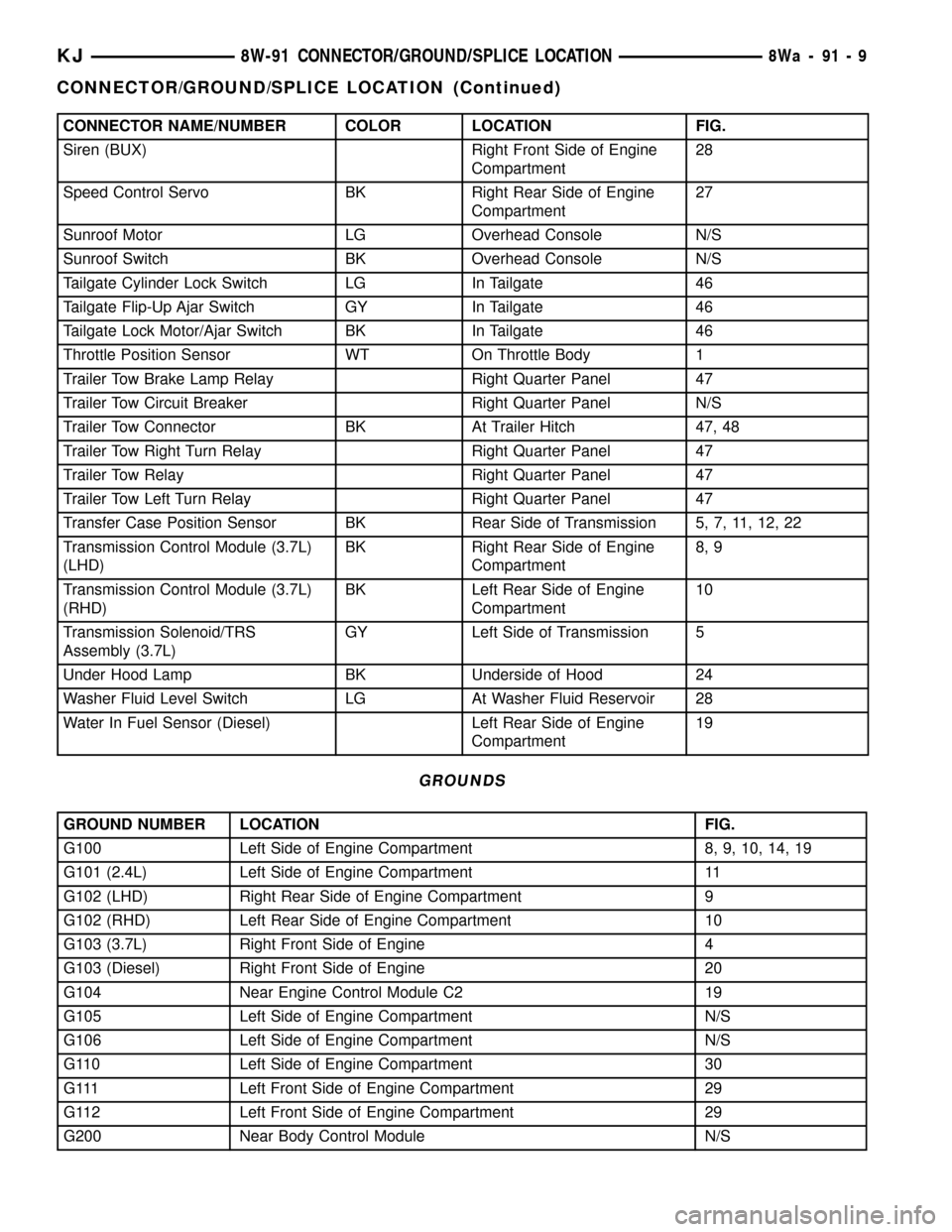
CONNECTOR NAME/NUMBER COLOR LOCATION FIG.
Siren (BUX) Right Front Side of Engine
Compartment28
Speed Control Servo BK Right Rear Side of Engine
Compartment27
Sunroof Motor LG Overhead Console N/S
Sunroof Switch BK Overhead Console N/S
Tailgate Cylinder Lock Switch LG In Tailgate 46
Tailgate Flip-Up Ajar Switch GY In Tailgate 46
Tailgate Lock Motor/Ajar Switch BK In Tailgate 46
Throttle Position Sensor WT On Throttle Body 1
Trailer Tow Brake Lamp Relay Right Quarter Panel 47
Trailer Tow Circuit Breaker Right Quarter Panel N/S
Trailer Tow Connector BK At Trailer Hitch 47, 48
Trailer Tow Right Turn Relay Right Quarter Panel 47
Trailer Tow Relay Right Quarter Panel 47
Trailer Tow Left Turn Relay Right Quarter Panel 47
Transfer Case Position Sensor BK Rear Side of Transmission 5, 7, 11, 12, 22
Transmission Control Module (3.7L)
(LHD)BK Right Rear Side of Engine
Compartment8, 9
Transmission Control Module (3.7L)
(RHD)BK Left Rear Side of Engine
Compartment10
Transmission Solenoid/TRS
Assembly (3.7L)GY Left Side of Transmission 5
Under Hood Lamp BK Underside of Hood 24
Washer Fluid Level Switch LG At Washer Fluid Reservoir 28
Water In Fuel Sensor (Diesel) Left Rear Side of Engine
Compartment19
GROUNDS
GROUND NUMBER LOCATION FIG.
G100 Left Side of Engine Compartment 8, 9, 10, 14, 19
G101 (2.4L) Left Side of Engine Compartment 11
G102 (LHD) Right Rear Side of Engine Compartment 9
G102 (RHD) Left Rear Side of Engine Compartment 10
G103 (3.7L) Right Front Side of Engine 4
G103 (Diesel) Right Front Side of Engine 20
G104 Near Engine Control Module C2 19
G105 Left Side of Engine Compartment N/S
G106 Left Side of Engine Compartment N/S
G110 Left Side of Engine Compartment 30
G111 Left Front Side of Engine Compartment 29
G112 Left Front Side of Engine Compartment 29
G200 Near Body Control Module N/S
KJ8W-91 CONNECTOR/GROUND/SPLICE LOCATION8Wa-91-9
CONNECTOR/GROUND/SPLICE LOCATION (Continued)
Page 1374 of 1803

FRAMES & BUMPERS
TABLE OF CONTENTS
page page
FRONT FASCIA
REMOVAL.............................1
INSTALLATION..........................2
REAR FASCIA
REMOVAL.............................2
INSTALLATION..........................2
REAR FASCIA SUPPORT
REMOVAL.............................3
INSTALLATION..........................3
FRAME
SPECIFICATIONS
SPECIFICATIONS - FRAME DIMENSIONS . . . 3
SPECIFICATIONS - TORQUE.............6
FRONT SKID PLATE
REMOVAL.............................6
INSTALLATION..........................6
ENGINE CRADLE CROSSMEMBER
REMOVAL.............................6
INSTALLATION..........................6TRANSFER CASE SKID PLATE
REMOVAL.............................7
INSTALLATION..........................7
REAR CROSSMEMBER
REMOVAL.............................7
INSTALLATION..........................7
FRONT TOW HOOK
REMOVAL.............................8
INSTALLATION..........................8
REAR TOW HOOK
REMOVAL.............................8
INSTALLATION..........................8
TRAILER HITCH
REMOVAL.............................9
INSTALLATION..........................9
FUEL TANK SKID PLATE
REMOVAL.............................9
INSTALLATION..........................9
FRONT FASCIA
REMOVAL
(1) Remove the grille. (Refer to 23 - BODY/EXTE-
RIOR/GRILLE - REMOVAL)
(2) Raise and support vehicle.
(3) Remove the front wheel opening flare moldings.
(Refer to 23 - BODY/EXTERIOR/FRONT WHEEL
OPENING FLARE MOLDINGS - REMOVAL)
(4) Remove the four screws through the lower air
dam (Fig. 1).
(5) Disconnect the electrical connectors:
²Fascia to grille opening reinforcement. (Fig. 1)
²Side repeater lights, both sides, if equipped.
(Fig. 2)
(6) Remove the six push pins from the grill sup-
port.
(7) Remove the rivets attaching the air dam to the
wheelhouse splash shield.
(8) Release the support tabs beneath the head-
lamps.
(9) Release the inner support clips from within the
fascia between the lights (Fig. 2).
(10) Remove the fascia.
Fig. 1 FRONT FASCIA
1 - ELECTRICAL CONNECTOR
2 - PUSH PINS
3 - FRONT FASCIA ASSEMBLY
4 - LOWER SCREWS
5 - PLASTIC RIVETS (2)
6 - INNER SUPPORT CLIPS
7 - SUPPORT TABS
KJFRAMES & BUMPERS 13 - 1