2002 JEEP LIBERTY air condition
[x] Cancel search: air conditionPage 326 of 1803
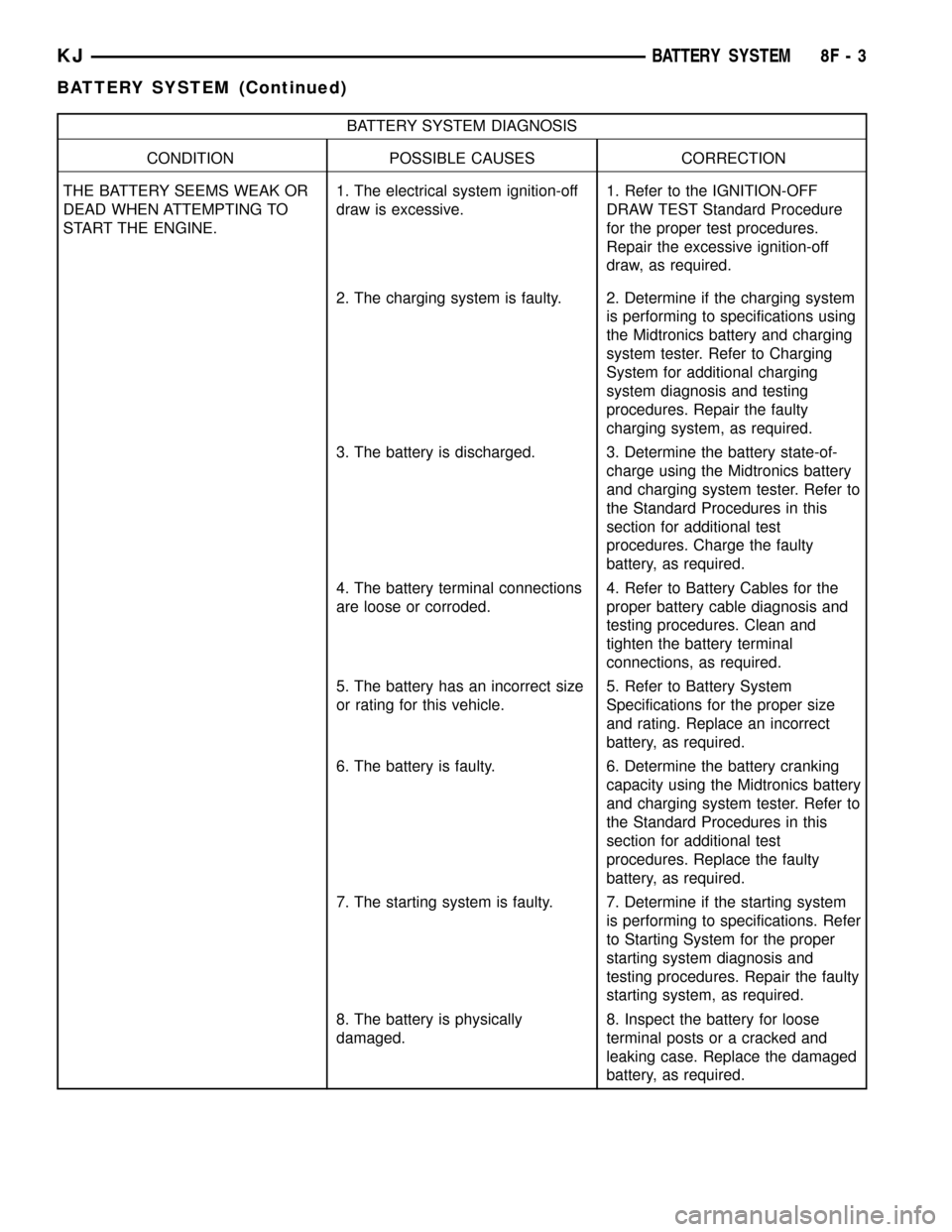
BATTERY SYSTEM DIAGNOSIS
CONDITION POSSIBLE CAUSES CORRECTION
THE BATTERY SEEMS WEAK OR
DEAD WHEN ATTEMPTING TO
START THE ENGINE.1. The electrical system ignition-off
draw is excessive.1. Refer to the IGNITION-OFF
DRAW TEST Standard Procedure
for the proper test procedures.
Repair the excessive ignition-off
draw, as required.
2. The charging system is faulty. 2. Determine if the charging system
is performing to specifications using
the Midtronics battery and charging
system tester. Refer to Charging
System for additional charging
system diagnosis and testing
procedures. Repair the faulty
charging system, as required.
3. The battery is discharged. 3. Determine the battery state-of-
charge using the Midtronics battery
and charging system tester. Refer to
the Standard Procedures in this
section for additional test
procedures. Charge the faulty
battery, as required.
4. The battery terminal connections
are loose or corroded.4. Refer to Battery Cables for the
proper battery cable diagnosis and
testing procedures. Clean and
tighten the battery terminal
connections, as required.
5. The battery has an incorrect size
or rating for this vehicle.5. Refer to Battery System
Specifications for the proper size
and rating. Replace an incorrect
battery, as required.
6. The battery is faulty. 6. Determine the battery cranking
capacity using the Midtronics battery
and charging system tester. Refer to
the Standard Procedures in this
section for additional test
procedures. Replace the faulty
battery, as required.
7. The starting system is faulty. 7. Determine if the starting system
is performing to specifications. Refer
to Starting System for the proper
starting system diagnosis and
testing procedures. Repair the faulty
starting system, as required.
8. The battery is physically
damaged.8. Inspect the battery for loose
terminal posts or a cracked and
leaking case. Replace the damaged
battery, as required.
KJBATTERY SYSTEM 8F - 3
BATTERY SYSTEM (Continued)
Page 327 of 1803
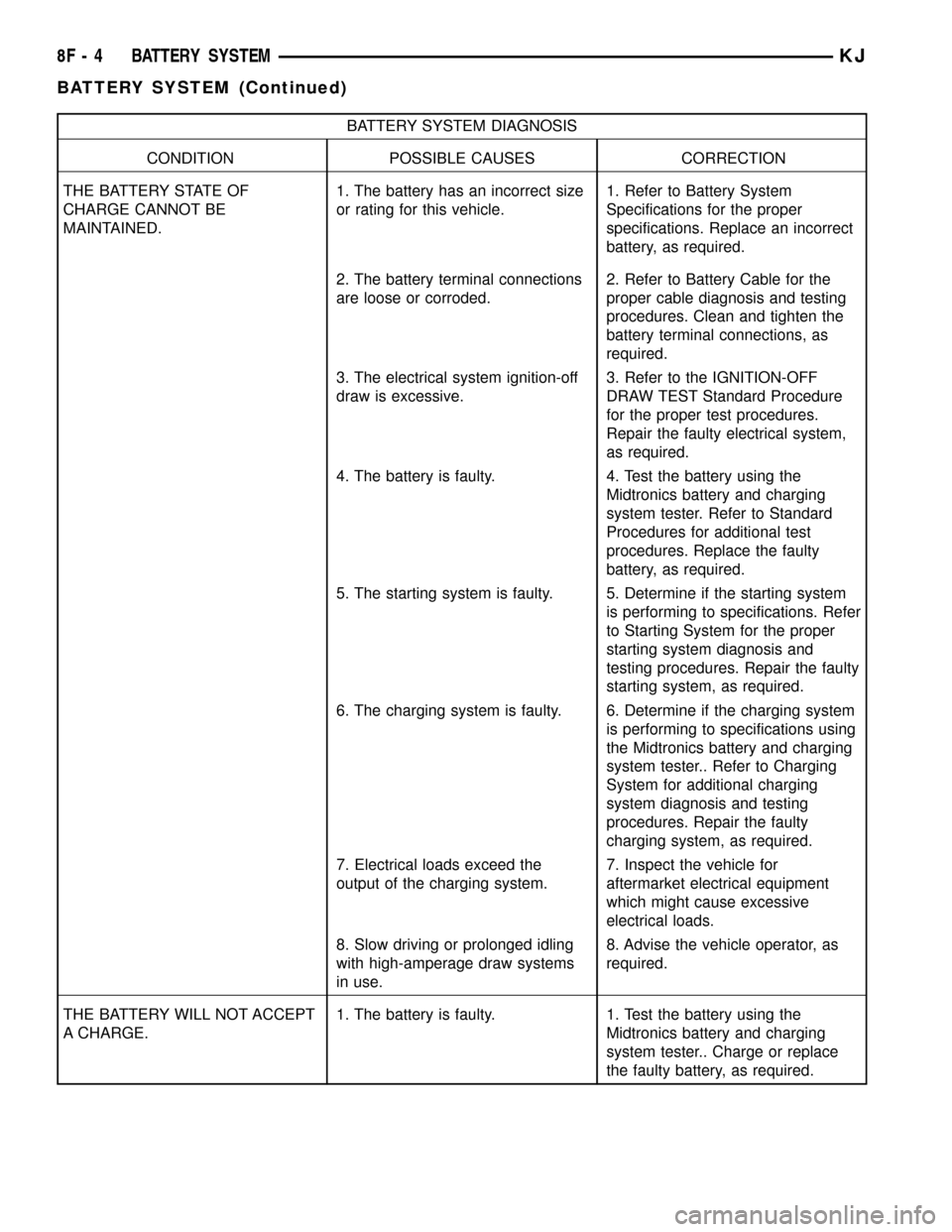
BATTERY SYSTEM DIAGNOSIS
CONDITION POSSIBLE CAUSES CORRECTION
THE BATTERY STATE OF
CHARGE CANNOT BE
MAINTAINED.1. The battery has an incorrect size
or rating for this vehicle.1. Refer to Battery System
Specifications for the proper
specifications. Replace an incorrect
battery, as required.
2. The battery terminal connections
are loose or corroded.2. Refer to Battery Cable for the
proper cable diagnosis and testing
procedures. Clean and tighten the
battery terminal connections, as
required.
3. The electrical system ignition-off
draw is excessive.3. Refer to the IGNITION-OFF
DRAW TEST Standard Procedure
for the proper test procedures.
Repair the faulty electrical system,
as required.
4. The battery is faulty. 4. Test the battery using the
Midtronics battery and charging
system tester. Refer to Standard
Procedures for additional test
procedures. Replace the faulty
battery, as required.
5. The starting system is faulty. 5. Determine if the starting system
is performing to specifications. Refer
to Starting System for the proper
starting system diagnosis and
testing procedures. Repair the faulty
starting system, as required.
6. The charging system is faulty. 6. Determine if the charging system
is performing to specifications using
the Midtronics battery and charging
system tester.. Refer to Charging
System for additional charging
system diagnosis and testing
procedures. Repair the faulty
charging system, as required.
7. Electrical loads exceed the
output of the charging system.7. Inspect the vehicle for
aftermarket electrical equipment
which might cause excessive
electrical loads.
8. Slow driving or prolonged idling
with high-amperage draw systems
in use.8. Advise the vehicle operator, as
required.
THE BATTERY WILL NOT ACCEPT
A CHARGE.1. The battery is faulty. 1. Test the battery using the
Midtronics battery and charging
system tester.. Charge or replace
the faulty battery, as required.
8F - 4 BATTERY SYSTEMKJ
BATTERY SYSTEM (Continued)
Page 346 of 1803

²the voltmeter (if equipped) does not register
properly
²an undercharged or overcharged battery condi-
tion occurs.
Remember that an undercharged battery is often
caused by:
²accessories being left on with the engine not
running
²a faulty or improperly adjusted switch that
allows a lamp to stay on. Refer to Ignition-Off Draw
Test in 8, Battery for more information.
INSPECTION
The Powertrain Control Module (PCM) monitors
critical input and output circuits of the charging sys-
tem, making sure they are operational. A Diagnostic
Trouble Code (DTC) is assigned to each input and
output circuit monitored by the On-Board Diagnostic
(OBD) system. Some charging system circuits are
checked continuously, and some are checked only
under certain conditions.
Refer to Diagnostic Trouble Codes in; Powertrain
Control Module; Electronic Control Modules for more
DTC information. This will include a complete list of
DTC's including DTC's for the charging system.
To perform a complete test of the charging system,
refer to the appropriate Powertrain Diagnostic Proce-
dures service manual and the DRBtscan tool. Per-form the following inspections before attaching the
scan tool.
(1) Inspect the battery condition. Refer to 8, Bat-
tery for procedures.
(2) Inspect condition of battery cable terminals,
battery posts, connections at engine block, starter
solenoid and relay. They should be clean and tight.
Repair as required.
(3) Inspect all fuses in both the fuseblock and
Power Distribution Center (PDC) for tightness in
receptacles. They should be properly installed and
tight. Repair or replace as required.
(4) Inspect generator mounting bolts for tightness.
Replace or tighten bolts if required. Refer to the Gen-
erator Removal/Installation section of this group for
torque specifications.
(5) Inspect generator drive belt condition and ten-
sion. Tighten or replace belt as required. Refer to
Belt Tension Specifications in 7, Cooling System.
(6) Inspect automatic belt tensioner (if equipped).
Refer to 7, Cooling System for information.
(7) Inspect generator electrical connections at gen-
erator field, battery output, and ground terminal (if
equipped). Also check generator ground wire connec-
tion at engine (if equipped). They should all be clean
and tight. Repair as required.
SPECIFICATIONS
TORQUE - EXCEPT DIESEL
DESCRIPTION N-m Ft. Lbs. In. Lbs.
Generator Horizontal Mounting Bolts - 3.7L 57 42 -
Generator Vertical Mounting Bolt - 3.7L 40 29 -
Generator Mounting Bolts - 2.4L 57 42 -
B+ Terminal Nut at Top of Generator 13 - 115
Generator Decoupler 110 81 -
GENERATOR RATINGS - GAS ENGINES
TYPE PART NUMBER RATED SAE AMPS ENGINES MINIMUM TEST AMPS
DENSO 56044530AB 124 2.4L 88
DENSO 56044532AB 136 2.4L 96
DENSO 56041693AA 136 3.7L 96
DENSO 56029914AA 160 3.7L 112
KJCHARGING SYSTEM 8F - 23
CHARGING SYSTEM (Continued)
Page 356 of 1803

If the vehicle is equipped with an automatic trans-
mission, battery voltage is supplied through the low-
amperage control circuit to the coil battery terminal
of the starter relay when the ignition switch is
turned to the momentary Start position. The park/
neutral position switch is installed in series between
the starter relay coil ground terminal and ground.
This normally open switch prevents the starter relay
from being energized and the starter motor from
operating unless the automatic transmission gear
selector is in the Neutral or Park positions.
When the starter relay coil is energized, the nor-
mally open relay contacts close. The relay contacts
connect the relay common feed terminal to the relay
normally open terminal. The closed relay contacts
energize the starter solenoid coil windings.
The energized solenoid pull-in coil pulls in the sole-
noid plunger. The solenoid plunger pulls the shift
lever in the starter motor. This engages the starter
overrunning clutch and pinion gear with the starter
ring gear on the manual transmission flywheel or on
the automatic transmission torque converter or
torque converter drive plate.
As the solenoid plunger reaches the end of its
travel, the solenoid contact disc completes the high-
amperage starter feed circuit and energizes the sole-
noid plunger hold-in coil. Current now flows betweenthe solenoid battery terminal and the starter motor,
energizing the starter.
Once the engine starts, the overrunning clutch pro-
tects the starter motor from damage by allowing the
starter pinion gear to spin faster than the pinion
shaft. When the driver releases the ignition switch to
the On position, the starter relay coil is de-energized.
This causes the relay contacts to open. When the
relay contacts open, the starter solenoid plunger
hold-in coil is de-energized.
When the solenoid plunger hold-in coil is de-ener-
gized, the solenoid plunger return spring returns the
plunger to its relaxed position. This causes the con-
tact disc to open the starter feed circuit, and the shift
lever to disengage the overrunning clutch and pinion
gear from the starter ring gear.
DIAGNOSIS AND TESTING - STARTING
SYSTEM
The battery, starting, and charging systems oper-
ate in conjunction with one another, and must be
tested as a complete system. For correct starting/
charging system operation, all of the components
involved in these 3 systems must perform within
specifications.
Starting System Diagnosis
CONDITION POSSIBLE CAUSE CORRECTION
STARTER FAILS TO
OPERATE.1. Battery discharged or
faulty.1. Refer to Battery. Charge or replace battery, if required.
2. Starting circuit wiring
faulty.2. Refer to 8, Wiring Diagrams. Test and repair starter
feed and/or control circuits, if required.
3. Starter relay faulty. 3. Refer to Starter Relay in Diagnosis and Testing.
Replace starter relay if required.
4. Ignition switch faulty. 4. Refer to Ignition Switch and Key Lock Cylinder.
Replace ignition switch if required.
5. Clutch pedal position
switch faulty.5. Refer to Clutch Pedal Position Switch.
6. Park/Neutral position
switch faulty or
misadjusted.6. Refer to Park/Neutral Position Switch. Replace
park/neutral position switch if required.
7. Starter solenoid faulty. 7. Refer to Starter Motor. Replace starter motor assembly
if required.
8. Starter motor faulty. 8. If all other starting system components and circuits test
OK, replace starter motor.
KJSTARTING SYSTEM 8F - 33
STARTING SYSTEM (Continued)
Page 357 of 1803

Starting System Diagnosis
CONDITION POSSIBLE CAUSE CORRECTION
STARTER ENGAGES,
FAILS TO TURN
ENGINE.1. Battery discharged or
faulty.1. Refer to Battery. Charge or replace battery if required.
2. Starting circuit wiring
faulty.2. Refer to 8, Wiring Diagrams. Test and repair starter
feed and/or control circuits if required.
3. Starter motor faulty. 3. If all other starting system components and circuits test
OK, replace starter motor assembly.
4. Engine seized. 4. Refer to Engine Diagnosis in the Diagnosis and Testing
section of 9, Engine.
STARTER ENGAGES,
SPINS OUT BEFORE
ENGINE STARTS.1. Starter ring gear faulty. 1. Refer to Starter Motor Removal and Installation.
Remove starter motor to inspect starter ring gear.
Replace starter ring gear if required.
2. Starter motor faulty. 2. If all other starting system components and circuits test
OK, replace starter motor assembly.
STARTER DOES NOT
DISENGAGE.1. Starter motor
improperly installed.1. Refer to Starter Motor Removal and Installation.
Tighten starter mounting hardware to correct torque
specifications.
2. Starter relay faulty. 2. Refer to Starter Relay Diagnosis and Testing. Replace
starter relay if required.
3. Ignition switch faulty. 3. Refer to Ignition Switch and Key Lock Cylinder.
Replace ignition switch if required.
4. Starter motor faulty. 4. If all other starting system components and circuits test
OK, replace starter motor.
INSPECTION
For complete starter wiring circuit diagrams, refer
to 8, Wiring Diagrams. Before removing any unit
from starting system for repair or diagnosis, perform
the following inspections:
WARNING: ON VEHICLES EQUIPPED WITH AIR-
BAGS, REFER TO 8, PASSIVE RESTRAINT SYS-
TEMS, BEFORE ATTEMPTING ANY STEERING
WHEEL, STEERING COLUMN, OR INSTRUMENT
PANEL COMPONENT DIAGNOSIS OR SERVICE.
FAILURE TO TAKE THE PROPER PRECAUTIONS
COULD RESULT IN ACCIDENTAL AIRBAG DEPLOY-
MENT AND POSSIBLE PERSONAL INJURY.
²Battery- Visually inspect battery for indica-
tions of physical damage and loose or corroded cable
connections. Determine state-of-charge and cranking
capacity of battery. Charge or replace battery if
required. Refer toBatteryin 8, Battery.Note: If
equipped with diesel engine, a dual battery sys-
tem may be used, and both batteries must be
inspected.
²Ignition Switch- Visually inspect ignition
switch for indications of physical damage and loose
or corroded wire harness connections. Refer toIgni-
tion Switch and Key Lock Cylinder.²Clutch Pedal Position Switch- If equipped
with manual transmission, visually inspect clutch
pedal position switch for indications of physical dam-
age and loose or corroded wire harness connections.
Refer toClutch Pedal Position Switchin 6,
Clutch.
²Park/Neutral Position Switch- If equipped
with automatic transmission, visually inspect park/
neutral position switch for indications of physical
damage and loose or corroded wire harness connec-
tions. Refer toPark/Neutral Position Switchin
21, Transmission.
²Starter Relay- Visually inspect starter relay
for indications of physical damage and loose or cor-
roded wire harness connections.
²Starter Motor- Visually inspect starter motor
for indications of physical damage and loose or cor-
roded wire harness connections.
²Starter Solenoid- Visually inspect starter sole-
noid for indications of physical damage and loose or
corroded wire harness connections.
²Wiring- Visually inspect wire harnesses for
damage. Repair or replace any faulty wiring, as
required. Refer to 8, Wiring Diagrams.
8F - 34 STARTING SYSTEMKJ
STARTING SYSTEM (Continued)
Page 366 of 1803

REMOVAL
The starter relay is located in the Power Distribu-
tion Center (PDC) (Fig. 14). Refer to label on PDC
cover for relay location.(1) Remove PDC cover.
(2) Remove relay from PDC.
(3) Check condition of relay terminals and PDC
connector terminals for damage or corrosion. Repair
if necessary before installing relay.
(4) Check for pin height (pin height should be the
same for all terminals within the PDC connector).
Repair if necessary before installing relay.
INSTALLATION
(1) Refer to Power Distribution Center (PDC) cover
for starter relay location.
(2) Install relay to PDC.
(3) Install cover to PDC.
Fig. 14 POWER DISTRIBUTION CENTER (PDC)
1 - BATTERY
2 - PDC
3 - PDC COVER
KJSTARTING SYSTEM 8F - 43
STARTER MOTOR RELAY (Continued)
Page 376 of 1803

DIAGNOSIS AND TESTING - REAR HVAC
CONTROL ASSEMBLY WINDOW DEFOGGER
FUNCTION
Before performing this test, complete the Defogger
Switch and Defogger Relay tests as described in this
group. For circuit descriptions and diagrams, (Refer
to Appropriate Wiring Information).
WARNING: ON VEHICLES EQUIPPED WITH AIR-
BAGS, DISABLE THE AIRBAG SYSTEM BEFORE
ATTEMPTING ANY STEERING WHEEL, STEERING
COLUMN, OR INSTRUMENT PANEL COMPONENT
DIAGNOSIS OR SERVICE. DISCONNECT AND ISO-
LATE THE BATTERY NEGATIVE (GROUND) CABLE,
THEN WAIT TWO MINUTES FOR THE AIRBAG SYS-
TEM CAPACITOR TO DISCHARGE BEFORE PER-
FORMING FURTHER DIAGNOSIS OR SERVICE. THIS
IS THE ONLY SURE WAY TO DISABLE THE AIRBAG
SYSTEM. FAILURE TO TAKE THE PROPER PRE-
CAUTIONS COULD RESULT IN AN ACCIDENTAL
AIRBAG DEPLOYMENT AND POSSIBLE PERSONAL
INJURY.
(1) Disconnect and isolate the battery negative
cable. Remove the defogger relay from the junction
block and unplug the defogger switch wire harness
connector.
(2) Remove the HVAC control head from the
instrument panel. This is accomplished by removing
the ashtray and the screw behind the ashtray and
uncliping the center bezel.
(3) Check for continuity between the rear window
defogger switch sense circuit cavity of the cluster
wire harness connector (connector B) and a good
ground. There should be no continuity. If OK, go to
Step 4. If not OK, repair the short circuit as
required.
(4) Check for continuity between the rear window
defogger switch sense circuit cavity of the right
instrument cluster wire harness connector (connector
B) and the defogger switch wire harness connector.
There should be continuity. If OK, go to Step 5. If not
OK, repair the open circuit as required.
(5) Check for continuity between the rear window
defogger relay control circuit cavity of the right
instrument cluster wire harness connector (connectorB) and a good ground. There should be no continuity.
If OK, go to Step 6. If not OK, repair the short circuit
as required.
(6) Check for continuity between the rear window
defogger relay control circuit cavities of the right
instrument cluster wire harness connector (connector
B) and the defogger relay receptacle (the cavity for
ISO relay terminal 85) in the junction block. There
should be continuity. If OK, replace the faulty HVAC
control head. If not OK, repair the open circuit as
required.
REMOVAL
WARNING: ON VEHICLES EQUIPPED WITH AIR-
BAGS, DISABLE THE AIRBAG SYSTEM BEFORE
ATTEMPTING ANY STEERING WHEEL, STEERING
COLUMN, OR INSTRUMENT PANEL COMPONENT
DIAGNOSIS OR SERVICE. DISCONNECT AND ISO-
LATE THE BATTERY NEGATIVE (GROUND) CABLE,
THEN WAIT TWO MINUTES FOR THE AIRBAG SYS-
TEM CAPACITOR TO DISCHARGE BEFORE PER-
FORMING FURTHER DIAGNOSIS OR SERVICE. THIS
IS THE ONLY SURE WAY TO DISABLE THE AIRBAG
SYSTEM. FAILURE TO TAKE THE PROPER PRE-
CAUTIONS COULD RESULT IN AN ACCIDENTAL
AIRBAG DEPLOYMENT AND POSSIBLE PERSONAL
INJURY.
(1) Disconnect and isolate the battery negative
cable.
(2) The Rear Window Defogger switch is part of
the HVAC assembly and if damaged or inoperative
the entire HVAC control assembly must be replace-
d(Refer to 24 - HEATING & AIR CONDITIONING/
CONTROLS/A/C HEATER CONTROL - REMOVAL).
INSTALLATION
(1) The Rear Window Defogger switch is part of
the HVAC control assembly and if damaged or inop-
erative you must replace the entire HVEAC control
head assembly(Refer to 24 - HEATING & AIR CON-
DITIONING/CONTROLS/A/C HEATER CONTROL -
INSTALLATION).
(2) Connect the battery negative cable.
KJWINDOW DEFOGGER 8G - 9
REAR WINDOW DEFOGGER SWITCH (Continued)
Page 378 of 1803

The heated seat module monitors inputs from the
heated seat sensors and the heated seat switches. In
response to these inputs the heated seat module uses
its internal programming to control outputs to the
heated seat elements in both front seats and to con-
trol the heated seat LED indicator lamps located in
both of the heated seat switches. The heated seat
module is also programmed to provide self-diagnostic
capability. When the module detects certain failures
within the heated seat system, it will provide a
visual indication of the failure by flashing the indica-
tor lamps in the affected heated seat switch. The
heated seat module will automatically turn off the
heated seat elements if it detects a short or open in
the heated seat element circuit or a heated seat sen-
sor value that is out of range.
DIAGNOSIS AND TESTING - HEATED SEAT
SYSTEM
HEATED SEAT SYSTEM SELF-DIAGNOSIS
The heated seat system is capable of performing
some self-diagnostics. The following table depicts the
various monitored failures which will be reported to
the vehicle operator or technician by flashing the
individual heated seat switch Light Emitting Diode
(LED) indicator lamps. Refer to the Heated Seat Sys-
tem Self-Diagnosis table for failure identification.
The driver side heated seat switch indicator lamps
will flash if a failure occurs in the driver side heated
seat, and the passenger side heated seat switch indi-
cator lamps will flash for a passenger side heated
seat failure. If a monitored heated seat system fail-
ure occurs, the switch indicator lamps will flash at a
pulse rate of about one-half second on, followed by
about one-half second off for a duration of about one
minute after the switch for the faulty heated seat is
depressed in either the Low or High direction. This
process will repeat every time the faulty heated seat
switch is actuated until the problem has been cor-
rected.
Heated Seat System Self-Diagnosis
Monitored FailureSwitch High
Indicator LampSwitch Low
Indicator Lamp
Heated Seat
Element ShortedFlashing Flashing
Heated Seat
Element OpenFlashing Off
Heated Seat
Sensor Value Out
of RangeOff FlashingIf the heated seat system failure is identified by
flashing heated seat switch indicator lamps, go to the
appropriate diagnosis and testing procedure in this
section and confirm the condition, using the step by
step procedure. If the monitored failure is confirmed,
replace the component. If the monitored failure is not
confirmed, replace the heated seat module with a
known good unit and retest the system.
HEATED SEAT SYSTEM TESTING
Refer toWiring Diagramsfor the location of com-
plete heated seat system wiring diagrams. Before
testing the individual components in the heated seat
system, perform the following preliminary checks:
²If a single indicator lamp for one heated seat
switch does not operate and the heated seat elements
do heat, refer toDiagnosis and Testing the
Heated Seat Switchin this section for the location
of heated seat switch diagnosis and testing proce-
dures.
²If both indicator lamps for a heated seat switch
operate, but the heated seat elements do not heat,
refer toDiagnosis and Testing the Heated Seat
Modulein Electronic Control Modules for the loca-
tion of heated seat module diagnosis and testing pro-
cedures.
²If an indicator lamp on either heated seat switch
remains illuminated after the heated seat has been
turned Off, refer toDiagnosis and Testing the
Heated Seat Modulein Electronic Control Modules
for the location of heated seat module diagnosis and
testing procedures. Also refer to the Body Diagnostic
Manual for additional diagnosis and testing proce-
dures.
DRIVER SEAT HEATER
SWITCH
DESCRIPTION
The heated seat switches are located on the out-
board cushion side shield of the driver and passenger
front seats (Fig. 1). The two, three-position rocker
type switches provide a resistor multiplexed signal to
the Heated Seat Module through separate hard wired
circuits. Each switch has an Off, Low and High set-
ting. Each switch contains two light emitting diodes
(LED), one for each High and Low setting to let the
occupant know that the seat heater system is on.
The heated seat switches and their LED's cannot
be repaired. If either switch is faulty or damaged the
entire switch must be replaced.
KJHEATED SEAT SYSTEM 8G - 11
HEATED SEAT SYSTEM (Continued)