2002 JEEP LIBERTY Psi
[x] Cancel search: PsiPage 1661 of 1803
(5) Connect the test set hose or probe to the open
end of the leaking circuit. The test set gauge should
return to the 27 kPa (8 in. Hg.) setting shortly after
each connection is made. If OK, replace the faulty
disconnected component. If not OK, go to Step 6.
(6)
To locate a leak in a vacuum line, leave one end
of the line plugged and connect the test set hose or
probe to the other end of the line. Run your fingers
slowly along the line while watching the test set gauge.
The vacuum reading will fluctuate when your fingers
contact the source of the leak. To repair the vacuum
line, cut out the leaking section of the line. Then, insert
the loose ends of the line into a suitable length of 3 mil-
limeter (0.125 inch) inside diameter rubber hose.
STANDARD PROCEDURE - DIODE
REPLACEMENT
(1) Disconnect the battery negative cable and iso-
late it.
(2) Locate the diode in the harness, and remove
the protective covering.
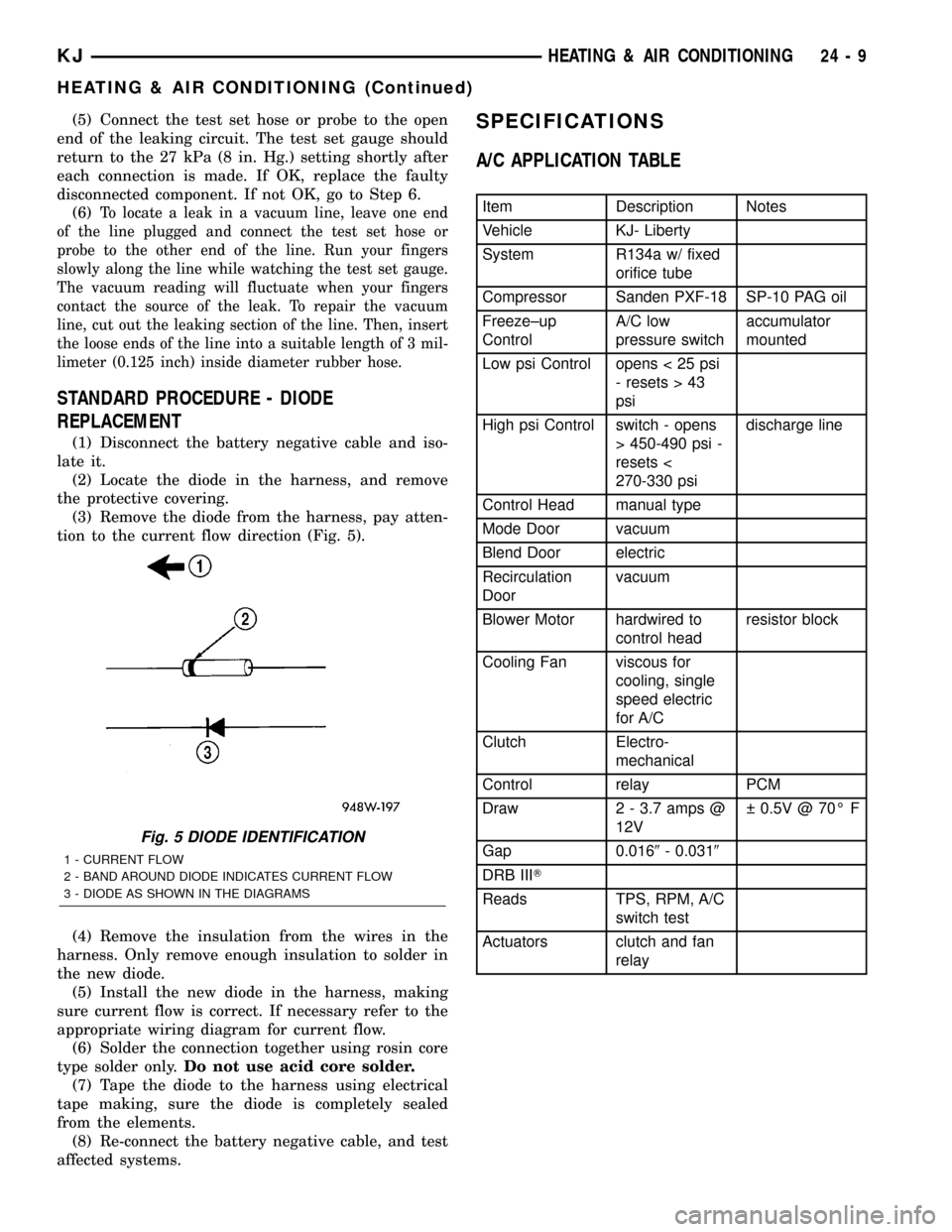
(3) Remove the diode from the harness, pay atten-
tion to the current flow direction (Fig. 5).
(4) Remove the insulation from the wires in the
harness. Only remove enough insulation to solder in
the new diode.
(5) Install the new diode in the harness, making
sure current flow is correct. If necessary refer to the
appropriate wiring diagram for current flow.
(6) Solder the connection together using rosin core
type solder only.Do not use acid core solder.
(7) Tape the diode to the harness using electrical
tape making, sure the diode is completely sealed
from the elements.
(8) Re-connect the battery negative cable, and test
affected systems.
SPECIFICATIONS
A/C APPLICATION TABLE
Item Description Notes
Vehicle KJ- Liberty
System R134a w/ fixed
orifice tube
Compressor Sanden PXF-18 SP-10 PAG oil
Freeze±up
ControlA/C low
pressure switchaccumulator
mounted
Low psi Control opens < 25 psi
- resets > 43
psi
High psi Control switch - opens
> 450-490 psi -
resets <
270-330 psidischarge line
Control Head manual type
Mode Door vacuum
Blend Door electric
Recirculation
Doorvacuum
Blower Motor hardwired to
control headresistor block
Cooling Fan viscous for
cooling, single
speed electric
for A/C
Clutch Electro-
mechanical
Control relay PCM
Draw 2 - 3.7 amps @
12V 0.5V @ 70É F
Gap 0.0169- 0.0319
DRB IIIT
Reads TPS, RPM, A/C
switch test
Actuators clutch and fan
relay
Fig. 5 DIODE IDENTIFICATION
1 - CURRENT FLOW
2 - BAND AROUND DIODE INDICATES CURRENT FLOW
3 - DIODE AS SHOWN IN THE DIAGRAMS
KJHEATING & AIR CONDITIONING 24 - 9
HEATING & AIR CONDITIONING (Continued)
Page 1670 of 1803

electric cooling fan operations. The switch is located
on the discharge line near the compressor. The
switch is screwed onto a fitting that contains a
Schrader-type valve, which allows the switch to be
serviced without discharging the refrigerant system.
The discharge line fitting is equipped with an O-ring
to seal the switch connection.
OPERATION
The A/C high pressure switch is connected in series
electrically with the A/C low pressure switch between
ground and the Powertrain Control Module (PCM).
The switch contacts open and close causing the PCM
to turn the compressor clutch on and off. This pre-
vents compressor operation when the discharge line
pressure approaches high levels, and also reduces
electrical surging from compressor clutch engage-
ment.
The A/C high pressure switch controls the electric
cooling fan operation by monitoring refrigerant line
pressures. When the discharge line pressure rises
above 1900 to 2200 kPa (280 to 320 psi) the fan will
turn on. The cooling fan will turn off when the dis-
charge line pressure drops to 1600 kPa (235 psi).
The A/C high pressure switch controls the A/C
clutch operation by disengaging the clutch when the
discharge line pressure rises above 3100 to 3375 kPa
(450 to 490 psi). The switch contacts will close and
allow A/C clutch engagement when the discharge line
pressure drops to 1860 to 2275 kPa (270 to 330 psi).
The A/C high pressure switch is a factory-cali-
brated unit. The switch cannot be adjusted or
repaired and, if faulty or damaged, it must be
replaced.
DIAGNOSIS AND TESTING - A/C HIGH
PRESSURE SWITCH
Before performing diagnosis of the A/C high pres-
sure switch, verify that the refrigerant system has
the correct refrigerant charge. (Refer to 24 - HEAT-
ING & AIR CONDITIONING/PLUMBING - STAN-
DARD PROCEDURE - REFRIGERANT SYSTEM
CHARGE)
For circuit descriptions and diagrams, (Refer to
Appropriate Wiring Information).
(1) Disconnect and isolate the battery negative
cable.
(2) Unplug the A/C high pressure switch wire har-
ness connector from the switch on the refrigerant
system fitting.
(3) On the four terminal A/C high pressure switch,
check for continuity between terminals C and D. On
the two terminal A/C high pressure switch, check for
continuity between both terminals of the switch.
There should be continuity. If OK, test and repair theA/C switch sense circuit as required. If not OK,
replace the faulty switch.
REMOVAL
(1) Disconnect and isolate the battery negative
cable.
(2) Unplug the wire harness connector from the
A/C high pressure switch, which is mounted to a fit-
ting on the non-flexible section of the discharge line
nearest the compressor.
(3) Unscrew the A/C high pressure switch from the
discharge line fitting.
(4) Remove the A/C high pressure switch from the
vehicle.
(5) Remove the O-ring seal from the discharge line
fitting and discard.
INSTALLATION
(1) Lubricate a new O-ring seal with clean refrig-
erant oil and install it on the discharge line fitting.
Use only the specified O-rings as they are made of a
special material for the R-134a system. Use only
refrigerant oil of the type recommended for the com-
pressor in the vehicle(Refer to 24 - HEATING & AIR
CONDITIONING - SPECIFICATIONS). (Refer to 24 -
HEATING & AIR CONDITIONING/PLUMBING/RE-
FRIGERANT OIL - DESCRIPTION)
(2) Install and tighten the a/c high pressure switch
on the discharge line fitting. The switch should be
hand-tightened onto the discharge line fitting.
(3) Plug the wire harness connector into the a/c
high pressure switch.
(4) Connect the battery negative cable.
A/C LOW PRESSURE SWITCH
DESCRIPTION
The a/c low pressure switch is located on the top of
the accumulator. The switch is screwed onto an accu-
mulator fitting that contains a Schrader-type valve,
which allows the switch to be serviced without dis-
charging the refrigerant system. The accumulator fit-
ting is equipped with an O-ring to seal the switch
connection.
OPERATION
The a/c low pressure switch is connected in series
electrically with the a/c high pressure switch,
between ground and the Powertrain Control Module
(PCM). The switch contacts open and close causing
the PCM to turn the a/c compressor clutch on and
off. This regulates the refrigerant system pressure
and controls evaporator temperature. Controlling the
evaporator temperature prevents condensate water
24 - 18 CONTROLSKJ
A/C HIGH PRESSURE SWITCH (Continued)
Page 1671 of 1803

on the evaporator fins from freezing and obstructing
air conditioning system air flow.
The a/c low pressure switch contacts are open
when the suction pressure is approximately 141 kPa
(20.5 psi) or lower. The switch contacts will close
when the suction pressure rises to approximately 234
to 262 kPa (34 to 38 psi) or above. Lower ambient
temperatures, below approximately -1É C (30É F), will
also cause the switch contacts to open. This is due to
the pressure/temperature relationship of the refriger-
ant in the system.
The a/c low pressure switch is a factory-calibrated
unit. It cannot be adjusted or repaired and, if faulty
or damaged, it must be replaced.
DIAGNOSIS AND TESTING - A/C LOW
PRESSURE SWITCH
Before performing diagnosis of the a/c low pressure
switch, be certain that the switch is properly
installed on the accumulator fitting. If the switch is
too loose it may not open the Schrader-type valve in
the accumulator fitting, which will prevent the
switch from correctly monitoring the refrigerant sys-
tem pressure. Remember that lower ambient temper-
atures, below about -1É C (30É F), during cold
weather will open the switch contacts and prevent
compressor operation due to the pressure/tempera-
ture relationship of the refrigerant.
Also verify that the refrigerant system has the cor-
rect refrigerant charge. (Refer to 24 - HEATING &
AIR CONDITIONING - DIAGNOSIS AND TESTING
- A/C PERFORMANCE) and (Refer to 24 - HEATING
& AIR CONDITIONING/PLUMBING - SPECIFICA-
TIONS).
For circuit descriptions and diagrams, (Refer to
Appropriate Wiring Information).
(1) Disconnect and isolate the battery negative
cable.
(2) Unplug the a/c low pressure switch wire har-
ness connector from the switch on the accumulator
fitting.
(3) Install a jumper wire between the two cavities
of the a/c low pressure switch wire harness connector.
(4) Connect a manifold gauge set to the refrigerant
system service ports. (Refer to 24 - HEATING & AIR
CONDITIONING/PLUMBING - STANDARD PRO-
CEDURE - REFRIGERANT SYSTEM SERVICE
EQUIPMENT) and (Refer to 24 - HEATING & AIR
CONDITIONING - DESCRIPTION - REFRIGERANT
SYSTEM SERVICE PORT)
(5) Connect the battery negative cable.
(6) Place the A/C Heater mode control switch knob
in any A/C position and start the engine.
(7) Check for continuity between the two terminals
of the a/c low pressure switch. There should be con-
tinuity with a suction pressure reading of 262 kPa(38 psi) or above, and no continuity with a suction
pressure reading of 141 kPa (20.5 psi) or below. If
OK, test and repair the A/C switch sense circuit as
required. If not OK, replace the faulty switch.
REMOVAL
(1) Disconnect and isolate the battery negative
cable.
(2) Unplug the wire harness connector from the a/c
low pressure switch on the top of the accumulator
(Fig. 13).
(3) Unscrew the a/c low pressure switch from the
fitting on the top of the accumulator.
(4) Remove the O-ring seal from the accumulator
fitting and discard.
INSTALLATION
(1) Lubricate a new O-ring seal with clean refrig-
erant oil and install it on the accumulator fitting.
Use only the specified O-rings as they are made of a
special material for the R-134a system. Use only
refrigerant oil of the type recommended for the com-
pressor in the vehicle. (Refer to 24 - HEATING &
AIR CONDITIONING/PLUMBING/REFRIGERANT
OIL - DESCRIPTION)
Fig. 13 A/C LOW PRESSURE SWITCH
1 - WIRING HARNESS CONNECTOR
2 - A/C LOW PRESSURE SWITCH
3 - A/C LINE TO EVAPORATOR
4 - ACCUMULATOR MOUNTING BRACKET
5 - ACCUMULATOR
6 - A/C LOW PRESSURE LINE
KJCONTROLS 24 - 19
A/C LOW PRESSURE SWITCH (Continued)
Page 1694 of 1803

used to charge the refrigerant system with R-134a
refrigerant. Refer to the operating instructions sup-
plied by the equipment manufacturer for proper care
and use of this equipment.
SPECIFICATIONS - CHARGE CAPACITY
The R-134a refrigerant system charge capacity for
this vehicle is 0.737 kilograms (1.63 pounds).
A/C COMPRESSOR
DESCRIPTION
DESCRIPTION
The air conditioning system uses a Sanden
PXF-18, reciprocating swash plate-type compressor
on all models. This compressor has a fixed displace-
ment of 180 cubic centimeters (10.984 cubic inches),
and has both the suction and discharge ports located
on the cylinder head. A label identifying the use of
R-134a refrigerant is located on the compressor.
DESCRIPTION - HIGH PRESSURE RELIEF
VALVE
A high pressure relief valve is located on the com-
pressor cylinder head, which is on the rear of the
compressor. This mechanical valve is designed to
vent refrigerant from the system to protect against
damage to the compressor and other system compo-
nents, caused by condenser air flow restriction or an
overcharge of refrigerant.
OPERATION
OPERATION
The compressor is driven by the engine through an
electric clutch, drive rotor and belt arrangement. The
compressor is lubricated by refrigerant oil that is cir-
culated throughout the refrigerant system with the
refrigerant.
The compressor draws in low-pressure refrigerant
vapor from the evaporator through its suction port. It
then compresses the refrigerant into a high-pressure,
high-temperature refrigerant vapor, which is then
pumped to the condenser through the compressor dis-
charge port.
The compressor cannot be repaired. If faulty or
damaged, the entire compressor assembly must be
replaced. The compressor clutch, pulley and clutch
coil are available for service.
OPERATION - HIGH PRESSURE RELIEF VALVE
The high pressure relief valve vents the system
when a discharge pressure of 3445 to 4135 kPa (500
to 600 psi) or above is reached. The valve closes
when a minimum discharge pressure of 2756 kPa
(400 psi) is reached.
The high pressure relief valve vents only enough
refrigerant to reduce the system pressure, and then
re-seats itself. The majority of the refrigerant is con-
served in the system. If the valve vents refrigerant, it
does not mean that the valve is faulty.
The high pressure relief valve is a factory-cali-
brated unit. The valve cannot be adjusted or
repaired, and must not be removed or otherwise dis-
turbed. The valve is only serviced as a part of the
compressor assembly.
DIAGNOSIS AND TESTING - A/C COMPRESSOR
NOISE
When investigating an air conditioning related
noise, you must first know the conditions under
which the noise occurs. These conditions include:
weather, vehicle speed, transmission in gear or neu-
tral, engine speed, engine temperature, and any
other special conditions. Noises that develop during
air conditioning operation can often be misleading.
For example: What sounds like a failed front bearing
or connecting rod, may be caused by loose bolts, nuts,
mounting brackets, or a loose compressor clutch
assembly.
Drive belts are speed sensitive. At different engine
speeds and depending upon belt tension, belts can
develop noises that are mistaken for a compressor
noise. Improper belt tension can cause a misleading
noise when the compressor clutch is engaged, which
may not occur when the compressor clutch is disen-
gaged. Check the serpentine drive belt condition and
tension as described in Cooling before beginning this
procedure.
(1) Select a quiet area for testing. Duplicate the
complaint conditions as much as possible. Switch the
compressor on and off several times to clearly iden-
tify the compressor noise. Listen to the compressor
while the clutch is engaged and disengaged. Probe
the compressor with an engine stethoscope or a long
screwdriver with the handle held to your ear to bet-
ter localize the source of the noise.
(2) Loosen all of the compressor mounting hard-
ware and retighten. Tighten the compressor clutch
mounting nut. Be certain that the clutch coil is
mounted securely to the compressor, and that the
clutch plate and rotor are properly aligned and have
the correct air gap. (Refer to 24 - HEATING & AIR
CONDITIONING/CONTROLS/A/C COMPRESSOR
CLUTCH - INSTALLATION)
24 - 42 PLUMBINGKJ
PLUMBING (Continued)
Page 1695 of 1803

(3) To duplicate a high-ambient temperature condi-
tion (high head pressure), restrict the air flow
through the condenser. Install a manifold gauge set
to be certain that the discharge pressure does not
exceed 2760 kPa (400 psi).
(4) Check the refrigerant system plumbing for
incorrect routing, rubbing or interference, which can
cause unusual noises. Also check the refrigerant lines
for kinks or sharp bends that will restrict refrigerant
flow, which can cause noises. (Refer to 24 - HEAT-
ING & AIR CONDITIONING/PLUMBING - CAU-
TION)
(5) If the noise is from opening and closing of the
high pressure relief valve, evacuate and recharge the
refrigerant system. (Refer to 24 - HEATING & AIR
CONDITIONING/PLUMBING - STANDARD PRO-
CEDURE - REFRIGERANT SYSTEM EVACUATE)
(Refer to 24 - HEATING & AIR CONDITIONING/
PLUMBING - STANDARD PROCEDURE - REFRIG-
ERANT SYSTEM CHARGE) If the high pressure
relief valve still does not seat properly, replace the
compressor.
(6) If the noise is from liquid slugging on the suc-
tion line, replace the accumulator. (Refer to 24 -
HEATING & AIR CONDITIONING/PLUMBING/AC-
CUMULATOR - REMOVAL) Check the refrigerant oil
level and the refrigerant system charge. (Refer to 24
- HEATING & AIR CONDITIONING/PLUMBING/
REFRIGERANT OIL - STANDARD PROCEDURE)
(Refer to 24 - HEATING & AIR CONDITIONING/
PLUMBING - SPECIFICATIONS - CHARGE
CAPACITY) If the liquid slugging condition continues
following accumulator replacement, replace the com-
pressor. (Refer to 24 - HEATING & AIR CONDI-
TIONING/PLUMBING/A/C COMPRESSOR -
REMOVAL)
(7) If the noise continues, replace the compressor
and repeat Step 1.
REMOVAL
WARNING: REVIEW THE WARNINGS AND CAU-
TIONS IN THE FRONT OF THIS SECTION BEFORE
PERFORMING THE FOLLOWING OPERATION.
(Refer to 24 - HEATING & AIR CONDITIONING/
PLUMBING - WARNING) (Refer to 24 - HEATING &
AIR CONDITIONING/PLUMBING - CAUTION)
The compressor may be removed and repositioned
without disconnecting the refrigerant lines or dis-
charging the refrigerant system. Discharging is not
necessary if servicing the compressor clutch or clutch
coil, the engine, the cylinder head, or the generator.
(1) Recover the refrigerant from the refrigerant
system. (Refer to 24 - HEATING & AIR CONDI-
TIONING/PLUMBING - STANDARD PROCEDURE -
REFRIGERANT RECOVERY)(2) Disconnect and isolate the battery negative
cable.
(3) Remove the serpentine drive belt(Refer to 7 -
COOLING/ACCESSORY DRIVE/DRIVE BELTS -
REMOVAL).
(4) Unplug the compressor clutch coil wire harness
connector.
(5) Remove the suction and discharge refrigerant
line manifold from the compressor. (Refer to 24 -
HEATING & AIR CONDITIONING/PLUMBING/
SUCTION LINE - REMOVAL) (Refer to 24 - HEAT-
ING & AIR CONDITIONING/PLUMBING/A/C
DISCHARGE LINE - REMOVAL) Install plugs in, or
tape over all of the opened refrigerant fittings.
(6) Remove the bolts that secure the compressor to
the mounting bracket (Fig. 2) or (Fig. 3) or (Fig. 4).
(7) Remove the compressor from the mounting
bracket.
Fig. 2 A/C COMPRESSOR - 2.4L ENGINE
1 - COMPRESSOR BOLT
2 - COMPRESSOR BOLT
3 - COMPRESSOR CLUTCH AND PULLY
4 - IDLER PULLEY
5 - ENGINE BLOCK
6 - A/C COMPRESSOR
KJPLUMBING 24 - 43
A/C COMPRESSOR (Continued)
Page 1722 of 1803
(M)Malfunction Indicator Lamp (MIL) illuminated during engine operation if this DTC was recorded
(depending if required by CARB and/or EPA). MIL is displayed as an engine icon on instrument panel.
(G)Generator lamp illuminated
Generic Scan
Tool P-CodeDRB Scan Tool Display Brief Description of DTC
P1756 (M) GOV Press Not Equal to Target @
15-20 PSIThe requested pressure and the actual pressure are not
within a tolerance band for the Governor Control System
which is used to regulate governor pressure to control
shifts for 1st, 2nd, and 3rd gear. (Mid Pressure
Malfunction)
P1756 (M) Governor Pressure Not Equal to
Target @ 15-20 PSIGovernor sensor input not between 10 and 25 psi when
requested (4-speed auto. trans. only).
P1757 GOV Press Not Equal to Target @
15-20 PSIThe requested pressure and the actual pressure are not
within a tolerance band for the Governor Control System
which is used to regulate governor pressure to control
shifts for 1st, 2nd, and 3rd gear (Zero Pressure
Malfunction)
P1757 (M) Governor Pressure Above 3 PSI In
Gear With 0 MPHGovernor pressure greater than 3 psi when requested to
be 0 psi (4-speed auto. trans. only).
P1762 (M) Gov Press Sen Offset Volts Too Lo
or HighThe Governor Pressure Sensor input is greater than a
calibration limit or is less than a calibration limit for 3
consecutive park/neutral calibrations.
P1762 (M) Governor Press Sen Offset Volts Too
Low or HighSensor input greater or less than calibration for 3
consecutive Neutral/Park occurrences (4-speed auto.
trans. only).
P1763 Governor Pressure Sensor Volts Too
HiThe Governor Pressure Sensor input is above an
acceptable voltage level.
P1763 (M) Governor Pressure Sensor Volts Too
HIVoltage greater than 4.89 volts (4-speed auto. trans.
only).
P1764 (M) Governor Pressure Sensor Volts Too
LowThe Governor Pressure Sensor input is below an
acceptable voltage level.
P1764 (M) Governor Pressure Sensor Volts Too
LowVoltage less than .10 volts (4-speed auto. trans. only).
P1765 (M) Trans 12 Volt Supply Relay CTRL
CircuitAn open or shorted condition is detected in the
Transmission Relay control circuit. This relay supplies
power to the TCC
P1765 (M) Trans 12 Volt Supply Relay Ctrl
CircuitCurrent state of solenoid output port is different than
expected (4-speed auto. trans. only).
P1830 Clutch Override Relay Circuit Problem detected in clutch pedal switch override relay
circuit.
P1899 (M) P/N Switch Stuck in Park or in Gear Incorrect input state detected for the Park/Neutral switch.
P1899 (M) P/N Switch Stuck in Park or in Gear Incorrect input state detected for the Park/Neutral switch
(3 or 4-speed auto. trans. only).
25 - 16 EMISSIONS CONTROLKJ
EMISSIONS CONTROL (Continued)
Page 1744 of 1803

CASE BEARINGS - REMOVAL,
DIFFERENTIAL...............3-110,3-43,3-79
CASE, NV231 - TRANSFER............21-206
CASE, NV242 - TRANSFER............21-244
CASE SKID PLATE - INSTALLATION,
TRANSFER...........................13-7
CASE SKID PLATE - REMOVAL,
TRANSFER...........................13-7
CASE, SPECIFICATIONS - NV242
TRANSFER.........................21-244
CASTER ADJUSTMENT - STANDARD
PROCEDURE, CAMBER..................2-5
CASTER AND TOE ADJUSTMENT -
STANDARD PROCEDURE, CAMBER........2-5
CATALYTIC CONVERTER - DESCRIPTION . . . 11-2
CATALYTIC CONVERTER - INSPECTION....11-3
CATALYTIC CONVERTER - INSTALLATION . . . 11-3
CATALYTIC CONVERTER - REMOVAL......11-2
CAUSES OF BURNT FLUID - DIAGNOSIS
AND TESTING......................21-125
CAUTION - SERVICE CAUTIONS.........24-39
CAUTION, HALF SHAFT.................3-10
CAUTION, REFRIGERANT HOSES/LINES/
TUBES PRECAUTIONS.................24-40
CAUTIONS, CAUTION - SERVICE.........24-39
CD CHANGER - DESCRIPTION...........8A-7
CD CHANGER - INSTALLATION...........8A-7
CD CHANGER - OPERATION.............8A-7
CD CHANGER - REMOVAL..............8A-7
CENTER - DESCRIPTION, POWER
DISTRIBUTION....................8W-97-6
CENTER - OPERATION, POWER
DISTRIBUTION....................8W-97-7
CENTER - REMOVAL, POWER
DISTRIBUTION....................8W-97-7
CENTER ASSEMBLY, ASSEMBLY -
POWER DISTRIBUTION.............8W-97-10
CENTER BEZEL - INSTALLATION,
INSTRUMENT PANEL.................23-154
CENTER BEZEL - REMOVAL,
INSTRUMENT PANEL.................23-154
CENTER DISASSEMBLY, DISASSEMBLY -
POWER DISTRIBUTION..............8W-97-7
CENTER HIGH MOUNTED STOP LAMP
BULB - INSTALLATION................8L-19
CENTER HIGH MOUNTED STOP LAMP
BULB - REMOVAL....................8L-18
CENTER HIGH MOUNTED STOP LAMP
UNIT - INSTALLATION.................8L-19
CENTER HIGH MOUNTED STOP LAMP
UNIT - REMOVAL....................8L-19
CENTER SEAT BELT & RETRACTOR -
INSTALLATION, REAR.................8O-33
CENTER SEAT BELT & RETRACTOR -
REMOVAL, REAR....................8O-32
CENTERING - STANDARD PROCEDURE,
CLOCKSPRING......................8O-14
CERTIFICATION LABEL - DESCRIPTION,
VEHICLE SAFETY...................Intro.-9
CHAIN COVER(S) - INSTALLATION,
TIMING BELT.........................9-76
CHAIN COVER(S) - REMOVAL, TIMING
BELT ...............................9-74
CHAIN WEAR, STANDARD PROCEDURE -
MEASURING TIMING...................9-71
CHANGER - DESCRIPTION, CD...........8A-7
CHANGER - INSTALLATION, CD..........8A-7
CHANGER - OPERATION, CD.............8A-7
CHANGER - REMOVAL, CD..............8A-7
CHANNEL - INSTALLATION, GLASS RUN . 23-123,
23-130
CHANNEL - REMOVAL, GLASS RUN....23-123,
23-130
CHARGE - STANDARD PROCEDURE,
REFRIGERANT SYSTEM...............24-41
CHARGE CAPACITY - SPECIFICATIONS....24-42
CHARGING - STANDARD PROCEDURE,
BATTERY............................8F-8
CHARGING INDICATOR - DESCRIPTION . . . 8J-15
CHARGING INDICATOR - OPERATION.....8J-15
CHARGING SYSTEM - DESCRIPTION
.....8F-22
CHARGING SYSTEM - DIAGNOSIS AND
TESTING
...........................8F-22
CHARGING SYSTEM - OPERATION
.......8F-22
CHART - DIAGNOSIS AND TESTING,
COOLING SYSTEM DIAGNOSIS
............7-6
CHART, SPECIFICATIONS - TORQUE
.....19-15,
19-19,19-8CHART, SPECIFICATIONS - TORQUE....2-17,2-8
CHECK - STANDARD PROCEDURE, FLUID
LEVEL............................21-126
CHECK - STANDARD PROCEDURE, OIL
PUMP VOLUME.....................21-148
CHECK STRAP - INSTALLATION . . 23-121,23-128,
23-135
CHECK STRAP - REMOVAL.....23-121,23-128,
23-135
CHECK VALVE - DESCRIPTION, FRONT....8R-8
CHECK VALVE - DESCRIPTION, FUEL
TANK ..............................14-28
CHECK VALVE - DESCRIPTION, REAR....8R-34
CHECK VALVE - DESCRIPTION, VACUUM . . 24-28
CHECK VALVE - INSTALLATION, FRONT....8R-9
CHECK VALVE - INSTALLATION, FUEL
TANK ..............................14-28
CHECK VALVE - INSTALLATION, REAR....8R-35
CHECK VALVE - INSTALLATION, VACUUM . 24-28
CHECK VALVE - OPERATION, FRONT......8R-9
CHECK VALVE - OPERATION, FUEL TANK . . 14-28
CHECK VALVE - OPERATION, REAR......8R-34
CHECK VALVE - OPERATION, VACUUM....24-28
CHECK VALVE - REMOVAL, FRONT.......8R-9
CHECK VALVE - REMOVAL, FUEL TANK . . . 14-28
CHECK VALVE - REMOVAL, REAR.......8R-34
CHECK VALVE - REMOVAL, VACUUM.....24-28
CHECKING TRANSMISSION CLUTCH
OPERATION - DIAGNOSIS AND
TESTING, AIR.......................21-80
CHECKS - DIAGNOSIS AND TESTING,
PRELIMINARY.........................7-3
CHILD TETHER ANCHOR - DESCRIPTION . . 8O-13
CHILD TETHER ANCHOR - OPERATION . . . 8O-13
CHIME WARNING SYSTEM -
DESCRIPTION........................8B-1
CHIME WARNING SYSTEM - DIAGNOSIS
AND TESTING........................8B-6
CHIME WARNING SYSTEM - OPERATION . . . 8B-2
CHOKE AND RELAY - DESCRIPTION,
AMPLIFIER..........................8A-3
CHOKE AND RELAY - DIAGNOSIS AND
TESTING, AMPLIFIER..................8A-4
CHOKE AND RELAY - INSTALLATION,
AMPLIFIER..........................8A-4
CHOKE AND RELAY - OPERATION,
AMPLIFIER..........................8A-3
CHOKE AND RELAY - REMOVAL,
AMPLIFIER..........................8A-4
CIGAR LIGHTER OUTLET -
DESCRIPTION.....................8W-97-2
CIGAR LIGHTER OUTLET - DIAGNOSIS
AND TESTING.....................8W-97-2
CIGAR LIGHTER OUTLET - OPERATION . 8W-97-2
CLEVIS BRACKET - INSTALLATION........2-13
CLEVIS BRACKET - REMOVAL...........2-13
CLOCKSPRING - DESCRIPTION.........8O-13
CLOCKSPRING - INSTALLATION.........8O-16
CLOCKSPRING - OPERATION...........8O-14
CLOCKSPRING - REMOVAL............8O-15
CLOCKSPRING CENTERING - STANDARD
PROCEDURE........................8O-14
CLUSTER - ASSEMBLY, INSTRUMENT....8J-10
CLUSTER - DESCRIPTION, INSTRUMENT . . . 8J-2
CLUSTER - DIAGNOSIS AND TESTING,
INSTRUMENT........................8J-7
CLUSTER - DISASSEMBLY, INSTRUMENT . . . 8J-9
CLUSTER - INSTALLATION, INSTRUMENT . 8J-11
CLUSTER - OPERATION, INSTRUMENT.....8J-4
CLUSTER - REMOVAL, INSTRUMENT......8J-9
CLUSTER BEZEL - INSTALLATION.......23-147
CLUSTER BEZEL - REMOVAL..........23-147
CLUTCH - ASSEMBLY, LOW/REVERSE
. . . 21-146
CLUTCH - CLEANING, LOW/REVERSE
....21-146
CLUTCH - DESCRIPTION
.................6-1
CLUTCH - DIAGNOSIS AND TESTING
.......6-2
CLUTCH - DISASSEMBLY, LOW/REVERSE
. 21-145
CLUTCH - INSPECTION, A/C
COMPRESSOR
.......................24-14
CLUTCH - INSPECTION, LOW/REVERSE
. . 21-146
CLUTCH - INSTALLATION, A/C
COMPRESSOR
.......................24-14
CLUTCH - OPERATION
..................6-1
CLUTCH - REMOVAL, A/C COMPRESSOR
. . 24-13
CLUTCH - SPECIFICATIONS
...............6-5
CLUTCH - WARNING
....................6-2
CLUTCH ASSEMBLY - ASSEMBLY, INPUT
. 21-138CLUTCH ASSEMBLY - DESCRIPTION,
INPUT............................21-133
CLUTCH ASSEMBLY - DISASSEMBLY,
INPUT............................21-135
CLUTCH ASSEMBLY - OPERATION,
INPUT............................21-135
CLUTCH BREAK-IN - STANDARD
PROCEDURE, A/C COMPRESSOR........24-12
CLUTCH COIL - DIAGNOSIS AND
TESTING, A/C COMPRESSOR...........24-12
CLUTCH DISC - INSTALLATION............6-6
CLUTCH DISC - REMOVAL...............6-6
CLUTCH OPERATION - DIAGNOSIS AND
TESTING, AIR CHECKING
TRANSMISSION......................21-80
CLUTCH PEDAL - INSTALLATION.........6-10
CLUTCH PEDAL - REMOVAL.............6-10
CLUTCH PEDAL POSITION SWITCH -
DESCRIPTION........................6-11
CLUTCH PEDAL POSITION SWITCH -
DIAGNOSIS AND TESTING..............6-11
CLUTCH PEDAL POSITION SWITCH -
OPERATION..........................6-11
CLUTCH RELAY - DESCRIPTION, A/C
COMPRESSOR.......................24-15
CLUTCH RELAY - DIAGNOSIS AND
TESTING, COMPRESSOR...............24-15
CLUTCH RELAY - INSTALLATION, A/C
COMPRESSOR.......................24-16
CLUTCH RELAY - OPERATION, A/C
COMPRESSOR.......................24-15
CLUTCH RELAY - REMOVAL, A/C
COMPRESSOR........................24-16
CLUTCH RELEASE BEARING -
INSTALLATION.........................6-6
CLUTCH RELEASE BEARING - REMOVAL....6-6
CLUTCH SWITCH OVERRIDE RELAY -
DESCRIPTION........................6-10
CLUTCH SWITCH OVERRIDE RELAY -
INSTALLATION........................6-10
CLUTCH SWITCH OVERRIDE RELAY -
OPERATION..........................6-10
CLUTCH SWITCH OVERRIDE RELAY -
REMOVAL...........................6-10
CLUTCHES - DESCRIPTION, HOLDING . . . 21-131
CLUTCHES - OPERATION, HOLDING.....21-132
CMTC LAMP REPLACEMENT -
STANDARD PROCEDURE...............8M-2
COAT FINISH - DESCRIPTION, BASE
COAT/CLEAR.......................23-162
COAT/CLEAR COAT FINISH -
DESCRIPTION, BASE.................23-162
CODE - DESCRIPTION, PAINT..........23-162
CODES - DESCRIPTION, DIAGNOSTIC
TROUBLE............................25-2
CODES - SPECIFICATIONS, PAINT.......23-162
CODES - STANDARD PROCEDURE,
ERASING TRANSMITTER...............8M-8
CODES - STANDARD PROCEDURE,
SETTING TRANSMITTER...............8M-9
COIL - DESCRIPTION, IGNITION..........8I-9
COIL - DIAGNOSIS AND TESTING, A/C
COMPRESSOR CLUTCH...............24-12
COIL - INSTALLATION, IGNITION.........8I-10
COIL - OPERATION, IGNITION............8I-9
COIL - REMOVAL, IGNITION............8I-10
COIL CAPACITOR - DESCRIPTION,
IGNITION...........................8I-16
COIL CAPACITOR - INSTALLATION,
IGNITION...........................8I-16
COIL CAPACITOR - OPERATION,
IGNITION...........................8I-16
COIL CAPACITOR - REMOVAL, IGNITION . . . 8I-16
COIL RESISTANCE, 2.4L - IGNITION
.......8I-2
COIL RESISTANCE, 3.7L V-6 - IGNITION
....8I-3
COLLAPSIBLE SPACER - INSTALLATION
....3-70
COLLAPSIBLE SPACER - REMOVAL
.......3-70
COLUMN - DESCRIPTION
...............19-5
COLUMN - INSTALLATION
...............19-7
COLUMN - REMOVAL
..................19-5
COLUMN, SPECIAL TOOLS - STEERING
....19-8
COMBINATION FLASHER - DESCRIPTION
. . 8L-19
COMBINATION FLASHER - OPERATION
. . . 8L-19
COMBUSTION PRESSURE LEAKAGE -
DIAGNOSIS AND TESTING, CYLINDER
......9-8
COMMUNICATION - DESCRIPTION
........8E-8
COMMUNICATION - OPERATION
..........8E-8
KJINDEX 5
Description Group-Page Description Group-Page Description Group-Page
Page 1763 of 1803

SENSOR - INSTALLATION, OXYGEN......14-43
SENSOR - INSTALLATION, POSITION....21-210,
21-247
SENSOR - INSTALLATION, REAR WHEEL
SPEED..............................5-35
SENSOR - INSTALLATION, THROTTLE
POSITION..........................14-48
SENSOR - OPERATION, AMBIENT TEMP . . . 8M-9
SENSOR - OPERATION, BATTERY
TEMPERATURE......................8F-24
SENSOR - OPERATION, CRANKSHAFT
POSITION..........................14-31
SENSOR - OPERATION, ENGINE
COOLANT TEMPERATURE...............7-20
SENSOR - OPERATION, FRONT IMPACT . . . 8O-21
SENSOR - OPERATION, FUEL LEVEL
SENDING UNIT.......................14-9
SENSOR - OPERATION, INPUT SPEED . . . 21-143
SENSOR - OPERATION, INTAKE AIR
TEMPERATURE......................14-36
SENSOR - OPERATION, KNOCK..........8I-11
SENSOR - OPERATION, LINE PRESSURE
(LP)..............................21-144
SENSOR - OPERATION, MAP...........14-38
SENSOR - OPERATION, OUTPUT SPEED . . 21-152
SENSOR - OPERATION, OXYGEN........14-40
SENSOR - OPERATION, POSITION......21-209,
21-247
SENSOR - OPERATION, THROTTLE
POSITION..........................14-47
SENSOR - OPERATION, TRANSMISSION
RANGE............................21-168
SENSOR - OPERATION, TRANSMISSION
TEMPERATURE.....................21-170
SENSOR - REMOVAL, BATTERY
TEMPERATURE......................8F-24
SENSOR - REMOVAL, CRANKSHAFT
POSITION..........................14-31
SENSOR - REMOVAL, ENGINE COOLANT
TEMPERATURE.......................7-20
SENSOR - REMOVAL, FRONT IMPACT....8O-22
SENSOR - REMOVAL, FRONT WHEEL
SPEED..............................5-34
SENSOR - REMOVAL, FUEL LEVEL
SENDING UNIT.......................14-9
SENSOR - REMOVAL, INPUT SPEED.....21-143
SENSOR - REMOVAL, INTAKE AIR
TEMPERATURE......................14-37
SENSOR - REMOVAL, KNOCK...........8I-12
SENSOR - REMOVAL, LINE PRESSURE
(LP)..............................21-144
SENSOR - REMOVAL, MAP.............14-39
SENSOR - REMOVAL, OUTPUT SPEED . . . 21-152
SENSOR - REMOVAL, OXYGEN..........14-41
SENSOR - REMOVAL, POSITION . . 21-210,21-247
SENSOR - REMOVAL, REAR WHEEL
SPEED..............................5-35
SENSOR - REMOVAL, THROTTLE
POSITION..........................14-47
SENSOR CIRCUIT - DIAGNOSIS AND
TESTING, AMBIENT TEMPERATURE.......8M-9
SENSOR RETURN - DESCRIPTION.......8E-14
SENSOR/SWITCH - DESCRIPTION, OIL
PRESSURE..........................9-65
SENSOR/SWITCH - INSTALLATION, OIL
PRESSURE
..........................9-65
SENSOR/SWITCH - OPERATION, OIL
PRESSURE
..........................9-65
SENSOR/SWITCH - REMOVAL, OIL
PRESSURE
..........................9-65
SENTRY KEY IMMOBILIZER MODULE -
DESCRIPTION
.......................8E-15
SENTRY KEY IMMOBILIZER MODULE -
INSTALLATION
.......................8E-18
SENTRY KEY IMMOBILIZER MODULE -
OPERATION
.........................8E-16
SENTRY KEY IMMOBILIZER MODULE -
REMOVAL
..........................8E-17
SENTRY KEY TRANSPONDER
PROGRAMMING - STANDARD
PROCEDURE
.........................8Q-8
SERPENTINE DRIVE BELT - DIAGNOSIS
AND TESTING
........................7-15
SERVO - DESCRIPTION
.................8P-4
SERVO - INSTALLATION
................8P-5
SERVO - OPERATION
..................8P-4
SERVO - REMOVAL
....................8P-4SETTING TRANSMITTER CODES -
STANDARD PROCEDURE...............8M-9
SEVERAL LOADS - STANDARD
PROCEDURE, TESTING FOR A SHORT
TO GROUND ON FUSES POWERING . . . 8W-01-9
SHAFT - CAUTION, HALF................3-10
SHAFT - DIAGNOSIS AND TESTING,
HALF...............................3-10
SHAFT - DIAGNOSIS AND TESTING,
PROPELLER...........................3-1
SHAFT - FRONT - INSTALLATION,
PROPELLER...........................3-6
SHAFT - FRONT - REMOVAL,
PROPELLER...........................3-6
SHAFT - INSTALLATION, BALANCE........9-74
SHAFT - INSTALLATION, HALF...........3-11
SHAFT - INSTALLATION, IDLER..........9-77
SHAFT - INSTALLATION, INTERMEDIATE . . 19-11
SHAFT - REAR - INSTALLATION,
PROPELLER...........................3-7
SHAFT - REAR - REMOVAL, PROPELLER....3-7
SHAFT - REMOVAL, BALANCE...........9-74
SHAFT - REMOVAL, HALF...............3-10
SHAFT - REMOVAL, IDLER..............9-77
SHAFT - REMOVAL, INTERMEDIATE......19-11
SHAFT ANGLE - STANDARD
PROCEDURES, PROPELLER..............3-3
SHAFT SEAL - INSTALLATION, FRONT
OUTPUT.....................21-208,21-246
SHAFT SEAL - INSTALLATION, REAR
OUTPUT............................21-212
SHAFT SEAL - REMOVAL, FRONT
OUTPUT.....................21-208,21-246
SHAFT SEAL - REMOVAL, REAR OUTPUT . 21-210
SHAFT SEALS - INSTALLATION, AXLE....3-102,
3-38
SHAFT SEALS - REMOVAL, AXLE....3-101,3-37
SHAFT, SPECIFICATIONS - HALF..........3-11
SHAFT, SPECIFICATIONS - PROPELLER.....3-6
SHAFTS - INSTALLATION, AXLE . 3-101,3-37,3-65
SHAFTS - REMOVAL, AXLE.....3-101,3-37,3-65
SHIELD - INSTALLATION, FRONT
WHEELHOUSE SPLASH...............23-143
SHIELD - INSTALLATION, REAR
WHEELHOUSE SPLASH...............23-144
SHIELD - REMOVAL, FRONT
WHEELHOUSE SPLASH...............23-143
SHIELD - REMOVAL, REAR
WHEELHOUSE SPLASH...............23-144
SHIELDS - DESCRIPTION, HEAT..........11-4
SHIELDS - INSTALLATION, SEAT
CUSHION SIDE.....................23-167
SHIELDS - REMOVAL, SEAT CUSHION
SIDE.............................23-167
SHIFT BEZEL - INSTALLATION.........23-158
SHIFT BEZEL - REMOVAL.............23-158
SHIFT BOOT - INSTALLATION, 4WD
FLOOR............................23-156
SHIFT BOOT - REMOVAL, 4WD FLOOR . . . 23-156
SHIFT INTERLOCK SYSTEM -
DESCRIPTION, BRAKE TRANSMISSION . . 21-124
SHIFT INTERLOCK SYSTEM - DIAGNOSIS
AND TESTING, BRAKE TRANSMISSION . . 21-125
SHIFT INTERLOCK SYSTEM -
OPERATION, BRAKE TRANSMISSION....21-125
SHIFT LEVER - INSTALLATION . . . 21-214,21-249
SHIFT LEVER - REMOVAL.......21-213,21-248
SHIFT MECHANISM - DESCRIPTION.....21-160
SHIFT MECHANISM - INSTALLATION....21-160
SHIFT MECHANISM - OPERATION
......21-160
SHIFT MECHANISM - REMOVAL
........21-160
SHOCK - INSTALLATION
................2-18
SHOCK - REMOVAL
....................2-18
SHOES - INSTALLATION, DRUM BRAKE
....5-11
SHOES - REMOVAL, DRUM BRAKE
.......5-11
SHORT TO GROUND - STANDARD
PROCEDURE, TESTING FOR A
........8W-01-9
SHORT TO GROUND ON FUSES
POWERING SEVERAL LOADS -
STANDARD PROCEDURE, TESTING
FOR A
...........................8W-01-9
SIDE - INSTALLATION, LEFT
.........2-12,2-15
SIDE - INSTALLATION, RIGHT
........2-12,2-15
SIDE - REMOVAL, LEFT
.............2-11,2-15
SIDE - REMOVAL, RIGHT
...........2-11,2-14
SIDE BEZEL - INSTALLATION,
INSTRUMENT PANEL PASSENGER
......23-154SIDE BEZEL - REMOVAL, INSTRUMENT
PANEL PASSENGER..................23-154
SIDE BEZELS - INSTALLATION,
INSTRUMENT PANEL DRIVER..........23-154
SIDE BEZELS - REMOVAL, INSTRUMENT
PANEL DRIVER.....................23-153
SIDE CURTAIN AIRBAG - DESCRIPTION . . . 8O-38
SIDE CURTAIN AIRBAG - INSTALLATION . . 8O-41
SIDE CURTAIN AIRBAG - OPERATION....8O-39
SIDE CURTAIN AIRBAG - REMOVAL......8O-40
SIDE IMPACT AIRBAG CONTROL
MODULE - DESCRIPTION..............8O-43
SIDE IMPACT AIRBAG CONTROL
MODULE - INSTALLATION.............8O-45
SIDE IMPACT AIRBAG CONTROL
MODULE - OPERATION................8O-43
SIDE IMPACT AIRBAG CONTROL
MODULE - REMOVAL.................8O-44
SIDE MOLDINGS - INSTALLATION, BODY . 23-140
SIDE MOLDINGS - REMOVAL, BODY....23-140
SIDE RAIL WEATHERSTRIP/RETAINER -
INSTALLATION......................23-186
SIDE RAIL WEATHERSTRIP/RETAINER -
REMOVAL.........................23-186
SIDE SHIELDS - INSTALLATION, SEAT
CUSHION..........................23-167
SIDE SHIELDS - REMOVAL, SEAT
CUSHION..........................23-167
SIDE VIEW MIRROR - INSTALLATION....23-145
SIDE VIEW MIRROR - REMOVAL.......23-145
SIDEVIEW MIRROR - REMOVAL..........8N-13
SIGNAL INDICATOR - DESCRIPTION,
TURN..............................8J-34
SIGNAL INDICATOR - OPERATION, TURN . . 8J-34
SILL SCUFF PLATE - INSTALLATION,
DOOR............................23-157
SILL SCUFF PLATE - REMOVAL, DOOR . . . 23-157
SINGLE CARDAN UNIVERSAL JOINTS -
ASSEMBLY...........................3-9
SINGLE CARDAN UNIVERSAL JOINTS -
DISASSEMBLY.........................3-8
SIREN - DESCRIPTION................8Q-16
SIREN - INSTALLATION...............8Q-17
SIREN - OPERATION..................8Q-17
SIREN - REMOVAL...................8Q-17
SKID PLATE - INSTALLATION, FRONT......13-6
SKID PLATE - INSTALLATION, FUEL
TANK ...............................13-9
SKID PLATE - INSTALLATION, TRANSFER
CASE...............................13-7
SKID PLATE - REMOVAL, FRONT.........13-6
SKID PLATE - REMOVAL, FUEL TANK......13-9
SKID PLATE - REMOVAL, TRANSFER
CASE...............................13-7
SKIS INDICATOR - DESCRIPTION........8J-31
SKIS INDICATOR - OPERATION..........8J-31
SKIS INITIALIZATION - STANDARD
PROCEDURE.........................8Q-8
SLEEVE - INSTALLATION, HEADREST....23-164
SLEEVE - REMOVAL, HEADREST.......23-164
SOLENOID - DESCRIPTION, EVAP/PURGE . 25-27
SOLENOID - INSTALLATION, EVAP/
PURGE.............................25-27
SOLENOID - OPERATION, EVAP/PURGE . . . 25-27
SOLENOID - REMOVAL, EVAP/PURGE.....25-27
SOLENOID SWITCH VALVE -
DESCRIPTION......................21-161
SOLENOID SWITCH VALVE - OPERATION . 21-161
SOLENOIDS - DESCRIPTION...........21-161
SOLENOIDS - OPERATION.............21-162
SOLENOID/TRS ASSEMBLY -
DESCRIPTION, TRANSMISSION........21-169
SOLENOID/TRS ASSEMBLY -
INSTALLATION, TRANSMISSION........21-170
SOLENOID/TRS ASSEMBLY -
OPERATION, TRANSMISSION..........21-169
SOLENOID/TRS ASSEMBLY - REMOVAL,
TRANSMISSION.....................21-170
SPACER - INSTALLATION, COLLAPSIBLE . . . 3-70
SPACER - REMOVAL, COLLAPSIBLE.......3-70
SPARE TIRE - INSTALLATION............22-9
SPARE TIRE - REMOVAL
................22-8
SPARE TIRE &TEMPORARY -
DESCRIPTION
........................22-6
SPARK PLUG - CLEANING SPARK
PLUGS
.............................8I-15
SPARK PLUG - DESCRIPTION
...........8I-12
SPARK PLUG - INSTALLATION
...........8I-15
24 INDEXKJ
Description Group-Page Description Group-Page Description Group-Page