Page 58 of 1803
ASSEMBLY
(1) Apply extreme pressure (EP) N.L.G.I. Grade 1
or 2 grease to inside of yoke bores.
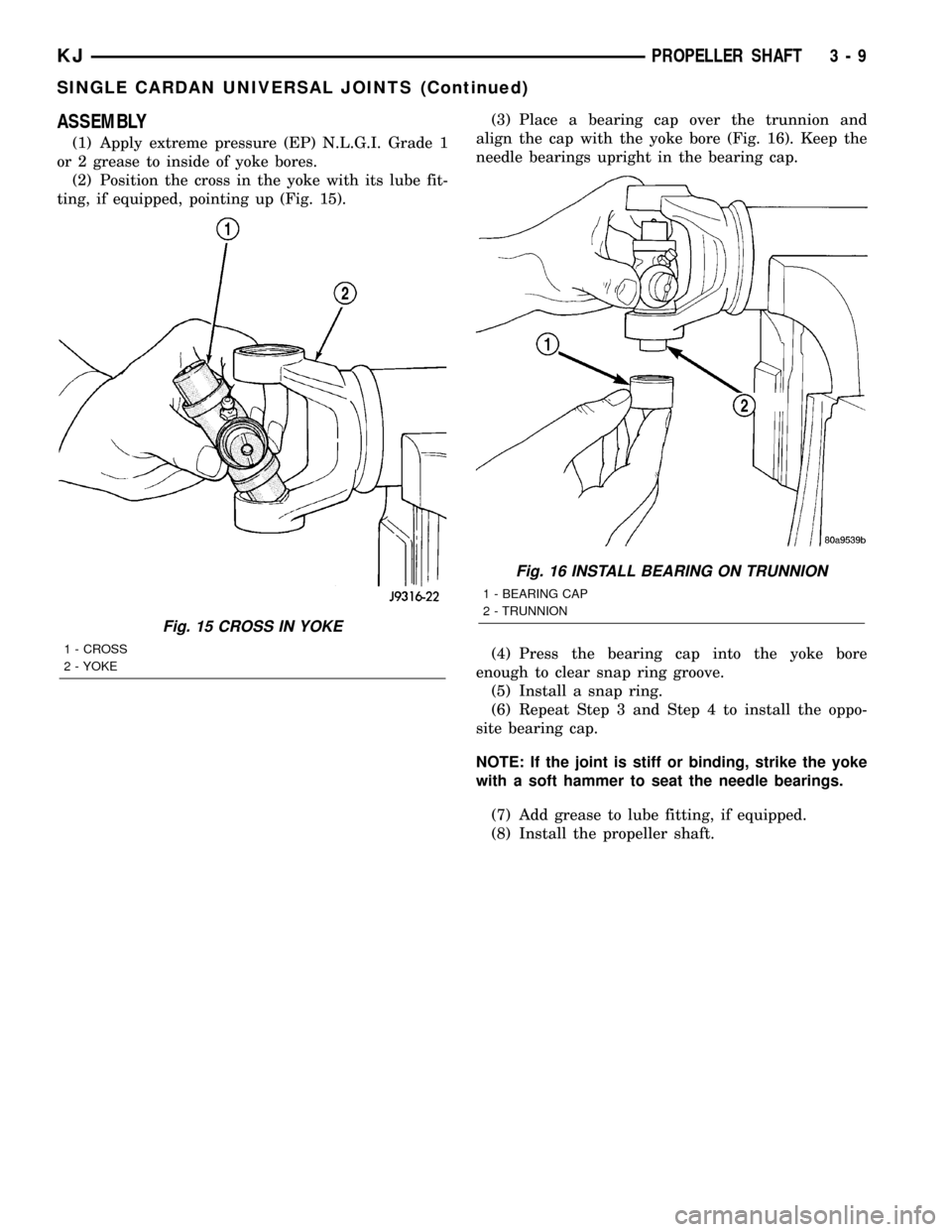
(2) Position the cross in the yoke with its lube fit-
ting, if equipped, pointing up (Fig. 15).(3) Place a bearing cap over the trunnion and
align the cap with the yoke bore (Fig. 16). Keep the
needle bearings upright in the bearing cap.
(4) Press the bearing cap into the yoke bore
enough to clear snap ring groove.
(5) Install a snap ring.
(6) Repeat Step 3 and Step 4 to install the oppo-
site bearing cap.
NOTE: If the joint is stiff or binding, strike the yoke
with a soft hammer to seat the needle bearings.
(7) Add grease to lube fitting, if equipped.
(8) Install the propeller shaft.
Fig. 15 CROSS IN YOKE
1 - CROSS
2 - YOKE
Fig. 16 INSTALL BEARING ON TRUNNION
1 - BEARING CAP
2 - TRUNNION
KJPROPELLER SHAFT 3 - 9
SINGLE CARDAN UNIVERSAL JOINTS (Continued)
Page 59 of 1803

HALF SHAFT
TABLE OF CONTENTS
page page
HALF SHAFT
CAUTION.............................10
DIAGNOSIS AND TESTING - HALF SHAFT....10
REMOVAL.............................10
INSTALLATION.........................11
SPECIFICATIONS
HALF SHAFT.........................11SPECIAL TOOLS.......................12
CV JOINT/BOOT-OUTER
REMOVAL.............................12
INSTALLATION.........................13
CV JOINT/BOOT-INNER
REMOVAL.............................15
INSTALLATION.........................17
HALF SHAFT
CAUTION
CAUTION:: Never grasp half shaft assembly by the
boots. This may cause the boot to pucker or crease
and reduce the service life of the boot.
Avoid over angulating or stroking the C/V joints
when handling the half shaft.
Half shafts exposed to battery acid, transmission
fluid, brake fluid, differential fluid or gasoline may
cause the boots to deteriorate.
DIAGNOSIS AND TESTING - HALF SHAFT
Check for grease at the inboard and outboard C/V
joint. This is a sign of boot or boot clamp damage.
NOISE AND/OR VIBRATION IN TURNS
A clicking noise or a vibration in turns could be
caused by a damaged outer C/V or inner tripod joint
seal boot or seal boot clamps. This will result in the
loss/contamination of the joint grease, resulting in
inadequate lubrication of the joint. Noise could also
be caused by another component of the vehicle com-
ing in contact with the half shafts.
CLUNKING NOISE DURING ACCELERATION
This noise may be a result of a damaged or worn
C/V joint. A torn boot or loose/missing clamp on the
inner/outer joint which has allowed the grease to be
lost will damage the C/V joint.
SHUDDER OR VIBRATION DURING ACCELERATION
This problem could be a result of a worn/damaged
inner tripod joint or a sticking tripod joint. Improper
wheel alignment may also cause a shudder or vibration.
VIBRATION AT HIGHWAY SPEEDS
This problem could be a result of out of balance
front tires or tire/wheel runout. Foreign material
(mud, etc.) packed on the backside of the wheel(s)
will also cause a vibration.
REMOVAL
(1) Raise and support vehicle.
(2) Remove wheel and tire assembly.
(3) Remove half shaft hub nut.
(4) Remove stabilizer link (Fig. 1).
Fig. 1 STABILIZER BAR LINK
1 - STABILIZER BAR
2 - STABILIZER BAR LINK
3 - 10 HALF SHAFTKJ
Page 60 of 1803

(5) Remove lower clevis bolt (Fig. 2).
(6) Seperate lower ball joint from the lower control
arm (Fig. 3).
(7) Pull out on the steering knuckle and push the
half shaft out of the knuckle.
(8) With a pry bar remove the half shaft from the
axle.
NOTE: The right side has a splined axle shaft that
will stay in the axle.
INSTALLATION
(1) Apply a light coat of wheel bearing grease on
the female splines of the inner C/V joint.(2) Install half shaft on the axle shaft spline and
push firmly to engage the snap ring. Pull on the half
shaft to verify snap has engaged.
(3) Clean hub bearing bore and apply a light coat
of wheel bearing grease.
(4) Pull out on the steering knuckle and push the
half shaft through the knuckle.
(5) Install lower ball joint into the lower control
arm and tighten pinch bolt.
(6) Align clevis with knuckle. Install and tighten
lower clevis bolt.
(7) Install stabilizer link.
(8) Install half shaft hub nut.
(9) Install wheel and tire assembly.
(10) Remove support and lower vehicle.
SPECIFICATIONS
HALF SHAFT
TORQUE SPECIFICATIONS
DESCRIPTION N´m Ft. Lbs. In. Lbs.
Half Shaft Nut 136 100 -
Fig. 3 LOWER CONTROL ARM
1 - FRONT CAM BOLT
2 - OUTER TIE ROD END
3 - LOWER BALL JOINT NUT
4 - LOWER CONTROL ARM
5 - REAR CAM BOLTFig. 2 CLEVIS BRACKET
1 - UPPER BOLT
2 - CLEVIS BRACKET
3 - LOWER BOLT
KJHALF SHAFT 3 - 11
HALF SHAFT (Continued)
Page 61 of 1803
SPECIAL TOOLS
CV JOINT/BOOT-OUTER
REMOVAL
(1) Clamp shaft in a vise (with soft jaws) and sup-
port C/V joint.
(2) Remove clamps with a cut-off wheel or grinder
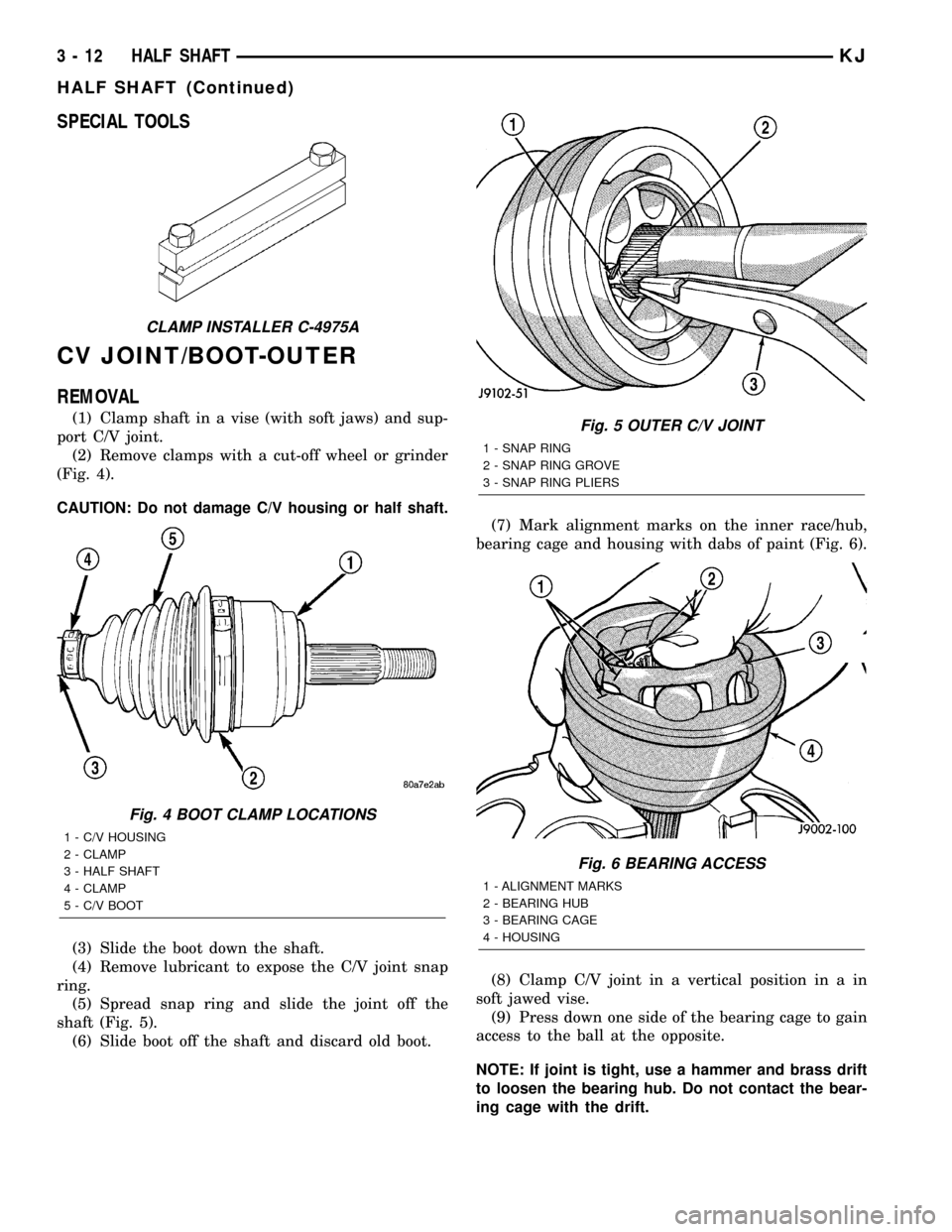
(Fig. 4).
CAUTION: Do not damage C/V housing or half shaft.
(3) Slide the boot down the shaft.
(4) Remove lubricant to expose the C/V joint snap
ring.
(5) Spread snap ring and slide the joint off the
shaft (Fig. 5).
(6) Slide boot off the shaft and discard old boot.(7) Mark alignment marks on the inner race/hub,
bearing cage and housing with dabs of paint (Fig. 6).
(8) Clamp C/V joint in a vertical position in a in
soft jawed vise.
(9) Press down one side of the bearing cage to gain
access to the ball at the opposite.
NOTE: If joint is tight, use a hammer and brass drift
to loosen the bearing hub. Do not contact the bear-
ing cage with the drift.
CLAMP INSTALLER C-4975A
Fig. 4 BOOT CLAMP LOCATIONS
1 - C/V HOUSING
2 - CLAMP
3 - HALF SHAFT
4 - CLAMP
5 - C/V BOOT
Fig. 5 OUTER C/V JOINT
1 - SNAP RING
2 - SNAP RING GROVE
3 - SNAP RING PLIERS
Fig. 6 BEARING ACCESS
1 - ALIGNMENT MARKS
2 - BEARING HUB
3 - BEARING CAGE
4 - HOUSING
3 - 12 HALF SHAFTKJ
HALF SHAFT (Continued)
Page 62 of 1803
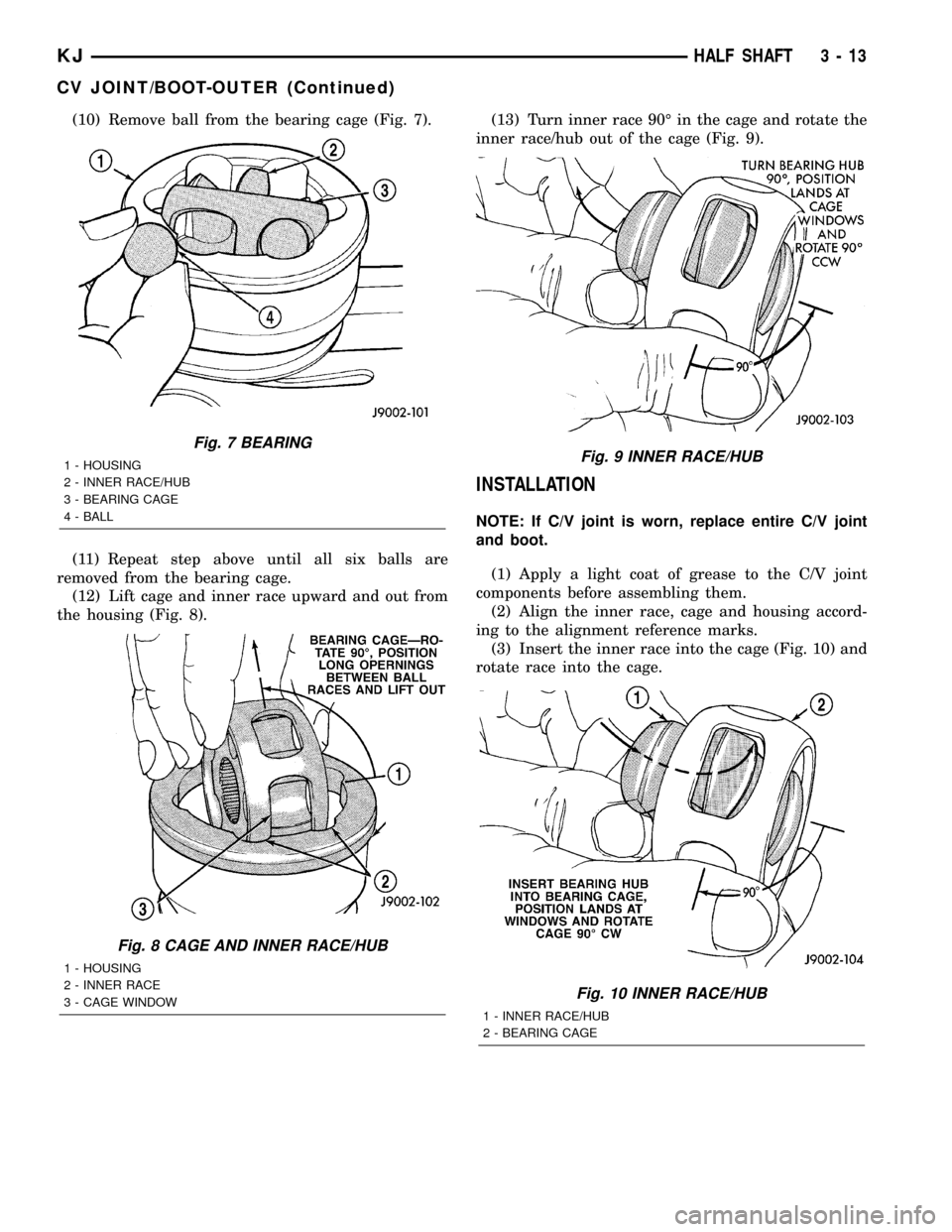
(10) Remove ball from the bearing cage (Fig. 7).
(11) Repeat step above until all six balls are
removed from the bearing cage.
(12) Lift cage and inner race upward and out from
the housing (Fig. 8).(13) Turn inner race 90É in the cage and rotate the
inner race/hub out of the cage (Fig. 9).
INSTALLATION
NOTE: If C/V joint is worn, replace entire C/V joint
and boot.
(1) Apply a light coat of grease to the C/V joint
components before assembling them.
(2) Align the inner race, cage and housing accord-
ing to the alignment reference marks.
(3) Insert the inner race into the cage (Fig. 10) and
rotate race into the cage.
Fig. 7 BEARING
1 - HOUSING
2 - INNER RACE/HUB
3 - BEARING CAGE
4 - BALL
Fig. 8 CAGE AND INNER RACE/HUB
1 - HOUSING
2 - INNER RACE
3 - CAGE WINDOW
Fig. 9 INNER RACE/HUB
Fig. 10 INNER RACE/HUB
1 - INNER RACE/HUB
2 - BEARING CAGE
KJHALF SHAFT 3 - 13
CV JOINT/BOOT-OUTER (Continued)
Page 63 of 1803
(4) Rotate the inner race/hub in the cage (Fig. 11).
(5) Insert cage into the housing (Fig. 12). Rotate
the cage 90É into the housing (Fig. 13).
(6) Apply the lubricant included with the replace-
ment boot to the ball races. Spread the lubricant
equally between all the races.
(7) Tilt inner race/hub and cage and install the
balls (Fig. 14).
Fig. 11 CAGE AND INNER RACE/HUB
1 - CAGE WINDOWS
2 - SNAP RING
Fig. 12 BEARING CAGE AND HOUSING
1 - OUTER RACE
2 - BEARING CAGE WINDOW
3 - CV JOINT HOUSING
Fig. 13 CAGE AND INNER RACE/HUB
1 - C/V HOUSING
2 - BEARING HUB LARGE COUNTERBORE OUTWARD
3 - BOOT RETAINING SHOULDER
4 - BEARING HUB SMALL COUNTERBORE INWARD
5 - SLINGER
Fig. 14 BALL BEARING
1 - C/V HOUSING
2 - INNER RACE/HUB
3 - BEARING CAGE
4 - BEARING
3 - 14 HALF SHAFTKJ
CV JOINT/BOOT-OUTER (Continued)
Page 64 of 1803
(8) Place new clamps onto new boot and slide boot
onto the shaft to it's original position.
(9) Apply the rest of lubricant to the C/V joint and
boot.
(10) Install the joint onto the shaft. Push the joint
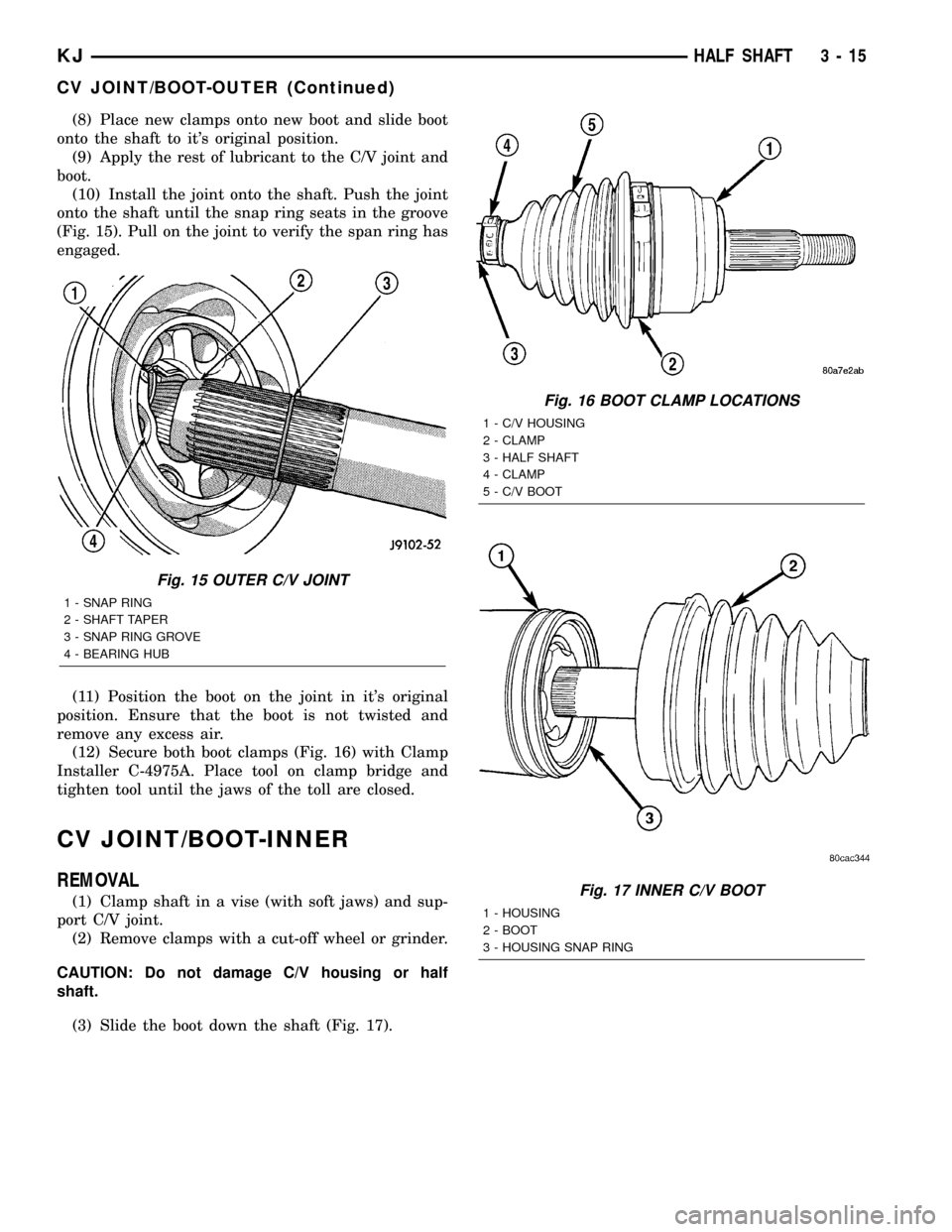
onto the shaft until the snap ring seats in the groove
(Fig. 15). Pull on the joint to verify the span ring has
engaged.
(11) Position the boot on the joint in it's original
position. Ensure that the boot is not twisted and
remove any excess air.
(12) Secure both boot clamps (Fig. 16) with Clamp
Installer C-4975A. Place tool on clamp bridge and
tighten tool until the jaws of the toll are closed.
CV JOINT/BOOT-INNER
REMOVAL
(1) Clamp shaft in a vise (with soft jaws) and sup-
port C/V joint.
(2) Remove clamps with a cut-off wheel or grinder.
CAUTION: Do not damage C/V housing or half
shaft.
(3) Slide the boot down the shaft (Fig. 17).
Fig. 15 OUTER C/V JOINT
1 - SNAP RING
2 - SHAFT TAPER
3 - SNAP RING GROVE
4 - BEARING HUB
Fig. 16 BOOT CLAMP LOCATIONS
1 - C/V HOUSING
2 - CLAMP
3 - HALF SHAFT
4 - CLAMP
5 - C/V BOOT
Fig. 17 INNER C/V BOOT
1 - HOUSING
2 - BOOT
3 - HOUSING SNAP RING
KJHALF SHAFT 3 - 15
CV JOINT/BOOT-OUTER (Continued)
Page 65 of 1803
(4) Remove lubricant to expose the C/V housing
snap ring and remove snap ring (Fig. 18).
(5) Remove bearings from the cage (Fig. 19).
(6) Rotate cage 30É and slide cage off the inner
race and down the shaft.
(7) Remove spread inner race snap ring (Fig. 20)
and remove race from the shaft.
(8) Remove boot from the shaft and discard.(9) Clean and inspect all components for wear or
damage (Fig. 21).
Fig. 18 HOUSING SNAP RING
1 - HOUSING
2 - SNAP RING
3 - CAGE/INNER RACE
Fig. 19 C/V BEARINGS
1 - CAGE
2 - INNER RACE
3 - SHAFT
4 - BEARING
Fig. 20 INNER RACE
1 - INNER RACE
2 - PLIERS
3 - SHAFT
4 - SNAP RING ACCESS
Fig. 21 INNER C/V JOINT
1 - HOUSING
2 - CAGE
3 - BEARINGS
4 - HOUSING SNAP RING
5 - INNER RACE SNAP RING
6 - INNER RACE
3 - 16 HALF SHAFTKJ
CV JOINT/BOOT-INNER (Continued)