2002 JEEP LIBERTY Front suspension
[x] Cancel search: Front suspensionPage 531 of 1803

FRONT FOG LAMPS
Vehicles equipped with optional front fog lamps
have a premium Body Control Module (BCM), a front
fog lamp relay installed in the Junction Block (JB),
and a front fog lamp switch integral to the left (light-
ing) control stalk of the multi-function switch. The
front fog lamps have a path to ground at all times
through their connection to the front fascia wire har-
ness from two take outs of the headlamp and dash
wire harness with eyelet terminal connectors that
are secured by ground screws to the left inner fender
shield in the engine compartment. The BCM controls
front fog lamp operation by monitoring the exterior
lighting switch input from the multi-function switch,
then energizing or de-energizing the front fog lamp
relay control coil; and, by sending the appropriate
electronic message to the instrument cluster over the
Programmable Communications Interface (PCI) data
bus to turn the front fog lamp indicator on or off.
When the front fog lamp relay is energized, it pro-
vides battery current from a fused B(+) fuse in the
JB to the front fog lamps through the front fog lamp
relay output circuit. The BCM provides a battery
saver (load shedding) feature for the front fog lamps,
which will turn these lamps off if they are left on for
more than about eight minutes with the ignition
switch in the Off position. In certain markets where
required, the front fog lamps are also turned off by
the BCM whenever the headlamp high beams are
selected. Each front fog lamp includes an integral
adjustment screw to be used for static aiming the fog
lamp beams.
HAZARD WARNING LAMPS
With the hazard switch in the On position, the
hazard warning system is activated causing the haz-
ard switch button illumination lamp, the right and
left turn signal indicators, and the right and left turn
signal lamps to flash on and off. When the hazard
warning system is activated, the circuitry within the
hazard switch and electronic combination flasher
unit will repeatedly energize and de-energize two
internal relays that switch battery current from a
fused B(+) fuse in the Junction Block (JB) to the
right side and left side turn signal indicators, and
turn signal lamps through the right and left turn sig-
nal circuits. The flashing of the hazard switch button
illumination lamp is performed internally by the haz-
ard switch and combination flasher unit circuit
board. The hazard warning lamps can also be ener-
gized by the Body Control Module (BCM) through a
hazard lamp control circuit input to the hazard
switch and combination flasher unit.HEADLAMPS
The headlamp system includes the Body Control
Module (BCM), a low beam relay installed in the
Junction Block (JB), a high beam relay installed in
the JB (except Canada), a solid state Daytime Run-
ning Lamps (DRL) relay installed in the JB (Canada
only), and the exterior lighting (headlamp and dim-
mer) switches integral to the left (lighting) control
stalk of the multi-function switch. The headlamp
bulbs have a path to ground at all times through
their connection to the grille opening reinforcement
wire harness from two take outs of the headlamp and
dash wire harness with eyelet terminal connectors
that are secured by ground screws to the left inner
fender shield in the engine compartment. The BCM
controls the headlamp operation by monitoring the
exterior lighting switch inputs from the multi-func-
tion switch, then energizing or de-energizing the con-
trol coils of the low beam relay, the high beam relay,
or the solid state circuitry of the DRL relay; and, by
sending the appropriate electronic message to the
instrument cluster over the Programmable Commu-
nications Interface (PCI) data bus to turn the high
beam indicator on or off. When each respective relay
is energized, it provides battery current from a fused
B(+) fuse in the Power Distribution Center (PDC)
through a relay (low beam, high beam, or DRL) out-
put circuit and four separate fuses in the JB through
individual fused right and left, low and high beam
output circuits to the appropriate headlamp bulb fil-
aments. The BCM provides a battery saver (load
shedding) feature for the headlamps, which will turn
these lamps off if they are left on for more than
about eight minutes with the ignition switch in the
Off position; and, a headlamp delay feature with a
DRBIIItscan tool programmable delay interval.
Each headlamp includes an integral adjustment
screw to be used for static aiming of the headlamp
beams.
HEADLAMP LEVELING
In certain markets where required, a headlamp
leveling system is provided on the vehicle. The head-
lamp leveling system includes unique headlamp units
equipped with a headlamp leveling actuator motor,
and a rotary thumbwheel actuated headlamp leveling
switch on the instrument panel. The headlamp level-
ing system allows the headlamp beams to be
adjusted to one of four vertical positions to compen-
sate for changes in inclination caused by the loading
of the vehicle suspension. The actuator motors are
mechanically connected through an integral pushrod
to an adjustable headlamp reflector. The headlamp
leveling switch is a resistor multiplexed unit that
provides one of four voltage outputs to the headlamp
leveling motors. The headlamp leveling motors will
8Ls - 6 LAMPSKJ
LAMPS/LIGHTING - EXTERIOR (Continued)
Page 551 of 1803

(3) Rock the vehicle from side-to-side three times
to allow the suspension to stabilize, then jounce the
front suspension three times by pushing downward
on the front bumper and releasing. Measure the dis-
tance from the center of the front fog lamp lens to
the floor. Transfer this measurement to the align-
ment screen and tape a horizontal line on the wall at
this mark. This line will be used for up-and-down
adjustment reference.
(4) Measure the distance from the centerline of the
vehicle to the center of each front fog lamp being
aligned. Transfer these measurements to the align-
ment screen and tape a vertical line this distance to
each side of the vehicle centerline. These lines will be
used for left/right reference.
(5) Rotate the front fog lamp adjusting screws to
adjust the beam height as required (Fig. 17).
Fig. 16 Front Fog Lamp Alignment - Typical
1 - VEHICLE CENTERLINE
2 - CENTER OF VEHICLE TO CENTER OF FOG LAMP LENS
3 - HIGH-INTENSITY AREA
4 - FLOOR TO CENTER OF FOG LAMP LENS5 - 100 MILLIMETERS (4 INCHES)
6 - 7.62 METERS (25 FEET)
7 - FRONT OF FOG LAMP
Fig. 17 Front Fog Lamp Adjusting Screw
1 - FRONT BUMPER FASCIA
2 - ADJUSTING SCREW
3 - FRONT FOG LAMP UNIT
8Ls - 26 LAMPSKJ
FRONT FOG LAMP UNIT (Continued)
Page 568 of 1803

HEADLAMP ALIGNMENT SCREEN PREPARATION
Prepare an alignment screen as illustrated.
(1) Position the vehicle on a level surface perpen-
dicular to a flat wall 7.62 meters (25 feet) away from
the front of the headlamp lens for North American
vehicles, or 10.0 meters (32.81 feet) away from the
front of the headlamp lens for Rest-Of-World vehicles
(Fig. 43). If necessary, tape a line on the floor at the
appropriate distance away from and parallel to the
wall.
(2) Measure up on the wall 1.27 meters (5 feet)
from the floor and tape a vertical line on the align-
ment screen at the centerline of the vehicle. Sight
along the centerline of the vehicle (from the rear of
the vehicle forward) to verify the accuracy of the cen-
terline placement.
(3) Rock the vehicle from side-to-side three times
to allow the suspension to stabilize, then jounce the
front suspension three times by pushing downward
on the front bumper and releasing. Measure the dis-
tance from the center of the headlamp lens to the
floor. Transfer this measurement to the alignment
screen and tape a horizontal line on the wall at this
mark. This line will be used for up-and-down adjust-
ment reference.(4) Measure the distance from the centerline of the
vehicle to the center of each headlamp being aligned.
Transfer these measurements to the alignment
screen and tape a vertical line this distance to each
side of the vehicle centerline. These lines will be used
for left/right reference.
HEADLAMP ADJUSTMENT
A properly aligned headlamp will project a pattern
on the alignment screen from just below horizontal to
75 millimeters (3 inches) below the headlamp center-
line for vehicles in North America, or from just below
horizontal to 125 millimeters (5 inches) below the
headlamp horizontal centerline for vehicles in Rest-
Of-World.
(1) Vehicles for all markets except Japan should
have the headlamp low beams selected with the dim-
mer (multi-function) switch during the adjustment
procedure. Vehicles for the Japanese market should
have the headlamp high beams selected.
(2) Cover the lens of the headlamp that is not
being adjusted.
(3) Turn the adjusting screw (Fig. 44) until the top
edge of the beam intensity pattern is positioned from
just below horizontal to 75 millimeters (3 inches)
Fig. 43 Headlamp Alignment Screen - Typical
1 - CENTER OF VEHICLE TO CENTER OF HEADLAMP LENS
2 - FLOOR TO CENTER OF HEADLAMP LENS
3 - 7.62 METERS (25 FEET) NORTH AMERICA/10.0 METERS
(32.81 FEET) REST-OF-WORLD4 - FRONT OF HEADLAMP
5 - VEHICLE CENTERLINE
KJLAMPS8Ls-43
HEADLAMP UNIT (Continued)
Page 752 of 1803

TERMINOLOGY
This is a list of terms and definitions used in the
wiring diagrams.
LHD .................Left Hand Drive Vehicles
RHD................Right Hand Drive Vehicles
ATX . . Automatic Transmissions-Front Wheel Drive
MTX....Manual Transmissions-Front Wheel Drive
AT ....Automatic Transmissions-Rear Wheel Drive
MT .....Manual Transmissions-Rear Wheel Drive
SOHC...........Single Over Head Cam Engine
DOHC..........Double Over Head Cam Engine
Built-Up-Export........ Vehicles Built For Sale In
Markets Other Than North America
Except-Built-Up-Export . . Vehicles Built For Sale In
North America
DESCRIPTION - CIRCUIT INFORMATION
Each wire shown in the diagrams contains a code
which identifies the main circuit, part of the main
circuit, gage of wire, and color (Fig. 4).
WIRE COLOR CODE CHART
COLOR CODE COLOR
BL BLUE
BK BLACK
BR BROWN
DB DARK BLUE
DG DARK GREEN
GY GRAY
LB LIGHT BLUE
LG LIGHT GREEN
COLOR CODE COLOR
OR ORANGE
PK PINK
RD RED
TN TAN
VT VIOLET
WT WHITE
YL YELLOW
* WITH TRACER
DESCRIPTION - CIRCUIT FUNCTIONS
All circuits in the diagrams use an alpha/numeric
code to identify the wire and it's function. To identify
which circuit code applies to a system, refer to the
Circuit Identification Code Chart. This chart shows
the main circuits only and does not show the second-
ary codes that may apply to some models.
CIRCUIT IDENTIFICATION CODE CHART
CIRCUIT FUNCTION
A BATTERY FEED
B BRAKE CONTROLS
C CLIMATE CONTROLS
D DIAGNOSTIC CIRCUITS
E DIMMING ILLUMINATION
CIRCUITS
F FUSED CIRCUITS
G MONITORING CIRCUITS
(GAUGES)
H OPEN
I NOT USED
J OPEN
K POWERTRAIN CONTROL
MODULE
L EXTERIOR LIGHTING
M INTERIOR LIGHTING
N NOT USED
O NOT USED
P POWER OPTION (BATTERY
FEED)
Q POWER OPTIONS (IGNITION
FEED)
R PASSIVE RESTRAINT
S SUSPENSION/STEERING
T TRANSMISSION/TRANSAXLE/
TRANSFER CASE
Fig. 4 WIRE CODE IDENTIFICATION
1 - COLOR OF WIRE (LIGHT BLUE WITH YELLOW TRACER
2 - GAGE OF WIRE (18 GAGE)
3 - PART OF MAIN CIRCUIT (VARIES DEPENDING ON
EQUIPMENT)
4 - MAIN CIRCUIT IDENTIFICATION
KJ8W-01 WIRING DIAGRAM INFORMATION8Wa-01-5
WIRING DIAGRAM INFORMATION (Continued)
Page 1379 of 1803
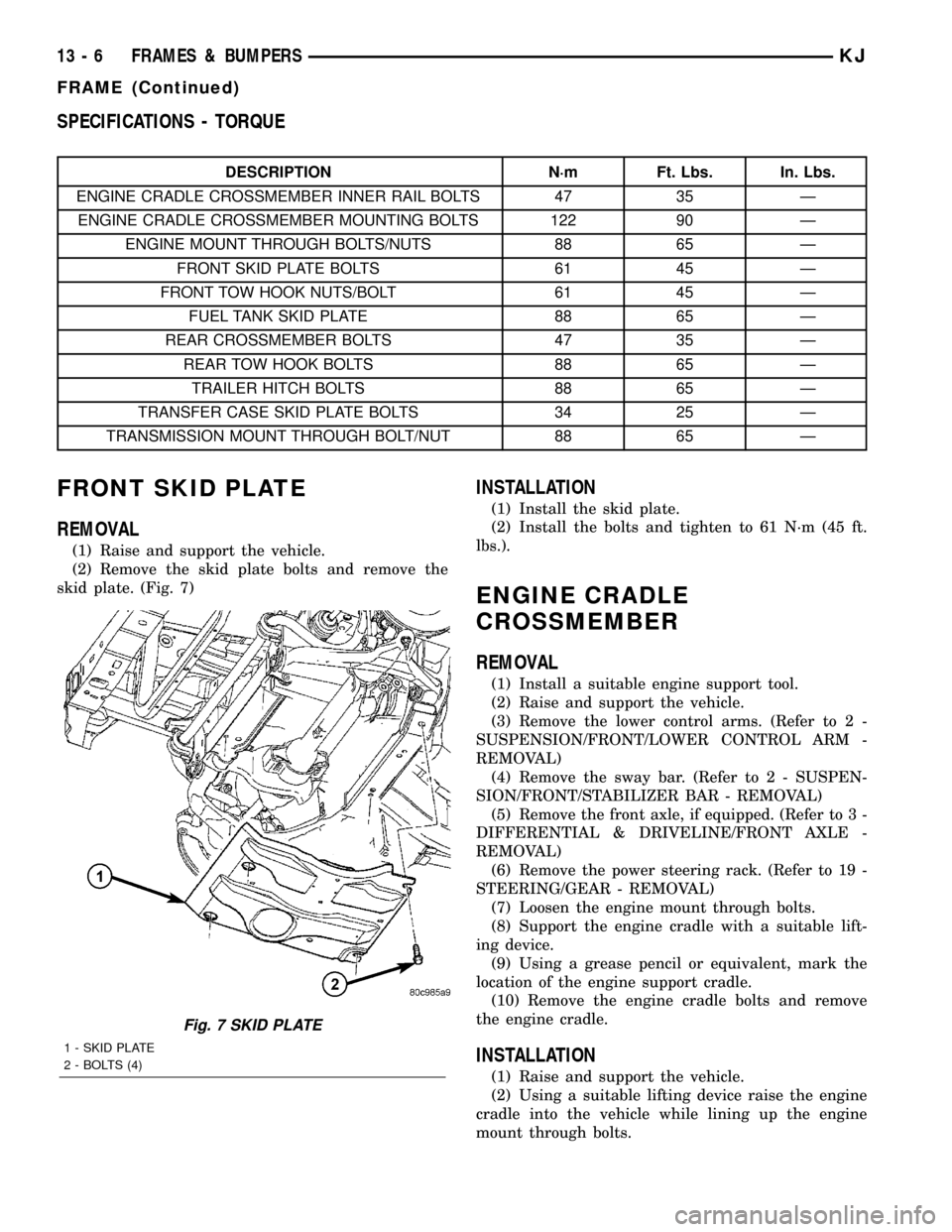
SPECIFICATIONS - TORQUE
DESCRIPTION N´m Ft. Lbs. In. Lbs.
ENGINE CRADLE CROSSMEMBER INNER RAIL BOLTS 47 35 Ð
ENGINE CRADLE CROSSMEMBER MOUNTING BOLTS 122 90 Ð
ENGINE MOUNT THROUGH BOLTS/NUTS 88 65 Ð
FRONT SKID PLATE BOLTS 61 45 Ð
FRONT TOW HOOK NUTS/BOLT 61 45 Ð
FUEL TANK SKID PLATE 88 65 Ð
REAR CROSSMEMBER BOLTS 47 35 Ð
REAR TOW HOOK BOLTS 88 65 Ð
TRAILER HITCH BOLTS 88 65 Ð
TRANSFER CASE SKID PLATE BOLTS 34 25 Ð
TRANSMISSION MOUNT THROUGH BOLT/NUT 88 65 Ð
FRONT SKID PLATE
REMOVAL
(1) Raise and support the vehicle.
(2) Remove the skid plate bolts and remove the
skid plate. (Fig. 7)
INSTALLATION
(1) Install the skid plate.
(2) Install the bolts and tighten to 61 N´m (45 ft.
lbs.).
ENGINE CRADLE
CROSSMEMBER
REMOVAL
(1) Install a suitable engine support tool.
(2) Raise and support the vehicle.
(3) Remove the lower control arms. (Refer to 2 -
SUSPENSION/FRONT/LOWER CONTROL ARM -
REMOVAL)
(4) Remove the sway bar. (Refer to 2 - SUSPEN-
SION/FRONT/STABILIZER BAR - REMOVAL)
(5) Remove the front axle, if equipped. (Refer to 3 -
DIFFERENTIAL & DRIVELINE/FRONT AXLE -
REMOVAL)
(6) Remove the power steering rack. (Refer to 19 -
STEERING/GEAR - REMOVAL)
(7) Loosen the engine mount through bolts.
(8) Support the engine cradle with a suitable lift-
ing device.
(9) Using a grease pencil or equivalent, mark the
location of the engine support cradle.
(10) Remove the engine cradle bolts and remove
the engine cradle.
INSTALLATION
(1) Raise and support the vehicle.
(2) Using a suitable lifting device raise the engine
cradle into the vehicle while lining up the engine
mount through bolts.
Fig. 7 SKID PLATE
1 - SKID PLATE
2 - BOLTS (4)
13 - 6 FRAMES & BUMPERSKJ
FRAME (Continued)
Page 1380 of 1803

(3) Align the engine cradle to the marks made dur-
ing removal and install the mounting and inner rail
bolts.
(4) Tighten the mounting bolts to 122 N´m (90 ft.
lbs.).
(5) Tighten the inner rail bolts to 47 N´m (35 ft.
lbs.).
(6) Tighten the engine mount through bolts to 88
N´m (65 ft. lbs.).
(7) Install the power steering rack. (Refer to 19 -
STEERING/GEAR - INSTALLATION)
(8) Install the front axle, if equipped. (Refer to 3 -
DIFFERENTIAL & DRIVELINE/FRONT AXLE -
INSTALLATION)
(9) Install the stabilizer bar. (Refer to 2 - SUS-
PENSION/FRONT/STABILIZER BAR - INSTALLA-
TION)
(10) Install the lower control arms. (Refer to 2 -
SUSPENSION/FRONT/LOWER CONTROL ARM -
INSTALLATION)
(11) Lower the vehicle and remove the engine sup-
port tool.
TRANSFER CASE SKID PLATE
REMOVAL
(1) Remove the bolts and remove the skid plate.
(Fig. 8)
INSTALLATION
(1) Install the skid plate.
(2) Install the bolts and tighten to 34 N´m (25 ft.
lbs.).
REAR CROSSMEMBER
REMOVAL
(1) Raise and support the vehicle.
(2) Support the transmission with a suitable lifting
device.
(3) Remove the transmission mount through bolt.
(4) Remove the crossmember bolts and remove the
crossmember. (Fig. 9)
INSTALLATION
(1) Install the crossmember and install the bolts.
(2) Tighten the bolts to 47 N´m (35 ft. lbs.)
(3) Install transmission mount through bolt and
tighten to 88 N´m (65 ft. lbs.).
Fig. 8 SKID PLATE
1 - SKID PLATE
2 - BOLTS
Fig. 9 CROSS MEMBER
1 - CROSSMEMBER
2 - BOLTS
KJFRAMES & BUMPERS 13 - 7
ENGINE CRADLE CROSSMEMBER (Continued)
Page 1431 of 1803
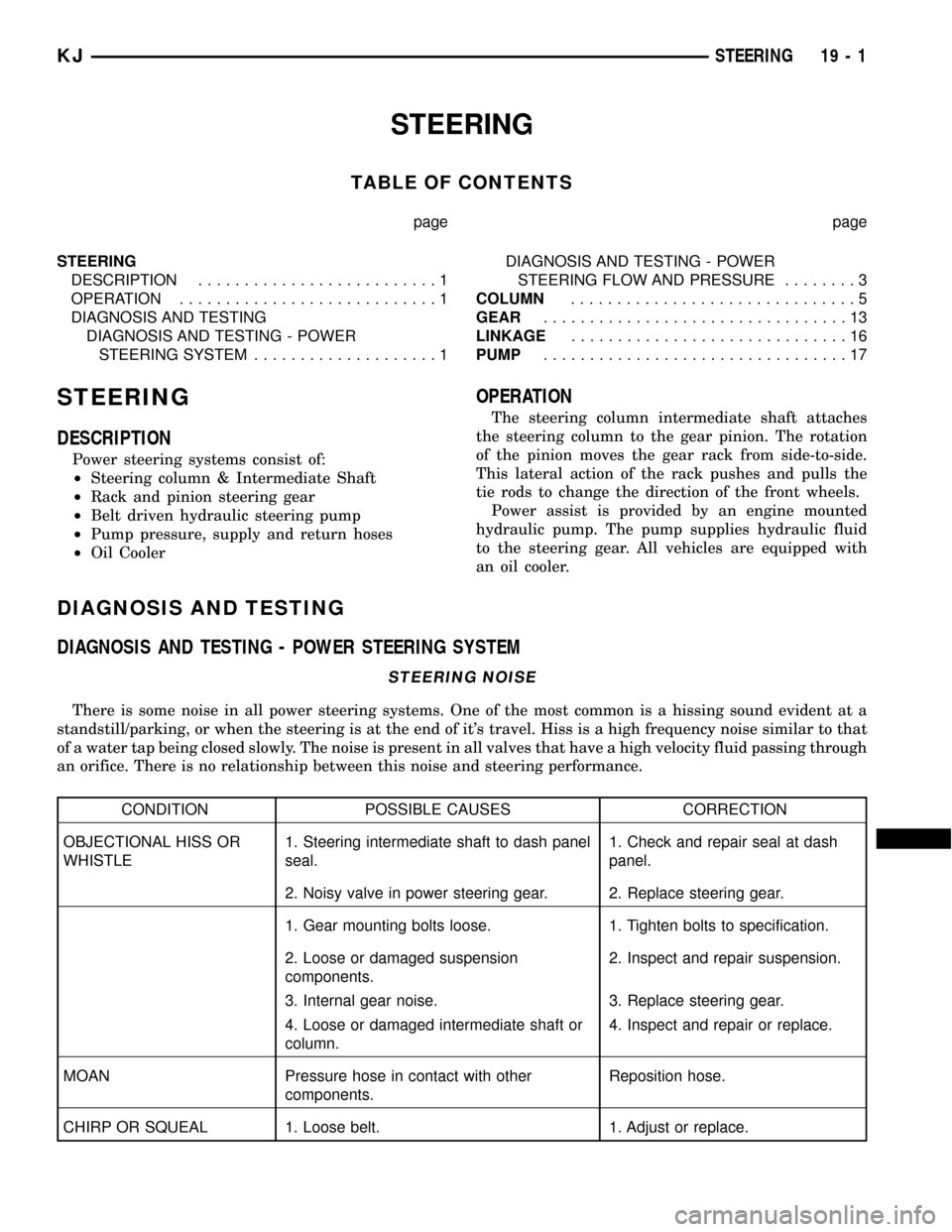
STEERING
TABLE OF CONTENTS
page page
STEERING
DESCRIPTION..........................1
OPERATION............................1
DIAGNOSIS AND TESTING
DIAGNOSIS AND TESTING - POWER
STEERING SYSTEM....................1DIAGNOSIS AND TESTING - POWER
STEERING FLOW AND PRESSURE........3
COLUMN...............................5
GEAR.................................13
LINKAGE..............................16
PUMP.................................17
STEERING
DESCRIPTION
Power steering systems consist of:
²Steering column & Intermediate Shaft
²Rack and pinion steering gear
²Belt driven hydraulic steering pump
²Pump pressure, supply and return hoses
²Oil Cooler
OPERATION
The steering column intermediate shaft attaches
the steering column to the gear pinion. The rotation
of the pinion moves the gear rack from side-to-side.
This lateral action of the rack pushes and pulls the
tie rods to change the direction of the front wheels.
Power assist is provided by an engine mounted
hydraulic pump. The pump supplies hydraulic fluid
to the steering gear. All vehicles are equipped with
an oil cooler.
DIAGNOSIS AND TESTING
DIAGNOSIS AND TESTING - POWER STEERING SYSTEM
STEERING NOISE
There is some noise in all power steering systems. One of the most common is a hissing sound evident at a
standstill/parking, or when the steering is at the end of it's travel. Hiss is a high frequency noise similar to that
of a water tap being closed slowly. The noise is present in all valves that have a high velocity fluid passing through
an orifice. There is no relationship between this noise and steering performance.
CONDITION POSSIBLE CAUSES CORRECTION
OBJECTIONAL HISS OR
WHISTLE1. Steering intermediate shaft to dash panel
seal.1. Check and repair seal at dash
panel.
2. Noisy valve in power steering gear. 2. Replace steering gear.
1. Gear mounting bolts loose. 1. Tighten bolts to specification.
2. Loose or damaged suspension
components.2. Inspect and repair suspension.
3. Internal gear noise. 3. Replace steering gear.
4. Loose or damaged intermediate shaft or
column.4. Inspect and repair or replace.
MOAN Pressure hose in contact with other
components.Reposition hose.
CHIRP OR SQUEAL 1. Loose belt. 1. Adjust or replace.
KJSTEERING 19 - 1
Page 1432 of 1803

CONDITION POSSIBLE CAUSES CORRECTION
WHINE OR GROWL 1. Low fluid level. 1. Fill to proper level.
2. Pressure hose in contact with other
components.2. Reposition hose.
3. Internal pump noise. 3. Replace pump.
SUCKING AIR SOUND 1. Loose return line clamp. 1. Replace clamp.
2. O-ring missing or damaged on hose
fitting.2. Replace o-ring.
3. Low fluid level. 3. Fill to proper level.
4. Air leak between pump and reservoir. 4. Repair as necessary.
5. Reservoir cap not installed correctly. 5. Install reservoir cap correctly.
SCRUBBING OR
KNOCKING1. Wrong tire size. 1. Verify tire size.
2. Wrong gear. 2. Verify gear.
3. Tire Pressure 3. Adjust Tire Pressure
BINDING AND STICKING
CONDITION POSSIBLE CAUSE CORRECTION
DIFFICULT TO TURN WHEEL
STICKS OR BINDS1. Low fluid level. 1. Fill to proper level.
2. Tire pressure. 2. Adjust tire pressure.
3. Steering components (ball
joints/tie rod ends).3 Inspect and repair as necessary.
4. Loose belt. 4. Adjust or replace.
5. Low pump pressure. 5. Pressure test and replace if
necessary.
6. Column Intermediate shaft
binding.6. Replace Intermediate Shaft.
7. Steering gear worn. 7. Replace gear.
INSUFFICIENT ASST. OR POOR RETURN TO CENTER
CONDITION POSSIBLE CAUSE CORRECTION
HARD TURNING OR MOMENTARY
INCREASE IN TURNING EFFORT1. Tire pressure. 1. Adjust tire pressure.
2. Low fluid level. 2. Fill to proper level.
3. Loose belt. 3. Adjust or replace.
4. Low pump pressure. 4. Pressure test and repair as
necessary.
5. Internal gear leak. 5. Replace gear.
STEERING WHEEL DOES NOT
WANT TO RETURN TO CENTER
POSITION1. Tire pressure. 1. Adjust tire pressure.
2. Wheel alignment. 2. Align front end.
3. Lack of lubrication. 3. Inspect and lubricate suspension
compnents.
4. High friction in steering gear. 4. Replace gear.
19 - 2 STEERINGKJ
STEERING (Continued)