2002 JEEP LIBERTY instrument panel
[x] Cancel search: instrument panelPage 1466 of 1803

BODY
TABLE OF CONTENTS
page page
BODY
WARNING
SAFETY PRECAUTIONS AND WARNINGS . . . 1
DIAGNOSIS AND TESTING
DIAGNOSIS AND TESTING - WATER LEAKS . 2
DIAGNOSIS AND TESTING - WIND NOISE . . . 3
STANDARD PROCEDURE
STANDARD PROCEDURE - BODY
LUBRICATION.........................3
STANDARD PROCEDURE - HEAT STAKING . . 3
SPECIFICATIONS........................4
SPECIAL TOOLS
BODY...............................5BODY STRUCTURE.......................6
HOOD................................119
DOOR - FRONT........................121
DOORS - REAR........................128
SWING GATE..........................135
EXTERIOR............................140
INSTRUMENT PANEL....................147
INTERIOR.............................156
PAINT................................162
SEATS...............................164
STATIONARY GLASS....................172
SUNROOF.............................175
WEATHERSTRIP/SEALS..................185
BODY
WARNING
SAFETY PRECAUTIONS AND WARNINGS
WARNING: EYE PROTECTION SHOULD BE USED
WHEN SERVICING GLASS COMPONENTS. PER-
SONAL INJURY CAN RESULT.
²USE A OSHA APPROVED BREATHING FILTER
WHEN SPRAYING PAINT OR SOLVENTS IN A CON-
FINED AREA. PERSONAL INJURY CAN RESULT.
²AVOID PROLONGED SKIN CONTACT WITH
PETROLEUM OR ALCOHOL±BASED CLEANING
SOLVENTS. PERSONAL INJURY CAN RESULT.
²DO NOT STAND UNDER A HOISTED VEHICLE
THAT IS NOT PROPERLY SUPPORTED ON SAFETY
STANDS. PERSONAL INJURY CAN RESULT.
CAUTION: When holes must be drilled or punched
in an inner body panel, verify depth of space to the
outer body panel, electrical wiring, or other compo-
nents. Damage to vehicle can result.
²Do not weld exterior panels unless combustible
material on the interior of vehicle is removed from
the repair area. Fire or hazardous conditions, can
result.
²Always have a fire extinguisher ready for use
when welding.
²Disconnect the negative (-) cable clamp from
the battery when servicing electrical components
that are live when the ignition is OFF. Damage to
electrical system can result.²Do not use abrasive chemicals or compounds
on painted surfaces. Damage to finish can result.
²Do not use harsh alkaline based cleaning sol-
vents on painted or upholstered surfaces. Damage
to finish or color can result.
²Do not hammer or pound on plastic trim panel
when servicing interior trim. Plastic panels can
break.
DaimlerChrysler Corporation uses many different
types of push-in fasteners to secure the interior and
exterior trim to the body. Most of these fasteners can
be reused to assemble the trim during various repair
procedures. At times, a push-in fastener cannot be
removed without damaging the fastener or the com-
ponent it is holding. If it is not possible to remove a
fastener without damaging a component or body, cut
or break the fastener and use a new one when
installing the component. Never pry or pound on a
plastic or pressed-board trim component. Using a
suitable fork-type prying device, pry the fastener
from the retaining hole behind the component being
removed. When installing, verify fastener alignment
with the retaining hole by hand. Push directly on or
over the fastener until it seats. Apply a low-force pull
to the panel to verify that it is secure.
When it is necessary to remove components to ser-
vice another, it should not be necessary to apply
excessive force or bend a component to remove it.
Before damaging a trim component, verify hidden
fasteners or captured edges holding the component in
place.
KJBODY 23 - 1
Page 1469 of 1803
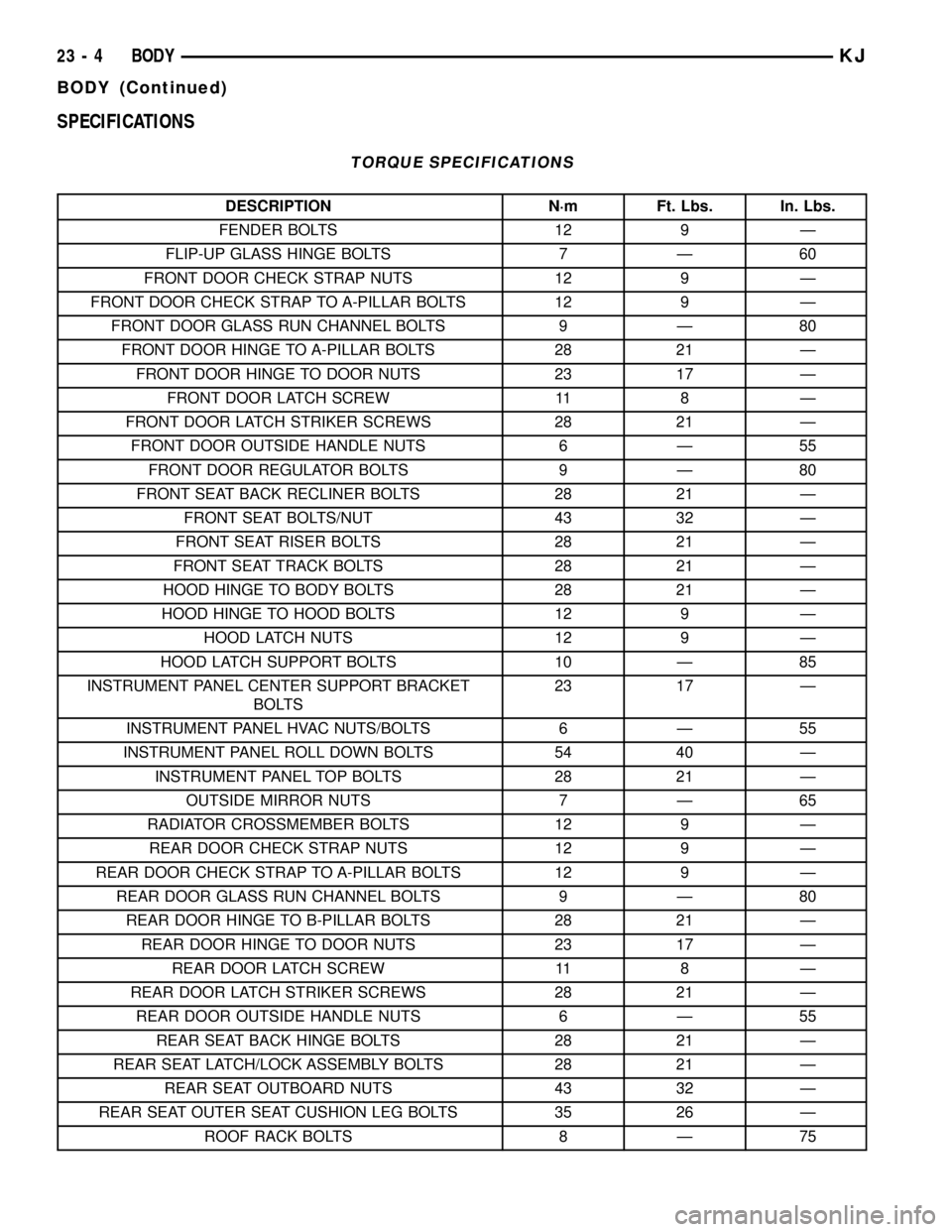
SPECIFICATIONS
TORQUE SPECIFICATIONS
DESCRIPTION N´m Ft. Lbs. In. Lbs.
FENDER BOLTS 12 9 Ð
FLIP-UP GLASS HINGE BOLTS 7 Ð 60
FRONT DOOR CHECK STRAP NUTS 12 9 Ð
FRONT DOOR CHECK STRAP TO A-PILLAR BOLTS 12 9 Ð
FRONT DOOR GLASS RUN CHANNEL BOLTS 9 Ð 80
FRONT DOOR HINGE TO A-PILLAR BOLTS 28 21 Ð
FRONT DOOR HINGE TO DOOR NUTS 23 17 Ð
FRONT DOOR LATCH SCREW 11 8 Ð
FRONT DOOR LATCH STRIKER SCREWS 28 21 Ð
FRONT DOOR OUTSIDE HANDLE NUTS 6 Ð 55
FRONT DOOR REGULATOR BOLTS 9 Ð 80
FRONT SEAT BACK RECLINER BOLTS 28 21 Ð
FRONT SEAT BOLTS/NUT 43 32 Ð
FRONT SEAT RISER BOLTS 28 21 Ð
FRONT SEAT TRACK BOLTS 28 21 Ð
HOOD HINGE TO BODY BOLTS 28 21 Ð
HOOD HINGE TO HOOD BOLTS 12 9 Ð
HOOD LATCH NUTS 12 9 Ð
HOOD LATCH SUPPORT BOLTS 10 Ð 85
INSTRUMENT PANEL CENTER SUPPORT BRACKET
BOLTS23 17 Ð
INSTRUMENT PANEL HVAC NUTS/BOLTS 6 Ð 55
INSTRUMENT PANEL ROLL DOWN BOLTS 54 40 Ð
INSTRUMENT PANEL TOP BOLTS 28 21 Ð
OUTSIDE MIRROR NUTS 7 Ð 65
RADIATOR CROSSMEMBER BOLTS 12 9 Ð
REAR DOOR CHECK STRAP NUTS 12 9 Ð
REAR DOOR CHECK STRAP TO A-PILLAR BOLTS 12 9 Ð
REAR DOOR GLASS RUN CHANNEL BOLTS 9 Ð 80
REAR DOOR HINGE TO B-PILLAR BOLTS 28 21 Ð
REAR DOOR HINGE TO DOOR NUTS 23 17 Ð
REAR DOOR LATCH SCREW 11 8 Ð
REAR DOOR LATCH STRIKER SCREWS 28 21 Ð
REAR DOOR OUTSIDE HANDLE NUTS 6 Ð 55
REAR SEAT BACK HINGE BOLTS 28 21 Ð
REAR SEAT LATCH/LOCK ASSEMBLY BOLTS 28 21 Ð
REAR SEAT OUTBOARD NUTS 43 32 Ð
REAR SEAT OUTER SEAT CUSHION LEG BOLTS 35 26 Ð
ROOF RACK BOLTS 8 Ð 75
23 - 4 BODYKJ
BODY (Continued)
Page 1612 of 1803

INSTRUMENT PANEL
TABLE OF CONTENTS
page page
CLUSTER BEZEL
REMOVAL............................147
INSTALLATION........................147
GLOVE BOX
REMOVAL............................148
INSTALLATION........................148
GLOVE BOX LATCH
REMOVAL............................148
INSTALLATION........................148
GLOVE BOX LATCH STRIKER
REMOVAL............................148
INSTALLATION........................149
INSTRUMENT PANEL ASSEMBLY
REMOVAL............................149
INSTALLATION........................151
INSTRUMENT PANEL TOP COVER
REMOVAL............................152INSTALLATION........................153
INSTRUMENT PANEL END CAP
REMOVAL............................153
INSTALLATION........................153
INSTRUMENT PANEL DRIVER SIDE BEZELS
REMOVAL............................153
INSTALLATION........................154
INSTRUMENT PANEL CENTER BEZEL
REMOVAL............................154
INSTALLATION........................154
INSTRUMENT PANEL PASSENGER SIDE
BEZEL
REMOVAL............................154
INSTALLATION........................154
KNEE BLOCKER
REMOVAL............................155
INSTALLATION........................155
CLUSTER BEZEL
REMOVAL
WARNING: ON VEHICLES EQUIPPED WITH AIR-
BAGS, DISABLE THE AIRBAG SYSTEM BEFORE
ATTEMPTING ANY STEERING WHEEL, STEERING
COLUMN, SEAT BELT TENSIONER, OR INSTRU-
MENT PANEL COMPONENT DIAGNOSIS OR SER-
VICE. DISCONNECT AND ISOLATE THE BATTERY
NEGATIVE (GROUND) CABLE, THEN WAIT TWO
MINUTES FOR THE AIRBAG SYSTEM CAPACITOR
TO DISCHARGE BEFORE PERFORMING FURTHER
DIAGNOSIS OR SERVICE. THIS IS THE ONLY SURE
WAY TO DISABLE THE AIRBAG SYSTEM. FAILURE
TO TAKE THE PROPER PRECAUTIONS COULD
RESULT IN ACCIDENTAL AIRBAG DEPLOYMENT
AND POSSIBLE PERSONAL INJURY.
(1) Remove the drives side trim bezels. (Refer to
23 - BODY/INSTRUMENT PANEL/INSTRUMENT
PANEL DRIVER SIDE BEZEL - REMOVAL)
(2) Remove the instrument panel top cover. (Refer
to 23 - BODY/INSTRUMENT PANEL/INSTRUMENT
PANEL TOP COVER - REMOVAL)
(3) Remove the seven screws and remove the clus-
ter bezel.
INSTALLATION
WARNING: ON VEHICLES EQUIPPED WITH AIR-
BAGS, DISABLE THE AIRBAG SYSTEM BEFORE
ATTEMPTING ANY STEERING WHEEL, STEERING
COLUMN, SEAT BELT TENSIONER, OR INSTRU-
MENT PANEL COMPONENT DIAGNOSIS OR SER-
VICE. DISCONNECT AND ISOLATE THE BATTERY
NEGATIVE (GROUND) CABLE, THEN WAIT TWO
MINUTES FOR THE AIRBAG SYSTEM CAPACITOR
TO DISCHARGE BEFORE PERFORMING FURTHER
DIAGNOSIS OR SERVICE. THIS IS THE ONLY SURE
WAY TO DISABLE THE AIRBAG SYSTEM. FAILURE
TO TAKE THE PROPER PRECAUTIONS COULD
RESULT IN ACCIDENTAL AIRBAG DEPLOYMENT
AND POSSIBLE PERSONAL INJURY.
(1) Install the cluster bezel and the seven screws.
(2) Install the instrument panel top cover. (Refer
to 23 - BODY/INSTRUMENT PANEL/INSTRUMENT
PANEL TOP COVER - INSTALLATION)
(3) Install the drives side trim bezels. (Refer to 23
- BODY/INSTRUMENT PANEL/INSTRUMENT
PANEL DRIVER SIDE BEZEL - INSTALLATION)
KJINSTRUMENT PANEL 23 - 147
Page 1613 of 1803

GLOVE BOX
REMOVAL
WARNING: ON VEHICLES EQUIPPED WITH AIR-
BAGS, DISABLE THE AIRBAG SYSTEM BEFORE
ATTEMPTING ANY STEERING WHEEL, STEERING
COLUMN, SEAT BELT TENSIONER, OR INSTRU-
MENT PANEL COMPONENT DIAGNOSIS OR SER-
VICE. DISCONNECT AND ISOLATE THE BATTERY
NEGATIVE (GROUND) CABLE, THEN WAIT TWO
MINUTES FOR THE AIRBAG SYSTEM CAPACITOR
TO DISCHARGE BEFORE PERFORMING FURTHER
DIAGNOSIS OR SERVICE. THIS IS THE ONLY SURE
WAY TO DISABLE THE AIRBAG SYSTEM. FAILURE
TO TAKE THE PROPER PRECAUTIONS COULD
RESULT IN ACCIDENTAL AIRBAG DEPLOYMENT
AND POSSIBLE PERSONAL INJURY.
(1) Open the glove box.
(2) Squeeze the stop tabs located on the sides of
the box and allow the box to open fully.
(3) With box in the full down position slide the box
to the right off of the hinges and remove.
INSTALLATION
WARNING: ON VEHICLES EQUIPPED WITH AIR-
BAGS, DISABLE THE AIRBAG SYSTEM BEFORE
ATTEMPTING ANY STEERING WHEEL, STEERING
COLUMN, SEAT BELT TENSIONER, OR INSTRU-
MENT PANEL COMPONENT DIAGNOSIS OR SER-
VICE. DISCONNECT AND ISOLATE THE BATTERY
NEGATIVE (GROUND) CABLE, THEN WAIT TWO
MINUTES FOR THE AIRBAG SYSTEM CAPACITOR
TO DISCHARGE BEFORE PERFORMING FURTHER
DIAGNOSIS OR SERVICE. THIS IS THE ONLY SURE
WAY TO DISABLE THE AIRBAG SYSTEM. FAILURE
TO TAKE THE PROPER PRECAUTIONS COULD
RESULT IN ACCIDENTAL AIRBAG DEPLOYMENT
AND POSSIBLE PERSONAL INJURY.
(1) Position the box on and slide the box to the left
to engage the hinges.
(2) Close the glove box.
GLOVE BOX LATCH
REMOVAL
WARNING: ON VEHICLES EQUIPPED WITH AIR-
BAGS, DISABLE THE AIRBAG SYSTEM BEFORE
ATTEMPTING ANY STEERING WHEEL, STEERING
COLUMN, SEAT BELT TENSIONER, OR INSTRU-
MENT PANEL COMPONENT DIAGNOSIS OR SER-
VICE. DISCONNECT AND ISOLATE THE BATTERYNEGATIVE (GROUND) CABLE, THEN WAIT TWO
MINUTES FOR THE AIRBAG SYSTEM CAPACITOR
TO DISCHARGE BEFORE PERFORMING FURTHER
DIAGNOSIS OR SERVICE. THIS IS THE ONLY SURE
WAY TO DISABLE THE AIRBAG SYSTEM. FAILURE
TO TAKE THE PROPER PRECAUTIONS COULD
RESULT IN ACCIDENTAL AIRBAG DEPLOYMENT
AND POSSIBLE PERSONAL INJURY.
(1) Remove the glove box. (Refer to 23 - BODY/IN-
STRUMENT PANEL/GLOVE BOX - REMOVAL)
(2) Remove the nine screws and remove the glove
box skin.
(3) Remove the latch from the locators.
INSTALLATION
WARNING: ON VEHICLES EQUIPPED WITH AIR-
BAGS, DISABLE THE AIRBAG SYSTEM BEFORE
ATTEMPTING ANY STEERING WHEEL, STEERING
COLUMN, SEAT BELT TENSIONER, OR INSTRU-
MENT PANEL COMPONENT DIAGNOSIS OR SER-
VICE. DISCONNECT AND ISOLATE THE BATTERY
NEGATIVE (GROUND) CABLE, THEN WAIT TWO
MINUTES FOR THE AIRBAG SYSTEM CAPACITOR
TO DISCHARGE BEFORE PERFORMING FURTHER
DIAGNOSIS OR SERVICE. THIS IS THE ONLY SURE
WAY TO DISABLE THE AIRBAG SYSTEM. FAILURE
TO TAKE THE PROPER PRECAUTIONS COULD
RESULT IN ACCIDENTAL AIRBAG DEPLOYMENT
AND POSSIBLE PERSONAL INJURY.
(1) Position the latch onto the locators.
(2) Install the glove box skin onto the glove box
and install the nine screws.
(3) Install the glove box. (Refer to 23 - BODY/IN-
STRUMENT PANEL/GLOVE BOX - INSTALLA-
TION)
GLOVE BOX LATCH STRIKER
REMOVAL
WARNING: ON VEHICLES EQUIPPED WITH AIR-
BAGS, DISABLE THE AIRBAG SYSTEM BEFORE
ATTEMPTING ANY STEERING WHEEL, STEERING
COLUMN, SEAT BELT TENSIONER, OR INSTRU-
MENT PANEL COMPONENT DIAGNOSIS OR SER-
VICE. DISCONNECT AND ISOLATE THE BATTERY
NEGATIVE (GROUND) CABLE, THEN WAIT TWO
MINUTES FOR THE AIRBAG SYSTEM CAPACITOR
TO DISCHARGE BEFORE PERFORMING FURTHER
DIAGNOSIS OR SERVICE. THIS IS THE ONLY SURE
WAY TO DISABLE THE AIRBAG SYSTEM. FAILURE
TO TAKE THE PROPER PRECAUTIONS COULD
RESULT IN ACCIDENTAL AIRBAG DEPLOYMENT
AND POSSIBLE PERSONAL INJURY.
23 - 148 INSTRUMENT PANELKJ
Page 1614 of 1803

(1) Open the glove box.
(2) Remove the two striker screws and remove the
latch striker.
INSTALLATION
WARNING: ON VEHICLES EQUIPPED WITH AIR-
BAGS, DISABLE THE AIRBAG SYSTEM BEFORE
ATTEMPTING ANY STEERING WHEEL, STEERING
COLUMN, SEAT BELT TENSIONER, OR INSTRU-
MENT PANEL COMPONENT DIAGNOSIS OR SER-
VICE. DISCONNECT AND ISOLATE THE BATTERY
NEGATIVE (GROUND) CABLE, THEN WAIT TWO
MINUTES FOR THE AIRBAG SYSTEM CAPACITOR
TO DISCHARGE BEFORE PERFORMING FURTHER
DIAGNOSIS OR SERVICE. THIS IS THE ONLY SURE
WAY TO DISABLE THE AIRBAG SYSTEM. FAILURE
TO TAKE THE PROPER PRECAUTIONS COULD
RESULT IN ACCIDENTAL AIRBAG DEPLOYMENT
AND POSSIBLE PERSONAL INJURY.
(1) Install the striker and install the two screws.
(2) Loosen the screws to adjust if necessary.
INSTRUMENT PANEL
ASSEMBLY
REMOVAL
WARNING: ON VEHICLES EQUIPPED WITH AIR-
BAGS, DISABLE THE AIRBAG SYSTEM BEFORE
ATTEMPTING ANY STEERING WHEEL, STEERING
COLUMN, OR INSTRUMENT PANEL COMPONENT
DIAGNOSIS OR SERVICE. DISCONNECT AND ISO-
LATE THE BATTERY NEGATIVE (GROUND) CABLE,
THEN WAIT TWO MINUTES FOR THE AIRBAG SYS-
TEM CAPACITOR TO DISCHARGE BEFORE PER-
FORMING FURTHER DIAGNOSIS OR SERVICE. THIS
IS THE ONLY SURE WAY TO DISABLE THE AIRBAG
SYSTEM. FAILURE TO TAKE THE PROPER PRE-
CAUTIONS COULD RESULT IN ACCIDENTAL AIR-
BAG DEPLOYMENT AND POSSIBLE PERSONAL
INJURY.
NOTE: Before starting this procedure, be certain to
turn the steering wheel until the front wheels are in
the straight-ahead position.(1) Disconnect and isolate the battery negative
cable.
(2) Remove the instrument panel top cover. (Refer
to 23 - BODY/INSTRUMENT PANEL/INSTRUMENT
PANEL TOP COVER - REMOVAL)
(3) Remove the speakers.
(4) Remove the floor console. (Refer to 23 - BODY/
INTERIOR/FLOOR CONSOLE - REMOVAL)
(5) Remove the radio. (Refer to 8 - ELECTRICAL/
AUDIO/RADIO - REMOVAL)
(6) Remove the four nuts and remove the center
support bracket. (Fig. 6)
(7) Remove the steering column. (Refer to 19 -
STEERING/COLUMN - REMOVAL)
(8) Remove the drivers side cowl trim cover. (Refer
to 23 - BODY/INTERIOR/COWL TRIM COVER -
REMOVAL)
(9) Disconnect the wire harness connector behind
the drivers side cowl trim cover.
(10) Disconnect the green and light blue wire har-
ness bulk connectors at the junction block. (Fig. 1)
(11) Disconnect the electrical connector at the
inner side of the pedal support bracket. (Fig. 2)
(12) Remove the two bolts at the front of the pedal
support bracket. (Fig. 2)
(13) Remove the two bolts from the bottom side of
the pedal support bracket. (Fig. 2)
Fig. 1 JUNCTION BLOCK CONNECTORS
1 - ELECTRICAL CONNECTOR
2 - ELECTRICAL CONNECTOR
3 - PEDAL SUPPORT BRACKET
4 - JUNCTION BLOCK
KJINSTRUMENT PANEL 23 - 149
GLOVE BOX LATCH STRIKER (Continued)
Page 1615 of 1803

(14) Remove the two roll down bracket bolts at the
left cowl side panel. (Fig. 6)
(15) Remove the ground strap bolt and disconnect
the restraint module electrical connector. (Fig. 3)
(16) Remove the glove box. (Refer to 23 - BODY/
INSTRUMENT PANEL/GLOVE BOX - REMOVAL)
(17) Remove the two HVAC mounting bolts behind
the center trim. (Fig. 3)
(18) Remove the passenger side trim bezel. (Refer
to 23 - BODY/INSTRUMENT PANEL/IP PASSEN-
GER SIDE BEZEL - REMOVAL)(19) Remove the HVAC mounting bolt above the
glove box striker. (Fig. 4)
(20) Remove the HVAC bolt at the lower outside
corner of the glove box opening. (Fig. 5)
(21) Remove the passenger side cowl trim cover.
(Refer to 23 - BODY/INTERIOR/COWL TRIM
COVER - REMOVAL)
(22) Disconnect the blower resistor electrical con-
nector. (Fig. 5)
(23) Remove the two roll down bracket bolts at the
right cowl side panel.
Fig. 2 PEDAL SUPPORT BRACKET
1 - PEDAL SUPPORT BRACKET
2 - BOLTS
3 - BOLTS
4 - ELECTRICAL CONNECTOR
Fig. 3 HVAC BOLTS
1 - RESTRAINT MODULE
2 - HVAC BOLTS
3 - RADIO WIRE HARNESS
Fig. 4 HVAC UPPER BOLT
1 - BOLT
2 - GLOVE BOX STRIKER
3 - HVAC UNIT
Fig. 5 HVAC CONNECTIONS
1 - GLOVE BOX STRIKER
2 - BLOWER RESISTOR
3 - VACUUM CHECK VALVE
4 - BOLT
23 - 150 INSTRUMENT PANELKJ
INSTRUMENT PANEL ASSEMBLY (Continued)
Page 1616 of 1803

(24) Disconnect the vacuum check valve and the
vacuum reservoir. (Fig. 5)
(25) Disconnect the blower motor electrical connec-
tor.
(26) Remove the four bolts at the top of the instru-
ment panel connecting to the cowl front panel.
(27) Roll the instrument panel rearward and
remove the wire harness from routing channel in the
rear.
(28) Disconnect the push pin fastener and position
aside the radio wire harness. Note the location of the
harness for installation.
(29) Remove the instrument panel.
INSTALLATION
WARNING: ON VEHICLES EQUIPPED WITH AIR-
BAGS, DISABLE THE AIRBAG SYSTEM BEFORE
ATTEMPTING ANY STEERING WHEEL, STEERING
COLUMN, OR INSTRUMENT PANEL COMPONENT
DIAGNOSIS OR SERVICE. DISCONNECT AND ISO-
LATE THE BATTERY NEGATIVE (GROUND) CABLE,
THEN WAIT TWO MINUTES FOR THE AIRBAG SYS-
TEM CAPACITOR TO DISCHARGE BEFORE PER-
FORMING FURTHER DIAGNOSIS OR SERVICE. THISIS THE ONLY SURE WAY TO DISABLE THE AIRBAG
SYSTEM. FAILURE TO TAKE THE PROPER PRE-
CAUTIONS COULD RESULT IN ACCIDENTAL AIR-
BAG DEPLOYMENT AND POSSIBLE PERSONAL
INJURY.
(1) Position the instrument panel into the vehicle.
(2) Position the wire harness into the rear routing
channel and roll the instrument panel back against
the cowl.
(3) Position the radio wire harness and seat the
push pin fastener.
NOTE: Position the speaker wires through the
speaker openings.
(4) Install the four bolts at the top of the instru-
ment panel connecting to the cowl front panel and
tighten to 28 N´m (21 ft. lbs.).
(5) Connect the blower motor electrical connector.
(6) Connect the vacuum check valve and the vac-
uum reservoir.
(7) Connect the blower resister electrical connector.
NOTE: Do not push or pull bracket. Tighten at the
rest position.
Fig. 6 INSTRUMENT PANEL ASSEMBLY
1 - TOP BOLTS (4)
2 - CENTER SUPPORT BRACKET
3 - NUTS (4)4 - ROLL DOWN BOLTS (4)
5 - INSTRUMENT PANEL ASSEMBLY
KJINSTRUMENT PANEL 23 - 151
INSTRUMENT PANEL ASSEMBLY (Continued)
Page 1617 of 1803

(8) Install the two roll down bracket bolts at the
right cowl side panel and tighten to 54 N´m (40 ft.
lbs.).
(9) Install the HVAC mounting bolt at the lower
outside corner of the glove box opening and tighten
to 6 N´m (55 in. lbs.).
(10) Install the HVAC mounting bolt above the
glove box striker.
(11) Install the passenger side trim bezel. (Refer to
23 - BODY/INSTRUMENT PANEL/INSTRUMENT
PANEL PASSENGER SIDE BEZEL - INSTALLA-
TION)
(12) Install the passenger side cowl trim cover.
(Refer to 23 - BODY/INTERIOR/COWL TRIM
COVER - INSTALLATION)
(13) Install the glove box. (Refer to 23 - BODY/IN-
STRUMENT PANEL/GLOVE BOX - INSTALLA-
TION)
NOTE: Do not push or pull bracket. Tighten at the
rest position.
(14) Install the two roll down bracket bolts at the
drivers cowl side panel and tighten to 54 N´m (40 ft.
lbs.).
(15) Install the two bolts at the bottom side of the
pedal support bracket.
(16) Install the two bolts at the front of the pedal
support bracket.
(17) Connect the electrical connector at the inner
side of the pedal support bracket.
(18) Connect the wiring harness electrical connec-
tors at the junction block.
(19) Connect the wire harness electrical connector
behind the drivers side cowl trim cover.
(20) Install the left cowl trim cover. (Refer to 23 -
BODY/INTERIOR/COWL TRIM COVER - INSTAL-
LATION)
(21) Install the steering column. (Refer to 19 -
STEERING/COLUMN - INSTALLATION)
(22) Install the two HVAC mounting bolts behind
the center trim.
(23) Install the ground strap and bolt and connect
the restraint module electrical connector.
(24) Install the center support bracket and hold it
tight against the instrument panel.
(25) Tighten the lower nuts to 23 N´m (17 ft. lbs.).
(26) Tighten the upper bracket nuts to 23 N´m (17
ft. lbs.).
(27) Install the radio. (Refer to 8 - ELECTRICAL/
AUDIO/RADIO - INSTALLATION)
(28) Install the floor console. (Refer to 23 - BODY/
INTERIOR/FLOOR CONSOLE - INSTALLATION)
(29) Install the speakers.
(30) Install the instrument panel top cover. (Refer
to 23 - BODY/INSTRUMENT PANEL/INSTRUMENT
PANEL TOP COVER - INSTALLATION)(31) Reconnect the battery ground cable.
INSTRUMENT PANEL TOP
COVER
REMOVAL
WARNING: ON VEHICLES EQUIPPED WITH AIR-
BAGS, DISABLE THE AIRBAG SYSTEM BEFORE
ATTEMPTING ANY STEERING WHEEL, STEERING
COLUMN, SEAT BELT TENSIONER, OR INSTRU-
MENT PANEL COMPONENT DIAGNOSIS OR SER-
VICE. DISCONNECT AND ISOLATE THE BATTERY
NEGATIVE (GROUND) CABLE, THEN WAIT TWO
MINUTES FOR THE AIRBAG SYSTEM CAPACITOR
TO DISCHARGE BEFORE PERFORMING FURTHER
DIAGNOSIS OR SERVICE. THIS IS THE ONLY SURE
WAY TO DISABLE THE AIRBAG SYSTEM. FAILURE
TO TAKE THE PROPER PRECAUTIONS COULD
RESULT IN ACCIDENTAL AIRBAG DEPLOYMENT
AND POSSIBLE PERSONAL INJURY.
(1) Remove the a-pillar trim. (Refer to 23 - BODY/
INTERIOR/A-PILLAR TRIM AND GRAB HANDLE -
REMOVAL)
(2) Using a trim stick C-4755 or equivalent,
release the attachment clips and remove the top
cover. (Fig. 7)
Fig. 7 INSTRUMENT PANEL COVERS
1 - SIDE COVER
2 - INSTRUMENT PANEL ASSEMBLY
3 - TOP COVER
23 - 152 INSTRUMENT PANELKJ
INSTRUMENT PANEL ASSEMBLY (Continued)