2002 JEEP LIBERTY wheel
[x] Cancel search: wheelPage 32 of 1803

(11) Remove the clevis bracket at the shock. (Fig.
5)
(12) Remove the shock assembly from the vehicle.
(Fig. 5)
(13) Remove the spring from the shock (if needed).
(Refer to 2 - SUSPENSION/FRONT/SPRING -
REMOVAL).
INSTALLATION
INSTALLATION - LEFT SIDE
(1) Install the spring to the shock (if removed).
(2) Install the shock assembly to the vehicle.
(3) Install the four upper shock mounting nuts.
Tighten the nuts to 108 N´m (80 ft.lbs.).
(4) Install the clevis bracket at the shock. (Refer to
2 - SUSPENSION/FRONT/CLEVIS BRACKET -
INSTALLATION). Tighten the bolt to 88 N´m (65
ft.lbs.).
(5) Raise the lower control into place and recon-
nect the lower ball joint nut. Tighten the nut to 81
N´m (60 ft.lbs.).
(6) Install the clevis bracket at the lower control
arm. (Refer to 2 - SUSPENSION/FRONT/CLEVIS
BRACKET - INSTALLATION). Tighten the bolt to
150 N´m (110 ft.lbs.).(7) Install the lower stabilizer link at the lower
control arm. Tighten the bolt to 136 N´m (100 ft.lbs.)
(Refer to 2 - SUSPENSION/FRONT/STABILIZER
LINK - INSTALLATION).
(8) Install the left tire and wheel assembly. (Refer
to 22 - TIRES/WHEELS/WHEELS - STANDARD
PROCEDURE).
(9) Lower the vehicle.
(10) Reconnect the battery temperature sensor.
(11) Install the battery tray (Refer to 8 - ELEC-
TRICAL/BATTERY SYSTEM/TRAY - INSTALLA-
TION).
(12) Install the battery (Refer to 8 - ELECTRI-
CAL/BATTERY SYSTEM/BATTERY - INSTALLA-
TION).
(13) Reconnect the battery cables.
INSTALLATION - RIGHT SIDE
(1) Install the spring to the shock (if removed).
(Refer to 2 - SUSPENSION/FRONT/SPRING -
INSTALLATION).
(2) Install the shock assembly to the vehicle.
(3) Install the four upper shock mounting nuts.
Tighten the nuts to 108 N´m (80 ft.lbs.).
(4) Install the clevis bracket at the shock. (Refer to
2 - SUSPENSION/FRONT/CLEVIS BRACKET -
INSTALLATION). Tighten the bolt to 88 N´m (65
ft.lbs.).
(5) Raise the lower control into place and recon-
nect the lower ball joint nut. Tighten the nut to 81
N´m (60 ft.lbs.).
(6) Install the clevis bracket at the lower control
arm. (Refer to 2 - SUSPENSION/FRONT/CLEVIS
BRACKET - INSTALLATION). Tighten the bolt to
150 N´m (110 ft.lbs.).
(7) Install the lower stabilizer link at the lower
control arm. Tighten the bolt to 136 N´m (100 ft.lbs.)
(Refer to 2 - SUSPENSION/FRONT/STABILIZER
LINK - INSTALLATION).
(8) Install the right tire and wheel assembly.
(Refer to 22 - TIRES/WHEELS/WHEELS - STAN-
DARD PROCEDURE).
(9) Lower the vehicle.
(10) Install the cruise control servo mounting nuts.
(11) Install the airbox (Refer to 9 - ENGINE/AIR
INTAKE SYSTEM/AIR CLEANER ELEMENT -
INSTALLATION).
Fig. 5 SHOCK & CLEVIS ASSEMBLY
1 - FRONT CRADLE
2 - SPRING & SHOCK ASSEMBLY
3 - STEERING KNUCKLE
4 - CLEVIS BRACKET
5 - LOWER CONTROL ARM
2 - 12 FRONTKJ
SHOCK (Continued)
Page 33 of 1803
SPRING
REMOVAL
(1) Raise and support the vehicle.
(2) Remove the tire and wheel assembly.
(3) Remove the shock. Refer to the proper side
shock removal procedure being worked on. (Refer to 2
- SUSPENSION/FRONT/SHOCK - REMOVAL).
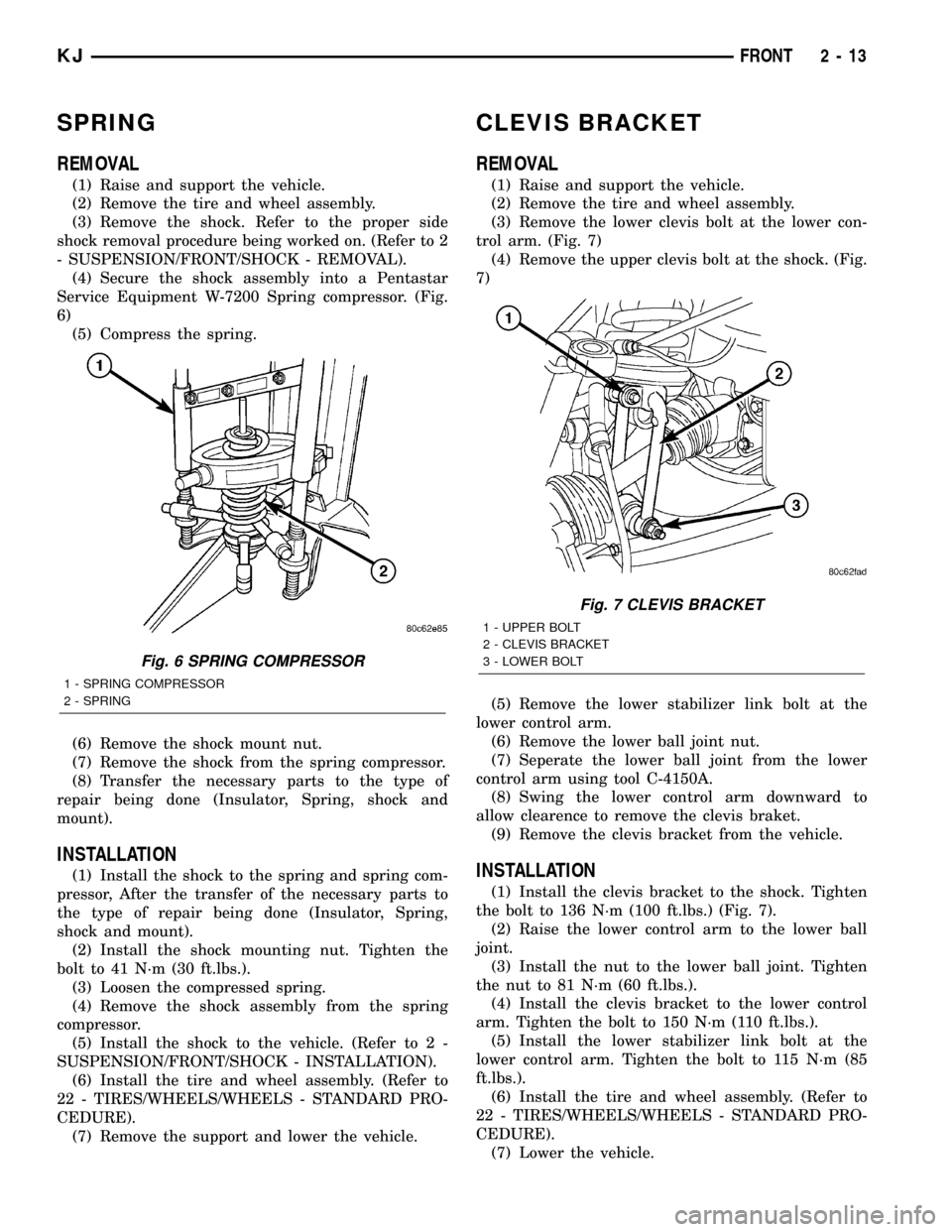
(4) Secure the shock assembly into a Pentastar
Service Equipment W-7200 Spring compressor. (Fig.
6)
(5) Compress the spring.
(6) Remove the shock mount nut.
(7) Remove the shock from the spring compressor.
(8) Transfer the necessary parts to the type of
repair being done (Insulator, Spring, shock and
mount).
INSTALLATION
(1) Install the shock to the spring and spring com-
pressor, After the transfer of the necessary parts to
the type of repair being done (Insulator, Spring,
shock and mount).
(2) Install the shock mounting nut. Tighten the
bolt to 41 N´m (30 ft.lbs.).
(3) Loosen the compressed spring.
(4) Remove the shock assembly from the spring
compressor.
(5) Install the shock to the vehicle. (Refer to 2 -
SUSPENSION/FRONT/SHOCK - INSTALLATION).
(6) Install the tire and wheel assembly. (Refer to
22 - TIRES/WHEELS/WHEELS - STANDARD PRO-
CEDURE).
(7) Remove the support and lower the vehicle.
CLEVIS BRACKET
REMOVAL
(1) Raise and support the vehicle.
(2) Remove the tire and wheel assembly.
(3) Remove the lower clevis bolt at the lower con-
trol arm. (Fig. 7)
(4) Remove the upper clevis bolt at the shock. (Fig.
7)
(5) Remove the lower stabilizer link bolt at the
lower control arm.
(6) Remove the lower ball joint nut.
(7) Seperate the lower ball joint from the lower
control arm using tool C-4150A.
(8) Swing the lower control arm downward to
allow clearence to remove the clevis braket.
(9) Remove the clevis bracket from the vehicle.
INSTALLATION
(1) Install the clevis bracket to the shock. Tighten
the bolt to 136 N´m (100 ft.lbs.) (Fig. 7).
(2) Raise the lower control arm to the lower ball
joint.
(3) Install the nut to the lower ball joint. Tighten
the nut to 81 N´m (60 ft.lbs.).
(4) Install the clevis bracket to the lower control
arm. Tighten the bolt to 150 N´m (110 ft.lbs.).
(5) Install the lower stabilizer link bolt at the
lower control arm. Tighten the bolt to 115 N´m (85
ft.lbs.).
(6) Install the tire and wheel assembly. (Refer to
22 - TIRES/WHEELS/WHEELS - STANDARD PRO-
CEDURE).
(7) Lower the vehicle.
Fig. 6 SPRING COMPRESSOR
1 - SPRING COMPRESSOR
2 - SPRING
Fig. 7 CLEVIS BRACKET
1 - UPPER BOLT
2 - CLEVIS BRACKET
3 - LOWER BOLT
KJFRONT 2 - 13
Page 34 of 1803

STABILIZER BAR
REMOVAL
(1) Raise and support the vehicle.
(2) Remove the tire and wheel assembly.
(3) Remove the upper stabilizer link bolts at the
stabilizer bar.
(4) Remove the stabilizer bar bushing clamps from
the frame (Fig. 8).
(5) Remove the stabilizer bar from the vehicle.
INSTALLATION
(1) Install the stabilizer bar to the vehicle.
(2) Install the stabilizer bar bushing clamps (Fig.
8). Tighten the nuts to 149 N´m (110 ft.lbs.).
(3) Install the upper stabilizer link bolts and
washer at the stabilizer bar. Tighten the bolt to 136
N´m (100 ft.lbs.).
(4) Install the tire and wheel assembly. (Refer to
22 - TIRES/WHEELS/WHEELS - STANDARD PRO-
CEDURE).
(5) Lower the vehicle.
STABILIZER LINK
REMOVAL
(1) Raise and support the vehicle.
(2) Remove the tire and wheel assembly.
(3) Remove the lower stabilizer link bolt at the
lower control arm.
(4) Remove the upper stabilizer link bolt at the
stabilizer bar.
(5) Remove the stabilizer link. (Fig. 9)
INSTALLATION
(1) Install the stabilizer link (Fig. 9).
(2) Install the upper stabilizer link bolt and
washer at the stabilizer bar. Tighten the bolt to 136
N´m (100 ft.lbs.).
(3) Install the lower stabilizer link bolt and
washer at the lower control arm. Tighten the nut to
115 N´m (85 ft.lbs.).
(4) Install the tire and wheel assembly. (Refer to
22 - TIRES/WHEELS/WHEELS - STANDARD PRO-
CEDURE).
UPPER CONTROL ARM
REMOVAL
REMOVAL - RIGHT SIDE
(1) Raise and support the vehicle.
(2) Remove the right side tire and wheel assembly.
(3) Remove the upper ball joint nut.
(4) Separate the upper ball joint from the steering
knuckle using tool C-4150A.
(5) Lower the vehicle.
(6) Remove the air box (Refer to 9 - ENGINE/AIR
INTAKE SYSTEM/AIR CLEANER ELEMENT -
REMOVAL).
(7) Remove the cruise control servo mounting nuts.
(8) Remove the upper control arm rear bolt.
(9) Remove the upper control arm front bolt.
(10) Remove the upper control arm from the vehi-
cle.
Fig. 8 SWAY BAR
1-SWAYBAR
2 - SWAY BAR BUSHINGS
Fig. 9 STABILIZER BAR LINK
1 - STABILIZER BAR
2 - STABILIZER BAR LINK
2 - 14 FRONTKJ
Page 35 of 1803

REMOVAL - LEFT SIDE
(1) Raise and support the vehicle.
(2) Remove the left side tire and wheel assembly.
(3) Remove the upper ball joint nut.
(4) Separate the upper ball joint from the steering
knuckle using tool C-4150A.
(5) Lower the vehicle.
(6) Remove the battery (Refer to 8 - ELECTRI-
CAL/BATTERY SYSTEM/BATTERY - REMOVAL).
(7) Unclip the power center and move it to the side
out of the way.
(8) Remove the battery tray (Refer to 8 - ELEC-
TRICAL/BATTERY SYSTEM/TRAY - REMOVAL).
(9) Disconnect the battery temperature sensor
from the battery tray.
(10) Remove the upper control arm rear bolt by
using a ratchet and extension under the steering
shaft and positioned by the power steering reservoir.
(Fig. 10)
(11) Remove the upper control arm front bolt.
(12) Remove the upper control arm from the vehi-
cle.
INSTALLATION
INSTALLATION - RIGHT SIDE
(1) Install the upper control arm to the vehicle.
(2) Install the upper control arm front bolt.
Tighten the bolt to 122 N´m (90 ft.lbs.).
(3) Install the upper control arm rear bolt. Tighten
the bolt to 122 N´m (90 ft.lbs.).
(4) Install the cruise control servo mounting nuts.(5) Install the air box (Refer to 9 - ENGINE/AIR
INTAKE SYSTEM/AIR CLEANER ELEMENT -
INSTALLATION).
(6) Install the upper ball joint nut. Tighten the nut
to 81 N´m (60 ft.lbs.).
(7) Install the right side tire and wheel assembly.
(Refer to 22 - TIRES/WHEELS/WHEELS - STAN-
DARD PROCEDURE).
(8) Lower the vehicle.
(9) Set the toe and center the steering wheel
(Refer to 2 - SUSPENSION/WHEEL ALIGNMENT -
STANDARD PROCEDURE).
INSTALLATION - LEFT SIDE
(1) Install the upper control arm to the vehicle.
(2) Install the upper control arm front bolt (Fig.
11). Tighten the bolt to 122 N´m (90 ft.lbs.).
(3) Install the upper control arm rear bolt (Fig.
11). Tighten the bolt to 122 N´m (90 ft.lbs.).
(4) Reconnect the battery temperature sensor to
the battery tray.
(5) Install the battery tray (Refer to 8 - ELECTRI-
CAL/BATTERY SYSTEM/TRAY - INSTALLATION).
(6) Install the battery (Refer to 8 - ELECTRICAL/
BATTERY SYSTEM/BATTERY - INSTALLATION).
(7) Reclip and mount the power center.
(8) Install the upper ball joint nut (Fig. 11).
Tighten the nut to 81 N´m (60 ft.lbs.).
(9) Install the left side tire and wheel assembly.
(Refer to 22 - TIRES/WHEELS/WHEELS - STAN-
DARD PROCEDURE).
(10) Lower the vehicle.
(11) Set the toe and center the steering wheel
(Refer to 2 - SUSPENSION/WHEEL ALIGNMENT -
STANDARD PROCEDURE).
Fig. 10 REAR BOLT
1 - STEERING SHAFT
2 - REAR BOLT
3 - RATCHET WITH AN EXTENSION
Fig. 11 UPPER CONTROL ARM
KJFRONT 2 - 15
UPPER CONTROL ARM (Continued)
Page 37 of 1803

DIAGNOSIS AND TESTING - REAR SUSPENSION
CONDITION POSSIBLE CAUSES CORRECTION
VEHICLE INSTABILITY 1. Loose or worn wheel bearings. 1. Replace wheel bearings.
2. Loose, worn or bent suspension
components.2. Inspect, tighten or replace components
as necessary.
3. Tire pressure. 3. Adjust tire pressure.
VEHICLE PULLS TO ONE
SIDE1. Weak or broken spring. 1. Replace spring.
2. Alignment. 2. Align vehicle to specifications.
3.Tires. 3. Replace tires.
4. Brakes. 4. Repair as necassary.
KNOCKING, RATTLING
OR SQUEAKING1. Worn shock bushings. 1. Replace shock.
2. Loose shock mounting. 2. Tighten to specifications.
3. Shock valve. 3. Replace shock.
4. Loose upper ball joint. 4. Replace ball joint.
5. Loose, worn or bent suspension
components.5. Inspect, tighten or replace components
as necessary.
IMPROPER TRACKING 1. Loose, worn or bent suspension
components.1. Inspect, tighten or replace components
as necessary.
2. Bent axle. 2.Replace axle.
SPECIFICATIONS
TORQUE CHART
TORQUE SPECIFICATIONS
DESCRIPTION N´m Ft. Lbs. In. Lbs.
Shock Absorber Upper Nut 108 80 Ð
Shock Absorber Lower Nut 115 85 Ð
Suspension Arm Upper Ball Joint Nut 95 70 Ð
Suspension Arm Upper Frame Bolts 100 74 Ð
Rear Upper Ball Joint Bracket Bolts 136 100 Ð
Suspension Arms Lower Body/Axle Bracket Nut 163 120 Ð
Suspension Arms Lower Frame Bracket Nut 163 120 Ð
Stabilizer Bar Bolts 99 73 Ð
KJREAR 2 - 17
REAR (Continued)
Page 45 of 1803

(2) Remove the control arm from the vise.
(3) Install the lower control arm (Refer to 2 - SUS-
PENSION/FRONT/LOWER CONTROL ARM -
INSTALLATION).
(4) Reset the vehicle ride height (Refer to 2 - SUS-
PENSION/WHEEL ALIGNMENT - STANDARD
PROCEDURE).
(5) Perform a wheel alignment (Refer to 2 - SUS-
PENSION/WHEEL ALIGNMENT - STANDARD
PROCEDURE).
INSTALLATION - CLEVIS BRACKET BUSHING
NOTE: Extreme pressure lubrication must be used
on the threaded portions of the tool. This will
increase the longevity of the tool and insure proper
operation during the removal and installation pro-
cess.
(1) Install the new clevis bracket bushing into the
lower control arm using tools 8858-2 (driver), 8858-1
(receiver) and the bearing with the threaded rod
8839 (Fig. 5) making sure to properly orient the
bushing in the control.
(2) Install the clevis bracket (Refer to 2 - SUS-
PENSION/FRONT/CLEVIS BRACKET - INSTALLA-
TION).
INSTALLATION - UPPER CONTROL ARM
BUSHINGS
NOTE: Extreme pressure lubrication must be used
on the threaded portions of the tool. This will
increase the longevity of the tool and insure proper
operation during the removal and installation pro-
cess.
(1) Install the new upper control arm bushings
into the upper control arm using tools 8830-3, 8830-1
and 8830-2 the bearing with the threaded rod 8838
(Fig. 6) making sure to properly orient the bushing in
the control arm.
(2) Remove the control arm from the vise.
(3) Install the upper control arm (Refer to 2 - SUS-
PENSION/FRONT/UPPER CONTROL ARM -
INSTALLATION).
(4) Reset the vehicle ride height (Refer to 2 - SUS-
PENSION/WHEEL ALIGNMENT - STANDARD
PROCEDURE).
(5) Perform a wheel alignment (Refer to 2 - SUS-
PENSION/WHEEL ALIGNMENT - STANDARD
PROCEDURE).
Fig. 5 CLEVIS BRACKET BUSHING
1 - 8858-2 DRIVER
2 - 8858-1 RECEIVER
3 - 8839 THREADED RODFig. 6 UPPER CONTROL ARM BUSHING -
INSTALLATION
1 - 8830-3
2 - 8830-1
3 - BUSHING
4 - 8830-2
5 - 8838
2s - 4 SUSPENSIONKJ
BUSHINGS (Continued)
Page 46 of 1803

LOWER BALL JOINT
REMOVAL
(1) Remove the tire and wheel assembly.
(2) Remove the brake caliper and rotor (Refer to 5
- BRAKES/HYDRAULIC/MECHANICAL/ROTORS -
REMOVAL).
(3) Disconnect the tie rod from the steering
knuckle (Refer to 19 - STEERING/LINKAGE/TIE
ROD END - REMOVAL).
(4) Remove the steering knuckle (Refer to 2 - SUS-
PENSION/FRONT/KNUCKLE - REMOVAL).
(5) Move the halfshaft to the side and support the
halfshaft out of the way (If Equipped).
NOTE: Extreme pressure lubrication must be used
on the threaded portions of the tool. This will
increase the longevity of the tool and insure proper
operation during the removal and installation pro-
cess.
(6) Secure the steering knuckle in a vise.
(7) Press the ball joint from the steering knuckle
using special tools C-4212±F (PRESS), 8859-2
(RECEIVER) and 8859-1 (DRIVER) (Fig. 7).
INSTALLATION
NOTE: Extreme pressure lubrication must be used
on the threaded portions of the tool. This will
increase the longevity of the tool and insure proper
operation during the removal and installation pro-
cess.(1) Install the ball joint into the steering knuckle
and press in using special tools C-4212±F (press),
8859-3 (driver) and 6761 (receiver) (Fig. 8).
(2) Install the ball joint boot.
(3) Remove the support for the halfshaft and
install into position (If Equipped).
(4) Install the steering knuckle (Refer to 2 - SUS-
PENSION/FRONT/KNUCKLE - INSTALLATION).
(5) Install the tie rod end into the steering knuckle
(Refer to 19 - STEERING/LINKAGE/TIE ROD END -
INSTALLATION).
(6) Install and tighten the halfshaft nut to 136
N´m (100 ft. lbs.).
(7) Install the brake caliper and rotor (Refer to 5 -
BRAKES/HYDRAULIC/MECHANICAL/ROTORS -
INSTALLATION).
(8) Install the tire and wheel assembly (Refer to 22
- TIRES/WHEELS/WHEELS - STANDARD PROCE-
DURE).
(9) Check the vehicle ride height (Refer to 2 - SUS-
PENSION/WHEEL ALIGNMENT - STANDARD
PROCEDURE).
(10) Perform a wheel alignment (Refer to 2 - SUS-
PENSION/WHEEL ALIGNMENT - STANDARD
PROCEDURE).
Fig. 7 LOWER BALL JOINT
1 - 8859-1 DRIVER
2 - C-4212F PRESS
3 - 8859-2 RECEIVER
Fig. 8 LOWER BALL JOINT
1 - 6761 RECEIVER
2 - 8859-3 DRIVER
3 - C-4212F PRESS
KJSUSPENSION 2s - 5
Page 50 of 1803

DIFFERENTIAL & DRIVELINE
TABLE OF CONTENTS
page page
PROPELLER SHAFT......................1
HALF SHAFT...........................10
FRONT AXLE - 186FIA....................19REAR AXLE - 198RBI.....................49
REAR AXLE-81/4.......................86
PROPELLER SHAFT
TABLE OF CONTENTS
page page
PROPELLER SHAFT
DIAGNOSIS AND TESTING - PROPELLER
SHAFT...............................1
STANDARD PROCEDURES - PROPELLER
SHAFT ANGLE........................3
SPECIFICATIONS
PROPELLER SHAFT....................6
SPECIAL TOOLS........................6
PROPELLER SHAFT - FRONT
REMOVAL.............................6INSTALLATION..........................6
PROPELLER SHAFT - REAR
REMOVAL.............................7
INSTALLATION..........................7
SINGLE CARDAN UNIVERSAL JOINTS
DISASSEMBLY..........................8
ASSEMBLY.............................9
PROPELLER SHAFT
DIAGNOSIS AND TESTING - PROPELLER
SHAFT
VIBRATION
Tires that are out-of-round, or wheels that are
unbalanced, will cause a low frequency vibration.
Brake rotors that are unbalanced will cause a
harsh, low frequency vibration.Driveline vibration can also result from loose or
damaged engine mounts.
Propeller shaft vibration increases as the vehicle
speed is increased. A vibration that occurs within a
specific speed range is not usually caused by a pro-
peller shaft being unbalanced. Defective joints or an
incorrect propeller shaft angle, are usually the cause
of such a vibration.
KJDIFFERENTIAL & DRIVELINE 3 - 1