2002 JEEP LIBERTY Psi
[x] Cancel search: PsiPage 120 of 1803

(6) Using yoke with Spanner Wrench 6958 and a
torque wrench set at 474 N´m (350 ft. lbs.), (Fig. 41)
slowly tighten the nut in 6.8 N´m (5 ft. lbs.) incre-
ments until the rotating torque is achieved. Measure
the rotating torque frequently to avoid over crushing
the collapsible spacer (Fig. 42).
NOTE: If more than 474 N´m (350 ft. lbs.) torque is
required to crush the collapsible spacer, the spacer
is defective and must be replaced.
(7) Check rotating torque with an inch pound
torque wrench (Fig. 42). The rotating torque of the
pinion gear should be, the reading recorded during
removal plus an additional 0.56 N´m (5 in. lbs.).
(8) Install propeller shaft with reference marks
aligned.
(9) Install rear brake drums.
(10) Add gear lubricant, if necessary.
(11) Install wheel and tire assemblies.
(12) Remove supports and lower vehicle.
DIFFERENTIAL
REMOVAL
(1) Raise and support vehicle.
(2) Remove differential cover and drain fluid.
(3) Clean the housing cavity with flushing oil, light
engine oil or lint free cloth.NOTE: Do not use water, steam, kerosene or gaso-
line for cleaning.
(4) Remove axle shafts.
(5)
Note the reference letters stamped on the bearing
caps and housing machined sealing surface (Fig. 43).
Fig. 41 YOKE SPANNER WRENCH
1 - PINION YOKE
2 - WRENCH
3 - PIPE
Fig. 42 PINION ROTATING TORQUE
1 - TORQUE WRENCH
2 - PINION YOKE
Fig. 43 BEARING CAP IDENTIFICATION
1 - REFERENCE LETTERS
2 - REFERENCE LETTERS
KJREAR AXLE - 198RBI 3 - 71
COLLAPSIBLE SPACER (Continued)
Page 130 of 1803
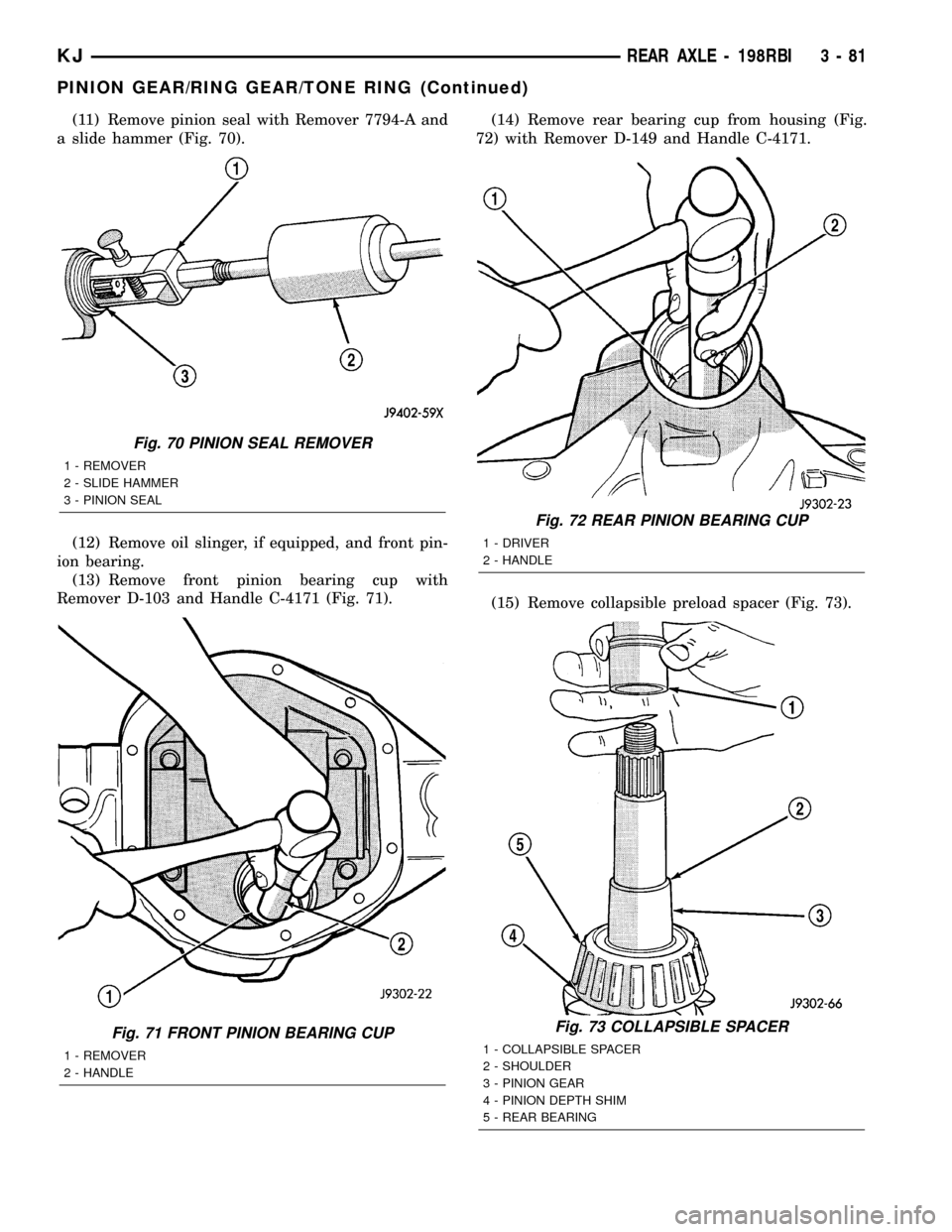
(11) Remove pinion seal with Remover 7794-A and
a slide hammer (Fig. 70).
(12) Remove oil slinger, if equipped, and front pin-
ion bearing.
(13) Remove front pinion bearing cup with
Remover D-103 and Handle C-4171 (Fig. 71).(14) Remove rear bearing cup from housing (Fig.
72) with Remover D-149 and Handle C-4171.
(15) Remove collapsible preload spacer (Fig. 73).
Fig. 70 PINION SEAL REMOVER
1 - REMOVER
2 - SLIDE HAMMER
3 - PINION SEAL
Fig. 71 FRONT PINION BEARING CUP
1 - REMOVER
2 - HANDLE
Fig. 72 REAR PINION BEARING CUP
1 - DRIVER
2 - HANDLE
Fig. 73 COLLAPSIBLE SPACER
1 - COLLAPSIBLE SPACER
2 - SHOULDER
3 - PINION GEAR
4 - PINION DEPTH SHIM
5 - REAR BEARING
KJREAR AXLE - 198RBI 3 - 81
PINION GEAR/RING GEAR/TONE RING (Continued)
Page 132 of 1803
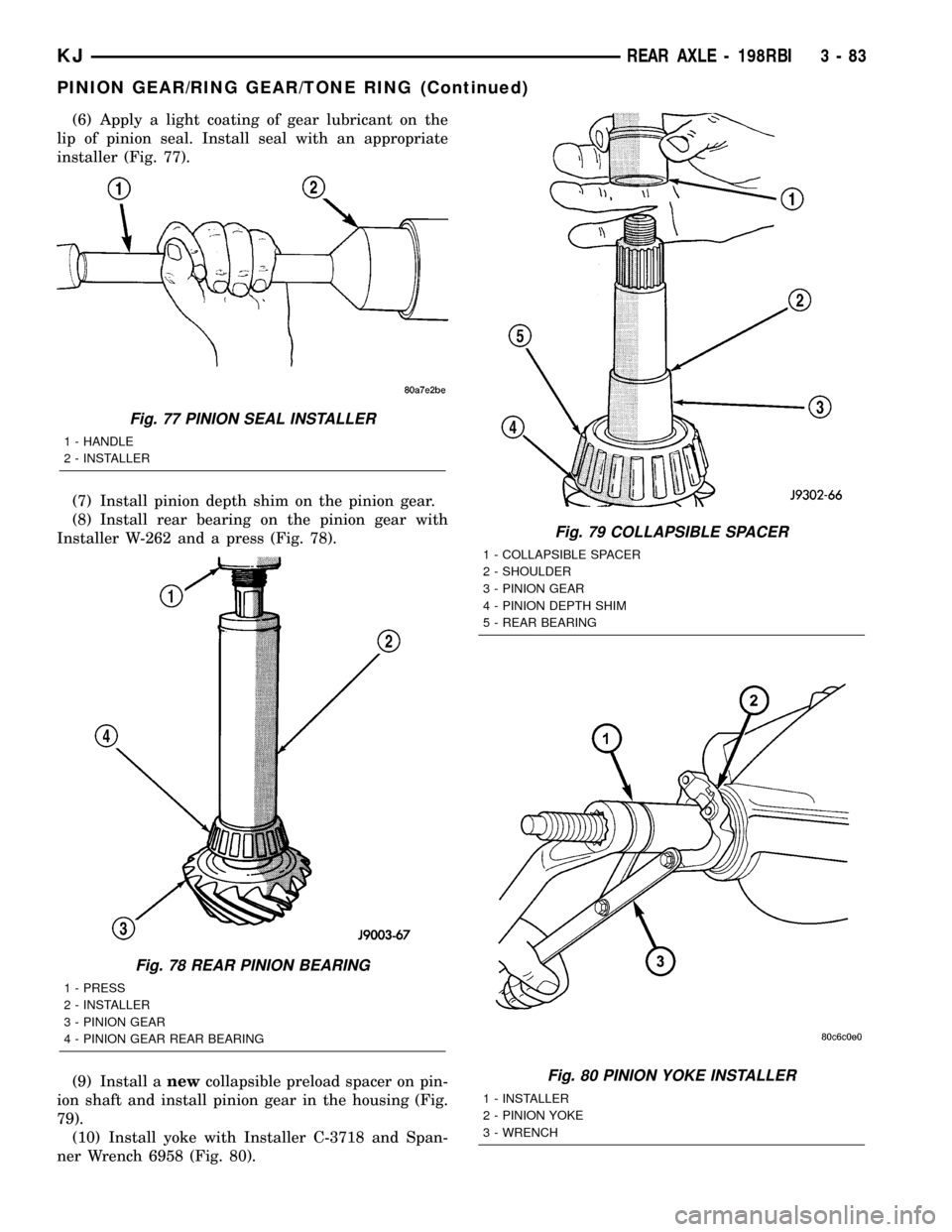
(6) Apply a light coating of gear lubricant on the
lip of pinion seal. Install seal with an appropriate
installer (Fig. 77).
(7) Install pinion depth shim on the pinion gear.
(8) Install rear bearing on the pinion gear with
Installer W-262 and a press (Fig. 78).
(9) Install anewcollapsible preload spacer on pin-
ion shaft and install pinion gear in the housing (Fig.
79).
(10) Install yoke with Installer C-3718 and Span-
ner Wrench 6958 (Fig. 80).
Fig. 77 PINION SEAL INSTALLER
1 - HANDLE
2 - INSTALLER
Fig. 78 REAR PINION BEARING
1 - PRESS
2 - INSTALLER
3 - PINION GEAR
4 - PINION GEAR REAR BEARING
Fig. 79 COLLAPSIBLE SPACER
1 - COLLAPSIBLE SPACER
2 - SHOULDER
3 - PINION GEAR
4 - PINION DEPTH SHIM
5 - REAR BEARING
Fig. 80 PINION YOKE INSTALLER
1 - INSTALLER
2 - PINION YOKE
3 - WRENCH
KJREAR AXLE - 198RBI 3 - 83
PINION GEAR/RING GEAR/TONE RING (Continued)
Page 133 of 1803
(11) Install the yoke washer and a new nut on the
pinion gear and tighten the pinion nut until there is
zero bearing end-play.
(12) Tighten the nut to 271 N´m (200 ft. lbs.).
CAUTION: Never loosen pinion gear nut to decrease
pinion gear bearing rotating torque and never
exceed specified preload torque. If preload torque
or rotating torque is exceeded a new collapsible
spacer must be installed.
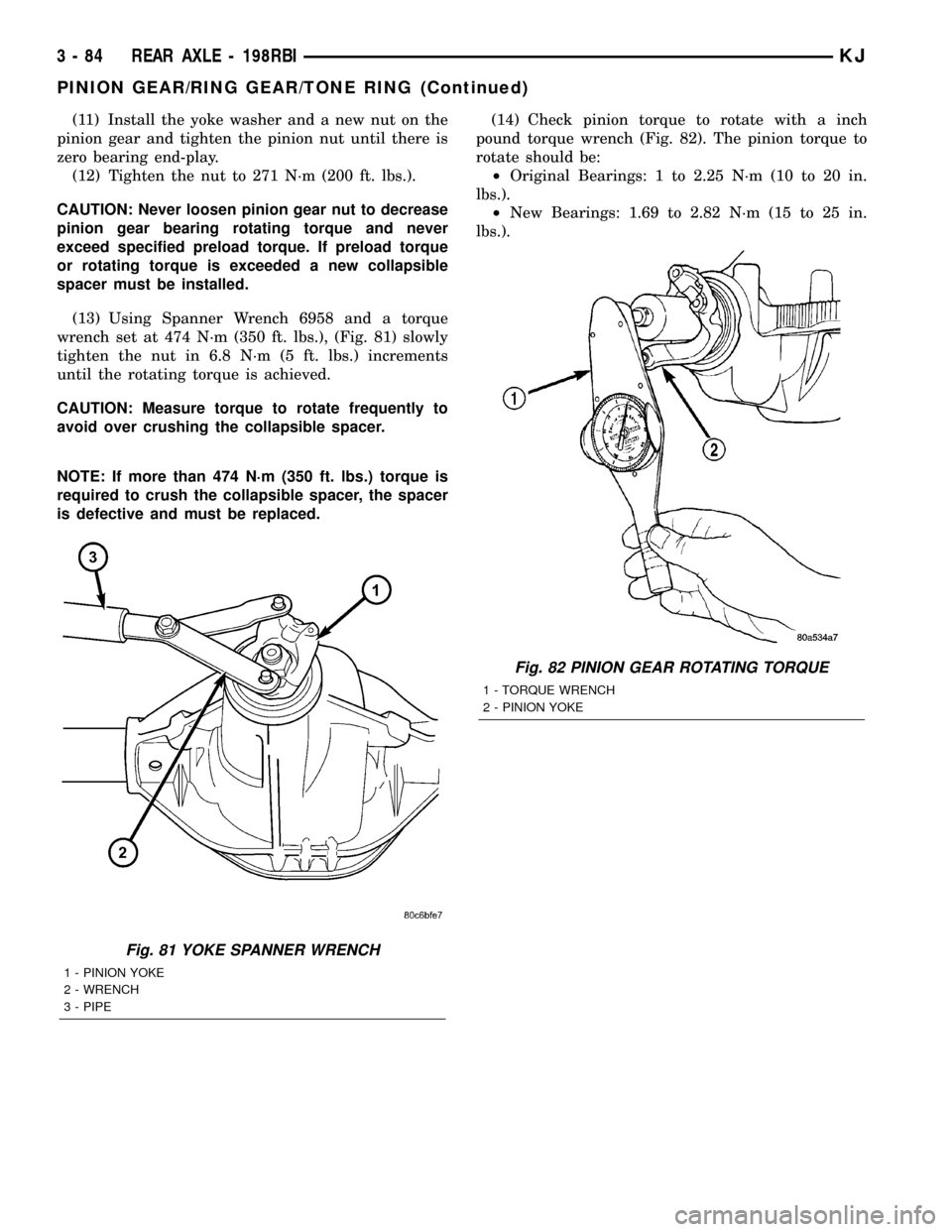
(13) Using Spanner Wrench 6958 and a torque
wrench set at 474 N´m (350 ft. lbs.), (Fig. 81) slowly
tighten the nut in 6.8 N´m (5 ft. lbs.) increments
until the rotating torque is achieved.
CAUTION: Measure torque to rotate frequently to
avoid over crushing the collapsible spacer.
NOTE: If more than 474 N´m (350 ft. lbs.) torque is
required to crush the collapsible spacer, the spacer
is defective and must be replaced.(14) Check pinion torque to rotate with a inch
pound torque wrench (Fig. 82). The pinion torque to
rotate should be:
²Original Bearings: 1 to 2.25 N´m (10 to 20 in.
lbs.).
²New Bearings: 1.69 to 2.82 N´m (15 to 25 in.
lbs.).
Fig. 81 YOKE SPANNER WRENCH
1 - PINION YOKE
2 - WRENCH
3 - PIPE
Fig. 82 PINION GEAR ROTATING TORQUE
1 - TORQUE WRENCH
2 - PINION YOKE
3 - 84 REAR AXLE - 198RBIKJ
PINION GEAR/RING GEAR/TONE RING (Continued)
Page 135 of 1803

REAR AXLE-81/4
TABLE OF CONTENTS
page page
REAR AXLE-81/4
DESCRIPTION.........................86
OPERATION...........................86
DIAGNOSIS AND TESTING - AXLE..........88
REMOVAL.............................91
INSTALLATION.........................91
ADJUSTMENTS........................92
SPECIFICATIONS
REAR AXLE..........................98
SPECIAL TOOLS
8 1/4 AXLE..........................98
AXLE SHAFTS
REMOVAL............................101
INSTALLATION........................101
AXLE SHAFT SEALS
REMOVAL............................101
INSTALLATION........................102
AXLE BEARINGS
REMOVAL............................102
INSTALLATION........................102PINION SEAL
REMOVAL............................102
INSTALLATION........................103
DIFFERENTIAL
REMOVAL............................104
DISASSEMBLY........................105
ASSEMBLY...........................105
INSTALLATION........................105
DIFFERENTIAL - TRAC-LOK
DIAGNOSIS AND TESTING - TRAC-LOKT....106
DISASSEMBLY........................107
CLEANING...........................109
INSPECTION.........................109
ASSEMBLY...........................109
DIFFERENTIAL CASE BEARINGS
REMOVAL............................110
INSTALLATION........................110
PINION GEAR/RING GEAR/TONE RING
REMOVAL............................110
INSTALLATION........................112
REAR AXLE-81/4
DESCRIPTION
The axle housings consist of a cast iron center sec-
tion with axle tubes extending from either side. The
tubes are pressed into and welded to the differential
housing to form a one-piece axle housing. The axles
are equipped with semi-floating axle shafts, meaning
vehicle loads are supported by the axle shaft and
bearings. The axle shafts are retained by C-locks in
the differential side gears.
The differential case is a one-piece design. The dif-
ferential pinion mate shaft is retained with a
threaded pin. Differential bearing preload and ring
gear backlash are set and maintained by threaded
adjusters at the outside of the differential housing.
Pinion bearing preload is set and maintained by the
use of a collapsible spacer.
The differential cover provides a means for inspec-
tion and service without removing the complete axlefrom the vehicle. A vent hose is used to relieve inter-
nal pressure caused by lubricant vaporization and
internal expansion.
Axles equipped with a Trac-Loktdifferential are
optional. A differential has a one-piece differential
case, and the same internal components as a stan-
dard differential, plus two clutch disc packs.
OPERATION
The axle receives power from the transmission/
transfer case through the rear propeller shaft. The
rear propeller shaft is connected to the pinion gear
which rotates the differential through the gear mesh
with the ring gear bolted to the differential case. The
engine power is transmitted to the axle shafts
through the pinion mate and side gears. The side
gears are splined to the axle shafts.
3 - 86 REAR AXLE-81/4KJ
Page 141 of 1803

(10) Install axle vent hose.
(11) Install propeller shaft with reference marks.
(12) Install the wheels and tires.
(13) Add gear lubricant to specifications, if neces-
sary.
(14) Remove lifting device from axle and lower the
vehicle.
(15) Tighten the lower control arm bolts to torque
specification.
ADJUSTMENTS
Ring gears and pinions are supplied as matched
sets only. The identifying numbers for the ring gear
and pinion are etched/marked onto each gear (Fig. 8).
A plus (+) number, minus (±) number or zero (0) is
etched/marked on the face or shaft of the pinion. This
number is the amount (in thousandths of an inch)
the depth varies from the standard depth setting of a
pinion etched with a (0). The standard depth pro-
vides the best gear tooth contact pattern. Refer to
Backlash and Contact Pattern Analysis paragraph in
this section for additional information.
Compensation for pinion depth variance is
achieved with select shims. The shims are placed
behind the rear pinion bearing (Fig. 9).
If a new gear set is being installed, note the depth
variance etched into both the original and replace-
ment pinion. Add or subtract the thickness of the
original depth shims to compensate for the difference
in the depth variances. Refer to the Depth Variance
chart.
Note where Old and New Pinion Marking columns
intersect. Intersecting figure represents plus or
minus the amount needed.Note the etched number on the face of the pinion
gear head (±1, ±2, 0, +1, +2, etc.). The numbers rep-
resent thousands of an inch deviation from the stan-
dard. If the number is negative, add that value to the
required thickness of the depth shims. If the number
is positive, subtract that value from the thickness of
the depth shim. If the number is 0 no change is nec-
essary.
Fig. 7 LOWER SUSPENSION ARM
1 - AXLE BRACKET BOLT
2 - LOWER CONTROL ARM
3 - BODY BRACKET BOLT
Fig. 8 Pinion Gear ID Numbers - Typical
1 - PRODUCTION NUMBERS
2 - DRIVE PINION GEAR DEPTH VARIANCE
3 - GEAR MATCHING NUMBER (SAME AS RING GEAR
NUMBER)
Fig. 9 Adjustment Shim Locations
1 - DIFFERENTIAL HOUSING
2 - COLLAPSIBLE SPACER
3 - REAR PINION BEARING
4 - PINION DEPTH SHIM
5 - PINION GEAR
6 - BEARING CUP
3 - 92 REAR AXLE-81/4KJ
REAR AXLE - 8 1/4 (Continued)
Page 152 of 1803
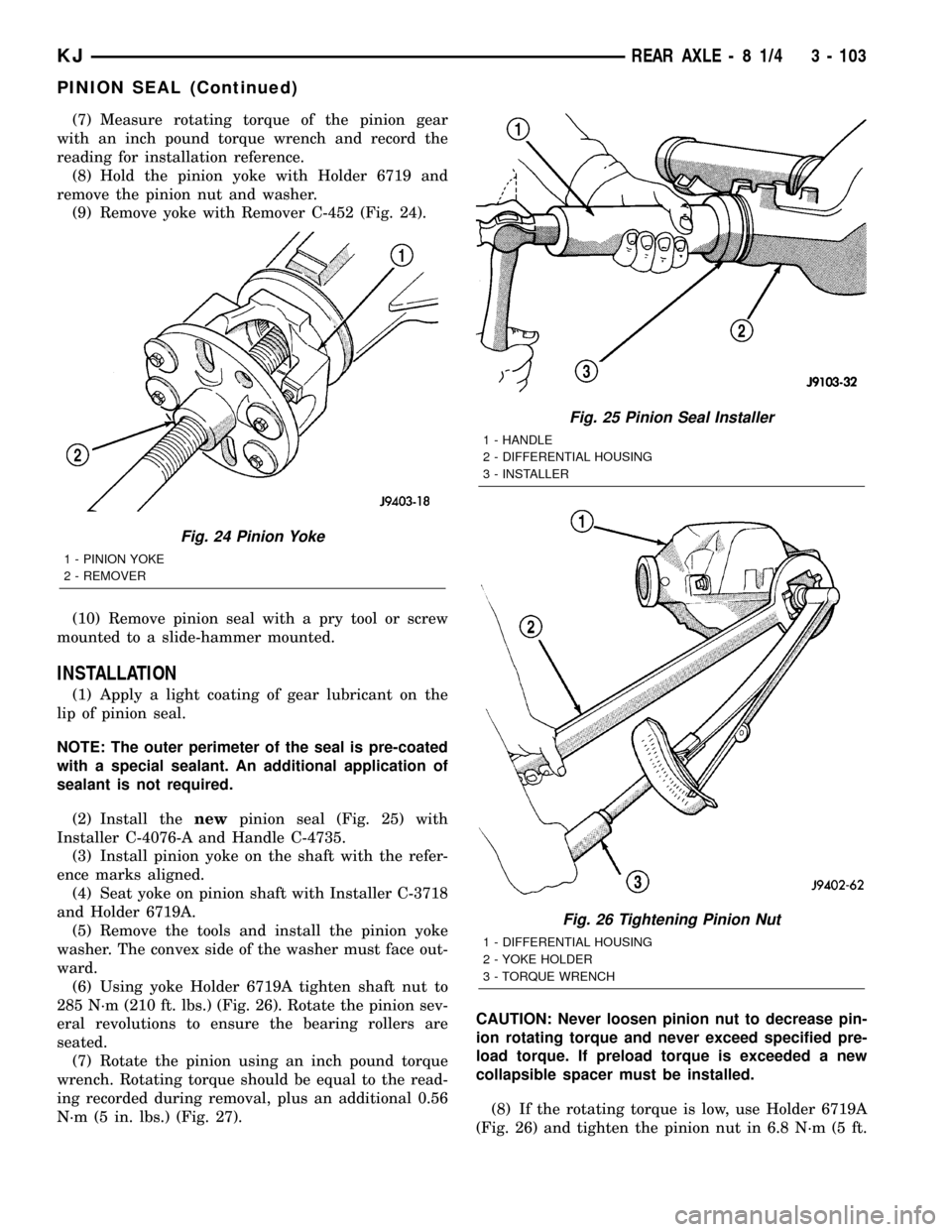
(7) Measure rotating torque of the pinion gear
with an inch pound torque wrench and record the
reading for installation reference.
(8) Hold the pinion yoke with Holder 6719 and
remove the pinion nut and washer.
(9) Remove yoke with Remover C-452 (Fig. 24).
(10) Remove pinion seal with a pry tool or screw
mounted to a slide-hammer mounted.
INSTALLATION
(1) Apply a light coating of gear lubricant on the
lip of pinion seal.
NOTE: The outer perimeter of the seal is pre-coated
with a special sealant. An additional application of
sealant is not required.
(2) Install thenewpinion seal (Fig. 25) with
Installer C-4076-A and Handle C-4735.
(3) Install pinion yoke on the shaft with the refer-
ence marks aligned.
(4) Seat yoke on pinion shaft with Installer C-3718
and Holder 6719A.
(5) Remove the tools and install the pinion yoke
washer. The convex side of the washer must face out-
ward.
(6) Using yoke Holder 6719A tighten shaft nut to
285 N´m (210 ft. lbs.) (Fig. 26). Rotate the pinion sev-
eral revolutions to ensure the bearing rollers are
seated.
(7) Rotate the pinion using an inch pound torque
wrench. Rotating torque should be equal to the read-
ing recorded during removal, plus an additional 0.56
N´m (5 in. lbs.) (Fig. 27).CAUTION: Never loosen pinion nut to decrease pin-
ion rotating torque and never exceed specified pre-
load torque. If preload torque is exceeded a new
collapsible spacer must be installed.
(8) If the rotating torque is low, use Holder 6719A
(Fig. 26) and tighten the pinion nut in 6.8 N´m (5 ft.
Fig. 24 Pinion Yoke
1 - PINION YOKE
2 - REMOVER
Fig. 25 Pinion Seal Installer
1 - HANDLE
2 - DIFFERENTIAL HOUSING
3 - INSTALLER
Fig. 26 Tightening Pinion Nut
1 - DIFFERENTIAL HOUSING
2 - YOKE HOLDER
3 - TORQUE WRENCH
KJREAR AXLE - 8 1/4 3 - 103
PINION SEAL (Continued)
Page 161 of 1803
(10) Remove pinion shaft seal with a pry tool or
slide-hammer mounted screw.
(11) Remove oil slinger, if equipped, and front pin-
ion bearing.
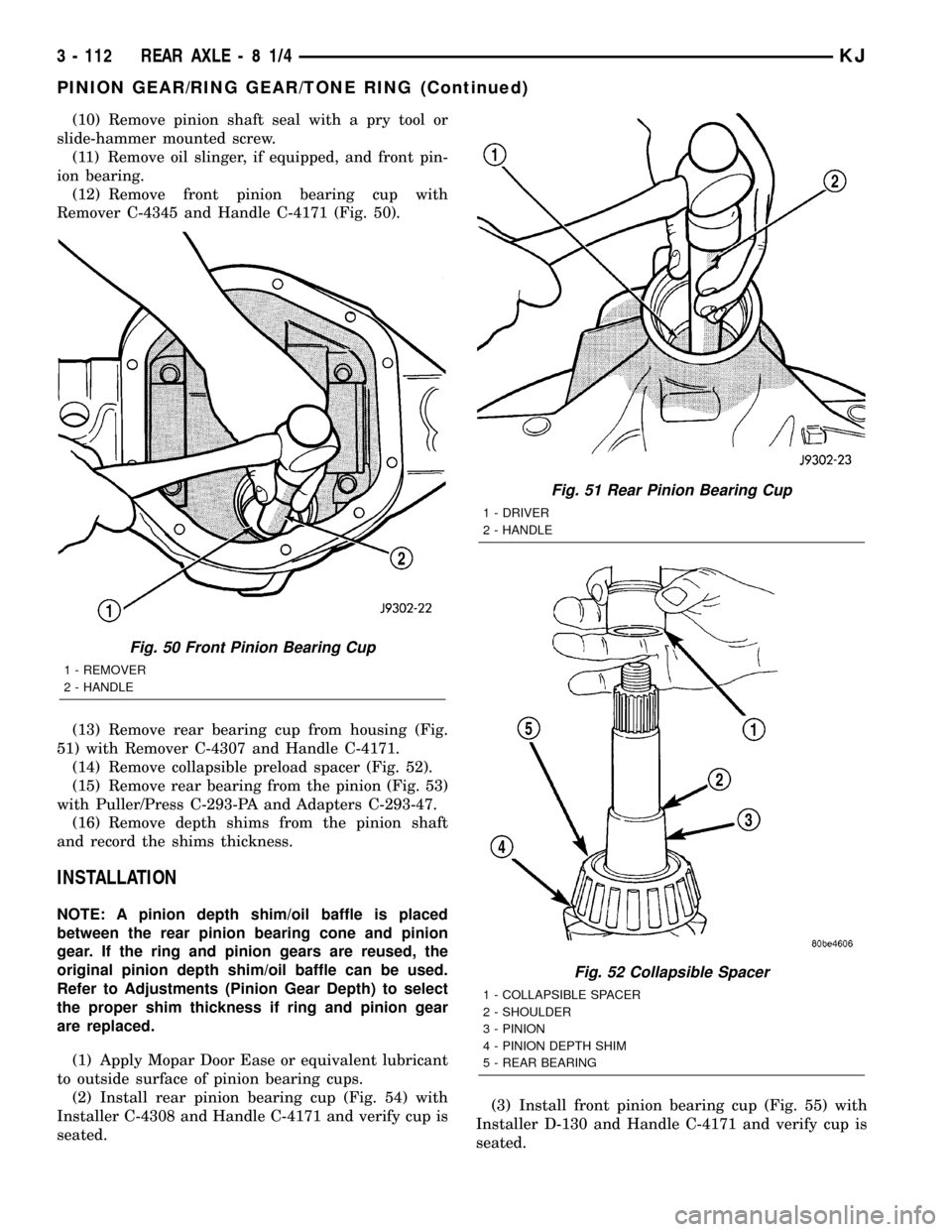
(12) Remove front pinion bearing cup with
Remover C-4345 and Handle C-4171 (Fig. 50).
(13) Remove rear bearing cup from housing (Fig.
51) with Remover C-4307 and Handle C-4171.
(14) Remove collapsible preload spacer (Fig. 52).
(15) Remove rear bearing from the pinion (Fig. 53)
with Puller/Press C-293-PA and Adapters C-293-47.
(16) Remove depth shims from the pinion shaft
and record the shims thickness.
INSTALLATION
NOTE: A pinion depth shim/oil baffle is placed
between the rear pinion bearing cone and pinion
gear. If the ring and pinion gears are reused, the
original pinion depth shim/oil baffle can be used.
Refer to Adjustments (Pinion Gear Depth) to select
the proper shim thickness if ring and pinion gear
are replaced.
(1) Apply Mopar Door Ease or equivalent lubricant
to outside surface of pinion bearing cups.
(2) Install rear pinion bearing cup (Fig. 54) with
Installer C-4308 and Handle C-4171 and verify cup is
seated.(3) Install front pinion bearing cup (Fig. 55) with
Installer D-130 and Handle C-4171 and verify cup is
seated.
Fig. 50 Front Pinion Bearing Cup
1 - REMOVER
2 - HANDLE
Fig. 51 Rear Pinion Bearing Cup
1 - DRIVER
2 - HANDLE
Fig. 52 Collapsible Spacer
1 - COLLAPSIBLE SPACER
2 - SHOULDER
3 - PINION
4 - PINION DEPTH SHIM
5 - REAR BEARING
3 - 112 REAR AXLE-81/4KJ
PINION GEAR/RING GEAR/TONE RING (Continued)